
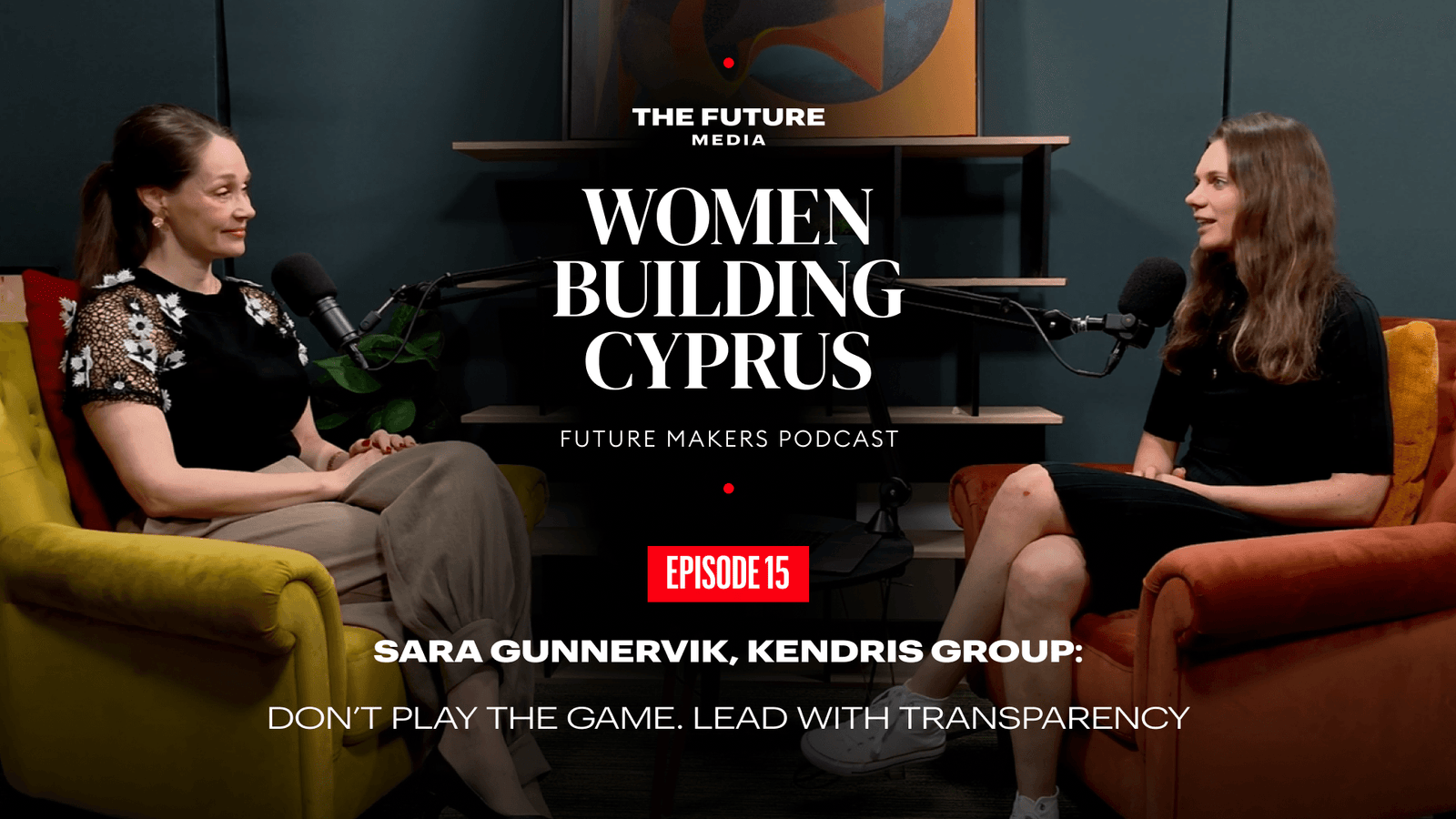
Sara Gunnervik once spent years inside a company so toxic that she would sit at her desk and feel angry before her phone had even rung. Because the anger wasn’t coming from imagining the person on the other end of the line, it was the people sitting behind and around her. When she finally left, she made a vow that she intends to keep. “I am not going to play this game ever again. Even if it becomes to my own detriment.” She is now the Managing Partner of KENDRIS Cyprus and Luxembourg, leading a firm that was recognised as Trust Company of the Year 2025. The vow is no longer something she keeps to herself. It is the first principle she has built an entire office culture around.
Sara Gunnervik is a Partner at KENDRIS Group and Managing Partner of KENDRIS Cyprus and Luxembourg. Originally from Sweden, she relocated to Cyprus over 25 years ago and has spent two decades advising high-net-worth families and international private clients on cross-border structuring, trust and fiduciary governance, family office services, and long-term wealth protection.
Follow THE FUTURE on LinkedIn, Facebook, Instagram, X and Telegram
She grew up in 1970s Sweden, the youngest of two daughters, in what she describes as a normal middle-class family, full of love and a strong sense of political purpose. Her father was an outspoken feminist. Even from a young age, Sara was aware of the care, equality, and mutual respect that her parents based their relationship on.
“They had a very equal relationship, and I think this is the main thing. If you, as a girl, see that there is a mutual respect and a mutual feeling of equality, where one person’s contribution is seen as equally valued as the other person’s contribution,”
she says.
That modelling, she says, is what forms you more than anything else.
She was never told she could not do anything. The casual stereotyping that other parents used with their daughters was absent from her childhood, and she is now visibly irritated when she hears it directed at other people’s children.
“When you say to a little girl, you’re so good, don’t carry that, you must be tired carrying that heavy thing? — You’re basically telling her you are weaker than the other person,”
Sara says.
Instead, her parents told her she was strong, and so Sara took that on board and became strong enough to persevere and challenge anyone who made her feel weak.
In all honesty, she had not planned to leave Sweden. But then she applied to study in London, she filled in the application mostly for fun. And got into Kingston University first try. Her grandmother’s favourite quote was that if you plan things in life, you can be sure that they will not happen. So, Sara didn’t plan and just took life as it happened.
London led to Cyprus through a Cypriot neighbour, who became her partner. Coming to Cyprus was in every way the cliché “culture shock” implies. Sweden, at the time, was considered one of the most equal countries in the world; that was the culture Sara grew up in. Cyprus, twenty-five years ago, was, as Sara carefully explains, a very different environment. Her first job after arriving was at a local law firm. She practised pure law for six or seven years and slowly realised it was not for her, too slow, too procedural, not enough action. She moved into legal advisory and transaction work, then into the fiduciary world. Nine years ago, she opened the KENDRIS Cyprus office. There were only three people back then. They are forty now.
What she found at KENDRIS, and what she is most proud of, is the company’s philosophy.
“It has the right philosophy when it comes to work. The right philosophy when it comes to the client. The right philosophy when it comes to ethics. The right philosophy when it comes to investing in its people.”
The philosophy, she explains, is the refusal to take on the things she watched other firms do as a matter of course. In their field, it meant no commissions, no mixing of incompatible services, such as hosting audit and directorships under the same roof.
“We have only one interest, and the interest is the client’s best interest. They hire us to be a fiduciary, which means taking care of their interest, and that is the highest interest. Nothing else should cloud that,”
she says.
But the ethics should not be a mere printed document disguised as a brochure for clients. “You cannot have one internal and one external,” she says. “It has to shine through the whole organisation.” Which is where her vow comes back in. The decision she made when she walked out of that toxic firm early in her career, that she would never sit in another room ready to go into battle before she even knew what the battle was about, is now the culture she nourishes in her team.
“You do not play games in my team. We work with transparency. If you don’t want that rule, I don’t care how good you are; you should not be with us.”
She quotes Indra Nooyi, the former CEO of PepsiCo, on the same idea.
“Understand the game. Understand the player. But do not play the game.”
Sara has built her career around exactly that. She has stopped sitting in any room with anger she has not earned. She has refused to compete on the terms set by the people she watched destroy each other in her early career. And the value she puts above almost everything else now, the value she credits a Ukrainian colleague with teaching her, is transparency. What it does to a company culture. What it does to your own leadership. What it does, in the long run, to the clients you are supposed to serve.
Motherhood, she will tell you, is one of the things that almost broke her on this island. She is a single mother to a thirteen-year-old boy. When she first became a mother, in those first few years in Cyprus, she felt alone in the relationship before she and her partner formally separated, and alone in a country that, as she experienced it, had no infrastructure for working mothers. Kindergartens close just after lunch, but most jobs do not finish before six. The expectation in Cyprus, she discovered, was that your extended family would fill the gap. “But I had no family here.” The days were difficult, and she barely had time to breathe, juggling a career to support her small family and a child who fully relied on her for his well-being. She tried to be a good mother in the two or three hours between collecting her son and putting him to bed. Then she worked again until midnight. This was her daily schedule for years. “That’s not right,” she says. “There’s a reason why I only have one.”
The crisis, she says, did not break her. It made her into the strong person her parents had told she was.
“It gives you the perseverance that any life crisis gives you.”
She came out the other side with the certainty that she had to have an independent income, an independent backbone, an independent stamina, and that whatever came next, she would not be at the mercy of anybody else’s expectation. The relationship she was in ended. The career she had built kept going. And the values that had been instilled in her by her Swedish parents, the ones she had nearly lost sight of in the years of trying to fit into a place that did not match them, came back into focus.
What she wants for her son now, more than anything else, is for him to be kind. Kind to others, kind to himself. To help the people who do not have what he has. To understand the equality and the respect that she has come to believe is the only thing that holds any relationship, whether personal or professional, together. She is also vocal about how she does not want him stuck inside the box that society builds for boys, the same way she has refused to be stuck in the box it builds for women.
“Maybe he’s not strong. Maybe he’s one of those who doesn’t want to carry. Maybe he wants to cry. Maybe he wants to have feelings, which he’s not allowed.”
She is raising him to know he is allowed.
Her advice to the next generation is built around something she has known since her grandmother first said it to her. “Whatever plan you make is not going to happen.” Look inward instead. Find what your real values are. Use them as the compass for whatever decisions come at you next because the world will keep changing. You will keep changing. “Have fun on the way,” she says.
“If you’re too serious, life is taking you to different places, no matter what you have in mind or not.”
Sara Gunnervik is a guest on The Future Makers: Women Building Cyprus. The full episode, including her reflections on Swedish equality, building KENDRIS Cyprus from three to forty employees, and what she believes Cyprus still needs to change for working mothers, is available to watch now.
The Future Makers Podcast is a series of in-depth conversations about how future-makers are made, in Cyprus and beyond. Host Annetta Benzar sits down with people who are a leading force in our shared future and looks past the titles. Together, they travel back to the people and moments that shaped them, walk through the choices and challenges they are living through now, and look ahead to the futures they are trying to build.
The first season, Women Building Cyprus, follows women whose lives and decisions are changing what this island can be.
A production of The Future Media.