
The first person who taught Effie Athanassiou that Kypriaka (Cypriot Greek) was worth learning was her father. She remembers those days, when she was eleven years old, sitting at the dining room table in her family’s home in Adelaide, doing homework set by her teacher at Greek school. Her father, born in Cyprus and having fought in the 1974 war before settling in Australia, would sit for hours explaining the difference between his tongue and that of the standard Greek his daughter’s teachers were trying to instill in her.
“He would start explaining to me that half of the tonos are missing in a sentence,” she says. “I would sit on that for two hours at the table, him explaining this tonos, that tonos, the little accents.” She did not understand at the time why he was teaching her something that she knew would be marked as wrong the next day. “I remember just really stressing out,” she says, “that he was teaching me something that our Greek school teachers were saying that’s not how we do Greek anymore.” Today, she understands why it was so important for her father. What he was doing was preserving something. What her school was doing was, without meaning to, erasing it.
Follow THE FUTURE on LinkedIn, Facebook, Instagram, X and Telegram
Effie Athanassiou is the founder and CEO of Сyprusays, the first mobile app dedicated to teaching modern Cypriot Greek digitally. Born in Australia to a father from Cyprus and a mother of Cypriot descent, she spent 15 years leading award-winning advertising and production campaigns for global brands including Kia, Amex and Samsung, before turning her creative expertise toward a cultural problem no one had yet solved. Cyprusays is both a tribute to her late father and a gift to the next generation.
Effie Athanassiou didn’t grow up in Cyprus, and it was only after she had turned 20 that she could finally visit the island she had heard so many stories about from her family. Her father had left the island after fighting in the 1974 war and had settled in Australia. She grew up in Adelaide with her two sisters. Cyprus was the setting of stories, the topic of conversations at the kitchen table, and the other end of Sunday phone calls to her grandmother. “We just would have our mom call our Yaya and say, ‘Hey, Yaya’s on the phone from Cyprus, jump on the phone call,’” Athanassiou remembers.
“That was sort of the connection we had. It was just a far-away place for us.”
As a teenager, she joined Cypriot dance groups and would mingle with the kids there. Her parents worked long hours running their local fish and chip shop and lived too far from a Greek school, so little Effie did not start attending until she turned eleven years old.
Her first few days were a shock and not just because it was a completely new environment. Every time little Effie would open her mouth to speak, the teachers were quick to correct every word and every sound she uttered. She grew to be ashamed of the language of her family, and found the only safe place to speak was back at home.
She treasures the memories of the days when her uncles and aunts would come over, and the house was filled with their voices talking about the island they had left in the language of that faraway home.
“It was just natural that they were speaking sta kypriaka. It was just a way for them to communicate. That’s just how our family lived together,”
she says.
What she loved most about it was the storytelling. “When my dad would tell a story, or my uncle would tell a story, it was just so rich and beautiful.”
She studied a Bachelor of Arts in Multimedia at the University of South Australia. “It was a really all-rounded course, which I really loved, because I got to do a bit of everything,” she says. She spent 15 years after graduation working across some of Australia’s biggest advertising agencies, including DDB and M&C Saatchi, learning how brands are built from scratch. “There’s just something about having a blank page when we start a campaign that is exciting,” she says. “Nothing exists. We just have our ideas, and we make it happen.” She didn’t know that this experience would become the preparation for what she was about to build. It would be a few years, however, before that moment would come.
The moment came during lockdown. As a lot of people faced long hours inside four walls, Effie Athanassiou was desperate to find something to keep her occupied during the long hours of the day. She pulled out a notebook and wrote down an idea that had been circling in her mind for years. She wanted to learn Cypriot Greek the way her father spoke it, but there was, as far as anyone in her family had ever told her, no way to do that.
“My uncles would tell me, ‘The only way to learn is to go live there and hear it from everybody else, and you’ll just pick it up.’” She was not satisfied with that response. “In my field, we make things happen from nothing,” she says. “So I really thought that wasn’t really an answer.”
She met her future husband around the same time. He was, in her account, someone with the same entrepreneurial instinct, and when she shared her idea, he immediately came on board. “He loved the idea,” she says. They put up a simple website to test the idea. They decided to send out a few emails to garner interest. “If we send an email and no one replies, then it doesn’t matter. We tried. At least we didn’t have that regret that we didn’t try,” she says. To their delight (and surprise), the emails did come in and enough of them, and with enough emotion in them, that Effie Athanassiou at one point thought her inbox was broken.
“People were just sending us their messages. ‘My American husband is ecstatic.’ ‘I’ve been looking for something to teach my daughters.’ All these messages that had me in tears, crying that I wasn’t the only one.” Cypriots wrote from Ireland, from South Africa, from Spain, from the United States, from the United Kingdom. “One guy in Ireland was so excited that he found us so he could speak to his Yaya and Bappou,” she says. “My heart just goes, ‘Oh, that’s so good. I’m so glad we did this.’”
Cyprusays took longer than they expected to build. Athanassiou and her husband reached out to linguists and experts in the field, some of whom would later become their academic team: Dr. Spyros Armostis, Dr. Natalia Pavlou, Constantina Fotiou, and Dr. Chryso Hadjidemetriou. Together they wrote the reading and pronunciation guide. What emerged was the first structured, teachable, digital form of Cypriot Greek in existence.
Which was not, Athanassiou is careful to admit, a straightforward product to build. The Cypriot Greek alphabet uses accents and letters that modern Greek does not. Some of those characters do not display properly as digital text. There is one specific letter, the tall zeta with a mark above it, that overlaps and misbehaves in most digital environments. If they could not solve that, they could not release the app.
“That was a big almost-failure that we had,” she says. “If that wasn’t going to work, we couldn’t put the app out there. We’ve done all of this for nothing. Just one letter. That one letter was going to undo the whole thing.”
Their Chief Data & Technology Officer, Hoàng Nguyễn, however, came to the rescue and was able to work out how to make that letter render correctly. Cyprusays is now live and downloadable, and every one of those accents and letters is included.
The politics of the language are messier than any single app can solve. Cypriot Greek is a dialect that many, including many Cypriots themselves, do not consider a language in its own right. It is often taught at home orally and treated at school as an error that needs correcting. Athanassiou and her team are not interested in adjudicating the linguistic debate.
“We don’t want people to feel shame speaking, or that you’re uneducated if you’re speaking Cypriot Greek. We’re not here to say this way of speaking is right or wrong,” she says. “Just to give it its own space, give it its respect.”
The future Athanassiou is working toward is one where Cypriots stop switching languages to please others. “That’s the future for us,” she says. “That people just feel like embracing who they are and the way they speak, and not feel like they need to switch it up and be embarrassed and not speak how they’re used to speaking, how it comes naturally to them, or how their family speaks.”
She wants Cyprusays taught alongside modern Greek in Cypriot schools. She wants the language recognised as worth teaching. She wants no child, anywhere, to grow up ashamed of how their family speaks.
The girl at the dining room table with her father, learning letters her teachers said were wrong, has grown into a woman who has spent the last several years proving her teachers wrong. Cypriot Greek can be learnt online. It can survive the digital age. All it needed was someone willing to make something from nothing. Someone whose whole career had been training for exactly that.
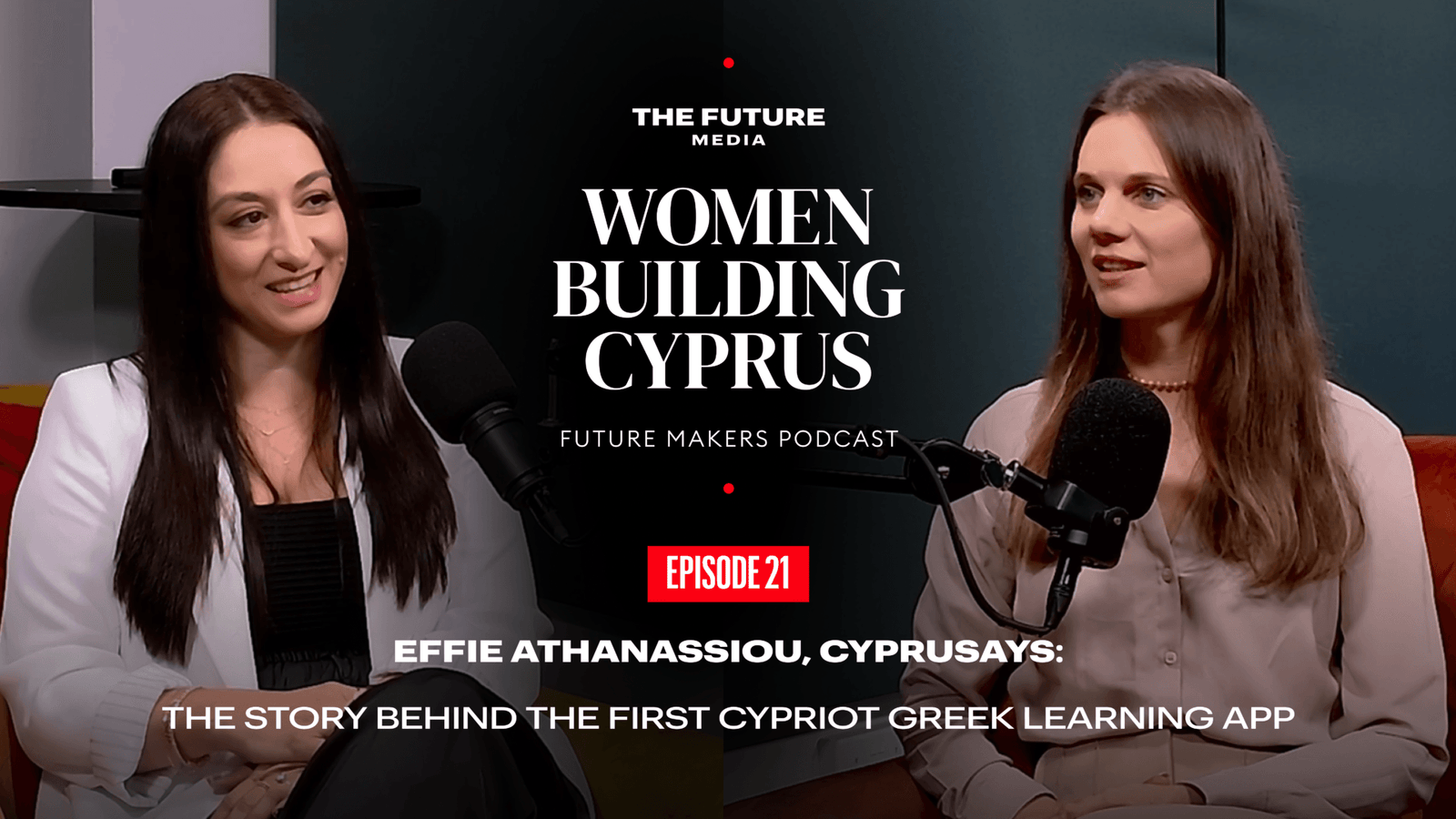
Effie Athanassiou is a guest on The Future Makers: Women Building Cyprus. The full episode, including her reflections on the diaspora experience, why she believes the shame around Cypriot Greek is holding a whole culture back, and what she wants Cyprusays to be in five years, is available to watch now.
The Future Makers Podcast is a series of in-depth conversations about how future-makers are made, in Cyprus and beyond. Host Annetta Benzar sits down with people who are a leading force in our shared future and looks past the titles. Together, they travel back to the people and moments that shaped them, walk through the choices and challenges they are living through now, and look ahead to the futures they are trying to build.
A production of The Future Media.