


Julia Kristeva loved mad women. She spent her life asking what happens to the parts of feminine experience that refuse to be translated into coherent political speech, and what is lost when women learn, merely to be heard, to speak in the vocabulary of the men who never listened. Kristeva was suspicious of popular feminist movements because she suspected that becoming politically legible meant adopting the very structures, especially those popularised by her male counterparts of the day, of rational discourse that had excluded women in the first place. The women she admired, or better yet, studied and paid attention to most carefully across her 30-book career, were the ones who could not or would not perform in the language or in the stereotypes society demanded of them.
Dr. Charis Xinari first heard of Kristeva’s ideas from a mentor at the University of Edinburgh, during her graduate years. “According to Kristeva,” her mentor said, “you need to kill the mother to save the mother.” This was not a replay of a scene from How to Get Away with Murder. The line was not intended literally. It refers to a process Kristeva called abjection: the psychological separation a child must undertake from the maternal body to become a speaking subject, a person who can enter language, culture, and society. Kristeva believed female children needed to go through the processes of rejecting and identifying with the mother simultaneously, and the tension between the two processes forms their identity.
Follow THE FUTURE on LinkedIn, Facebook, Instagram, X and Telegram
Xinari was in her twenties at the time, living thousands of kilometres away from her family back in Cyprus. The only connection she had to her mother was their phone calls, and even those were becoming more and more scarce as the daughter built her roots away from her mother’s land. Nearly three decades later, Xinari still identifies closely with Kristeva’s writing. She interprets them as both honouring the woman who made you whilst doing the work of becoming an independent person, who deserves to both speak and be heard in their own right. When you come back, you give the space your mother gave you to the next generation.
Dr. Charis Xinari is an Associate Professor of Critical and Cultural Theory at the European University Cyprus. She holds a PhD in English Literature and Gender from the University of Edinburgh. Her research focuses on gender, identity, and the politics of culture, including the ways identity is formed in everyday life in Cyprus and the increasingly urgent question of how online and offline lives interact to shape young people.
Xinari grew up in Cyprus in the late 1970s and early 1980s, in a country that was still metabolising the war and preparing its daughters for a future of…what? “For young girls, it really meant preparing you for a job,” she says.
“Because in postwar Cyprus, women were expected to work, but they were not necessarily expected to have ambitions. So ambition was never cultivated […] Little girls could not have big dreams as easily as boys were expected to have them.”
When she teaches this now to her own students, she is met with a room of shocked silence, if not cries of protest. “I have literally watched their jaws drop when I speak about what I call “the acceptable dream,” if you like. It would be to land a good job, possibly in the public sector, maybe become a teacher if you were good at it, marry, of course, have two children, buy a house, buy a car. And there’s nothing wrong with all those things. But that was more or less what was expected of us, young girls, back in the late 70s and early 80s when I was growing up.”
Her mother, however cliché Xinari admits it sounds, was her role model. “My mother has been an inspiration in my life, and I always get a little emotional when I talk about her.” Her mother had very little formal education. She worked alongside Xinari’s father for many years to provide her daughter with the education she never had.
It was Xinari’s mother who taught her daughter that a woman needs to be financially independent. “She said to me, ‘You always need to have your own money. You should never rely financially on anyone.’” Even to this day, her mother remains Xinari’s most honest critic but also her fiercest supporter.
The other women in Xinari’s early life were her grandmothers, refugees from the north of Cyprus. “My grandmothers always had stories from the war because that defined their generation. So though that was not pleasant, it gave me a lot of perspective. So it kind of formed my identity as the child of refugees from the north of Cyprus.” Little Xinari didn’t experience displacement herself as she was born after the division. But she grew up as part of a generation that, in her own description, lived displacement vicariously. “Technically we weren’t displaced, but then we never felt at home.” The emotional and social distancing from the narratives of the island she was expected to belong to would shape everything she chose next.
As both a child and a teenager, Xinari read constantly.
“I loved stories. Stories allowed me to travel and to imagine that there is another option for pretty much everybody.”
Her parents complained about the potential damage their daughter was doing to her eyes reading when the light was off, but she kept reading in the dark anyway. She wrote too but realised quite early on that writing didn’t bring her as much pleasure. What she loved was other people’s stories, being inside them, thinking about them, talking about them. It became, eventually, her profession. She was accepted into the University of Cyprus in the third year of its existence, part of a first generation of graduates from an institution that was, at the time, treated with scepticism even by its own students. “We were thinking, oh, it’s not a proper university,” she laughs. The scepticism was mostly frustration. Her generation had grown up dreaming of leaving the island, and the state university’s existence made it easier for their parents to keep them within driving distance. “You have no idea how much I cried when I entered the University of Cyprus, and it was not tears of joy. It was disappointment.”
She left eventually, having been accepted to the University of Edinburgh to do her Master’s. She arrived alone in a country she had never visited, unable to even understand what people were saying to her for the first two or three months. But after that first semester, something changed. “Edinburgh became such an easy home for me eventually, because I didn’t have to take sides. And because I could form my identity. I could be my own person.” The place that was not Cyprus, and did not ask her to be a Cypriot, was the place where she first met herself. She stayed on to do her PhD.
She eventually returned to Cyprus in 2006, at 30, expecting a red carpet at Larnaka airport. “I always say that I expected they would have rolled the red carpet for me at Larnaka airport, because I had a degree from a great university and I was so important. Self-importance comes with youth. But of course, the only thing that welcomed me in Cyprus was the humidity at Larnaka airport.” Despite having earned a doctorate from a top global university, she spent the next eight months unemployed. “And then I got this call one day that there’s a job opening at such and such private school. And of course, like I was not interested, but my parents said just try it for a few months. If it does not work out, then okay, just go back to Edinburgh, and that’s the end of that.” She took the job. It turned out to be one of the best decisions she made. She learned to teach teenagers preparing for their IGCSEs. “It’s the worst time,” she laughs, “an education in itself for the instructor.” Four months later, the position at the European University Cyprus opened. She was invited to interview and got the job. She has been there ever since.
What Charis sees when she looks at her students today is a challenge greater than the one her own generation faced. Her students live on the cusp of an online world and an offline world, and the two interact with each other in ways that were unimaginable in her early career. Much of her recent research work has been on gender-based violence that begins online and transcends into the physical space.
“I see the identities of young women being formed in ways that can be very dangerous for their very own survival, to be honest. And a lot of the work that I find interesting these days has to do with gender-based violence that stems from technology.”
What she wants is a critical media literacy that most of the education system, in Cyprus and elsewhere, has not yet taken seriously.
“You need to understand the powers that form the culture that formulates you. You’re not a passive individual in this context. We are all active agents. We do have agency.”
The message she wants to leave for the young people watching her career, or reading her research, or sitting in her lectures, is the one her mother gave her.
“What I would advise people is to follow the same advice that I took from my family back in my early years. Invest in yourselves. Invest in knowledge, in self-improvement. And understand that learning is a lifelong process.”
She cannot advise anyone on which profession to choose, she says, because with AI reshaping the labour market she does not know what professions will exist in five years. What she does know is that the skills any young person carries forward, that is, the ability to think critically, to keep learning, to keep separating from what is pulling them back to become themselves, will outlast whatever specific job those skills once qualified them for. “The only kind of investment you can make is in yourself and in your self-growth.”
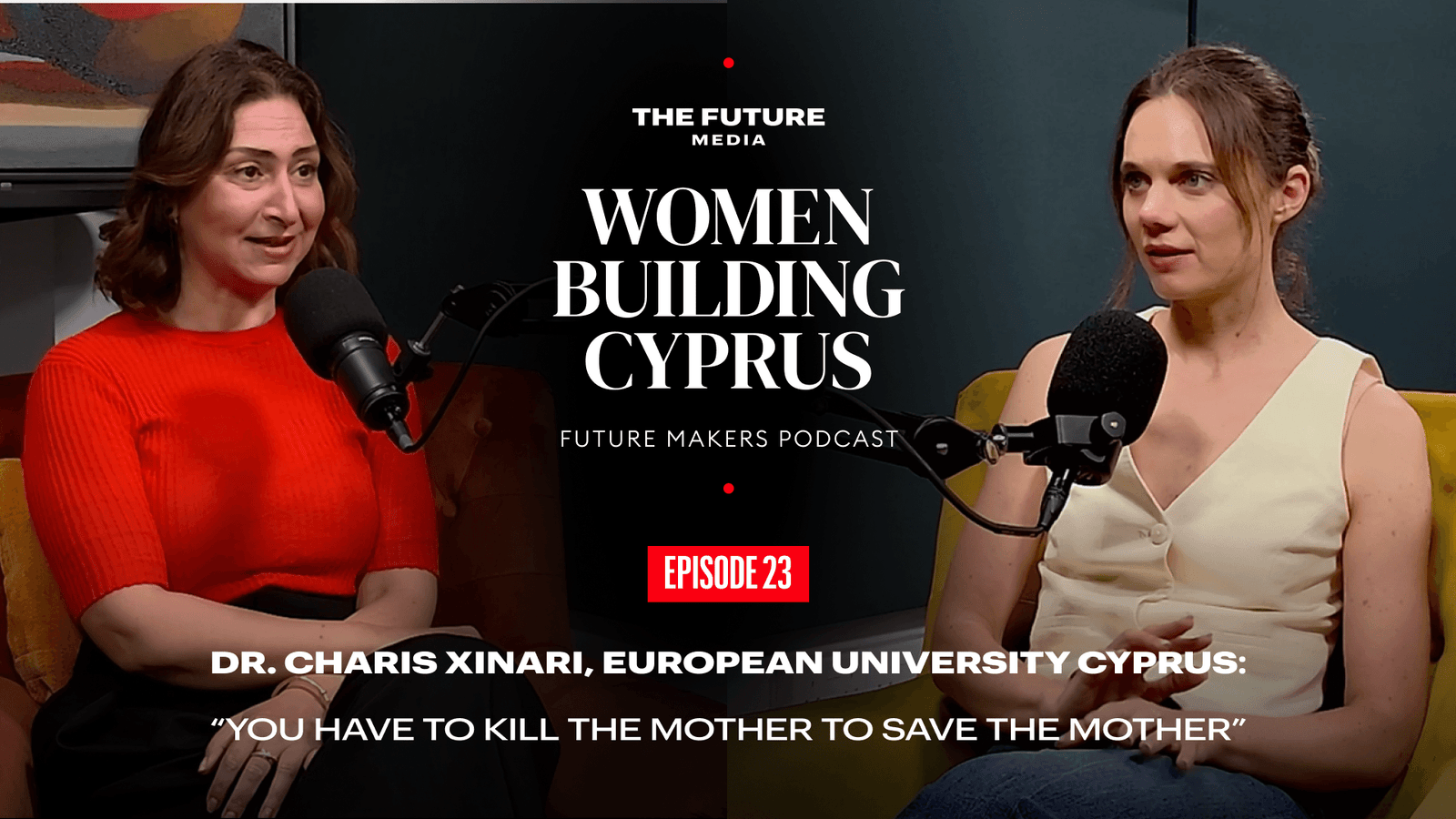
Dr. Charis Xinari is a guest on The Future Makers: Women Building Cyprus. The full episode, including her reflections on the University of Cyprus’s first generation of graduates, why she believes Cyprus should not ban social media for teenagers, and what she thinks a healthier academic culture would look like, is available to watch now.
The Future Makers Podcast is a series of in-depth conversations about how future-makers are made, in Cyprus and beyond. Host Annetta Benzar sits down with people who are a leading force in our shared future and looks past the titles. Together, they travel back to the people and moments that shaped them, walk through the choices and challenges they are living through now, and look ahead to the futures they are trying to build.
Women Building Cyprus follows women whose lives and decisions are changing what this island can be.
A production of The Future Media.