It’s not that Anna Prodromou stood in front of her mirror every morning, learning by rote the line: ‘stay quiet.’ She didn’t need to say the words out loud for them to embed themselves deep in her body; into her understanding of her place in the world, according to the world she was born into. “The only moments I was accepted were the moments I was silent,” she says now. Older now and having experienced the consequence of remaining silent for too long, she has spent the last seven years of her career doing the very thing she was told not to do. She is speaking up and is not afraid to offend people with her truth.
Follow THE FUTURE on LinkedIn, Facebook, Instagram, X and Telegram
Anna Prodromou is an expert in Diversity, Equity, Inclusion (DEI) and Communications. She is currently pursuing a PhD in Human-computer interaction (HCI) at the Open University of Cyprus, where her research focuses on the governance of AI in organisational contexts, and how transparency, accountability, and responsible AI are integrated in the small and medium enterprises that make up most of the Cypriot economy. She is the founder of Anna Prodromou Incorporated and the President of the WICZ Plus Foundation, a nonprofit focused on human rights that grew out of her work with women in conflict zones. She leads the Cyprus chapter of the Culture First community and created the Wikimedia Community User Group Cyprus. She was named the 12th Cyprus Businesswoman of the Year in 2018 and received the Forbes Cyprus Woman in Tech Award in 2023. Her book Women in Conflict Zones was published in 2019.
Anna Prodromou was born in Cyprus a few years before the outbreak of the 1974 war. She is not a refugee, and clarifies that when the subject comes up, but that doesn’t make growing up on an island that she felt was closing in on her any easier for a young child. The line drawn across the country in her early childhood was not just political or geographic. It felt like the line that decided what a girl could be, what a family should look like, what a woman was allowed to want and ask for. She could feel it in her body before she had the words to communicate it.
“I started realising that I live on a small island. And that that small place was becoming even smaller,”
she says.
Anna wanted out of the boundaries across land and shores.
The women she saw around her as a child were her mother, her aunts, her grandmother. As a young woman, the only image she had associated with a woman of the war era was a figure at the barricades in a black dress, holding a photograph of a missing son or husband. “It was always that figure of a woman weeping, the woman that has been either violated or hurt or missing something.” Only much later, as an adult reading Cypriot history, did she discover the other women whose images were not publicly propagated. She discovered some women marched. Other women fought for their island. Those women who stood up front.
“There are so many powerful women, but history books didn’t mention them,”
she says.
That erasure became the seed to her project, Women in Conflict Zones, to her book, Women in Conflict Zones, published in 2019, and the Women in Conflict Zones Plus foundation (WICZ+).
The project began as an EU-funded project because she wanted, in her words, to do something with women, even before she knew what that something was. She interviewed women from every community on the island: Greek Cypriot, Turkish Cypriot, the Latin community, Armenian, Maronite. Each interview was accompanied by a black-and-white portrait. As a showcase of the work, the photographs travelled as exhibitions across the island. When the EU project ended, people reached out asking her what was next. So, she turned the stories into a book, and later into a foundation. WICZ Plus takes the initials of Women in Conflict Zones and adds a plus because the mission of the foundation is to promote the rights of all, and not just one minority group. “Women’s rights are under human rights,” she says. “We are dealing more with any community that is on the margins, for all humans.”
The women in her own home were not the models she took forward. She says this carefully, hoping her aunts will forgive her.
“They were the obedient, the housewives, and all these things that had a negative connotation in my mind as I grew older. For me it was always something that I didn’t want to be. They didn’t really work as role models. They worked more as the models of avoidance.”
She watched her mother finish a day of paid work outside the home and come back to a second shift inside it, while her father sat down to relax. She watched her older brother allowed out at night while her older sister was not, unless the brother went with her. Young Anna watched who got to sit and who was still standing when the family gathered to eat, and it didn’t sit well with her.
After studying in Athens after high school, she returned to Cyprus, married, had two children, and built a career in communications on the island. From the outside, her life appeared nothing short of ordinary. But her early rebellious spirit had not quite disappeared. It simply had nowhere to go yet.
Then, seven years ago, a career in communications stopped being enough for her. “I could support organisations to promote their services, their products, but there was no meaning in that for me any longer.” She began reading extensively on the topics of diversity, equity and inclusion and started running workshops in the field of Diversity, Equity and Inclusion (DEI) at a time when this field was still controversial in Cyprus. She has been running them ever since, through the years when the field became briefly fashionable, and now, in her observation, back into controversy under the influence of the culture of the United States. What she has learned, session after session, is that the people who resist DEI most loudly in the room are almost always the people who come up to her at the coffee break to confess. “I was a bit aggressive because I experienced this in my life, or because I really have this in my family, and I don’t know how to handle it.” The resistance, she has come to understand, comes from a place of wanting to have the conversation and never being given the space for it.
The core of Anna Prodromou’s work lies in language.
“Language carries ideologies,”
she says.
Different ideologies run through different languages, different terms and structures to name and conceptualise ideas, identities and world systems. Every language does something to the people who use it before they even choose their words. Greek in particular, with its masculine, feminine, and neutral genders, has embedded structural biases that English does not carry as visibly. For instance, even if a woman holds a certain position, the masculine form is often used to describe her. This is the reason Anna Prodromou is so passionate about running inclusive language workshops; she believes the small structural choices language makes carry more value and impact than most people are willing to acknowledge. How a job advertisement is phrased. Whether the reader is addressed as “guys” or as “people.” Whether a female president is called by the feminine or masculine noun in Greek.
“Words have arbitrary meaning. It’s about time we reclaim language,”
she says.
Which brings her to the word she has become known (and even infamous for some) for refusing. That word is ‘empowerment.’ “It’s a word that I don’t like,” she says. “Every time I am in front of an audience, and someone says the word ‘empower,’ my immediate response is to ask how many women in that room are not empowered?” Women, in her observation, are already empowered, so the word does more damage than good by implying they still need something they already possess. Where the empowering actually has to happen, in her argument, is in a completely different direction.
“I think we need to empower men more, to be more accepting of their sensitive side, and to really be allies to women. That’s empowerment.”
She uses the provocation in her workshops and in interviews. She uses it because it forces the audience to notice that the current framing of the word puts the burden of change on the women being harmed rather than on the systems and men doing the harm.
The future Prodromou is working toward is one where she has done her part. For herself, she says, before anyone else. She wants to know that she has done what she can to inform people about diversity, to educate, to advocate for more inclusion, especially in relation to the rise in technology and AI today.
“I want a future that is equal for all,”
she says.
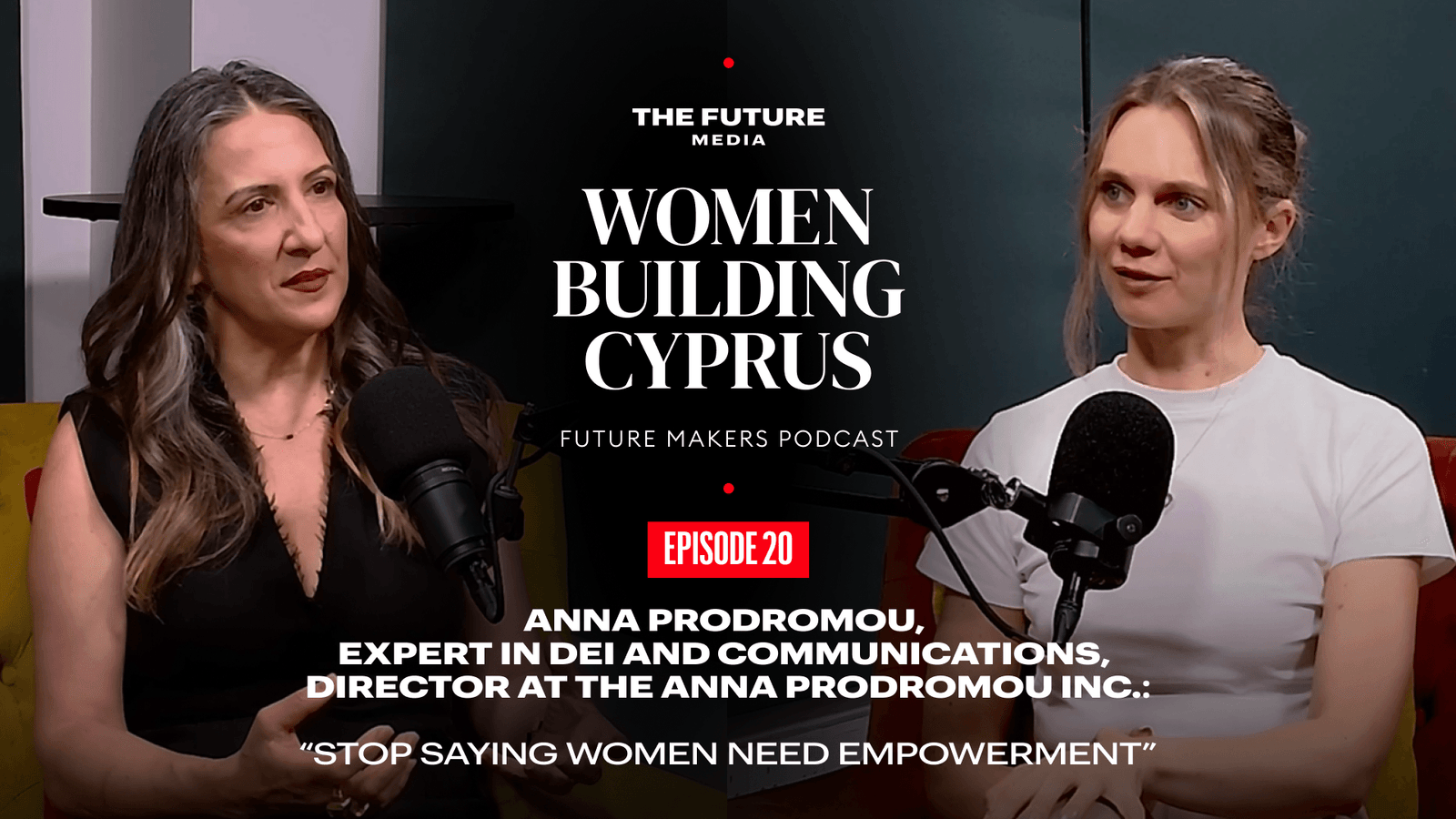
Anna Prodromou is a guest on The Future Makers: Women Building Cyprus. The full episode, including her reflections on the invisible women of Cypriot history, why she refuses the word empowerment, and how she thinks AI is training a generation to distrust their own voices, is available to watch now.
The Future Makers Podcast is a series of in-depth conversations about how future-makers are made, in Cyprus and beyond. Host Annetta Benzar sits down with people who are a leading force in our shared future and looks past the titles. Together, they travel back to the people and moments that shaped them, walk through the choices and challenges they are living through now, and look ahead to the futures they are trying to build.
The first season, Women Building Cyprus, follows women whose lives and decisions are changing what this island can be.