
“Some of my patients I see more than my family.”
Dr. Yiola Marcou’s patients have become an extension of her family. The women with advanced breast cancer, the ones who need close monitoring, come in once a week, sometimes twice. They know about her children, her reflections on life and the little stories she shares from her everyday life. She, in turn, knows them just as well, which is why, when one of her patients receives difficult news, she and her team take it personally. “It’s a loss for us as well,” Marcou says of the deaths. “It’s never like, I’m here, and my patient is there.” That closeness is why her work is possible. It is also why her work never ends when her shift does; it stays with her in her thoughts, her prayers and deep in her heart.
Follow THE FUTURE on LinkedIn, Facebook, Instagram, X and Telegram
Dr. Yiola Marcou is a Consultant Medical Oncologist at the Bank of Cyprus Oncology Centre. She completed her medical studies at the National and Kapodistrian University of Athens and her training in internal medicine and oncology in the UK, where she qualified as a Consultant Clinical Oncologist at Charing Cross Hospital in 2003. She is the Head of the Breast Multidisciplinary Team at the Oncology Centre, a Professor at the Medical School of the University of Nicosia, a member of the National Cancer Committee and the National Breast Cancer Committee, and a former President of the Cyprus Oncological Society.
Medicine was never really part of the family plan; nobody in Yiola Marcou’s family was a doctor. Her father even told her outright not to go into medicine and suggested business instead because he believed it would be more profitable than having his daughter spend her days by a hospital bed. She went into medicine anyway.
Ironically, although she was not a medical professional, it was her mother who instilled the values and work ethic that helped Yiola become the doctor she is today. Her mother worked tirelessly to keep the family together. She cooked, kept the household running and cared for anyone who needed her. Yiola’s own career has meant she has not always been able to give her two children the same amount of time that her parents gave her.
“I feel bad because sometimes my work takes me away from my two children. But all my free time was for them,”
she says.
The word she is careful not to use when talking about that trade-off is “compromise.” “I didn’t compromise. It was my choice.” Perhaps she has travelled less than some of her male colleagues. She has participated in fewer European projects than others on her team. She chose to attend two or three major conferences a year rather than many, whether to present her research or learn about the latest developments in her field. She chose to be present at home. That, in her view, is not compromise but balance.
“I think women are more balanced because they choose both. You are successful as long as you do something that you like and you have this fulfilment, especially in our work of giving and supporting.”
When Yiola returned to Cyprus in 2003, the Bank of Cyprus Oncology Centre was only five years old and the island’s only comprehensive cancer hospital with radiotherapy facilities. She joined a small team of two medical oncologists and two radiation oncologists who treated the majority of women in Cyprus with breast cancer. Shortly after her arrival, her senior colleague, Dr. Adamos, left to enter politics. Suddenly, she found herself leading a practice and a team that held him in high regard. Some of the women were, understandably, wary. “Oh my God, does this young doctor know what she’s doing?” she remembers them whispering. Six months later, she had earned their trust. She has spent every year since earning it from every new patient who walks through the door.
Cyprus is small. Back then, there was no NHS-style administrative framework, no ready-made protocols and no streamlined system. Together with Dr. Kakouri and Dr. Papamichael, who headed the department, Yiola sat down and wrote the protocols themselves. They worked closely with surgeons across the island to introduce sentinel lymph node biopsy in place of the more invasive axillary dissection. They also collaborated with radiologists who were eager to develop new expertise and adopt new techniques. They fought to bring new medicines to Cyprus despite resistance from the Ministry of Health, which had to protect its budget. Marcou and her team usually prevailed because patient advocates stood alongside them. Today, Cyprus has one of the highest breast cancer survival rates in Europe. She does not attribute that achievement to doctors alone, but also to the patients who fought alongside them.
Cancer, in Marcou’s words, is not a single event but an endurance race. Around 700 women in Cyprus are diagnosed with breast cancer every year. Most present with early-stage disease, which is highly curable. Advanced cases account for fewer than 5% of diagnoses. Thirty years ago, her greatest fear was that her patients would not survive. Today, her concerns are different because most of them will.
Her focus has shifted to the smaller things that shape a survivor’s quality of life: hot flashes and weight gain caused by anti-hormonal medication, vaginal dryness, neuropathy and the psychological distress that often continues long after treatment ends. Cyprus is now home to thousands of breast cancer survivors. The next step is to ensure they receive the same attention and support after diagnosis as they do during treatment.
“We live in a country where oncology services are very good. We have many survivors. The government needs to sit down with us and understand the challenges these people face,”
she says.
Some of the programmes survivors need are not profitable, she says. That is precisely why they require public support.
It takes a great deal of discipline to manage the emotional toll her work takes on her. Over 22 years, Yiola Marcou has learnt that it is not a profession she can simply switch on and off. As she describes it, breast cancer care is a deeply female practice, and she feels for every patient she treats, a responsibility that can be emotionally overwhelming. Her colleague Eleni kept her grounded in the early years. At the end of each day in the clinic, the two would sit together, with Marcou, the more extroverted of the pair, talking through the day while Eleni listened. Then it would be Yiola’s turn to listen. The team has grown since then. Today, they hold multidisciplinary meetings twice a week, allowing everyone to discuss the cases that keep them awake at night. “It’s a profession that you cannot keep inside you,” she says.
“The emotional weight of caring for a patient is very difficult to carry alone. You need the team.”
The future Marcou wants for Cyprus is one in which the fragmentation of oncology services comes to an end. One where patients are treated according to European guidelines, not the availability of the doctor they happen to see. One where expertise is concentrated so that every patient receives the best care modern medicine can offer. One where the primary healthcare system focuses on prevention rather than referral. One where clinical auditing catches up, giving the next generation of doctors the data they need to build on.
“I love what I do, I want to improve. On a small island, we can do even better,”
she says.
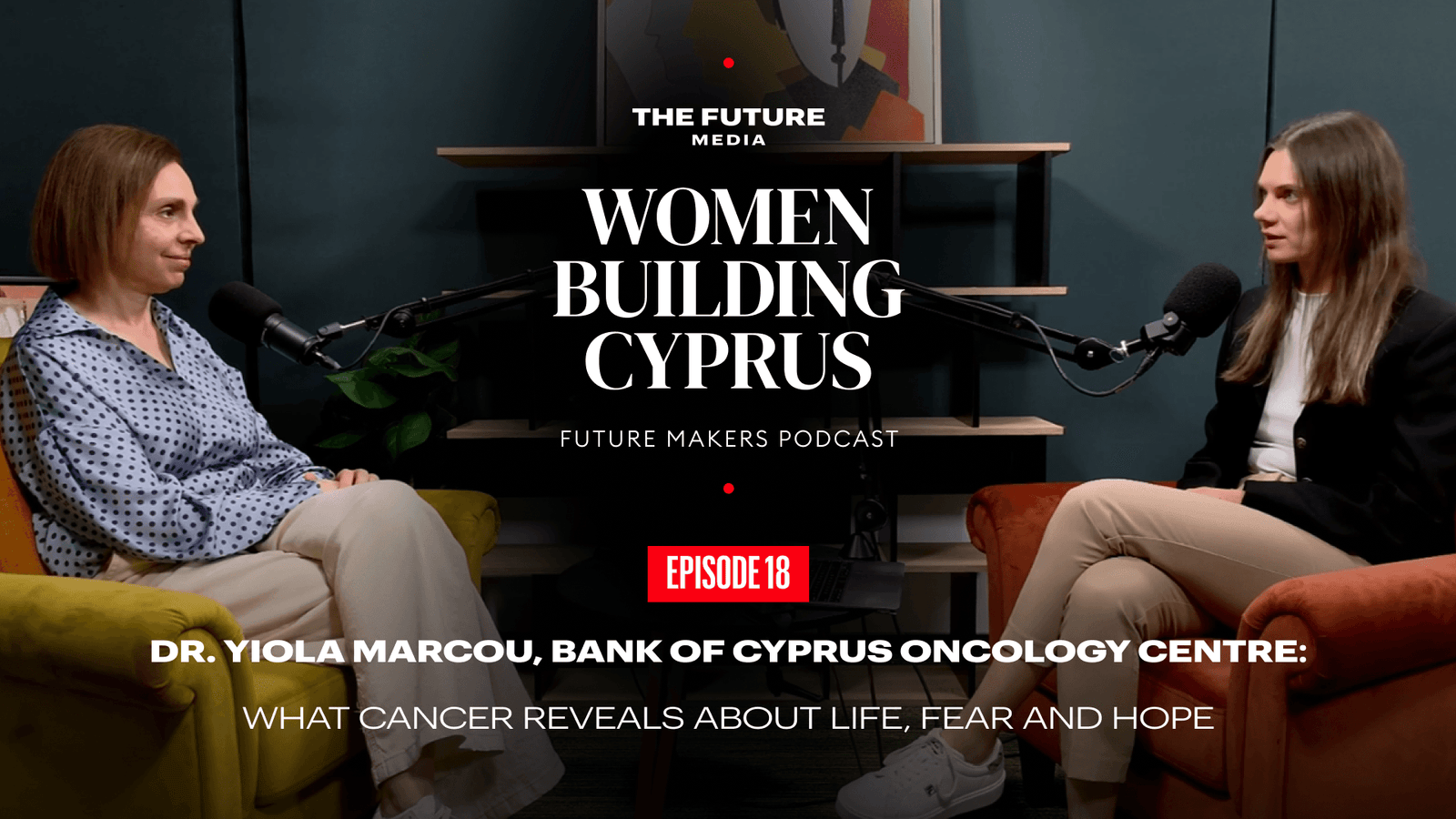
Dr. Yiola Marcou is a guest on The Future Makers: Women Building Cyprus. The full episode, including her reflections on the state of Cypriot healthcare, why she believes women do not compromise but choose, and her thoughts on how AI will transform medicine over the next twenty years, is available to watch now.
The Future Makers Podcast is a series of in-depth conversations exploring how future-makers are made, in Cyprus and beyond. Host Annetta Benzar sits down with people shaping our shared future and looks beyond their titles. Together, they revisit the people and moments that shaped them, explore the choices and challenges they face today, and look ahead to the futures they are working to build.
A production of The Future Media.