

Robert Burns wrote that the best-laid plans of mice and men often go awry. Violetta Skittidi could tell him about it. Building a legal tech company fresh out of university was not in her plans.
The initial idea was to find a way to differentiate herself (and her partner in the business, Ramzi Edward Khoury) from thousands of other law graduates fighting for a handful of training contracts in London. But what may have begun as an interesting edge on a CV grew into a full-on job. What that idea became was Formulaw, a legal tech startup validated by Deloitte, funded through Northeastern University, celebrated across three years of awards and accelerator programmes, and eventually shut down. Today Violetta is ready to talk more openly about what the journey was really like, behind all the awards and recognition she and her business partner were receiving for their business.
Follow THE FUTURE on LinkedIn, Facebook, Instagram, X and Telegram
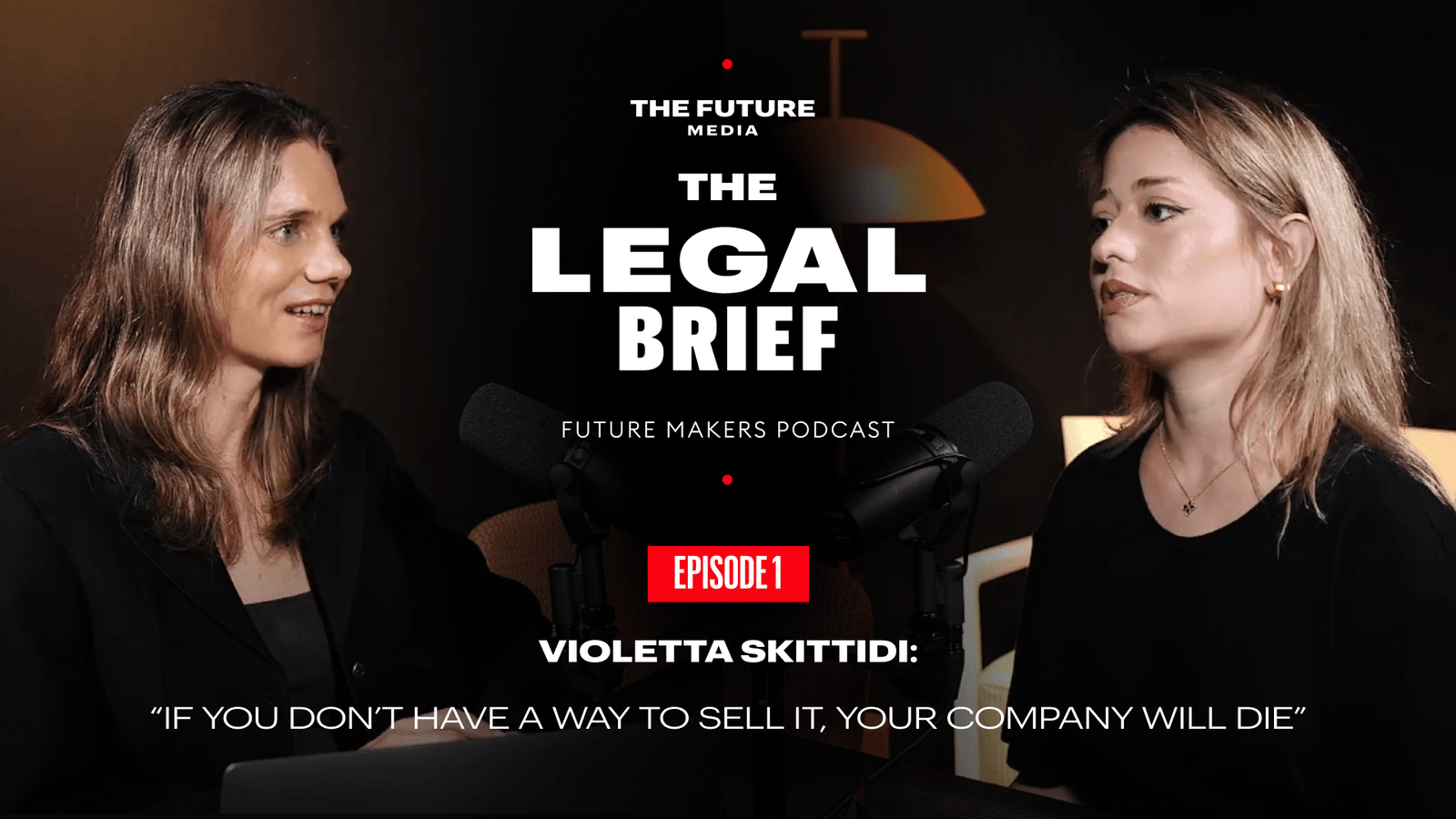
Violetta Skittidi is a lawyer working across corporate and private client matters. While studying for her legal bar exam, she co-founded and launched Formulaw. She is the first guest on The Legal Brief, a Future Makers series produced by The Future Media, hosted by Annetta Benzar, in which legal professionals unpack the reality of a profession that is being redefined, whether it wants to be or not.
Her route into law was slightly… unconventional. She studied Philosophy, Politics and Economy for her undergraduate degree at Warwick, and only stumbled into law while writing her thesis on art auction theory. Alongside the thesis, she was taking modules at Sotheby’s Auction House, and one of them was Art Law. “I genuinely was so fascinated by how many legal points and aspects art law touched,” she says. She finished her degree, enrolled in a Graduate Diploma in Law, and started training as a lawyer just in time for the pandemic to expose the “not-so-pretty” side of the profession she was trying to enter.
What she saw during her internships in the London legal industry, both in-house and in private practice, was a working culture a decade behind every other sector. “Everything in legal at that time was stuck. There wasn’t much digitalisation, aside from Outlook emails, maybe Slack, maybe Teams.” She had already caught the entrepreneurial instinct at Warwick. She and a friend had turned a third-year business module into a pitch deck for a start-up, won first prize at their university, then went and won second at a Warwick Business School competition. There was a budding entrepreneur seed fighting to reach the light inside her, and now she had a legal profession she believed needed fixing. Not to mention, enough curiosity to try.
Her co-founder was a friend from law school. The first version of Formulaw was a marketplace to connect clients to law firms based on filters such as price, jurisdiction, language, and area of law. Their initial vision was to bring more transparency into the business for clients from all walks of life. The industry was, however, not ready.
“The law firm did not want to be part of the marketplace because they did not want to disclose their prices,”
Violetta says.
She and her co-founder pivoted, pitched to a mentor from an accelerator, and pivoted again. This is how fifty ideas came and went. Their mentor kept repeating the same thing.
“Don’t think about what the market wants. Think about what it needs.”
Eventually they agreed on the idea to create a platform for handling contracts end-to-end, from drafting through to dispute resolution, especially targeting small companies and founders who could not afford a legal team.
The next two years looked, from the outside, of course, to be the perfect formula of success after success. Formulaw was selected for the Deloitte Aris accelerator in Cyprus. It received a grant from Northeastern University. It won the Deloitte Fast 50. Formulaw was invited to the United Nations STI conference, and Violetta was nominated for a Madame Figaro award. However, as is the case with all startup journeys, the reality was more complicated than what can be said in a social media post. Cyprus’s legal industry, Violetta and her team discovered, is a small, closed community that trusts what it already knows. Lawyers may have loved the demos, but the partners hesitated, and company IT teams flagged risks and extreme warnings where they weren’t warranted. The decision-making process was slow, and by the time it happened, the actual momentum had usually already died. “It was one of the biggest challenges ever,” she says. “A bigger challenge than building or ideating, for sure.”
Meanwhile, in the international market, Harvey and Legora were pulling in hundreds of millions of dollars in funding. Harvey alone is now valued at roughly eleven billion, and Legora just raised over five billion. Between them and Relativity, these three companies took sixty percent of all legal tech funding in the first quarter of 2026. What Violetta found comfort in was the story of Harvey, which was so close to closing just as their luck changed. “The founder even said he really struggled. They were thinking of shutting down operations.” What saved Harvey was a single major client, Allen & Overy. Once one of the biggest law firms in the world had signed up publicly, the industry followed.
“Unfortunately, that’s how it is in legal. It’s the fear of missing out. If one successful big law firm has something, they want it as well.”
She recently announced that Formulaw has shut down operations. When asked what she would do differently if she started again, she takes a moment to consider before answering.
“Definitely think about the distribution aspect more carefully. Strategise on that more carefully. We were more obsessed with how the product would look and how lawyers would use it, more than actually why the law firm or the company would use it? Why would they buy it? What’s the distribution network and route to getting them to buy it? That’s the most important thing, because your product itself is always going to change based on what they need. But if you don’t have a way to sell it, and you don’t have a distribution network, then your company will die.”
The future she is building toward is still one where access to justice is closer than it is now. For now, she is deepening her expertise in corporate, commercial, and private client law, working with clients while also learning. She has not ruled out the entrepreneur journey. She has already had offers from other legal tech startups. However, if she does it again, it will be with a proper team, more caution, and everything she now knows about distribution. “I am definitely a lot more cautious now than I was, because it’s also heartbreaking when something doesn’t kick off and when your vision doesn’t become a reality and you have to stop it.”
She is not done. She is a lawyer who has already seen how the profession she works in will be forced to change, and has done the difficult work of understanding why. That is a rare position to be in at 27. What she does next is worth watching.
Violetta Skittidi is the first guest on The Future Makers: The Legal Brief. The full episode, including her reflections on why the technology is no longer the moat, what Cyprus’s legal industry still refuses to accept, and why the profession will be forced to catch up whether it wants to or not, is available to watch now.
The Future Makers Podcast: The Legal Brief is a series of in-depth conversations with legal professionals about the profession, its blind spots, its clients, and the technology that is redefining how the work gets done. Host Annetta Benzar looks past the credentials to understand how lawyers think, where they are ahead of the curve, and where they are being left behind.
A production of The Future Media.