



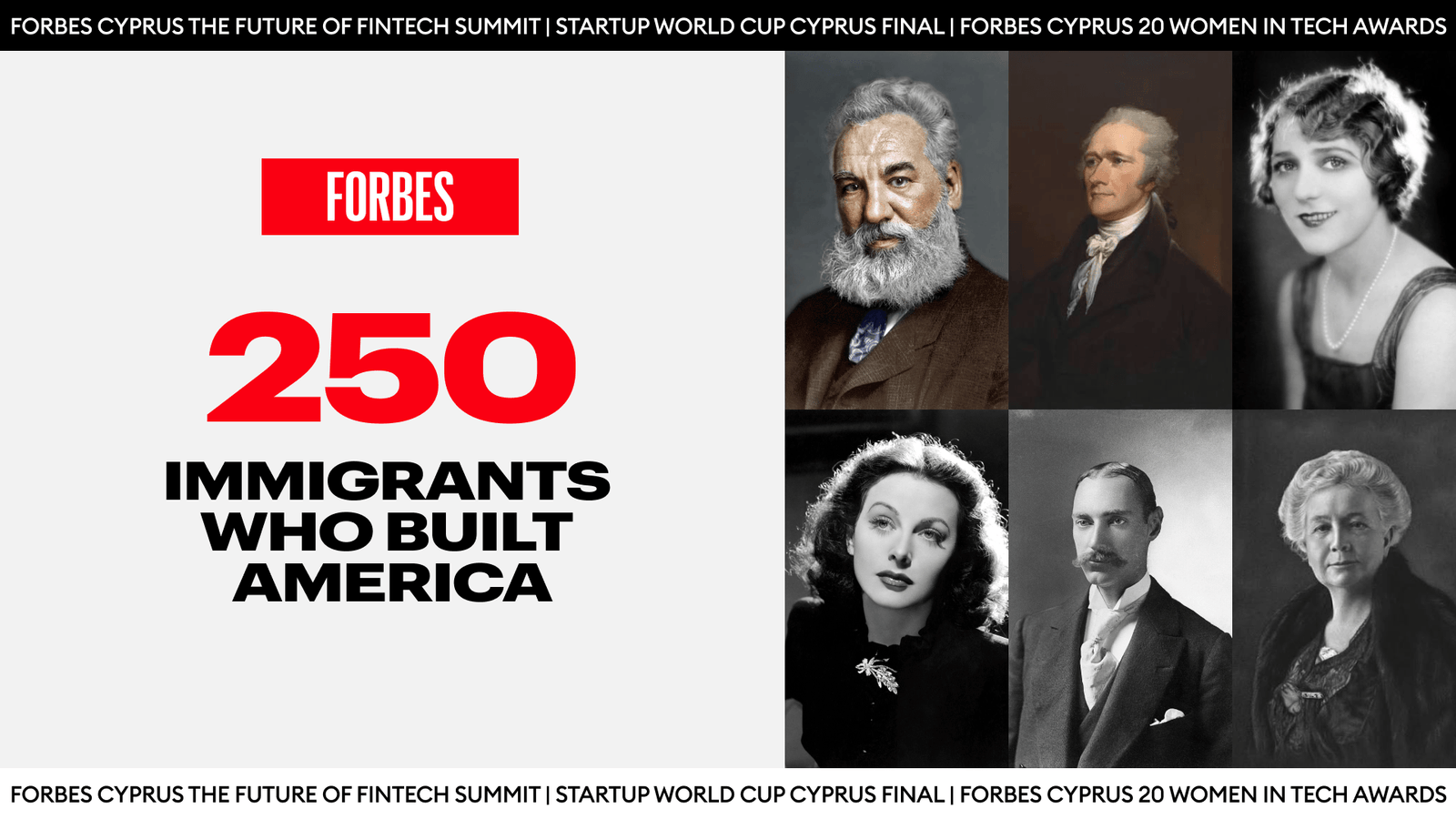
Forbes has ranked 250 immigrants who shaped the United States across 250 years. The top names read like a ledger of the country itself, the brand ambassadors of the infamous American Dream.
The telephone. Blue jeans. Goldman Sachs. The American financial system. The theory that led to the development of solar cells and digital cameras. These were instigated by people not born on American soil but who had chosen to leave their birthplace and reinvent themselves across the border and even across the ocean.
Follow THE FUTURE on LinkedIn, Facebook, Instagram, X and Telegram
Here are some of the prominent names included on the list.
Top 10
#1. Alexander Graham Bell (1847–1922, United Kingdom)
Bell did not wake up one day and decide to invent the telephone. He was trying to build devices to help deaf people communicate, and the telephone was actually a byproduct of that work. He went on to hold patents in wireless communication using light, aerial vehicles, and the audiometer, which remains standard clinical equipment for diagnosing hearing loss today. He founded AT&T.
#2. Alexander Hamilton (1755–1804, Nevis)
Orphaned at a young age, Hamilton’s Caribbean community pooled money to send him to school in New York. He went on to become George Washington’s closest aide during the Revolution, co-wrote the Federalist Papers with James Madison and John Jay, and, as America’s first Treasury Secretary, built the financial architecture the country still runs on.
#3. Andrew Carnegie (1835–1919, United Kingdom)
Carnegie arrived in America at 12 and started work a year later. He built an industrial empire across railroads, oil, and steel, then sold Carnegie Steel to J.P. Morgan in 1901 for an amount that is equivalent to roughly $20 billion today. He kept approximately half and spent the rest funding libraries, schools, and institutions across the country.
#4. Mary Pickford (1892–1979, Canada)
Audiences knew Pickford as America’s sweetheart. What they didn’t see was the producer who had quietly seized creative control over her own films, or the co-founder who helped dismantle Hollywood’s studio monopoly by giving independent filmmakers somewhere to distribute their work.
#5. Marcus Goldman (1821–1904, Germany)
A former shopkeeper who got tired of the retail industry, Goldman opened a small commercial paper business in New York in 1869. It became Goldman Sachs.
#6. Irving Berlin (1888–1989, Russia)
Berlin came to America at five years old, fleeing Jewish persecution in Russia. He arrived speaking no English. He never learned to read music or play in any key but F-sharp. What followed, however, was one of the most extraordinary bodies of work in American cultural history, including “White Christmas,” still the best-selling single ever recorded, and “God Bless America.” Composer Jerome Kern has said: “Irving Berlin has no place in American music — he is American music.”
#7. Charles Pfizer (1824–1906, Germany)
Pfizer founded his namesake company in 1849, beginning with food additives before expanding into pharmaceuticals. The company he started with a borrowed $2,500 is today one of the largest pharmaceutical corporations in the world.
#8. Eleuthere du Pont (1771–1834, France)
Du Pont started a gunpowder mill in Delaware. From that mill, he expanded into a chemical company that today manufactures everything from medical packaging to electronics insulation. DuPont remains one of the largest chemical companies on earth.
#9. Albert Einstein (1879–1955, Germany)
Einstein won the Nobel Prize in Physics in 1921, not for the Theory of Relativity, but for his discovery of the photoelectric effect, the science behind cameras, solar cells, and much of modern electronics. After becoming an American citizen in 1939, he wrote to President Roosevelt urging him to launch what became the Manhattan Project.
#10. Levi Strauss (1829–1902, Germany)
Strauss arrived in San Francisco as a dry goods merchant during the California Gold Rush. One of his customers was a tailor named Jacob Davis. Together they co-invented denim waist overalls — blue jeans — and secured the patent in 1873.
Honourable Mentions
#14. Nikola Tesla (1856–1943, born in present-day Croatia, of Serbian heritage)
Tesla’s pioneering work in alternating current and radio technologies laid the industrial foundation for the 20th century. His birthplace sits in modern Croatia, though he identified as Serbian throughout his life.
#22. Anna Bissell (1846–1934, Canada)
Her husband invented the carpet sweeper. After his death in 1889, she took over the company as the CEO, making her the first female CEO in American business history. Over the next three decades, she turned Bissell into a leading household name.
#26. Andrew Grove (1936–2016, Hungary)
Grove survived Nazi-occupied Hungary, then faced a Stalinist regime after the war. He crossed the border in 1957, came to America for his education, and became the first hire at Intel under founder Gordon Moore. Eleven years later, he became Intel’s CEO.
#29. Hedy Lamarr (1914–2000, Austria)
One of Hollywood’s most recognisable stars of the Golden Age, Lamarr spent her spare time on inventions. One of her most consequential inventions was a frequency-hopping signal technology originally designed for torpedo guidance systems. That work directly paved the way for GPS and WiFi.
#125. Gerty Cori (1896–1957, Czech Republic)
Cori and her husband Carl uncovered the chemistry behind how the body converts and stores energy, work that won them both the Nobel Prize for Medicine in 1947. Gerty was the first woman to win the Nobel Prize in that category. Their findings became foundational to understanding metabolic diseases, including diabetes.
Read the full list of the 250 immigrants who shaped the United States across 250 years.