Where are you from? Where are you really from?
Sophia Papastavrou was asked both questions, often, from a very young age, and there was never a version of the answer that could fit into a brief sentence. She did not yet have the academic language for what those questions were doing to her.
Follow THE FUTURE on LinkedIn, Facebook, Instagram, X and Telegram
“Identity is negotiated. Not a given,”
she says.
That space where identity is negotiated, that in-between, is where she has spent her career.
Sophia Papastavrou is a gender equality and humanitarian leader with over a decade of experience advancing gender-transformative and climate-resilient programmes in fragile and conflict-affected contexts. Currently with World Vision Canada, she is also a published author and TEDx speaker with a PhD in Social Justice Education. She partners with Nordic and bilateral donors to advance women, peace, and security, and rights-based development.
Sophia was raised as a third-culture kid, although it would be years before she would come across the concept during her PhD coursework. Born in Athens to parents from Cyprus, she moved less than a month later to the Dominican Republic for her father’s work, then to Ghana and West Africa for her early childhood and teens, then to Canada. Between homes, she would visit her extended family in Cyprus, not only physically but also through the stories her parents would share.
“What was interesting wasn’t the arrival into place or country,” she says. “It was the in between prior.” Memory, expectation, the feeling of a place before you got there. Those were the spaces that formed her experience of the island.
“Some of us are shaped by our roots. R-O-O-T-S. And some of us are shaped by our routes. R-O-U-T-E-S. Like a plant, but constantly translating language, not just in the way words are said, but in how you adapt, observe, listen,”
she says, spelling it out for the room.
As a teenager in Niagara Falls, Ontario, trying desperately to fit in somewhere, Sophia pushed back against her mother’s attempts to pass on the memories of her roots, the narratives of immigration, of 1974, and life post-conflict. Her daughter could not understand these stories, their significance or why learning the langauge and culture meant so much for her mother. She understands them now.
“I’ve written about inherited cultural threads. My mother’s memories, but also what she did. She was an artist. She collected African beads and made necklaces, and each of those beads served as a symbol for someone else,”
Sophia says.
Memory and resilience became tangible in the hands of a woman who had known displacement herself; a reminder and a warning wrapped around her wrists and throat.
Sophia went on to write a PhD focused on women’s organisations for peace in Cyprus. She focused on three organisations to understand their origin, who the key activists were, how they engaged with peace building on the island, and how they fit into the wider frame of transnational feminist theory. Since publication, she has continued observing the landscape, and has been disappointed in how various organisations on the island, seemingly working for similar purposes, interact, or don’t, among themselves.
“Stop working in silos.”
Coalitions on human trafficking, disability rights, women’s rights, and the formal peace process are all working on connected problems, because the women for whom these organisations are fighting for are rarely affected by only one of these problems. A working-class woman with a disability navigating the peace process is at the intersection of at least three of those conversations. If the organisations working on her behalf never speak to each other, none of them will ever fully see her. This is what Sophia means by the intersectional element. Who are the women in “women’s rights”? Whose peace is being discussed when peace is discussed? Peace for women, she says, means different things depending on which women you are asking.
Sophia is careful not to erase the progress that has been made in the last decade in Cyprus. “It’s a lot quieter here,” she says. “Class-based, in some ways. The disability movement feels missing to me.” She catches herself immediately. “But that doesn’t mean the work is not important, or the work is not of value.” It is just slower and there is a great deal of work still to do.
One of the greatest honours of life, she says, has been motherhood but she admits it is also one of the most unthankful jobs she has ever experienced. Her daughter is her greatest teacher.
What has surprised Sophia about becoming a mother is the diaspora piece.
“You won’t necessarily understand your own parents until you’ve had your own children. And especially when I say parents, I mean a specific kind of parent. A diaspora parent, an immigrant parent, a refugee parent. Where their traumas make more sense. Where you understand that they are human beings who came with all sorts of hang-ups that made them who they were, and made sense in their parenting, which doesn’t necessarily make sense in yours,”
she says.
The biggest thing motherhood has given her is not an understanding of the generation before but a commitment to the generation after, especially in relation to the conflict that has followed her across the world, the division of the place she now calls home. The border she can see right outside her window.
“It ends with us. It will end with my daughter and me. That intergenerational trauma.”
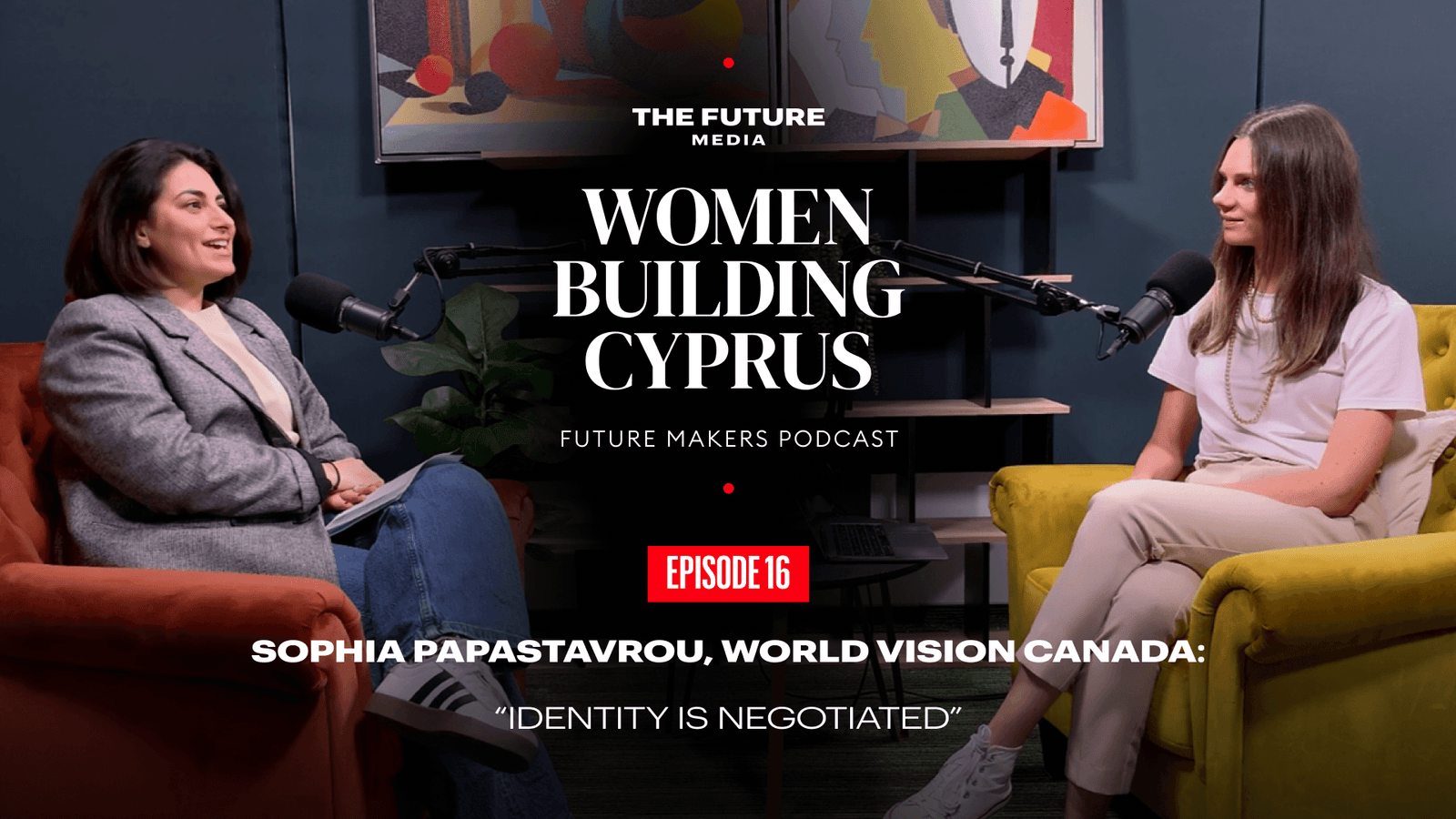
Sophia Papastavrou is a guest on The Future Makers: Women Building Cyprus. The full episode, including her reflections on grief, the vulnerability of relationships that survive it, and what she has come to understand about the invisible labour that holds every system together, is available to watch now.
The Future Makers Podcast is a series of in-depth conversations about how future-makers are made, in Cyprus and beyond. Host Annetta Benzar sits down with people who are a leading force in our shared future and looks past the titles. Together, they travel back to the people and moments that shaped them, walk through the choices and challenges they are living through now, and look ahead to the futures they are trying to build.
The first season, Women Building Cyprus, follows women whose lives and decisions are changing what this island can be.
A production of The Future Media.