
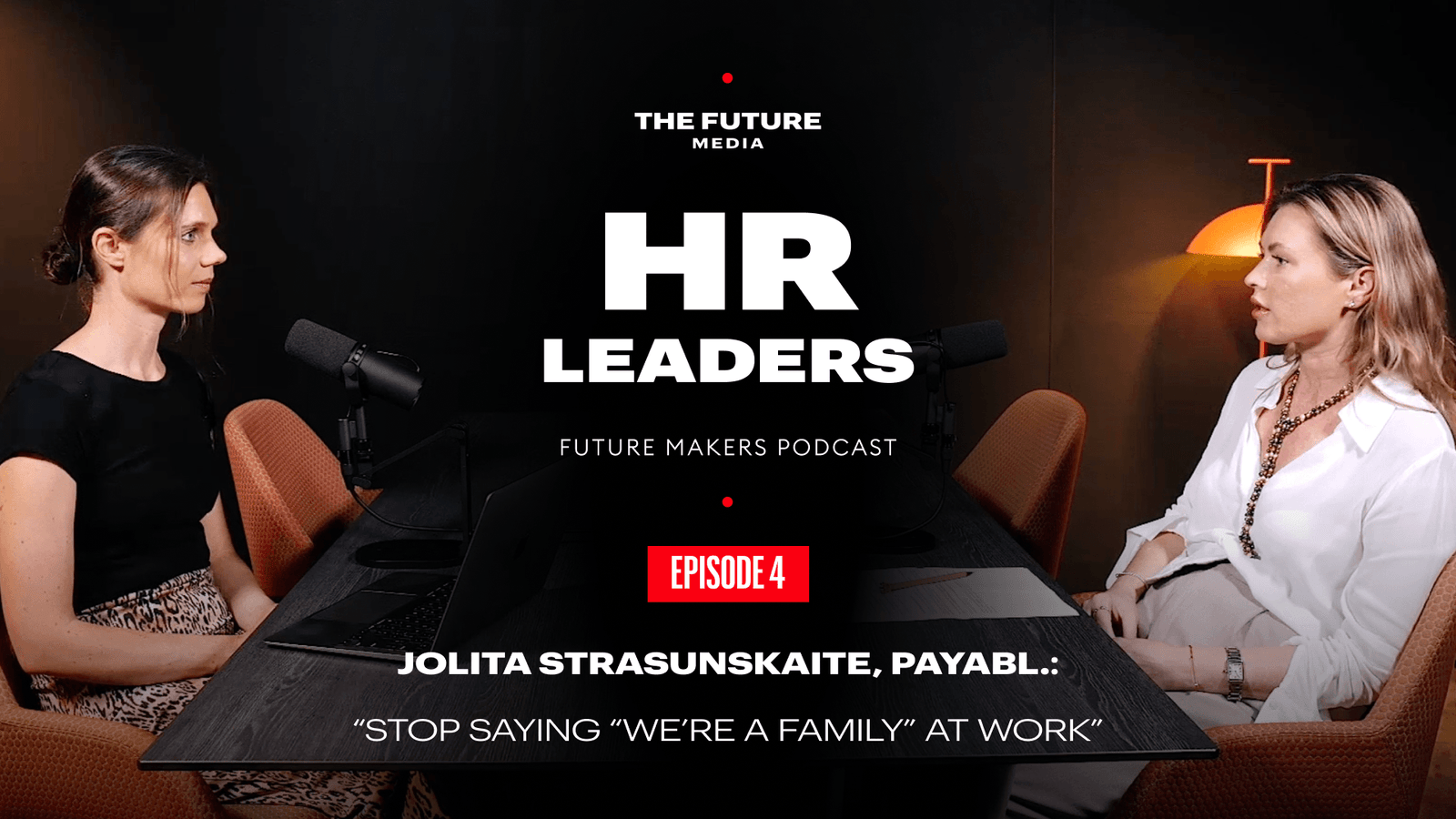
“We’re like family here.”
It’s one of those common slogans a company likes to post on their social pages together with a photo of their team at any big milestone or just before the holidays, and Jolita Strasunskaite cannot stand it.
Follow THE FUTURE on LinkedIn, Facebook, Instagram, X and Telegram
“We are not sisters and brothers. It is a business. It should be approached like a professional environment. Even if it’s a family business, it’s still business. There is an exchange in the relationship. The company provides opportunities, and employees with the skills,”
she says, talking about the employees of a company.
If you build a narrative around family dynamics, you risk raising expectations that can never be met. The disappointment will affect the business itself, and rarely in a positive way.
Jolita Strasunskaite is Group Chief People Officer at payabl., where she has spent the last five years driving the company’s global people strategy across fast-growing teams and regions. She joined when the company had thirty people. It now has almost three hundred (and growing). She brings over fifteen years of leadership experience across financial services, private wealth management, property development, and food and beverage.
“Who does HR work for?” is a question Jolita likes to ask candidates herself, especially when she’s building her own team (hint for any potential candidates!), and the answer she’s listening for is not the one most people give. “Unfortunately, it’s not the employees,” she says.
“HR works for the business,”
she says.
Far from being cold, it is about being realistic. HR’s job, as she sees it, is to make sure people are performing at their best, because that is what makes the business perform well, and the two elements are not in competition. “I see HR as a value-generating function,” she says, “not an administrative one. Behind every conversation about strategy, growth, and revenue, there are people making decisions, collaborating, and taking ownership. HR’s job is to read those behaviours and create the environment where people can do that.”
She came to HR almost by accident. “My first touch with HR wasn’t in an HR position,” she says. “I was working in an academic environment, and I was this middle person between students and the institution. This is where I believe I exercised the HR function for the first time.” From there, she moved into an international confectionery company, where she had a “real HR” title, but the role itself was still very operational and administrative. Even so, it was there that she began to understand that the job was not as straightforward as it appeared at the onset.
“There is no template for how you need to do things. All the time, things are changing, developing, evolving. You constantly need to educate yourself, constantly need to go out of your comfort zone,”
she says.
The moment she finally understood the true complexity of HR arrived five years ago, in her first conversation with payabl.’s Group CEO. “My job,” the CEO told her, “will be to make sure our people are happy, because they are the most important asset within the organisation.” Jolita still gets goosebumps telling the story. It became her guidance from day one, the foundation from which leadership should approach the decisions of their business. “Everything starts from leadership,” she says.
“Any manager needs to understand why we are here. We are here for the business, for performance. And to get that, you need to understand how people perform, what motivates each person on your team.”
Some people need recognition, some need a bonus, and some thrive under close attention, while others feel suffocated by it. Getting this right is not so much a soft skill muscle but the entire mechanism by which motivated, empowered people stop calculating their effort and start bringing creativity, ownership, and collaboration to the table. “It’s a different tier of work when they’re delivering to the company,” she says.
The word happy comes up often when she talks, and she defines it not as an emotion but in the relationship of the people of a company to their work. It is visible in how people show up. Someone clocking in for the paycheck and counting down to six o’clock is not happy, whatever they might say if asked. Someone who cares about a project, who brainstorms without watching the clock, who steps into a problem without calculating the personal cost first, that person is happy in the way that builds a company. Her favourite indicator, though, is even simpler.
“When I see my colleagues being proud of being part of payabl., for me, that is what professional happiness is.”
She is quick to dismantle the idea that this kind of culture is something HR nails together and delivers to everyone else. “I believe it’s one of the biggest misconceptions that culture belongs to HR,” she says. “It’s everyone’s effort. Every person shapes that. Every person can shape it in the wrong way, too.” HR can create the conditions, but the outcome belongs to everyone in the building.
Jolita Strasunskaite is the fourth guest on The Future Makers: HR Leaders. The full episode, including her thoughts on diversity at payabl., what she would change about HR communities, and the first moves she would tell any CEO to make when building culture from scratch, is available to watch now.
The Future Makers: HR Leaders, hosted by Annetta Benzar, is a series of conversations with people leaders focused on hiring, workplace culture, leadership, workforce transformation, talent strategy, learning, performance and building the workplace of tomorrow.
A production of The Future Media.