“I am a cancer researcher. How did I accommodate the needs of my sister? I did nothing.”
Dr. Marianna Prokopi-Demetriades would ask herself this in the months after her sister passed. Her sister was only 30 years old and had been diagnosed with cancer two years earlier. But it wasn’t the cancer in her body that had taken her so young, but the after-effects of the treatment. Prokopi-Demetriades, who had spent her career researching cancer at some of the most prestigious institutions in the UK, had watched in quiet horror the treatment take its toll on the person she loved, and had not been able to protect her sister from any of them. As she mourned her loss, she made it her mission to do all she could in her power to turn the grief she felt at her sister’s (and mother and father’s) passing into something that would be “useful.”
Follow THE FUTURE on LinkedIn, Facebook, Instagram, X and Telegram
Dr. Marianna Prokopi-Demetriades is a biotech entrepreneur, clinical associate professor and research oncologist, and co-founder of three Cyprus-based biotech companies: Theramir, RSL Revolutionary Labs, and Promed Bioscience. Her work spans across cancer therapeutics, regenerative medicine, and supportive skin care for cancer patients.
Prokopi-Demetriades was nine years old when her mother died. Her father was working in Saudi Arabia at the time. She and her sister were raised by their grandmother, aunt, and great-grandmother, all strong and intelligent women, though none had been allowed to attend university. Upon her mother’s death, the older sister became the mother figure of the house before she had even finished primary school. She raised her younger sister, who was only three when their mother died.
“Unfortunately, my life has been full of traumas. But instead of thinking that it was unfair and asking why these things were happening to me, I treated them as challenges and returned something positive in response,”
she admits.
She grew up in Athens in the 1980s, in a neighbourhood where children still played football together in the street. Even as a young child, she was drawn to the world that could only be seen through a microscope. Every week, she watched hours and hours of documentaries about biology. She knew this was what she wanted for her future. Even though no other woman in her immediate family had attended university, Prokopi-Demetriades was determined to enter the world of academia and research. When it came time to choose where to study, she made two decisions that were, in her own description, hard. She would go into the sciences, and she would leave Greece.
The day of her departure for the UK, her father drove her to the airport. He turned to her before she went through security and said something she still remembers today, word for word.
“Children are like the little birds,” he said. “They open up their hands, and they fly away.” He knew, standing there, that his eldest daughter would never really come back to their family nest. He was right about that.
London gave Prokopi-Demetriades what she had been longing for in Greece. Access. Mentorship. Time at a laboratory bench with people whose names were highly regarded in her field. She spent time across three universities: the University of Kent, the London School of Hygiene and Tropical Medicine, and King’s College London, where she worked at the James Black Centre and was briefly mentored by Nobel laureate Sir James Black. She dove into her work at King’s and published within her first year. Her work focused on stem cells, cardiovascular therapeutics, and one of the earliest prototypes of liquid biopsy diagnostics based on microRNAs and extracellular vesicles. Those years in London were chaotic, but they made her.
Her father had always said that a person needs to be 50% happy in their professional life and 50% happy in their personal life to be truly happy overall.
She was climbing up that career hill when she made a decision to pursue her personal life over her professional. She followed her husband to Cyprus, turning down an offer from Imperial College, and assumed the professional would follow her to the island. “I chose my personal happiness,” she says. “I knew that even though I was giving up something that could give me great success professionally, I thought I could earn the same back in Cyprus.” She laughs at that Marianna. “I just think how naive I was when I was young.” There was no red carpet waiting for her at the airport, however. There were only two public universities and tenure was scarce. Her first job was at a large pharmaceutical company where she lasted only nine months. “It was completely different from what I wanted to do in life. But going back now, it was a great lesson. Nothing that you do in your life is without any point.”
The low points she found herself in over the next decade were the kind that unmakes people. Only a short time after her arrival, the Cypriot financial crisis also made its round. The grant she had received for an Imperial College spin-out collapsed. She was accepted to work at Cyprus University of Technology but only part-time, which hardly covered the bills. Eventually she went to the unemployment services, and for four years she carried her four degrees to a government office to be told there was no work for her. In the middle of all of this “disaster” in her professional life, she lost her father to cancer. Her younger sister was diagnosed with cancer in 2016. Prokopi-Demetriades brought her from Athens to Cyprus and cared for her while raising her own two young children. Her sister died two years later. “Now you’re going to make me cry,” Prokopi-Demetriades says in the interview, when the subject comes up. “But it’s these moments in life that you have to take on and change and maybe correct.”
Every biotech company Prokopi-Demetriades has founded since is one slice of that correction. Her giving back, her being “useful.”
Weary of her attempts to find full-time employment, Prokopi-Demetriades decided to take an even riskier option: start her own business. The first company was Theramir. She calls it “the jewel of her work” and the most time-consuming, energy- and finance-draining, and most complicated project she ever took on. Prokopi-Demetriades and her co-founder, Costas Pitsillides, have patented a technology that targets LCB-1, a novel oncoprotein present in more than 20 different types of cancer. They identified a microRNA that can regulate the expression of that protein and designed a nanovehicle built from stem cells that carries the microRNA through the bloodstream, delivering it only to the tumour microenvironment, sparing healthy organs. What they discovered during their research was a way to change the phenotype of a cancer cell so that it reverts to normal. They also discovered that at late stages of metastasis, their therapeutic can stabilise the tumours and prevent further progression. If it works in humans, it will be among the first therapeutics of its kind.
This discovery may just turn the tables in global cancer treatment. “You don’t die from cancer itself or the type of cancer that you have,” says Prokopi-Demetriades. “You die from necrosis of your liver or your kidneys because of the toxicity that the chemotherapies provide to your organism.” Her sister was one of those who became a victim of this, so this discovery is not just academic pride for Prokopi-Demetriades. It is what she wishes had existed when her sister needed it.
The next company, Promed Bioscience, was supposed to be the “easier” company to run, or so Prokopi-Demetriades and her co-founder thought. The company produces medical-grade collagen for R&D use. This is the collagen that goes into fillers, injectables, bioprinting of artificial organs, and tissue regeneration. The idea was to sell to universities and research centres. The product worked and soon after was placed on the Thermo Fisher Scientific and Merck catalogues. But… there was no market for it. So, Prokopi-Demetriades and her co-founder had to close the company or pivot. They decided to pivot and found a niche as the manufacturer that could take other biomaterials companies’ finalised products through regulatory approval and large-scale production.
Promed has at present signed contracts with a value between 30 and 35 million euros over five years, with South Korean, American, German and French clients. A small Cypriot company, exporting collagen internationally.
What Prokopi-Demetriades is most proud of is that some is being bioprinted into replacement lymph nodes for women who have had mastectomies.
The third company is the most personal to Prokopi-Demetriades. RSL Revolutionary Labs was founded a few months after her sister died. What Prokopi-Demetriades could not stop thinking about, in the aftermath, was not the disease itself but what she saw as the more subtle but persistent cruelties. The radiation burns, blisters, toenails destroyed by chemotherapy. She can remember clearly her sister being forced to walk in flip-flops in the middle of winter because her feet could not tolerate shoes. And then not being able to wear a wig because the skin on her scalp was too raw and sensitive. These small daily indignities that, at the time, the standard skincare industry had no products for, because it had never even considered the needs of those having to go through treatment.
A month before her sister died, Prokopi-Demetriades wanted to give her a “good afternoon.” Her sister was in a wheelchair at the time, so Prokopi-Demetriades decided to treat her to a girls’ trip to the spa. When they arrived and filled in the health form, the receptionist saw the word cancer and, immediately, said she was sorry, but they could not take her. They had no training for patients going through treatment because their products were not safe for her skin.
In the end, Prokopi-Demetriades asked, as a personal favour, if she could be given a private space to massage her sister’s hands and feet herself. Her sister called it one of the best days of her life. She died a month later.
RSL is what Prokopi-Demetriades conceptualised with co-founder Anna Christophini, and developed a range of skincare designed for the specific vulnerabilities of oncology patients. RSL now exports to ten countries and has a medical-grade line. Most recently, RSL partnered with Thanos Hotels, whose properties include Anassa, Almyra and Annabelle, to launch an inclusive wellness programme so that people with cancer, autoimmune disease, cardiovascular conditions, diabetes, or menopausal skin changes are not turned away at the door of a spa the way her sister was. “This is my vision,” she says. “To create materials and solutions for people in need.”
Prokopi-Demetriades calls the three companies a “closed circle.” Theramir works on the therapy itself. Promed works on the biomaterials that repair the organs a body loses during the fight. RSL works on the skin, which she describes as the mirror of health and the largest organ of the body. Together, they map onto the arc of a cancer patient’s life, treatment, recovery, and quality of life.
The future Prokopi-Demetriades is building toward is one with less suffering. “Less pain, especially in the oncology field,” she says. “But less pain everywhere.” She is disappointed by where the startup world has drifted, where exit and unicorn are the only vocabularies everyone seems interested in. Impact nowadays, she says, is a word people use to tick a box.
“Nobody talks about impact. Or if we talk, we talk just to tick the box. We forget that we are humans. How much time do you think that we’re going to spend in this world? Not much. So you have to be useful. You need to create things with substance and have an impact in the community.”
The nine-year-old girl who lost her mother and became the mother of her house is now a woman who has built three companies out of what her family lost. What she is doing, she is doing so that other families do not have to lose the same way. She is nowhere near finished.
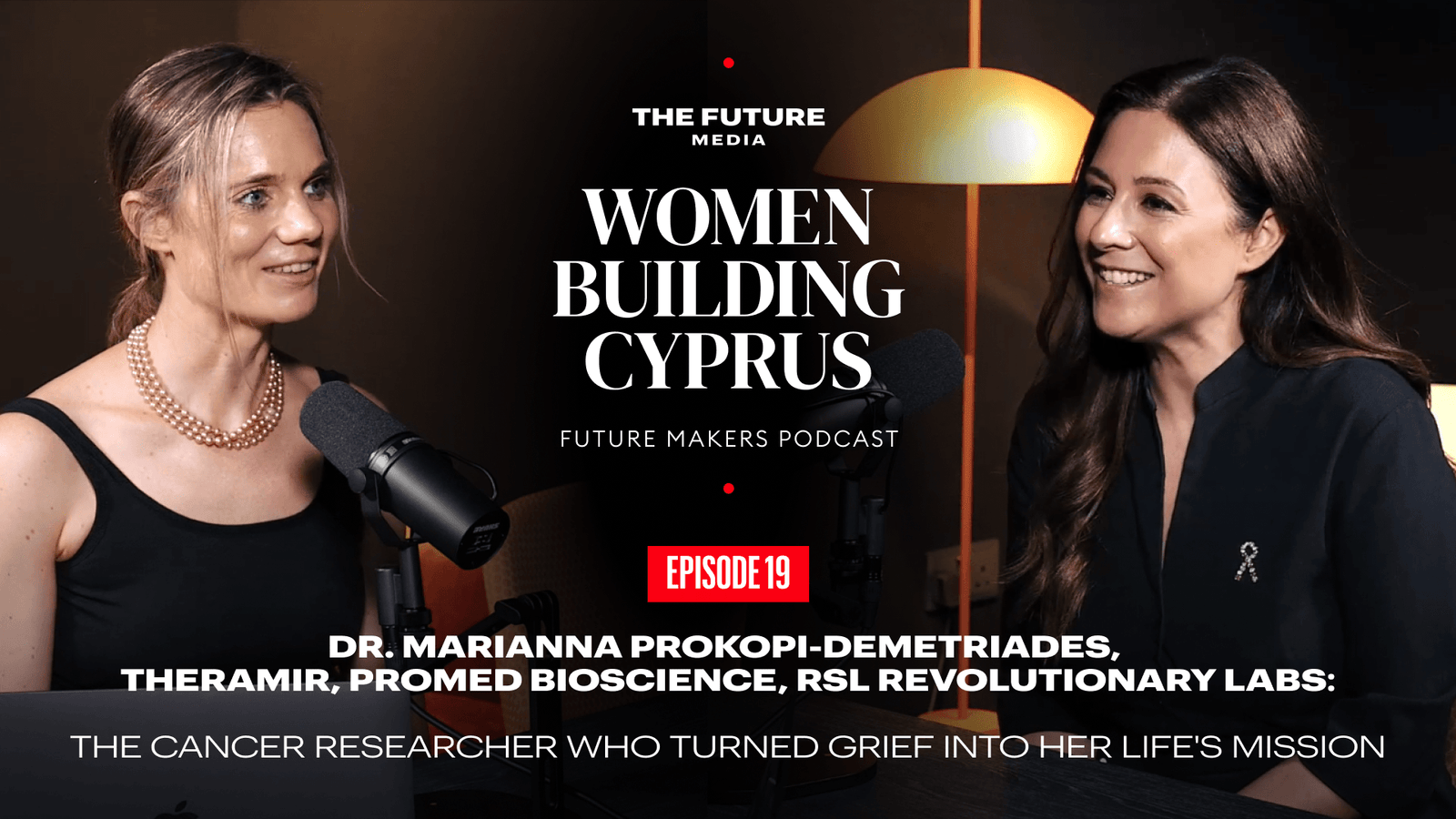
Dr. Marianna Prokopi-Demetriades is a guest on The Future Makers: Women Building Cyprus. The full episode, including her reflections on why she left the UK for Cyprus, what she believes the Cypriot biotech ecosystem still needs, and how she has built three companies out of the losses she has lived through, is available to watch now.
The Future Makers Podcast is a series of in-depth conversations about how future-makers are made, in Cyprus and beyond. Host Annetta Benzar sits down with people who are a leading force in our shared future and looks past the titles. Together, they travel back to the people and moments that shaped them, walk through the choices and challenges they are living through now, and look ahead to the futures they are trying to build.
The first season, Women Building Cyprus, follows women whose lives and decisions are changing what this island can be.
A production of The Future Media.