


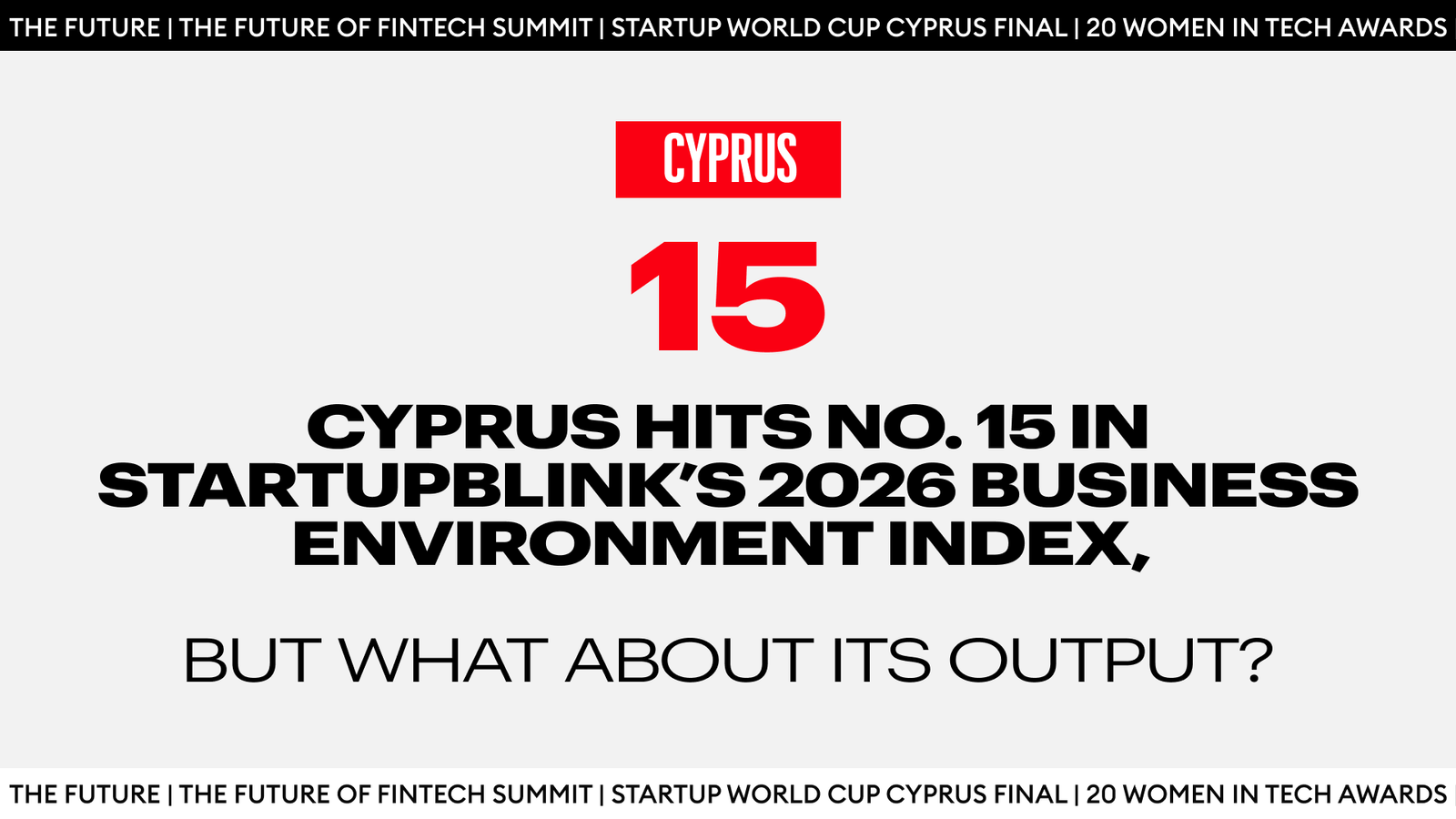
Cyprus has claimed 15th place globally, and 1st in Southern Europe, in StartupBlink’s 2026 Innovators Business Environment Index (IBEI), ranking ahead of major economies including Germany, France, and Spain. The result highlights the island as one of the world’s most competitive destinations for entrepreneurs and investors.
Cyprus now leads the European Union in taxation policy (10th worldwide), ranks 2nd in the EU for business incentives, and has built structural conditions that rival established innovation hubs. But can the island turn this structural advantage into a higher volume of (supported) startup activity?
Follow THE FUTURE on LinkedIn, Facebook, Instagram, X and Telegram
How Cyprus Compares
StartupBlink’s 2026 Innovators Business Environment Index (IBEI) places Cyprus 15th globally and 1st in Southern Europe, ahead of nearby competitors such as Greece (33rd) and Malta (49th).
In the wider European context, the executive summary highlights how Cyprus holds a top-tier position within the European Union, behind the United Kingdom, which ranks 3rd globally, and the Netherlands, 7th. The United States (1st), Singapore (2nd), and the United Kingdom (3rd) lead the index overall. But StartupBlink states that Cyprus “offers more competitive taxation conditions than all three.”
Cyprus doesn’t just lead Southern Europe. It significantly outperforms its Mediterranean neighbors. Greece ranks 33rd globally in the IBEI, while Malta ranks 49th.
Against the world’s top-tier innovation economies, Cyprus holds its ground on specific metrics. While the United States (1st globally), Singapore (2nd), and the United Kingdom (3rd) lead overall, Cyprus offers more competitive taxation conditions than all three.
President Nikos Christodoulides described the result as a validation of national ambition. “Cyprus is proving that size is no barrier to ambition… our startup ecosystem is showing continuous positive momentum, with both the country and all its cities rising.”
That growth on the city level is unusual. Cyprus is the only country with a population under 2 million to have four cities ranked in the global top 1,000. Limassol rests at 230th globally (up 9 spots from 2025), Nicosia at 346th (up 3 spots), while Larnaca and Paphos both showed improvement in the same period.
The Lens-by-lens Comparison
- Business Incentives. Cyprus’s strongest lens is incentives. It ranks 6th globally with a score of 78.000, and 2nd in the EU in this pillar, narrowly behind Bulgaria, which leads the EU on incentives and ranks 5th globally in that pillar.
- Ease of Operating a Business. Cyprus ranks 35th globally (score 77.217). The executive summary explicitly benchmarks Cyprus against operational leaders, such as Estonia (10th) and Finland (19th). Finland leads the EU. It also trails global category leaders such as the United States (1st) and Japan (2nd).
- Market Perception. This is Cyprus’s weakest of the three lenses. Cyprus ranks 39th globally (score 64.354). Improving this score to match the category leaders, such as Singapore (1st) and Denmark (2nd), remains a challenge.
Leading the EU on Taxation
Cyprus’s most decisive advantage is its corporate tax structure. The island ranks 1st in the EU for taxation, ahead of Luxembourg (2nd in Western Europe) and the Netherlands (14th in the category), and 10th globally.
That result is supported by perfect scores in capital gains tax rate and dividend tax rate, both clocking in at 100.000 in the IBEI’s micro-category assessments.
According to the report, Cyprus’s “corporate tax structure is one of the most competitive within the EU. It provides businesses with distinct long-term clarity.”
Cyprus also ranks 2nd in the EU for business incentives overall, with a score of 78.000, trailing only Bulgaria (which leads the EU and ranks 5th globally in this pillar).
The non-domiciled residency system has become a core draw for globally mobile founders and investors with international income streams. Combined with the Cyprus Startup Visa, which allows non-EU entrepreneurs the right to build high-potential ventures on the island, the country has created a fiscal and legal framework designed explicitly for founder mobility.
Talent, Migration, and Industry Strength
A strong tax-and-incentives package sets the foundation for business. Talent, however, is what turns those conditions into startup growth.
The Cypriot ecosystem has been remodeled by an influx of IT professionals from Russia and Ukraine, drawn to Cyprus for stability during the war. Cyprus already had one of the EU’s highest numbers of graduates per capita. The migration wave has diversified the alumni collective.
International companies have taken notice. NCR, Viber, Logicom, Semrush, and Amdocs have all established operations or corporate bases on the island.
Cyprus has also achieved sectoral leads. In 2025, the country ranked 2nd globally in gaming (1st in Europe) and 15th globally in social and leisure. The University of Nicosia was the first university in the world to offer a Master’s degree in digital currency, reinforcing the island’s early leadership in blockchain and fintech.
Long known as a tourist destination, Cyprus is now rapidly transforming into a hub of innovation and entrepreneurship. Positioned as a regional hub for research, innovation, and technology, Cyprus is a gateway to Europe while offering access to high-growth markets in the Middle East and beyond.
The Challenge Ahead
Cyprus’s 2026 IBEI ranking reflects an environment built for scale. The primary challenge for 2027 will be closing the gap between that 15th-place infrastructure and the 40th-place startup performance. In other words, turning favorable conditions into actual output.
In recent years, Cyprus has experienced a significant economic transformation. This change has transformed its image and established it as one of the more appealing business hubs in the area.
For founders, investors, and multinational companies evaluating where to build next, Cyprus is increasingly becoming the first choice. It’s a destination with infrastructure to match its ambition.