
Nadia Kapleva is the Medical Director of Lóvi, a skincare app building a methodology to make personalised, science-based skincare accessible to anyone, anywhere. But a medical director is far from where little Nadia ever imagined her life. Indeed, her career began heading in a very different direction.
But the thread that runs through all of her life, she says, is a single idea she was gifted in her early years and has kept close to her heart. “Everything is possible.”
Follow THE FUTURE on LinkedIn, Facebook, Instagram, X and Telegram
It came from her teachers, who taught her that no matter what was happening around them, they could succeed in whatever aspect of life they chose. “Even for now, it’s one of the main ideas that moves me,” she says. “That I can move mountains if it’s required for the goal.”
She puts down the nurturing of this belief to two disciplines: swimming and theatre. Twelve years of swimming built self-organisation and the ability to push through difficult moments. Theatre lessons gave her the tools for public conversation. Both have been instrumental in her life, both personal and professional.
Nadia’s first job was at PwC in St. Petersburg, in the business process optimisation department. She was young enough that company rules prevented her from being formally promoted above intern grade until she received her diploma, but she was already leading projects and managing team members from very early on. The lessons she drew from her years in the company have remained important lessons for her.
“If you can take the responsibility, you will get the power to make decisions.”
She also learnt, the hard way, that carrying everything herself was unsustainable. She was working around the clock, not seeing her family and with no time for herself.
That wasn’t the sole reason for her decision to move out of her advisory role into cosmetic chemistry and aesthetic medicine. She wanted to bring more direct value to people, to create something material. A tangible impact on their life, rather than cursory, sometimes brushed-off suggestions. She spent five years studying, gaining a degree in chemistry and a degree in aesthetic medicine, and built a career that by the time Lóvi found her included running a manufacturing company for injectable and professional cosmetics and an online academy educating cosmetologists in cosmetic chemistry.
Lóvi approached her in 2021. She describes what they were attempting then as almost like climbing Everest. Nobody was talking about AI in the way they are now, and what they wanted to do with cosmetic chemistry and ingredient analysis was, in her words, “impossible to imagine at that time.” After a year, she became the Medical Director at the company. The role meant more to her than any other job. “It was more than just earning money but an opportunity to change the world in some kind of way and to contribute to science with real impact.”
What Lóvi is building, she explains, is a methodology that didn’t previously exist. The skincare industry is driven by marketing, claims are written to sell rather than to inform, and even AI tools struggle to give reliable advice because the underlying data is full of contradictions. Lóvi takes a different approach to platforming choices by not affiliating with brands. It recommends skincare routines based on skin type, condition, issues, and goals, and crucially, based on what the person actually wants to address, not what an algorithm decides their problem is. “There is no good or bad cosmetics,” she says. “There are products that fit some skin profiles and products that don’t fit.”
Nadia is based in Cyprus, a fact that still surprises people at international conferences. At a major event in Dubai, when she told delegates where she was working from, they were visibly taken aback. She found that energising rather than deflating.
“I want to change people’s thinking about obstacles and borders. Cyprus helped me to realise that the world is quite small. It doesn’t matter where you live. You can still change the world.”
Her advice to young women thinking about their futures is the same principle that has guided everything she has done. Choose what you are passionate about, ask whether it brings value to others as well as to yourself, and then stand for it. “There will be obstacles. Something will always happen that will require you to ask yourself again and again: Are you still interested? Does this still bring value? And if the answer is yes, stand for it. You will receive the results. Maybe not today, maybe not next year. But some day, it will.”
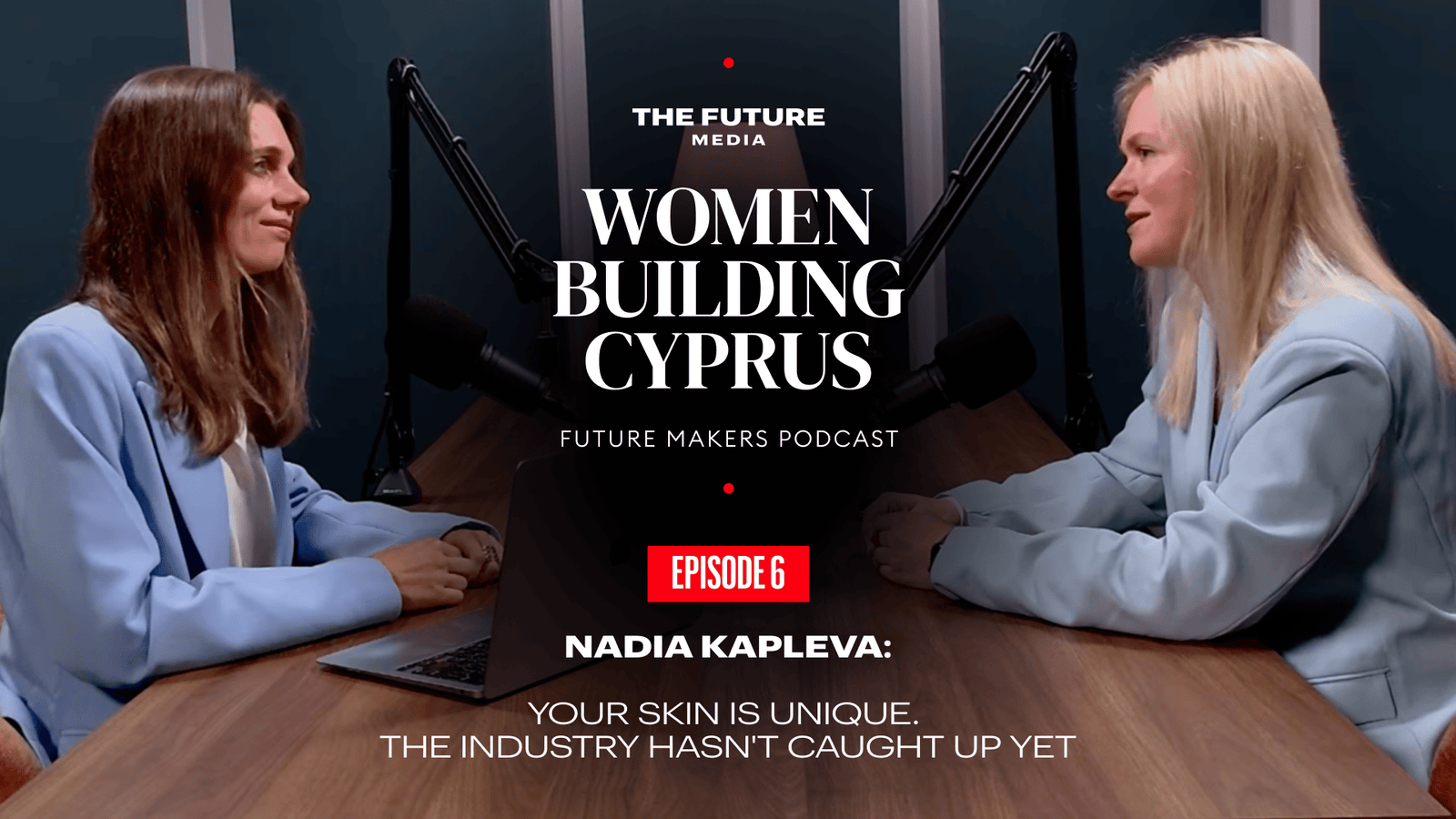
Dr Nadia Kapleva is a guest on The Future Makers: Women Building Cyprus. The full episode, including her reflections on building Lóvi from Cyprus, why most skincare claims don’t hold up to science, and what it takes to present at the world’s biggest aesthetic medicine congress, is available to watch now.
The Future Makers Podcast is a series of in-depth conversations about how future-makers are made, in Cyprus and beyond. Host Annetta Benzar sits down with people who are a leading force in our shared future and looks past the titles. Together, they travel back to the people and moments that shaped them, walk through the choices and challenges they are living through now, and look ahead to the futures they are trying to build.
The first season, Women Building Cyprus, follows women whose lives and decisions are changing what this island can be.
A production of The Future Media.