



StartupBlink’s Innovators Business Environment Index 2026 evaluates how easily innovators can start and operate businesses across 125 countries. The index looks at the rules, policies, and institutions that shape business conduciveness before the first company is registered.
This differs from StartupBlink’s Global Startup Ecosystem Index, which tracks actual startup output and performance. StartupBlink puts forward the IBEI as a tool for founders and ecosystem builders to compare ecosystems, in other words, a ranking of how easy it is to get started and operate based on existing data.
Follow THE FUTURE on LinkedIn, Facebook, Instagram, X and Telegram
Policymakers use it as a diagnostic instrument. Investors treat it as a risk assessment. Founders use it to identify the lowest barriers for entry and institutional support for growth.
The Global Top 20: Institutional Depth and the Taxation Paradox
The United States ranks first globally, followed by Singapore and the United Kingdom. There are a few trends that are consistent across the top 20 performers.
Sixteen of the top 20 countries show strong results in Regulation & Governance. Institutional stability and clear procedural protocols are nearly universal traits among leaders.
Seventeen of the top 20 demonstrate strong Access to Capital & Financial Infrastructure. The US, Singapore, and the UK lead in credit systems and investment channels.
When it comes to taxation, however, this is where the trend wavers. Seventeen of the top 20 countries perform weakly in this category. This is what the report calls the “taxation paradox,” where even among the world’s best overall business environments, taxation is usually not a strength. The exceptions are the UAE, which ranks second globally for taxation, and Saudi Arabia, which ranks sixth. Both are also global leaders in overall business conduciveness.
This suggests that top-tier business environments prioritise access to capital, legal stability, and infrastructure over low tax rates.
This makes smaller economies with promising tax scores interesting cases and worth considering. For instance, Estonia ranks 10th globally, and New Zealand ranks 11th. Luxembourg ranks 13th. In these cases, market size does not directly determine success. Instead, these nations offer highly streamlined and reliable conditions for innovators.
Countries also show distinct strengths across the index’s functional categories. Nordic nations dominate Digital Infrastructure, with Iceland, Norway, and Denmark forming the global top three. Portugal, Croatia, and Slovenia lead in Global Mobility & Openness. New Zealand ranks first worldwide for ease of starting a business.
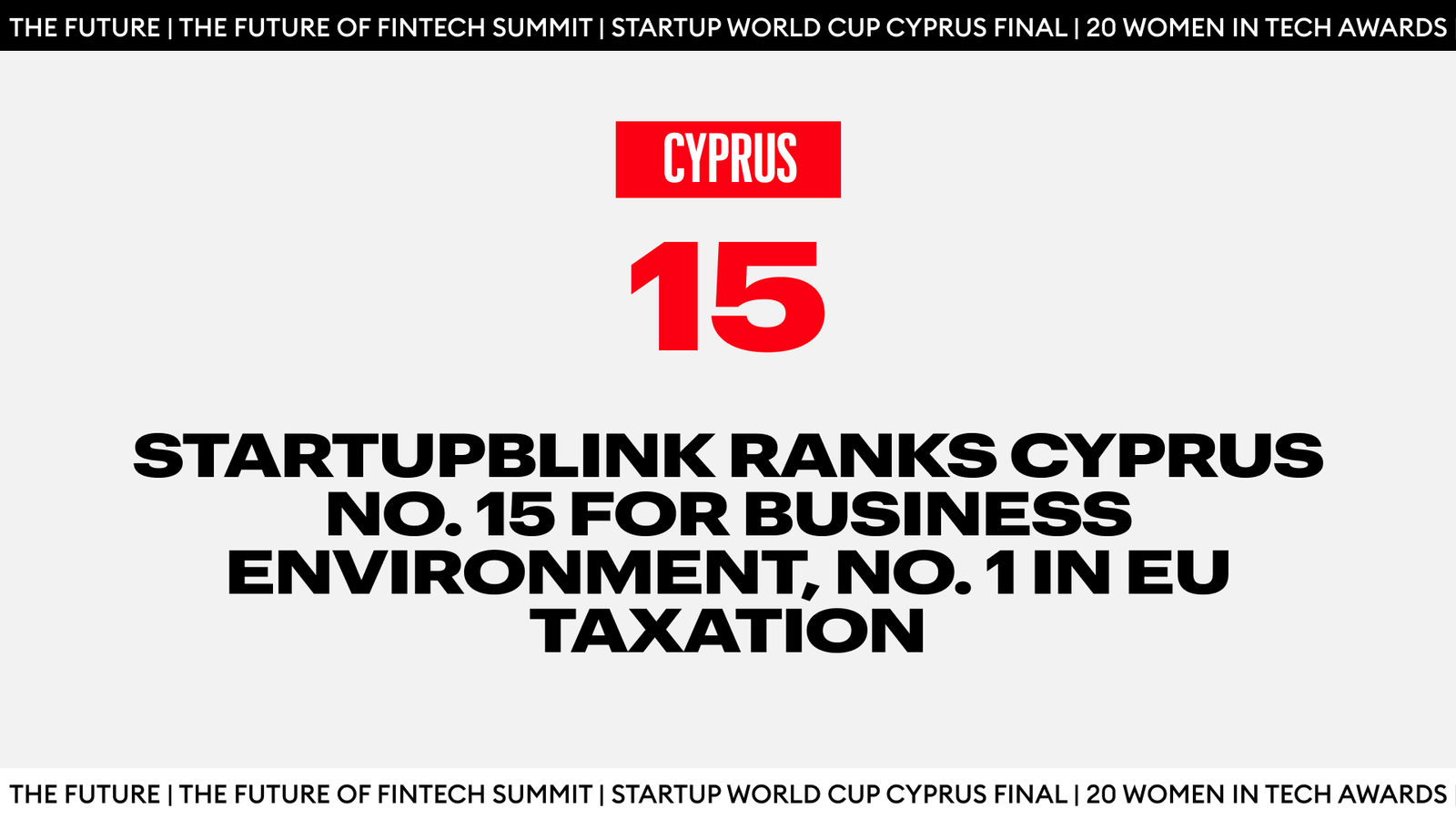
Cyprus: 15th Globally, 1st in Southern Europe
Cyprus ranks 15th globally with a score of 74.630. It is the highest-rated business environment in Southern Europe.
The island outperforms major innovation hubs, such as Belgium, which ranks 16th, Australia, which ranks 17th, and Finland, which ranks 19th. Within the Mediterranean, Cyprus also holds a lead. Greece ranks 33rd, and Malta ranks 49th.
If compared to the Middle East, Cyprus would rank third in the region, behind the UAE and Saudi Arabia but ahead of Israel (24th) and Bahrain (44th).
Cyprus achieves its standing through varying performance across the index’s three core pillars.
Cyprus’s strongest pillar is the Business Incentives. It ranks 6th globally with a score of 78.000 (and 2nd in the EU). This pillar measures financial attractiveness, taxation, and access to funding.
Next, Cyprus ranks 35th globally in Ease of Operating a Business, with a score of 77.217. This measures procedural costs and operational friction.
In its Market Perception pillar, the island ranks 39th globally with a score of 64.354. This is Cyprus’s lowest-ranking pillar, reflecting global views on governance, human capital, and international mobility.
The EU Taxation Leader
Cyprus leads the European Union in taxation. It ranks first in the EU and 10th globally in this functional category. Among Western European countries, it holds the top position for tax conditions.
In regards to the Capital Gains Tax Rate, Cyprus scores a perfect 100.000, compared to a world average of 63.962. Its Dividend Tax Rate also scores a perfect 100.000, against a world average of 74.591, and its Corporate Tax Rate scores 66.700, against a world average of 39.524.
The report also highlights the nation’s non-domiciled system as a key resource. Eligible residents can avoid specific taxes on dividends and interest, making Cyprus highly attractive for mobile innovators.
Another element that is discussed in the report is Cyprus’s Startup Visa Program, which provides a residency route for non-EU and non-EEA entrepreneurs to establish technology-focused businesses. The Research & Innovation Foundation manages initiatives that encourage scientific and commercial endeavors, and Invest Cyprus serves as the primary contact for international growth support.
The report describes Cyprus as a business environment “characterised by legal transparency, global accessibility, and strategies that assist entrepreneurs working internationally.” Its geographic location and historical role as a trade hub create an attractive base for founders engaged in international activities.
Untapped Potential
One data point stands out and is worth noting. Cyprus ranks higher in the IBEI (15th) than in the Global Startup Ecosystem Index 2025. The underlying business conditions are stronger than the current startup output.
This gap suggests a possible untapped potential. Evidently, the environment for growth is developing, and the fiscal structure is favourable. The institutional frameworks are also promising. What’s missing is the output that those conditions should enable.
The IBEI framework distinguishes between friction and performance. Cyprus has built the runway. Whether the ecosystem takes off depends on how well founders, investors, and policymakers leverage what’s already there.
What the Index Measures
The IBEI evaluates business environments through three pillars.
Ease of Operating a Business measures how simple, fast, and operationally frictionless it is to start, run, and maintain a business. Market Perception evaluates how a country is viewed globally in terms of governance quality, credibility, transparency, stability, human capital, and international mobility. Business Incentives captures fiscal and financial attractiveness for entrepreneurs and investors.
The pillars break down into five functional categories. Regulation & Governance covers the legal, regulatory, and procedural environment. Access to Capital & Financial Infrastructure looks at funding availability, lending and credit access, and cross-border banking. Taxation measures corporate tax rate, capital gains tax, dividend tax, and top personal income tax. Digital Infrastructure evaluates internet freedom and internet speed. Global Mobility & Openness examines English proficiency, cost of living, trade openness, and passport power.
The index also applies Rewards and Penalties. Rewards add bonus points, where enabling conditions reduce barriers for innovators. Penalties account for additional obstacles such as long registration times or restrictive currency rules. These adjustments affect only total scores, not individual pillars or functional categories.