
You’ve just landed after a long flight. You stumble into your hotel, drained from a day of travel and crowds, ready to pick up your key, have the world’s hottest shower and collapse for the night. Instead, you find yourself standing in a check-in line behind five other equally cranky and exhausted-looking people while one person at the desk is having a few issues processing one guest’s credit card, while simultaneously explaining breakfast hours. You release a groan. It’s going to be an hour at least before you can finally get to your room.
This is how most hotels still operate. Many property management systems remain on-premises software rather than cloud-based solutions. Basic guest requests still require heavy manual intervention. Physical front desks and in-room phones handle tasks that could be automated.
Follow THE FUTURE on LinkedIn, Facebook, Instagram, X and Telegram
According to a report by McKinsey titled “The future of tourism: Bridging the labor gap, enhancing customer experience,” only 11% of hotels worldwide used a guest app. A mere 3% offered keyless entry. The low market penetration of guest-facing technology represents approximately $2.4 billion in untapped revenue potential.
Automated self-check-in kiosks, such as those used by the Huazhu Group in China, can complete a process that, at best, takes 20 minutes and, at worst, hours, depending on the number of guests waiting, and can take under 30 seconds. Due to the high reliance on human labor for routine tasks, 70% of hotels have been forced to reduce or eliminate amenities and services in response to staffing shortfalls.
McKinsey estimates the industry could manage a structural labor shortage of 10% to 15% in the long run by increasing digital and automated efficiency. There is potential there. Millennials and Gen Z prefer the frictionless experience of instantaneous, tech-driven service over traditional face-to-face interactions. Automating transactional tasks frees staff to provide more authentic human interaction during high-value moments, like the sommelier at dinner, not the clerk processing payment.
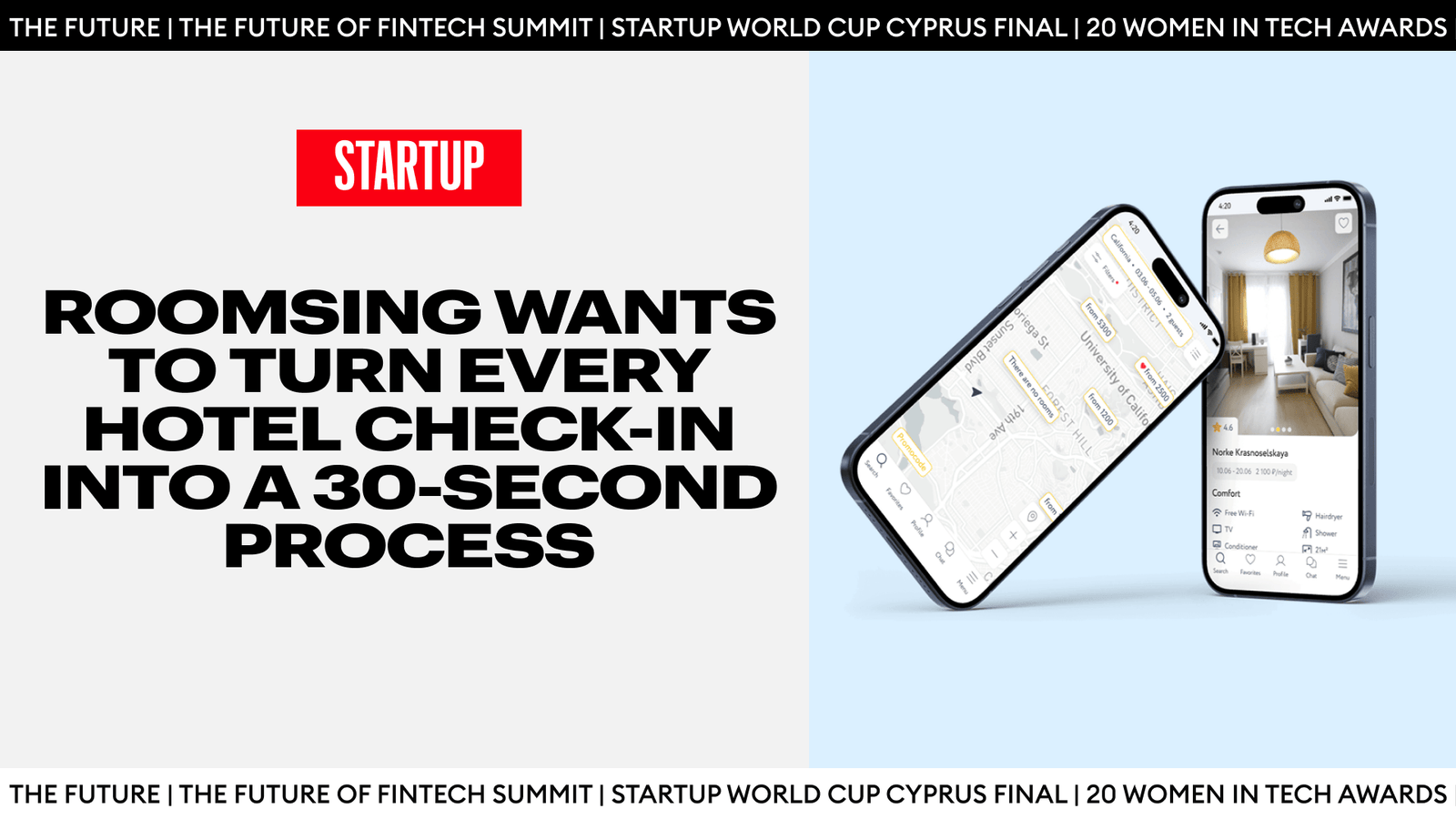
Roomsing is an online check-in and AI-powered guest communication system built by hoteliers for hoteliers. The Cyprus-based company operates as a SaaS B2B2C solution, combining software and hardware to eliminate queues at large hotels, remove reception desks entirely at smaller properties, and replace unsafe key handover practices at short-term rentals. The platform integrates with property management systems and booking platforms, enabling guests to check in using their smartphones and access properties via digital keys or personal codes.
In this interview with The Future Media, Roomsing’s founders, who preferred to remain anonymous, explain how they built the system from their experience running 15 smart hotels, why automation doesn’t mean eliminating human touch, and what success looks like when you’re building a global hospitality technology company from Cyprus.
1. For readers meeting you for the first time, can you introduce yourselves and what you were doing before Roomsing?
Right after university, I started working in international four- and five-star hotel chains. First, I was a waiter, and over time I moved into front-desk operations, working as an administrator and later as a night manager. That’s where I gained a firsthand understanding of how hospitality really works under pressure.
The front desk is where everything converges: queues, guest frustration, constant multitasking, and an overwhelming number of manual processes. Even at that early stage, I could see that many of the tasks could easily be automated, but there was little to nothing available in the market to do so.
Later on, I transitioned into a revenue director role, which gave me a strategic and financial perspective. That gave me an insider view of how operational inefficiencies directly impacted profitability through high payroll costs, staff turnover, lost revenue opportunities, and even internal risks.
At that point, I understood both the problem and the scale of the opportunity. Together with my partners, we built a hotel group of 15 smart hotels and a technology-driven management company. These properties became our real-world testing ground, where every decision had direct financial consequences.
Eventually, we productised the entire internal ecosystem we had developed, and that’s how Roomsing was born.
As we say, we are hoteliers building for hoteliers.
2. What is Roomsing, and who is it built for?
Roomsing is an online check-in and AI-powered guest communication system designed for hotels, apartments, and all types of rental properties. It operates as a SaaS B2B2C solution, serving as the “last mile” between booking and the actual guest experience.
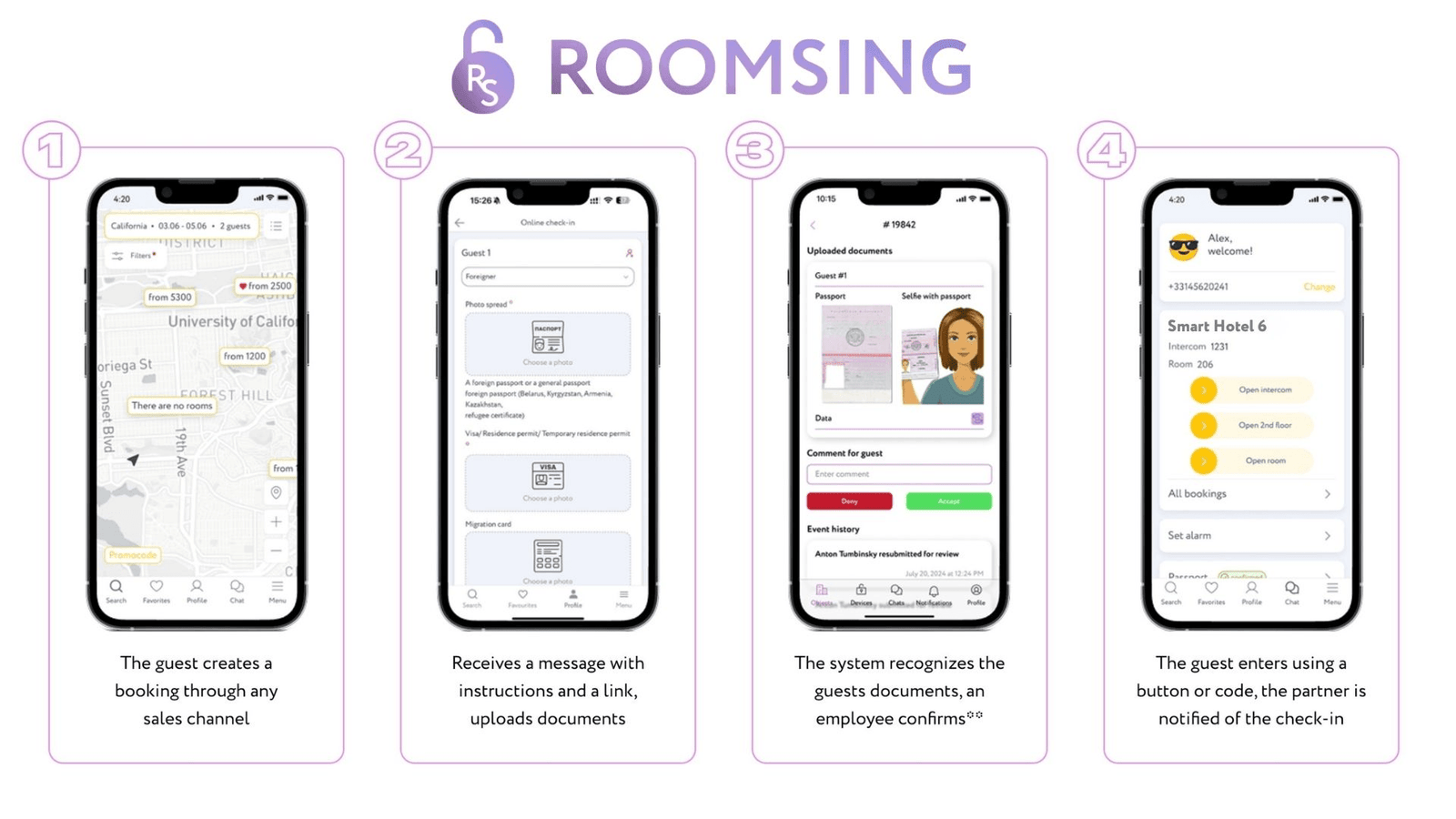
The system combines software and hardware into one seamless workflow. On the hardware side, we provide smart locks as well as a proprietary plug-and-play chip that upgrades existing hotel locks, making them remotely controllable without requiring full replacement.
On the software side, Roomsing integrates with PMS and CRM systems, as well as Booking.com and Airbnb, automating guest access and communication.
Our platform mirrors broader consumer behavior. We no longer hail taxis from the curb but use apps. We check in for flights online to save time and avoid unnecessary queues. Hospitality is undergoing the same transformation.
Our goal is to enable guests to check in quickly and seamlessly using their smartphones. We believe that in the near future, physical keys will disappear entirely. Everything will be digital.
For large hotels, we eliminate queues. For smaller properties, we remove the need for a reception desk altogether. For apartment owners, we replace unsafe and outdated key handover practices.
3. What problem were you seeing in the market that made you decide to build this?
On the operations side, hotels struggle with long queues, inefficient manual processes, and inefficient and ineffective guest communication. These issues directly impact guest satisfaction and reviews.
On the industry front, we are seeing high staff turnover, rising labor costs, and a heavy reliance on human involvement in routine tasks.
In the short-term rental segment, manual key handovers are still a common practice, which takes up unnecessary time and creates security risks.
Even premium hotels rely on outdated practices. For example, magnetic key cards fail frequently, forcing guests to return to reception and wait to get the key replaced or rechecked. That causes friction in the check-in service.
Our mission is to eliminate routine through automation and create a seamless, digital guest journey.
4. Walk us through how Roomsing works from the user’s point of view.
From the guest’s perspective, the experience is designed to be intuitive and frictionless.
A guest first books a stay through any channel of their choice, whether it’s a hotel website, Booking.com, or Airbnb. They then receive a message via their preferred messenger with booking details and a link to complete online check-in.
The process is similar to an airline check-in: upload documents, confirm details, and complete registration. It only takes a matter of a few minutes to complete.
Then the guest receives access to the property for their preferred dates, either via a personal code or a digital key within their account.
And they are ready. No queues. No waiting. No paperwork.
At the same time, operators maintain full visibility of their property. The system tracks check-in and check-out activity, while an integrated chat enables direct communication with the guest.
5. What makes Roomsing different from the obvious alternatives or competitors?
While there are other solutions on the market, Roomsing differentiates itself through both its technology and positioning. First, our proprietary plug-and-play chip allows existing hotel locks to become smart without requiring costly replacements. This significantly lowers adoption barriers.
Second, we operate across both hotels and short-term rentals. Our clients range from individual hosts and boutique properties to large management companies.
Third, we focus on forward-looking innovation. For example, we are developing AI-powered receptionist avatars that can handle guest communication autonomously.
But perhaps the most important difference is our origin. We are not just building software. We are experienced operators who have tested every feature in real hospitality environments.
6. How are you thinking about trust and quality control on the system?
Trust and security are fundamental to our system. We have developed anti-fraud algorithms that protect both operators and guests, reducing risks such as unauthorized access and internal misuse.
We do this through two-factor authentication aligned with OAuth 2.0 standards to ensure secure user verification.
Importantly, we follow a strict data minimization approach. Guest data is not stored longer than necessary. After verification, it is removed from our side and remains only within the partner’s PMS or CRM.
For us, technology should enhance both convenience and security, without compromising the safety of our users.
7. What has been the hardest part of building and launching so far?
Building the right team has been one of the most challenging aspects.
We needed people who are not only highly skilled but also aligned with a long-term vision. They needed to be capable of building a company that could reshape an entire industry.
From a technical standpoint, the product required deep expertise in both software and hardware. We had to bring in engineers specializing in microelectronics and secure systems for smart locks, an area where talent is, unfortunately, limited.
8. What has surprised you most since you started speaking to users or customers?
The most surprising and encouraging insight was the overwhelmingly positive response from guests.
Initially, we ourselves had our doubts about whether guests would be open to automation over human interaction. In reality, the opposite proved true. What we learned was that guests value speed and reliability more than unnecessary interaction. We saw higher satisfaction levels and better reviews.
This matches the overall trends in the sharing economy, where users are already accustomed to digital, self-service interactions. That insight became a defining moment for our product strategy.
We also observed that properties operating without traditional reception desks often achieve better financial performance, reducing costs while increasing efficiency. Guests value privacy and convenience more than excessive service.
After onboarding our first 50 partners, we began receiving organic referrals and continuous feedback. Many partners actively contribute ideas for product improvement, which has become a powerful growth driver.
Ultimately, the most rewarding part is seeing the real impact on businesses. That value goes beyond revenue.
9. Why build this in Cyprus? What has the local ecosystem helped with, and what has been a constraint?
Cyprus offered a strategic combination of advantages. It is a promising market for travel and hospitality innovation, with a strong international entrepreneurial community that encourages collaboration and growth.
There are also some important business benefits, including favorable tax conditions for IT companies, a supportive regulatory environment, and access to international investment.
Of course, there are challenges, particularly in sourcing highly specialized talent in areas like IoT. However, the overall ecosystem provides a strong foundation for building a global company.
10. What does success look like for Roomsing?
Success for us means becoming a global leader in travel technology, a company that fundamentally redefines the hospitality experience.
That means reaching unicorn status and scaling to over one million partners worldwide.
Beyond metrics, success is about setting a new standard. We envision a world where check-in is instant, access is seamless, and the entire guest journey is fully digital, intuitive, and frictionless.