
“I have been called a pessimist, Maria Ioannou says near the end of the conversation, “but I think there’s a lot of optimism in pessimism.” She stops a moment before adding: “When you’re grounded in realism, you can see the glimpses of the skyline even when the day is dark.” Those words have carried her through those rainy days of her life, and, in expectation of that brighter blue, Maria has remained clear-eyed about what is in front of her and always looking for what can be learned from it.
Maria Ioannou is the Portfolio and Investor Relations Manager at Kinisis Ventures, where she works closely with early-stage technology companies and international investors, supporting founders as they scale beyond Cyprus.
Follow THE FUTURE on LinkedIn, Facebook, Instagram, X and Telegram
She grew up, she says, as a “why” child. It was never about how things worked mechanically but about the people doing the work. She would follow her dad, her uncle, her grandfather like a tail whenever they were fixing something in the house, rattling off question after question: Why are you doing it that way? Why do you “have” to do it? Why does that person do it that way, and you in this way?
“I never really felt like I quite fit in. By trying to understand how others operated, I was trying to see whether this is what I would feel more comfortable doing, or maybe this is who I could be,”
she says.
That search for belonging through understanding other people is what eventually led her into communications, then to sales, and eventually into the field she finds herself in now: venture capital.
She grew up in Cyprus with the freedom to try almost anything, but little exposure to possibilities beyond the obvious paths. Accountant. Lawyer. Doctor. None of them, however, felt right for her. “I never heard somebody say, for example, ‘I’m going to go and create a company,’ or ‘I’m going to work for myself,” she says. “I never heard that growing up, so it never even occurred to me that it could be a possibility for me.” At seventeen and a half, when she was finally asked what she was going to do with her life post-school, her response was nothing less than practical: she was smart, but she was lazy, so she would do what came easily. She chose English Language and Linguistics, partly because the family ran private language institutes, partly because it sounded “safe” to her. Three months into her degree, she shocked her mother with an announcement over the phone: she did not want to be a teacher. Her mother had watched her daughter try something and change her mind before, but it still landed as a blow, especially as she had already planned out her daughter’s career. But the degree was not a total waste for Maria.
“Mastering the language allowed me to better break down more complex situations in a way that other people would understand them,”
she says.
It is, she believes, one of her strongest skills.
Her first job was in sales at a small B2B company, and her first boss became her first mentor, a man who was very confident himself and encouraged that same confidence in her from that first day. “Regardless if you’re young and regardless if you’re a girl, you can actually get people to want to talk to you,” he told her, “because you have whatever product they want at the best price.” Maria wore that confidence into the first day of her second job, a much larger organisation. But there was another lesson to be learned at this office desk. “People bring their own emotions, insecurities, and problems to work,” she says. “Not everybody goes to work and works on the same team as an adult.” The cost was billed to her ego and confidence. She learnt that not everyone, even if they are on the same team, wants to see the people around them grow. Some of them, she found, are more than happy to watch you fall.
It’s taken some time for Maria to understand her relationship with failure, and she could only do so through these lessons in and out of her nine-to-five.
“Failure is staying in an environment that does not appreciate you and makes you feel like you are not good enough,”
she says.
“Staying too long in a place that dimmed my light, or that wanted to instil in me that you’re not really going to go anywhere — that was my biggest failure.” She kept thinking she could change it. If she worked a little harder, bit her tongue a little longer, tried to be kind to everyone despite what they threw at her, then they would finally see that she was good at what she did. “No,” she says, “Learn to listen to when to stop learning, stop being interested, and when you have nothing left to give.”
The move into venture capital was, she is the first to admit, mostly luck. She happened to meet someone who had invested in companies that were looking for people to join their team. One thing led to another, and she moved from B2B sales to academia to startups to the investor side.
“I will never stop saying this to founders and entrepreneurs. We discount how much luck plays a factor,”
she says.
She gives herself credit for the courage to move from sector to sector and for doing everything in her power to adapt and re-educate herself. The rest, she says, was timing and the right person at the right moment.
Not that it didn’t take courage and a whole lot of re-education. She remembers one particular meeting in her new role at the venture capital firm. She walked into a room and immediately thought she must have been mistaken. It was full of men. “Is this like a men’s only event, I thought?” It was not. It was just the state of venture capital in Cyprus (and Europe). In fact, according to Level 20s 2024 European Gender Diversity Report, women make up only 28 to 30% of the VC workforce across Europe, and only 19% of senior investment roles. She is, more often than not, the only woman at the table. But she is grateful, however, that the men she works with do not treat her any differently from any other colleague.
She retells a conversation that she had recently. A colleague was talking about a woman in their network, someone brilliant, clearly capable, and whose instincts and expertise put her ahead of most people in the team. “Do you know that if she were a man, she would have already had the leadership title?” he said. Although the comment was not intended as criticism, her colleague had recognised in that woman something Maria had seen in herself time and time again. “We downplay ourselves,” Maria says. “It’s like we’re trying to shrink ourselves to fit in or be more palatable.” She has been asking herself why ever since.
Her message to younger women navigating their futures is the same thing she wishes someone had said to her earlier, before she spent too long in the spaces that didn’t let her light flourish.
“Don’t be afraid to try. Even if you fail, you’re failing forward. Whatever difficulty comes, because you are young, because you are a woman, because the environment is not set up for you, treat it as material.
Don’t let it get you stuck there. People don’t generally spend a lot of time thinking about other people. Just take whatever happens, learn from it, and keep moving,”
she says.
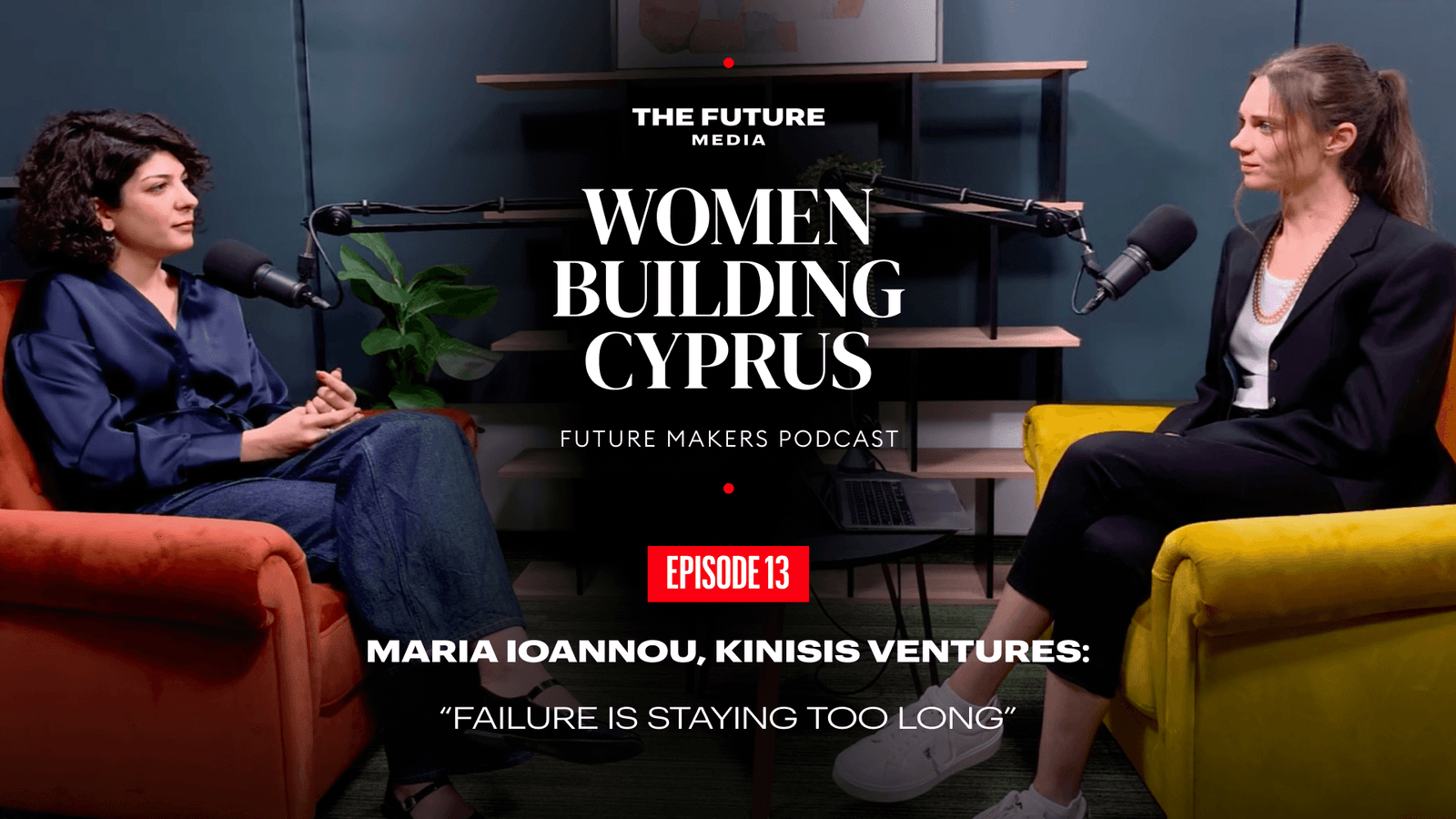
Maria Ioannou is a guest on The Future Makers: Women Building Cyprus. The full episode, including her thoughts on vulnerability in the founder relationship, why Cyprus founders need more flying hours, and what she has learned about the gap between how women see themselves and how others see them, is available to watch now.
The Future Makers Podcast is a series of in-depth conversations about how future-makers are made, in Cyprus and beyond. Host Annetta Benzar sits down with people who are a leading force in our shared future and looks past the titles. Together, they travel back to the people and moments that shaped them, walk through the choices and challenges they are living through now, and look ahead to the futures they are trying to build.
A production of The Future Media.