“Don’t do that, my child. You will go hungry.”
That is what Maria Evgeniou’s father told his seventeen-year-old daughter when she announced her decision to study History and Archaeology. She studied History and Archaeology at the University of Cyprus, anyway. Far from the stereotype of the hungry artist, she has built a career building the next generation of Cypriot startups from inside one of the island’s oldest-standing financial institutions, and it turns out the history degree had everything to do with how she got there.
Follow THE FUTURE on LinkedIn, Facebook, Instagram, X and Telegram
Maria Evgeniou is the Innovation and Entrepreneurship Officer at IDEAcy, the startup program of the Bank of Cyprus Innovation Centre, where she has been supporting founders since 2019. She coordinates the IDEA Startup Program across training design, startup evaluation, partnerships, content, legal agreements, and financial operations.
“My journey doesn’t really make sense,” Maria says with a bemused smile. From a History and Archaeology degree to a role as a Historical Research Associate at the Bank of Cyprus Cultural Centre, the Cultural Centre led to years in customer service at the bank branch, and the branch eventually led to supporting startups at the newly established innovation centre of the Bank of Cyprus, IDEAcy. The discipline of historical thinking, she argues, was never wasted and is what both guided and helped her adapt to each new role. It taught her to read systems. How did this come about? What were the consequences? How did change arrive? “I realised that it taught me to understand how people succeeded or failed, and cultures as well.”
Maria’s favourite illustration of this dates back four and a half thousand years ago. Around 4,500 years ago, Cypriots discovered how to smelt bronze and do it at scale. It was not an overnight success. “But it was so consequential that it actually gave the name to the island.” The name “Cyprus” is derived from the Greek word for copper, kypros.
“That’s what I want to achieve when helping startups today,” she says. “I’m hoping that some of them will succeed and bring about the change that we want. It’s not just the products. It’s the systems that are changing with these people, and they really believe in that.”
Maria grew up in a small town outside Nicosia, the eldest daughter and the first grandchild on both sides of a large, traditional family. Maria’s mother had lost her home in the 1974 invasion and was forced to rebuild her life from nothing. Her father left for work at 6:30 every morning and came home at nine in the evening, changing companies only three times in his entire career, and only when those companies failed or changed course. Her mother, working from home while raising children, tried a couple of ventures of her own but never fully got there because the resources weren’t available. But it didn’t deter her from trying again and again. “It was that role model,” Maria says, “that I think set me on this path to try to make something of myself.” The determination to push through whatever hardship life throws at her. To try and to try again.
Thinking back to her childhood, Maria acknowledges the social script of the culture when it came to the role of women and womanhood.
“There was that quiet understanding that most young Cypriot girls have,” she says, “that you are supposed to grow up, do well educationally, do well professionally, set up a home and manage everything as best as you can, but quietly, without showing any stress or causing issues.”
It was something she’s been reflecting on since she left her home, and continues to do that today. She has always been the kind of person who could not stay in a box. “I never wait to be told that I need to do something,” she says. “If I see something that needs to be done, I’ll do my research and then set myself into action mode to get everything done.” She may not have had a business degree, but one thing she was certain of: transferring to the innovation centre when the chance came made complete sense and was exactly where she needed to be.
What she found there, and what she has spent five years building around her, is a community of people willing to take risks.
“I am in complete awe of people who are willing to give up a safe job and go after a big idea,”
she says.
Her respect extends to those for whom IDEAcy is not built. “There are a lot of people, especially in academia, who have fantastic ideas but they’re not willing to bring them to life,” she says. “Or if they bring them sort of to life and they do an MVP or a simple prototype, they’re not willing to commercialise it because they’re not willing to give up the safe organisation that they’re in.” The people she works with are the ones prepared to put in the work. No job too small.
Maria describes herself as a bit of an introvert, though you would not know it.
“When it comes to founders and IDEAcy, I will always go out of my way to help. And to ask for help.”
She believes the benefit flows in both directions, that the mentor, the large organisation, the well-connected person who opens a door, they gain too. The IDEAcy community now counts 55 graduated startups, and even those that are no longer active stay in touch. Because at the end of the day, it’s about the people. The community.
She is a single mother of two boys, and she speaks about that reality without deflection or euphemisms. Her boys need to see that their mother is dedicated to them and loves them, but also that she has a life outside the identity of being their mother. “It’s very healthy for them to know that,” she says, “and that I am sometimes unavailable because of that.” But it doesn’t mean the “mother’s guilt” of being away from her boys goes away. “I don’t think you ever get over the guilt. But I think that guilt is probably what tells you that you’re a good mother, because you feel like you should be doing more.”
She does not stay quiet about the divorce either. Coming from a traditional family, the expectation was to stay and figure it out. The decision to leave was difficult and took time. What came after surprised her. She is, she says, in complete awe of her ex-husband. “We co-parent amazingly together. He loves to spend time with the kids, and he still cheers me on with my job because he knows the long hours that I’m putting in, and he tries to lift me up in front of the eyes of our kids. I love that.” The question she kept returning to, through all of it, was simpler than any of the noise around it. “What am I saying to my kids?”
Cyprus needs reform, Maria says, and it needs to begin with the education system. Schools produce workers, not thinkers. Standardised tests have pushed creative thinking and leadership skills out of classrooms, and the teachers who want to do more are doing it outside their contracted hours, out of love rather than policy. “So we need a reform that allows these teachers to be able to help more.” To get that reform requires political will, which in turn requires an electorate that thinks long-term and doesn’t get caught in momentary hype.
“We have a culture of sitting back and saying there’s nothing I can do about that. We don’t sit down and think about the consequences of our vote, what that means for our kids, what that means for the future.”
Her version of the future, and the one she is building towards, is the moment she can look back and say she was part of a changemaking startup’s success. But definitely not the face of it. “From the background, as always,” she says, with a laugh. One unicorn coming out of Cyprus would be extraordinary. Several would mean something in the system had finally changed.
“We have such great talent in Cyprus. We have startups with so much potential.”
The Bronze Age analogy comes full circle. That success didn’t happen overnight, either.
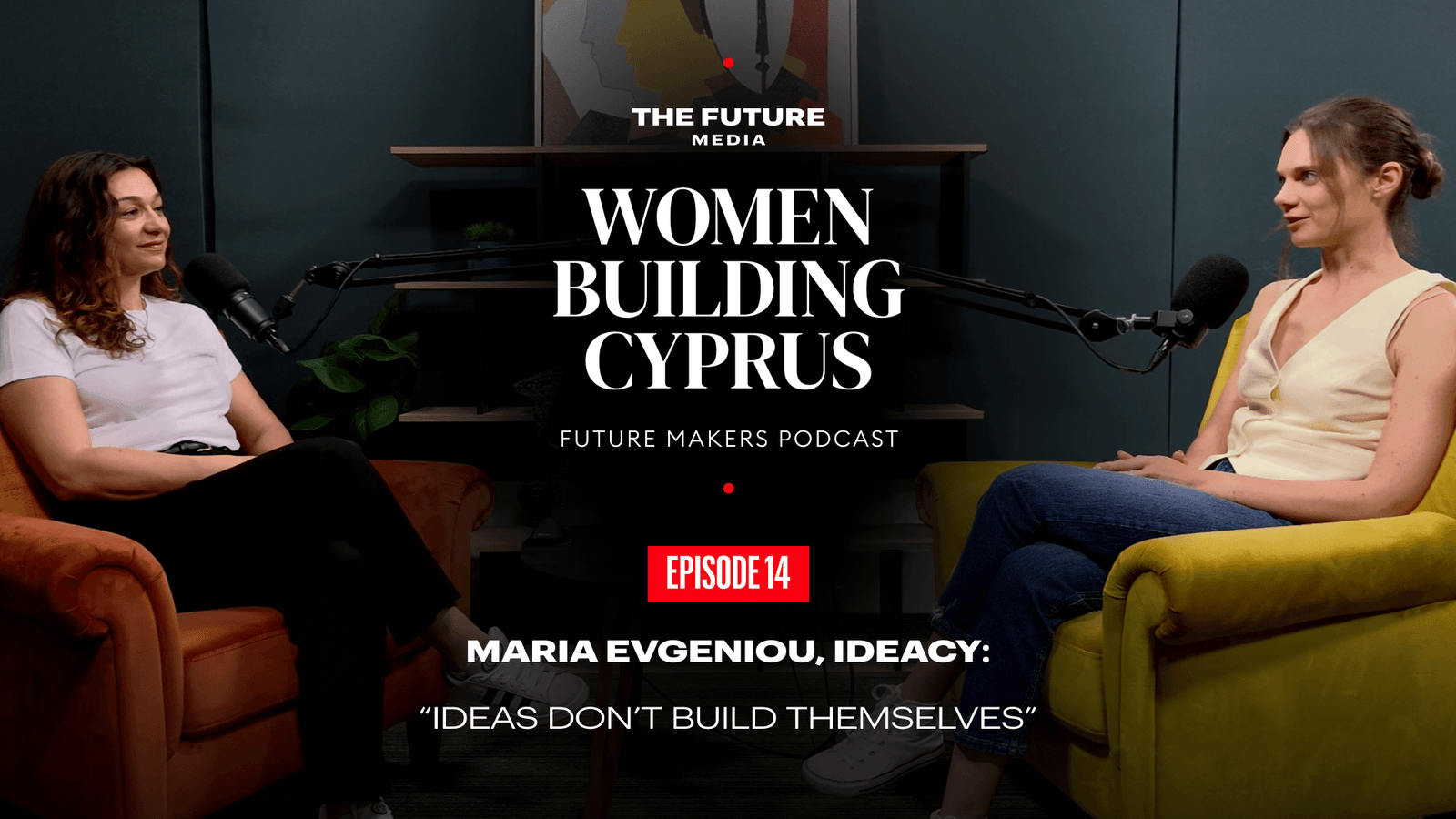
Maria Evgeniou is a guest on The Future Makers: Women Building Cyprus. The full episode, including her reflections on giving up her master’s degree, what she sees going wrong in the Cypriot startup ecosystem, and what it means to build not from the front but from behind, is available to watch now.
The Future Makers Podcast is a series of in-depth conversations about how future-makers are made, in Cyprus and beyond. Host Annetta Benzar sits down with people who are a leading force in our shared future and looks past the titles. Together, they travel back to the people and moments that shaped them, walk through the choices and challenges they are living through now, and look ahead to the futures they are trying to build.
Women Building Cyprus follows women whose lives and decisions are changing what this island can be.
A production of The Future Media.