
“I had to choose between pushing my career or choosing the lifestyle of a mum and a wife. I chose the second, and at that moment it actually felt like a failure.”
Marina Stasevich had just relocated to Lithuania with her family from Belarus at the time. She was the Head of Internships & Training at a global company, adapting to living in a new country and language, juggling motherhood and being a wife, and, to add to all this, a pandemic.
Follow THE FUTURE on LinkedIn, Facebook, Instagram, X and Telegram
At some point, Stasevich could no longer keep pushing every door open at the same time. She stepped back from her corporate career without a plan of what she was going to do next. She began studying at Erickson Coaching International and found her goals were changing, as was her vision for her future career.
“I didn’t want to manage systems. I wanted to help other people build systems, help other people to evolve, develop their mindset,”
she says.
Not long after, Kate Miroshnichenko called.
Kate Miroshnichenko is the co-founder of SOTA and a strategic HR leader with over 20 years of executive-level experience and more than a decade in executive coaching and group facilitation. She has led HR transformation at scale, managed teams of more than 100 HR professionals, facilitated strategic sessions with executive teams across martech, fintech and edtech, and run leadership programmes reaching hundreds of leaders across 15 locations and seven languages.
Marina Stasevich is her co-founder and a recognised expert in executive coaching, talent development and HR strategy, with over 15 years of experience in international technology companies and fast-growing startups. A certified Erickson-accredited coach aligned with ICF standards, she has logged more than 600 hours of coaching practice and supported hundreds of professionals across Europe and beyond. She designs and facilitates strategic leadership sessions, advises technology businesses on scaling and culture, and mentors women in tech.
Together, they founded SOTA, a company built around the belief that people are the foundation of an organisation’s success. The company works with founders, executives and scaling businesses across business strategy alignment, strategic HR, leadership development and team facilitation.
Both women were born and raised in Belarus. Miroshnichenko was born in the capital, Minsk, whilst Stasevich moved cities and several schools as a child. She credits her skill for reading a room quickly with the experience. The two women met inside a large multicultural technology company, where Stasevich led the talent acquisition team, and Miroshnichenko was in charge of HR. When Miroshnichenko left the corporate world and began building what would become SOTA, Stasevich was the first person she thought of to reach out.
“I realised that I work more effectively when I work with someone,” Miroshnichenko explains. “I’m not a solo entrepreneur. Marina is very strong at being responsible, following through, and execution. I have a little bit more of the ‘let’s create something’ mindset. Being with someone very good at execution was really important for me.”
SOTA (short for “state of the art”) emerged out of the women’s combined lessons and experiences from their time inside large technology companies about what actually supports people to perform at their best. They believe that everything a business claims to want, whether better technology, better products, or even better strategy, depends on the core of the organisation: the people.
“Many founders and C-level people believe that the technology is important, the product is important, the marketing strategy is important. But everything starts with people, and without people none of this is possible.”
“There is no one recipe for success,” Miroshnichenko adds. “There are frameworks, there are useful things from other companies that you could adopt, but it’s always important to reflect: what is my company about? What do I want to build?”
HR, Miroshnichenko says, is still too often treated as a support function. Yet any HR leader who wants to move a company forward has to be able to sit with executive leadership and speak as a strategic equal.
“HR is perceived by many founders and C-level that it’s a support function; it doesn’t matter,” she says. “Being able to show this difference and to have the conversation on the needed level, that probably was the challenge.”
Asked what gave her the confidence to have those conversations, Miroshnichenko does not pretend it came naturally.
“I like this phrase: you don’t have the confidence, and then you act. It’s vice versa. You act, and then you have the confidence. So you build the confidence through doing things,”
she says.
It was uncomfortable at the beginning. She worried. She overprepared. She was convinced on many occasions that she had failed.
Stasevich was no stranger to fear either, especially since building a company from the ground up was a very new experience for her. However, not trying was not an option.
“I have more fear of not achieving results,” she says. “So not trying, for me, is even more scary than trying and failing.”
SOTA grew in the same way. The first clients came through the networks they had built during their corporate years, and through these, they got referrals. At the beginning, Miroshnichenko says, they were not completely sure of themselves in the new setup. They had the experience, but reaching out to companies under a globally recognised brand didn’t quite hold the same authority as doing so under their own small brand.
It was not always easy. There were periods without clients. There was also the discomfort of having to say publicly that they were good at what they did. In a crowded consulting market, Miroshnichenko says, knowing you deliver value is not enough. Other people also have to know it.
Those leadership rooms are also still often male-dominated, which can be intimidating.
“It’s a complicated feeling,” Miroshnichenko says. “I wouldn’t say that it comes easy.”
For her, the work has involved understanding her own value, working through the need to be liked, and learning how to say things that may be unpopular. Moving her body helps. Therapy helps. So does the experience of having spent years inside male-dominated environments and realising that authority is not as untouchable as it can look from the outside.
Stasevich remembers a similar inner-work process. Early on, she says, she would over-prove herself, asking whether she was good enough, whether she fit the requirements, whether she was delivering what she was expected to deliver.
Now, as a member of Women in Tech and a mentor to other women, she sees the same question appear again and again in her mentees.
What holds women back?
“The lack of self-confidence,” she says.
How do they build it?
“Step by step. You need to act. You need to try.”
For Stasevich, confidence also comes from looking back at what has already been done. Women, she says, often need to be reminded of the skills, achievements and results they already have. Miroshnichenko adds the need to surround oneself with community. Mentors, peers and supporters, whether women or men, can help a person acknowledge their weaknesses and what is holding them back, and move through them.
Their definition of success is just as resistant to a single formula.
For Stasevich, success is the feeling of being in the right place. That place can be motherhood, or travel. It can be as simple as baking bread or taking the position of a leader. What is important is not whether the outside world recognises the role, but whether the person feels fulfilled.
Failure, for Miroshnichenko, is harder to define. Some instances that look like failures later become the reason another door opens.
“Fail fast. Learn fast,” she says. “If the door closes, which other door opens first?”
It is a fitting philosophy for two women who built a company from a path neither had planned.
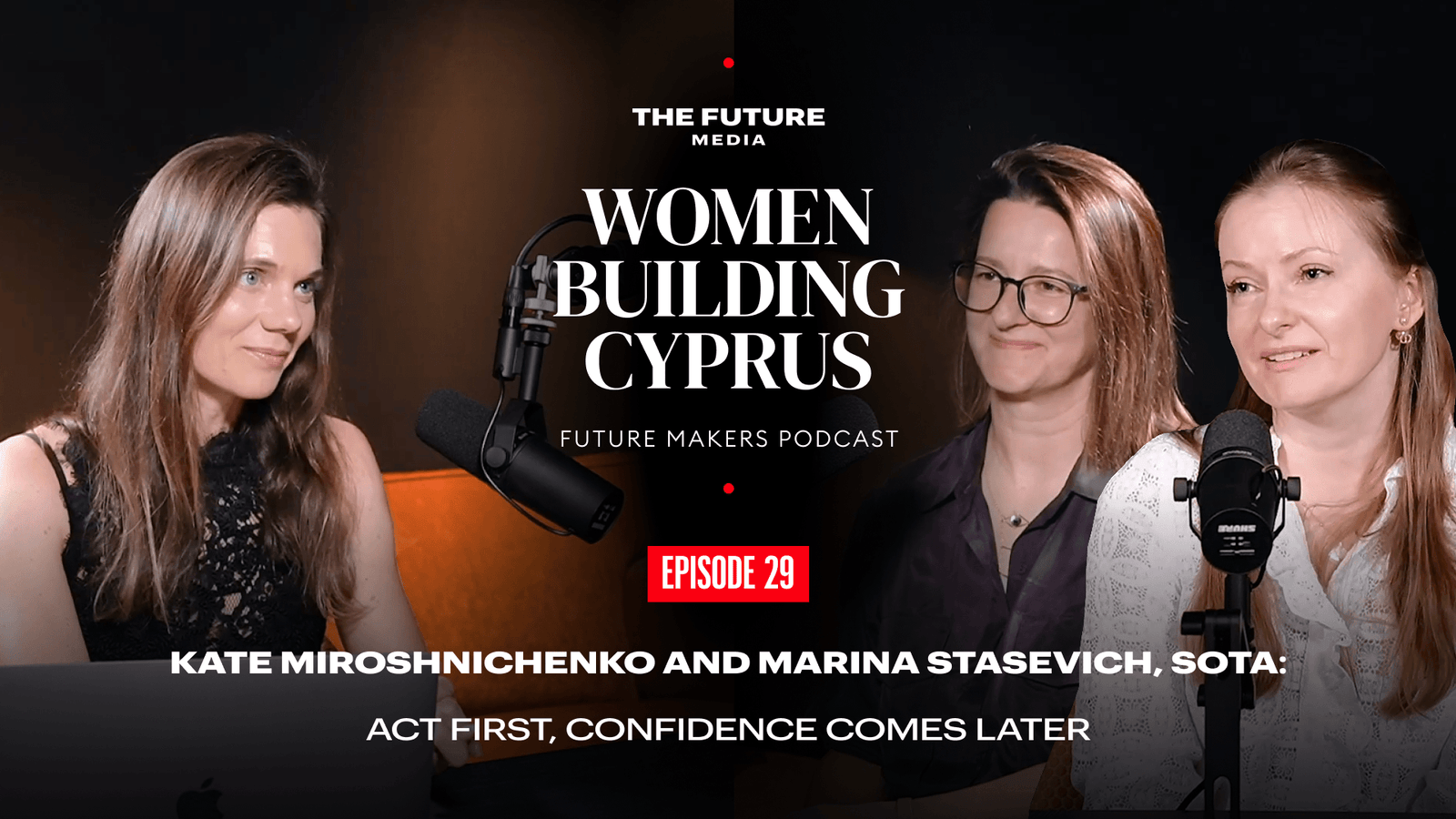
Kate Miroshnichenko and Marina Stasevich are guests on The Future Makers: Women Building Cyprus. The full episode, including their reflections on multicultural leadership, Cyprus’s technology ecosystem, women in leadership, self-doubt, failure, and how SOTA helps companies connect strategy with people, is available to watch now.
The Future Makers Podcast is a series of in-depth conversations about how future-makers are made, in Cyprus and beyond. Host Annetta Benzar sits down with people who are a leading force in our shared future and looks past the titles. Together, they travel back to the people and moments that shaped them, walk through the choices and challenges they are living through now, and look ahead to the futures they are trying to build.
The first season, Women Building Cyprus, follows women whose lives and decisions are changing what this island can be.
A production of The Future Media.