


“Fewer magazine covers, more investor meetings.”
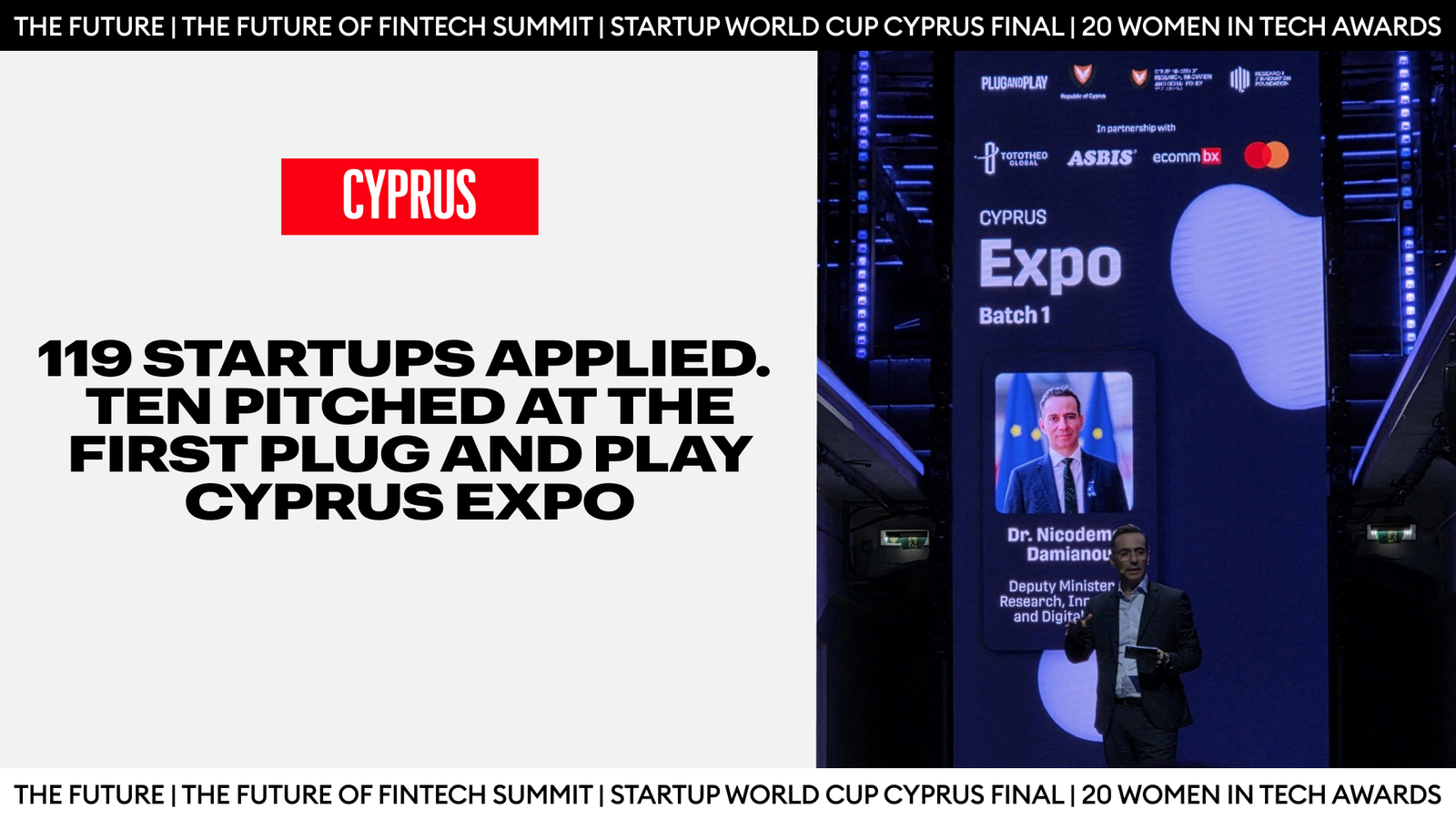
That was Dr Nicodemos Damianou’s advice to founders at the first Plug and Play Cyprus Expo. On 11 November, ten startups took the stage at ETKO in Limassol to close out the accelerator’s first programme on the island.
Follow THE FUTURE on LinkedIn, Facebook, Instagram, X and Telegram
The ten companies making up the Plug and Play Cyprus’s first batch were selected from 119 applicants. They received more than 250 hours of mentoring, and the programme made 27 introductions to investors and corporate partners, said Damianou, the Deputy Minister of Research, Innovation and Digital Policy. Four of the companies had raised nearly $4.5 million between them, he said.
Irene Piki, Deputy Minister to the President, said several participants had reported new clients, commercial agreements or interest from investors. She urged founders to look for customers outside the island from the start. “Use Cyprus as your base, but do not allow the size of our domestic market to define the size of your opportunity.”
The Ten Startups
First pitch session
- QubeHub.ai combines an AI sales assistant, a system for managing customer relationships and a portal that developers can put under their own brand. It helps property developers and large builders coordinate sales, automate payments to agents and manage international buyers across markets.
- EleniAI builds a conversational AI agent for estate agencies. It uses language models developed for the property sector to reopen conversations with inactive prospects, screen enquiries and follow up with potential clients.
- Neura Energy helps hotels and other commercial properties manage electricity demand from cooling. Its software uses weather data and information about how buildings store heat to adjust cooling loads. It is designed to lower electricity costs without upfront capital expenditure.
- Fewton helps hotels, resorts and restaurants identify energy waste. Its AI platform connects remotely to smart meters and building management systems, using the data to recommend changes that could cut energy use and operating costs.
- ModelRoom uses generative AI to create and test video ads that tell a story. Designed for marketing teams and mobile game publishers, the platform uses predicted returns to decide how to allocate advertising budgets.
Second pitch session
- EMBIO Diagnostics combines custom sensors with cloud software to monitor buildings in real time. It gives managers a view of indoor air quality, building safety and how efficiently resources are being used across their properties.
- BLEND.app is a mobile tool for scheduling and managing frontline teams in restaurants, hospitality and retail. It gives staff a dedicated place to swap shifts and lets managers track information for each shift.
- Cleedee is an AI recruitment platform for hotels, restaurants and other hospitality businesses. It covers the process from posting jobs and finding candidates to screening, matching, interviews and offers. Its AI is designed to show why a candidate matches a role.
- Digital Fox lets restaurant guests scan a QR code, split the bill and pay on their phones. The checkout links the payment with the order in the restaurant’s till system and the guest’s details.
- Sprouty is an AI parenting assistant for families with children up to age two. It uses information families share to offer personalised guidance on their child’s development, explain behaviour and suggest milestones to look out for.
What Founders Need From Their Backers
“It’s great to see startup technology, but in the end, it has to be applied,” Plug and Play partner Sascha Karimpour said in his opening remarks. He pointed to the city of Stuttgart, Germany, where the network works with automotive and mobility companies. Plug and Play has run more than 550 projects there over ten years, and companies had gone on to implement about a third of them, he said.
The evening’s From Grant to Growth panel looked at that challenge from a founder’s side. Autonomics co-founder Pavel Butov said his company could develop robots for industrial cleaning and software to manage them, but it needed help understanding how to sell, deliver and support them abroad. ASBIS, an early investor in Autonomics, helped the team understand what it would take to market, deliver and support its robots abroad, while Kinisis Ventures helped the team see the business through an investor’s eyes.
“As a founder, of course, I want to have one pitch deck and one data room for everyone,” Butov said. He said a corporate partner, a venture investor and a public funder each ask different questions about the same company. Those conversations help founders modify their approach to how they explain the business.
Theodoros Loukaidis, Director General of the Research and Innovation Foundation (RIF), said Autonomics secured backing from ASBIS and Kinisis Ventures before receiving public funding through RIF’s BOOST programme. Across its programmes that combine grants with private investment, RIF had deployed €12.5 million in public funding and mobilised €16.5 million in private capital, he said. In Loukaidis’s words, “government money can create enabling conditions”, but “it’s the private markets that choose the winners.”
“More and more startups knock on our doors,” said ASBIS CEO Serhei Kostevitch. ASBIS had limited time and expertise to assess all the startups approaching it. Kostevitch said he was happy to leave the initial screening to Plug and Play and venture investors. ASBIS prefers to get involved once a startup has a product it can help scale.
Andreas Panayi, co-founder of Kinisis Ventures, said a grant can give a company breathing room but founders still have to find paying customers. “But at one point, they need to start making money on their own and not rely on the government.”
What Comes After The First Batch
The University of Nicosia and the American University of Beirut signed memorandums of understanding to become Plug and Play’s first university partners in Cyprus. The aims include bringing industry experts into lecture theatres and helping universities adapt what they teach to what employers need.
Plug and Play ventures associate Evangelia Athanasiou announced that applications had opened for a second cohort focused on gaming. Plug and Play says Cyprus-based startups developing games or products for the gaming industry can apply through its website until 10 January 2027. The Cyprus Game Makers Association estimates that games companies operating from Cyprus generated around €3.2 billion in revenue in 2025.
The Expo programme sets a goal of supporting 60 startups across six programmes by 2029.
What the next round offers is a chance to bring more women founders in front of investors and corporate partners. The stage only saw two women during the event. Piki and Pitta were the two women on the first Expo’s published speaker line-up, and no women pitched in either startup session, with only one female co-founder in Batch 1.
On the funding panel, Butov made a case for giving local companies more opportunities to show people on the island what they’re building. “Cyprus is a small island, but sometimes you don’t know what your neighbours are doing.”