Leaving the 2026 budget meeting that morning, Ioanna Hadjicosti couldn’t stop the grin widening across her face. She had done it. She had finally done it.
The Department of Contemporary Culture had been granted a €600,000 increase for its funding programmes, supporting the development and work of Cypriot artists. She couldn’t wait to report back to her team. But her excitement was short-lived when she heard the Ministry of Defence, which had gone in straight after her, had been granted an additional €36 million.
Follow THE FUTURE on LinkedIn, Facebook, Instagram, X and Telegram
“I suddenly felt that I was robbed,” Hadjicosti says. She shakes her head, the sting of that memory still sharp. Culture, in Cyprus and elsewhere, she says, is often treated as the last nice-to-have.
At moments like this, she reaches for the stories that have inspired her to persevere. In this case, it was something she had read about Winston Churchill. During one of the toughest periods of the Second World War, so the story goes, one of Churchill’s advisers suggested diverting the arts budget to buy more ammunition. Churchill is said to have replied:
“Then what will we be fighting for?”
The arts, for Ioanna Hadjicosti, are not what you fund in times of ease and excess. They are what you fund because, without them, a country forgets what it stands for. It forgets who it is.
Ioanna Hadjicosti is the Director of the Department of Contemporary Culture at the Deputy Ministry of Culture of the Republic of Cyprus. She spent seven years as Director of the Bank of Cyprus Cultural Foundation, where she led a new strategic direction, oversaw the museums and collections research programmes, and coordinated the Horizon 2020 ReInHerit project. An active researcher, she received the Best Practice Award for the Grundtvig Workshop “Modern Views of Greek and Roman Antiquity,” held under the Lifelong Learning Programme Grundtvig 2011-2012. She has taught Ancient Greek and Early Byzantine Literature at the Open University of Cyprus. She has served on several boards and scientific bodies, including the Centre of Scientific Dialogue and Research and the Royal Commonwealth Society, Cyprus Branch.
Hadjicosti was born in Greece in the first years after the 1974 Turkish invasion of Cyprus. Her family relocated to the island while she was still a child. Hadjicosti recalls those early memories with warmth. Optimism, she says, was the default of her family. “It was a house full of equal opportunities and a house full of innovation somehow,” she says. “My parents were forward-thinking and encouraged their children to be forward-thinking. They encouraged us children to read literature and history.”
Outside the walls of her home was a world still healing. Cyprus in the late 1970s and 1980s was still processing the invasion. As a little girl growing up on the island, Hadjicosti witnessed how a people who had lost everything continued to carry themselves. “A country that was going through a struggle of her own,” she says, “and showcasing a lot of resilience and a lot of optimism as well, and a lot of ‘you can start all over again.’” Her father’s side of the family, who were from the now-occupied areas of the island, had been forced to leave everything they owned behind. Almost everything. “They didn’t manage to bring with them things they had there,” Hadjicosti says, “but they brought their cultural identity. They brought their songs, their resilience, their beliefs about nature, about art. They brought their language. They brought things that nobody can take away from you.”
That, she says, is the heart of culture. The intangible inheritance. It is not the buildings or the objects in the museums, important as those are. “It’s very deeply rooted, and nobody can take it away from you,” she says. “If no schools are educating you, this surrounding atmosphere of culture that has been going on for generations, it can take you forward for centuries.”
The stories her family told her at home became the life lessons she would use to make her own decisions about what a life in service to culture could look like. Her parents spoke often of historical and mythical figures who had worked for the common good against opposition. What their daughter absorbed from these stories was that strength and kindness come with responsibilities, and that public service is not what you do because it is easy. It is what you do because the collective consciousness is something everyone shapes and is reshaped by.
Hadjicosti chose to pursue Ancient Greek literature after completing high school and wrote her PhD in London, where she also taught in Greek schools and had her first real experience of what culture does for people who are far from home. The Greek children she was teaching in London were living out the same lesson her father’s family had come to understand: culture is the piece of an identity that survives displacement. Many were second- and third-generation children who had never been to Greece or Cyprus. “They just learned about it through narrations,” she says, “and they treasured this so much […] bringing them closer to the language, to the history, to the culture in general.”
When she returned to Cyprus, she joined the Bank of Cyprus Cultural Foundation, first as a curator and later as director. Over seven years, she and her team built a strategic direction, ran European programmes, established that cultural institutions could and should be fully accessible to all groups, and did substantial work on the connection between culture and public health.
The move from the private cultural foundation into the public sector, as Director of the Department of Contemporary Culture, was not an overnight decision. She had been thinking about transitioning for a while. What she wanted, and what she felt the country needed, was policy to protect and develop the cultural infrastructure of Cyprus. She had come to believe that Cyprus was missing the strategic conversation happening across Europe about culture as the fourth pillar of sustainable development, alongside the economic, social and environmental pillars. She wanted to bring the island into that conversation, and she wanted to help create the ecosystem the artists themselves were still fighting on their own to find.
“We can help Cyprus to become even better with its culture,” she says. “We can help the artist become more resilient by offering them a series of support mechanisms that they actually need. Connecting in strategic ways health and culture, or technology and culture, things that are happening all around Europe these days.”
The transition to the public sector was harder than she had expected. For instance, the politics are both visible and often invisible. Ministers change, which means pushing for change gets delayed. Priorities also shift. The system, she says cautiously, is very resistant to change. But she is also honest that the public sector is where real change, in theory, can be made.
One of the changes she is fighting for is inside the schools. Alongside the Ministry of Education, her department has created a programme called “Πολιτιστική Παιδεία” (Politistiki Paideia) that brings working Cypriot artists directly into classrooms. Children gain the opportunity not only to meet the actual artist but to see their passion for work and the results of that passion. What Ioanna is pushing for is a school system that does not try to only produce technocrats. She wants a school system that produces whole human beings.
“It’s very important for me to bring out in society citizens that have emotional intelligence combined with critical thinking, because these are the people that will be taking decisions in the future. These are the people that will be voting in the future, and that will become future leaders. If they are only mechanically equipped technocrats, they are missing this point. It will have an impact on society. It will have an impact on how we treat other people who are sick, other vulnerable people, other people who need our help.”
This is what she means when she says culture is the ministry that cannot collapse. History has taught us that finance ministries have collapsed. Defence ministries have collapsed. But culture, she argues, has an intangible quality that survives every crisis a country goes through, and becomes the core from which everything else can be rebuilt. “You can rebuild your ministry of finance, your ministry of defence or any other ministry you need,” she says. “It’s the core of our existence.”
There is an urgency to her fight. It comes, she feels, from two intersecting forces: the rapid technological change she is seeing, and what she describes as an era in which the cultures of individual countries are being flattened and even erased by universalisation. And AI, she adds, accelerates that risk. It flattens cultural specificity into generic content. It gives young people an interface that removes them from face-to-face connection. It offers a version of storytelling that has never once required the presence of another human being to make it.
Cyprus, she believes, has to strike a fine balance. Its culture needs to stay outward-looking, engaged with the world, present in the conversations happening across Europe. At the same time, it also needs to safeguard what is its own identity.
The intangible inheritance.
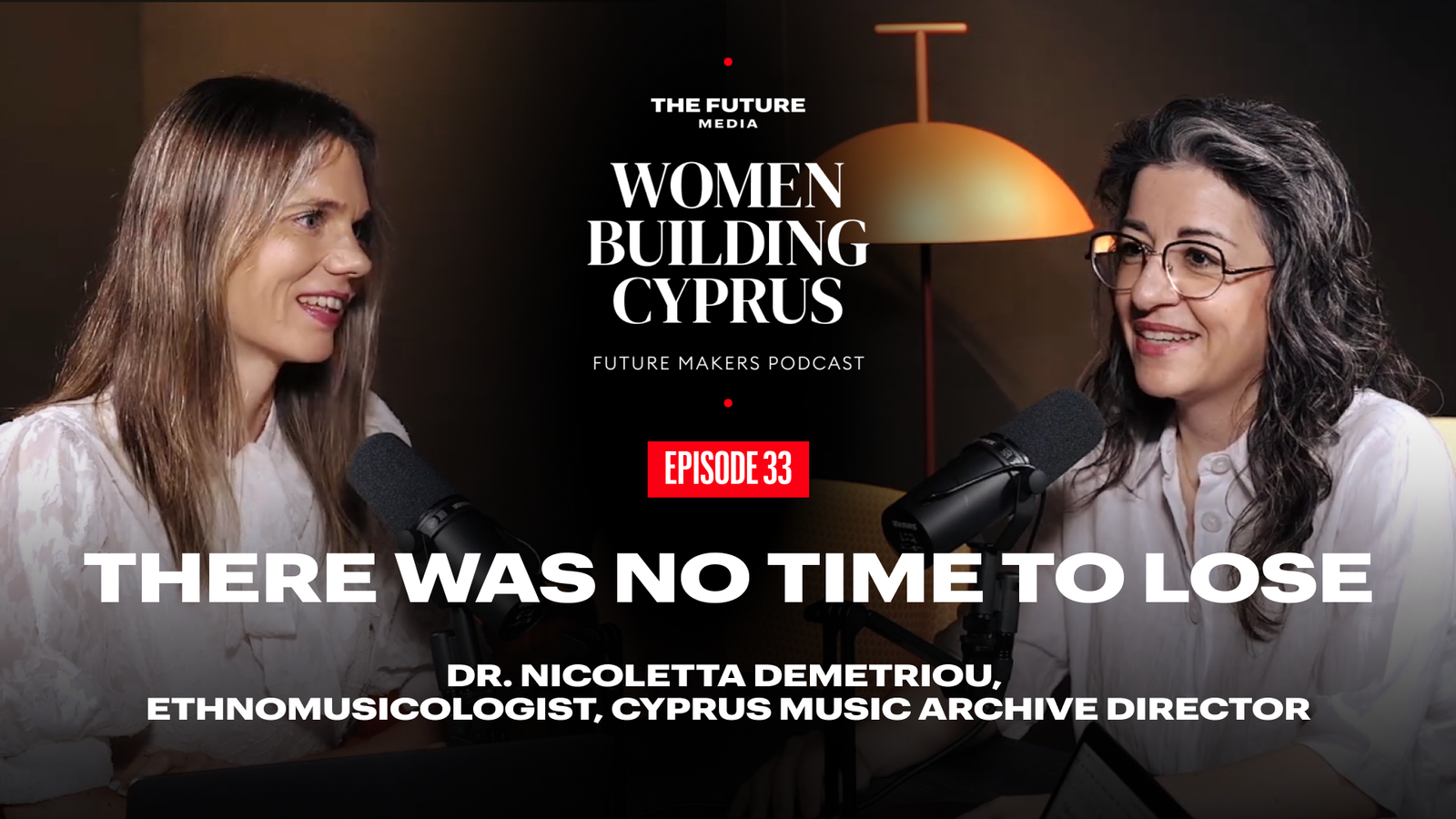
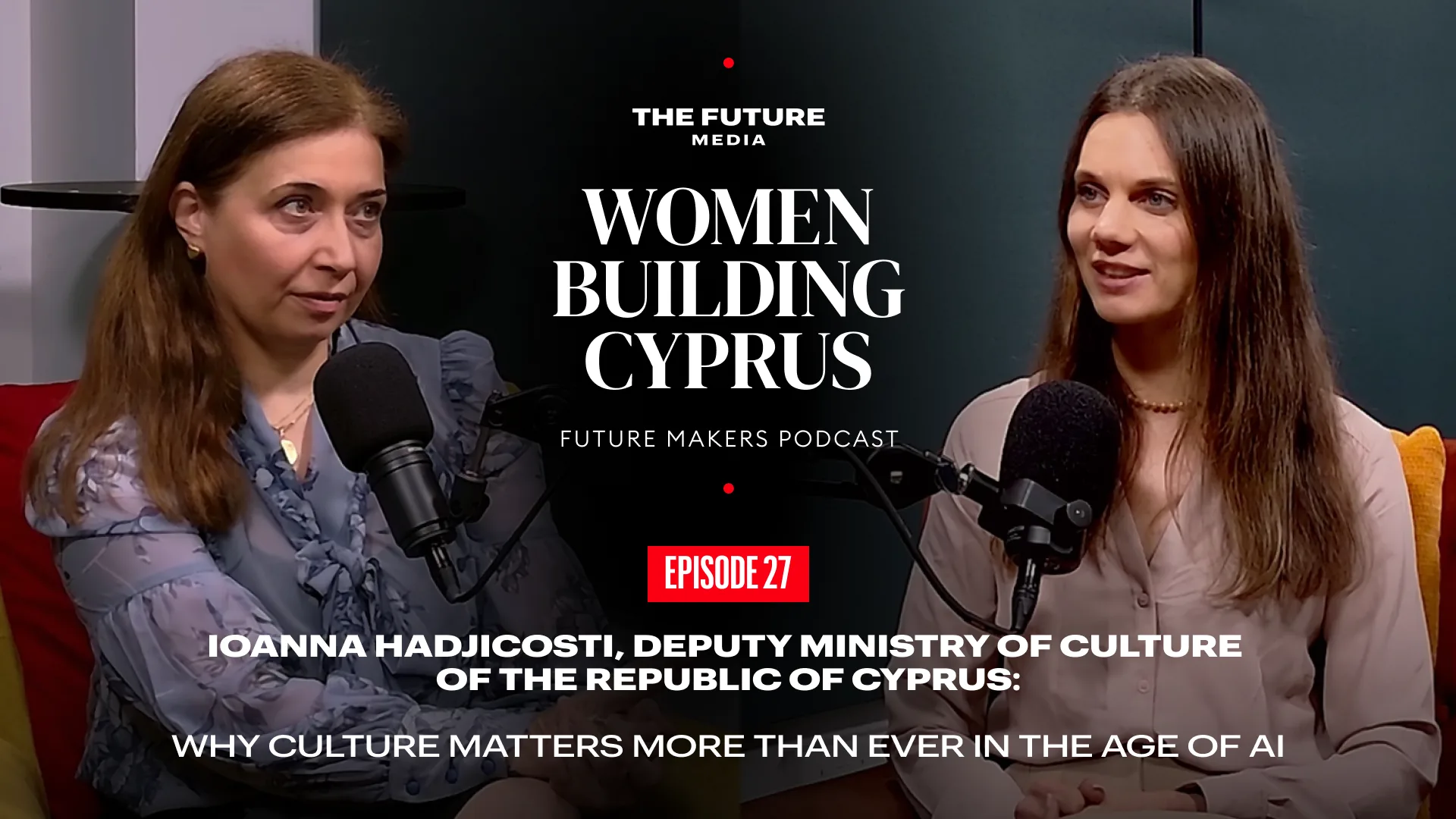
Ioanna Hadjicosti is a guest on The Future Makers: Women Building Cyprus. The full episode, including her reflections on cultural education in Cypriot schools, why she believes Cyprus should explore the medical prescription of art, and what she thinks a viable ecosystem for the island’s artists would actually look like, is available to watch now.
The Future Makers Podcast is a series of in-depth conversations about how future-makers are made, in Cyprus and beyond. Host Annetta Benzar sits down with people who are a leading force in our shared future and looks past the titles. Together, they travel back to the people and moments that shaped them, walk through the choices and challenges they are living through now, and look ahead to the futures they are trying to build.
The first season, Women Building Cyprus, follows women whose lives and decisions are changing what this island can be.
A production of The Future Media.