

Long before Nicoletta Demetriou became an ethnomusicologist, she spent her days immersed in the stories her grandmother and other elderly women on the refugee housing estate outside Nicosia shared. During these neighbourhood visits and extended coffee conversations, young Nicoletta was expected to sit quietly beside her grandmother and just…listen. Decades later, while interviewing elderly musicians across Cyprus, she recognised how much those early experiences had influenced her approach to research.
Follow THE FUTURE on LinkedIn, Facebook, Instagram, X and Telegram
Demetriou is a researcher, writer and performer specialising in Cypriot musical and oral traditions, and the founder of the Cyprus Music Archive. Her work explores the lives of the musicians themselves, asking how they learned their craft, how their communities treated them, and how they shaped, and were shaped by, the culture of rural Cyprus.
During her doctoral fieldwork in 2005–2006, she began collecting the life stories of musicians from a particular period in Cypriot music history. Something that stayed with her during these early encounters was the way the musicians described their role at village weddings. They did not say they had “played at a wedding.” Instead, they described their performance as “making a wedding.” Their music was essential to the rituals and celebrations of the ceremony.
Those encounters became the foundation of The Cypriot Fiddler, a research project encompassing a documentary, a book and a website. In May 2026, it received the European Heritage Awards / Europa Nostra Grand Prix in Research, more than a decade after the project began.
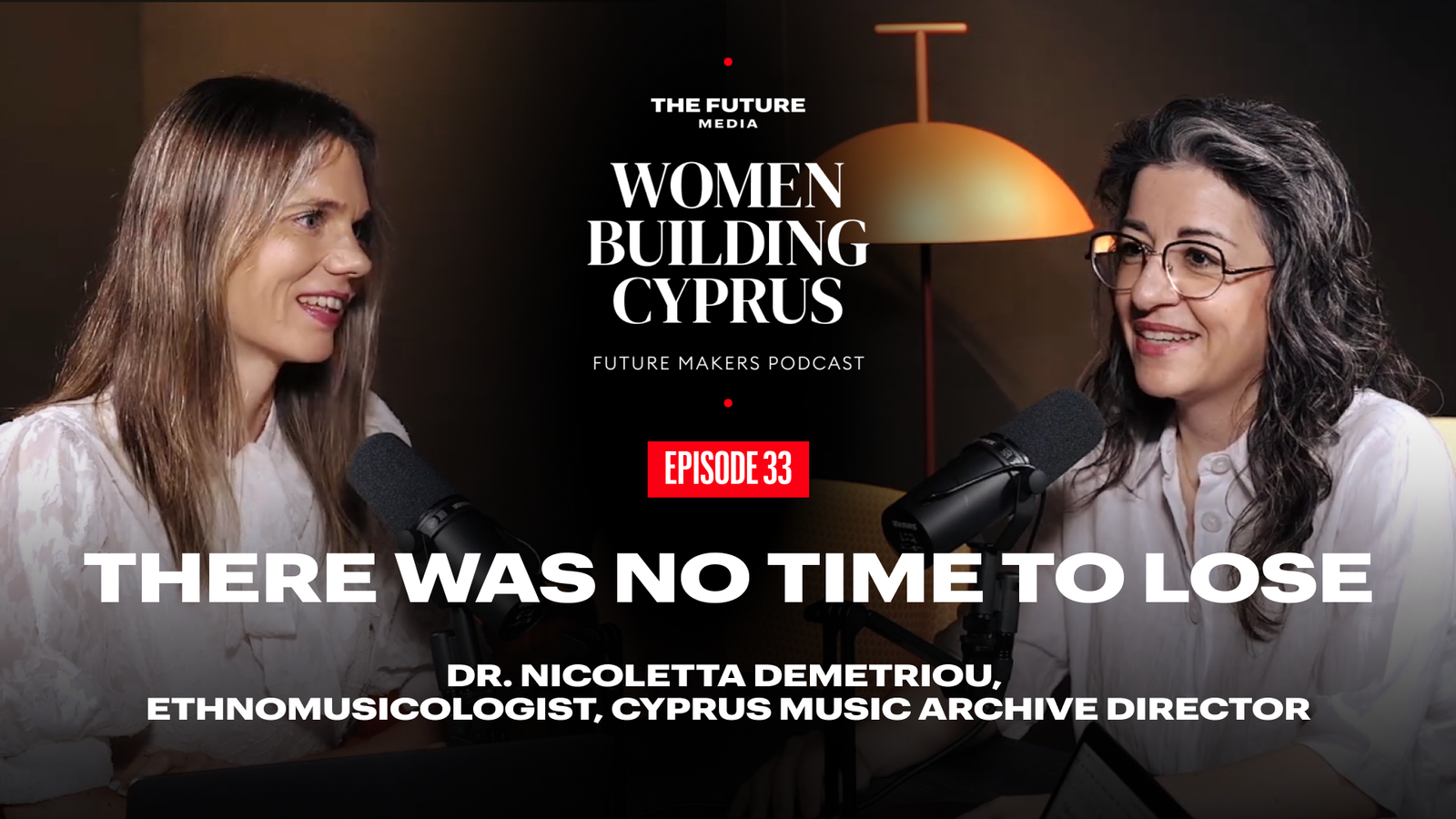
In this episode of The Future Makers: Women Building Cyprus, Nicoletta Demetriou reflects on her upbringing, women’s place in Cyprus’s musical traditions and the responsibility of recording someone’s life without taking over their story.
The following conversation has been edited for length and clarity.
About The Guest
Nicoletta Demetriou is an ethnomusicologist, writer and performer specialising in Cypriot musical and oral traditions. She holds a PhD in Ethnomusicology from SOAS and an MA in Life Writing from the University of East Anglia, and has held teaching and research positions at SOAS, Oxford, Princeton and the University of Cyprus. She is the founder and director of the Cyprus Music Archive, the author of The Cypriot Fiddler and producer of two ethnographic documentaries. She also performs Cypriot folk songs with Michalis Terlikkas and his group Mousa. In 2026, The Cypriot Fiddler won the Grand Prix of the European Heritage Award – Europa Nostra Award in the Research category.
Looking back at your early years, how did they shape the work you now do?
I was brought up on a refugee housing estate on the outskirts of Nicosia, raised by a grandmother who was born in 1908 and who was completely illiterate. In the first five years of my life, before I went to school, I was also illiterate like her.
We would go around the neighbourhood visiting other elderly women, mainly other grandmothers who lived with their families. My role during those very long coffee sessions and walks around the neighbourhood was to sit and listen to the elderly women talk among themselves, but not interrupt or talk.
I had no books. I couldn’t read or write. I had no toys with me. All I had was my ears, my eyes, my senses. Subconsciously, I suppose, I learned to listen and observe. That was ethnography, in quotation marks, without my knowing it was ethnography at the time.
When the time came for me to go around Cyprus and conduct interviews with elderly people, that came very naturally because it was actually the first thing I had learned in life. I had kind of forgotten that I knew it, and then I started practising it as I was doing ethnographic research. Once I was asked to reflect on it later in life, I put the dots together and realised why it felt so natural.
Your research describes women being discouraged from performing in public. How did that affect whose music and stories were recorded?
In traditional Cypriot society, which was primarily agricultural, there was a clear distinction between what we call the private and the public sphere. While men could sing, dance and play music in public as well as in private without any problem, for women this was not the case.
Women could sing or dance at home in front of their family and close friends. Women who would sing, dance, or play an instrument outside the home were more often than not seen as immoral by society. There were some exceptions, especially pertaining to women who had some kind of disability, for instance, if they were blind.
Women were not only not encouraged; they were actively discouraged from having that role in public. But women also had their own agency. Many said they did not want to sing or dance in public because that would put them in an awkward position socially. They wanted to protect themselves.
This is why, when we look at old field recordings or transcriptions, there are not that many women who were recorded. It is not always because the men doing the research didn’t ask. In many cases, we know they did ask. But women also wanted to protect themselves, and saying no was a way to do that. There are many grey areas here, and we are only touching upon the issue.
When I started singing in public, I was 12, so this was 1991. By then, Cypriot society had changed. The role of women on stage had begun to change more actively from the 1960s onwards. By 1991, there was no problem with me singing on stage. I was by no means the first woman to go on stage to sing.
How did The Cypriot Fiddler begin, and what did you want it to do?
My research at the time didn’t concern the fiddlers. It concerned a particular type of Cypriot folk song. Between 2005 and 2006, I was back in Cyprus for a year of fieldwork. Every time I met an elderly musician, I would ask them to tell me a few words about their life.
I was doing this for several reasons. First, to put them at ease. Second, I wanted to find out more about a period in Cypriot music and society for which there is not a lot of ethnographic data. I am not only talking about notes on paper, but about people’s experience of that time. Third, and most importantly for me, because I love stories. I found those people fascinating and couldn’t wait to hear more from them.
In 2012, I applied for a research fellowship at the Oxford Centre for Life-Writing at Wolfson College. The stories of these older musicians came back to mind, and I wrote a proposal to bring ethnomusicology and life-writing together. This is how The Cypriot Fiddler was born.
The idea was that I didn’t want to be the one actively telling their stories with them in the background. I wanted them to be in the foreground and to place myself in the background. This is why the project was very much informed by the methodology of oral history. The important thing for me was to let them talk about their experience using the words they wanted.
The fiddlers said they “made a wedding”. What does that expression tell us about their place in society?
In Cypriot Greek, the expression the musicians use is never “I went to play at a wedding” or “I performed at a wedding”. They always say, “I made a wedding”.
That verb captures their understanding that unless they were there, there wouldn’t be a wedding. They were the ones who made a wedding possible, both the rituals that preceded it and the celebration that followed the ceremony.
The overwhelming majority of them say they were treated as very special people. The way this was tangibly experienced was that the food they received was better than what the rest of the people ate. They said, “They always kept the best food for us, and they gave us the best place to sleep.”
Of all the musicians I interviewed, there was only one who said that in his village they didn’t think much of the fiddlers. Everyone else said they were appreciated. It is funny how so many musicians from so many different areas in Cyprus said that people showed their appreciation through food.
How did you manage to develop the documentary with so little funding?
I had been using my camera as a tool for ethnographic research. I am not a documentary maker. I know how to film a person giving me an interview for my own archive.
I started looking for funding to do the documentary. This was after 2013, after the financial crisis. Each and every application I made was rejected, if there was ever a reply. Many times there was no reply at all.
But I was working with people who were very advanced in years. Every time I came back to Cyprus, I was finding fewer and fewer of them. There was no time to lose. There was a sense of urgency attached to preserving their stories.
In 2015, I launched a campaign on Kickstarter to collect money to employ another person to go around with me and use a second camera and a microphone. We collected, I think, £1,500. That allowed me to employ another person for the duration of a summer.
In 2016, we put together edited material from the interviews to show at the Home for Cooperation in Nicosia, so the elderly musicians from both sides could come together and watch themselves on the big screen. They were very happy, proud and moved, especially those who came with their children and grandchildren.
They didn’t need someone telling their story for them. They needed the means to tell their story to the wider public.
In over 10 years, the project received no more than €10,600 in funding. This is why it also lasted so long. There was no money with which to complete it. I had to stop and go back to do something else, then return to the research. This kept happening for over a decade.
What is the value of listening to stories like these?
I couldn’t possibly generalise because I don’t know what the value is for everyone. I know what the value is for me.
For me, the value is the ability to listen irrespective of the content. What comes first is the ability to sit down and listen and not try to judge people. Give them the space and time they need to tell their stories without doing anything else, without looking at your phone or trying to cook dinner.
Just deep listening, sitting down and listening to other people’s stories without trying to judge them or talking to ourselves in the process of listening.
Whichever story you get, you will find something useful there, whether it is to adopt it, reject it, or say, “I’m glad we moved on from that.” There is something in each and every person’s story. We just need to stop what we are doing, stop our internal monologue, and listen.
In the full episode, Demetriou explains why she changed direction from classical singing in Vienna to ethnomusicology, how she developed a book in which her own chapters sit alongside the fiddlers’ accounts in Cypriot Greek, and what it meant to share the Europa Nostra Grand Prix celebration with their families. She also reflects on the dedication the work required and why she wants a future guided by curiosity and imagination. Watch now.
The Future Makers Podcast is a series of in-depth conversations about how future-makers are made, in Cyprus and beyond. Host Annetta Benzar sits down with people who are a leading force in our shared future and looks past the titles. Together, they travel back to the people and moments that shaped them, walk through the choices and challenges they are living through now, and look ahead to the futures they are trying to build.
Women Building Cyprus follows women whose lives and decisions are changing what this island can be.
A production of The Future Media.