


Breaking news

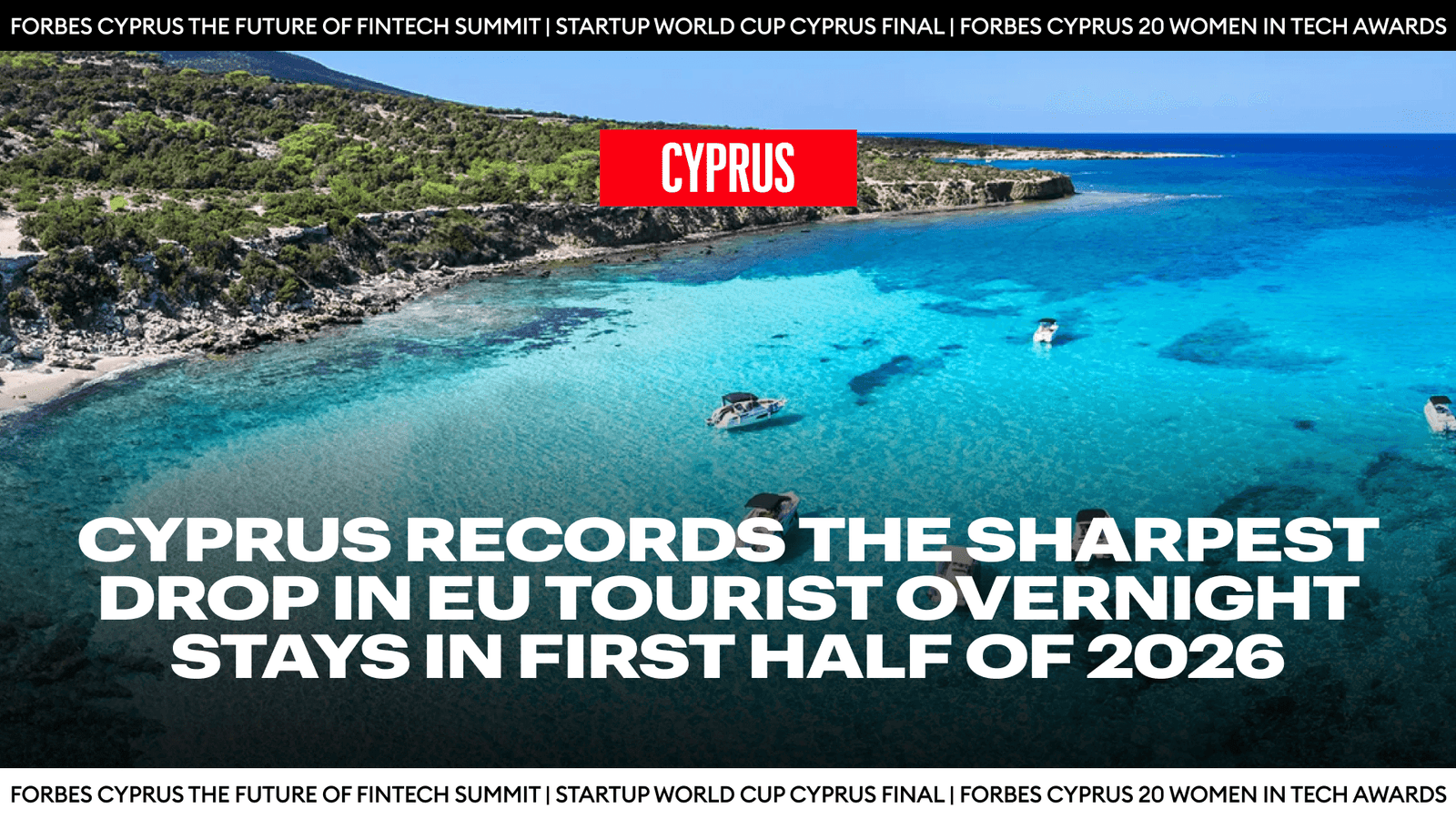
Cyprus Records The Sharpest Drop In EU Tourist Overnight Stays In First Half Of 2026

Cyprus recorded the largest decline in tourist overnight stays among European Union member states in the first half of 2026, as accommodation demand fell 7.7% year over year.

Overnight stays across the EU increased 1.7% during the same period, according to Eurostat data released Tuesday. The figures also show Cyprus has one of the bloc’s highest levels of reliance on international visitors.

Cyprus Leads The EU In Tourism Declines

Overnight stays in tourist accommodation in Cyprus fell 7.7% between January and June compared with the first half of 2025. Only nine EU member states recorded annual declines, with Romania posting the second-largest decrease at 6.7%.

The decline in Cyprus contrasts with overall growth across the bloc, where tourism activity continued to increase during the first six months of the year.

Ireland, Malta And Slovakia Post Strongest Gains

Ireland recorded the strongest increase in tourist overnight stays, with growth of 14.6%. Malta followed at 9.9%, while Slovakia recorded a 5.9% increase.

The results reflect differing tourism trends across EU markets, with some destinations recording substantial growth while others saw demand weaken.

EU Overnight Stays Rise To 1.321 Billion

Tourist accommodation providers across the EU recorded 1.321 billion overnight stays in the first half of 2026, up from 1.299 billion a year earlier.

Foreign visitors accounted for most of the increase. Overnight stays by non-residents rose 2.5%, compared with a 0.9% increase in stays by domestic travelers. Non-residents represented 48.9% of all overnight stays across the EU during the first six months of the year.

Cyprus Relies Heavily On International Visitors

The share of foreign visitors varies considerably across the bloc. Non-residents accounted for 95.2% of overnight stays in Malta, the highest proportion in the EU, followed by Cyprus at 92.6% and Luxembourg at 87.7%.

Foreign visitors represented less than one-quarter of overnight stays in Germany, Poland and Romania, at 18.5%, 19.8% and 23%, respectively. For Cyprus, where 92.6% of overnight stays came from non-residents, changes in international tourism demand have a direct effect on accommodation activity.

Europe’s Busiest Ports Show The Scale Of Maritime Trade

Maritime transport carried roughly 13 billion tonnes of goods worldwide in 2024, highlighting its central role in global trade and supply chains. EU ports handled about 3.4 billion tonnes, or 26% of the global total, while nearly 90% of the bloc’s external freight trade is carried by sea.

Rotterdam And Antwerp-Bruges Lead The EU

Rotterdam was the EU’s busiest port in 2024, handling 397.3 million tonnes of goods. Antwerp-Bruges ranked second with 243.7 million tonnes, putting the two northern European hubs well ahead of the rest.

Hamburg ranked third at 97 million tonnes, followed by Spain’s Algeciras at 81.5 million tonnes and Amsterdam at 78.8 million tonnes. France’s HAROPA port complex, covering Le Havre and Rouen, handled 76.6 million tonnes, while Gdansk recorded 71 million tonnes.

Marseille and Valencia followed with 66 million and 64.5 million tonnes, respectively. Romania’s Constanta completed the top 10 at 57.6 million tonnes, reflecting the Black Sea’s role in Europe’s wider trade network.

Europe’s Second Tier Of Major Ports

Several ports handled between 40 million and 56 million tonnes in 2024. Barcelona recorded 55.5 million tonnes, followed by Trieste at 53.5 million, Genoa at 47.4 million and Sines at 44.1 million.

Piraeus handled 43.7 million tonnes, while Germany’s Bremerhaven recorded 42.5 million. Sweden’s Göteborg handled 38.5 million tonnes and Dunkerque in France 36.8 million.

Netherlands Leads By National Port Volume

Looking at total cargo across each country’s ports, the Netherlands ranked first with 538.1 million tonnes in 2024. Italy followed with 488.6 million tonnes and Spain with 486 million tonnes, putting all three well ahead of the rest of the EU.

Belgium ranked fourth at 274.9 million tonnes, followed by Germany at 273.9 million and France at 269.8 million. Greece, Sweden and Poland each handled more than 100 million tonnes, showing the breadth of Europe’s maritime network.

Turkey Expands The Regional Picture

Including EU candidate countries and EFTA members puts Turkey in second place with 524.7 million tonnes, behind the Netherlands. Norway ranked eighth with 212.1 million tonnes and handled 212.1 million tonnes.

The European Commission has described maritime transport as a long-standing driver of European economic development. Its role now extends beyond moving cargo, with ports increasingly tied to supply chains, energy security and industrial policy.

In March 2026, the Commission adopted two strategies focused on competitiveness, sustainability, security and resilience across the EU’s waterborne sector, including ports, shipping and shipbuilding.

Aretilaw firm
Uol
The Future Forbes Realty Global Properties
eCredo

Become a Speaker

Become a Speaker

Become a Partner

Subscribe for our weekly newsletter