

If you’re walking into an investor meeting with notes, Andreas Panayi already has a problem with you. It’s not because he’s difficult. But if you need cards to describe your own company, then there’s a problem. The problem is you’ll be leaving that room before your five minutes are up.
Andreas Panayi is a serial entrepreneur and investor with over 35 years of experience founding, building, and exiting companies in professional services and technology. He conceptualised and launched Kinisis Ventures, a business acceleration firm with a mission to create growth opportunities for Cypriot and European technology-innovation companies lacking access to U.S. markets, networks, and capital. He is also a founding principal and lead member of the Investment Advisory Committee for Kinisis Ventures Fund I and II.
Follow THE FUTURE on LinkedIn, Facebook, Instagram, X and Telegram
Additionally, Andreas is a co-founder and board member of TKI, an enterprise software and AI development company with offices in the U.S., India, and Cyprus/EMEA. He also serves on the board of TK Partners, a U.S.-based technology holdings company, and teaches entrepreneurialism and new venture development as an adjunct professor.
His own entrepreneurial story starts in the mid-80s, when in the second week of his first job, he decided to print his own business cards with nothing but his name on them. He had no plan, but he just knew that somehow, someday, he was going to be working for himself eventually. “I didn’t even know what that meant,” he says. “But I did.” He went from an undergraduate degree in Hotel and Tourism Management to an MBA with a focus on Marketing to becoming the tech guy in a Madison Avenue agency at the precise moment the web was being born. It was a transformative time. His boss, whom Andreas describes as a visionary, sat him down one day and said, “One day we are going to be clicking our way through life.” It was the early 90s. Only a few years later, his boss’s words would come true.
From there, Andreas moved to another agency, grew their digital operation, and watched it get sold too. Then, an investment firm in New York, with offices right by the Twin Towers. September 11. The offices closed, but as the saying goes, when one door closes, you hail yourself to another. “That was the catalyst,” he says. “I said, I’m just going to start my own.” And he did.
One of these companies is Kinis Ventures. Its roots go back to 2018, when Andreas returned to Cyprus and found smart, hungry people building things with real potential to scale, but with no clear bridge to the US market. By 2022, Kinisis had evolved into a regulated fund. Getting a company US-ready, he says, is not just about having the right product. It is about knowing how to tell a story in a room where that is the currency. European founders, in his experience, tend to focus on functionality. American founders tell a story and make you feel it.
“How many of Elon Musk’s stories have we bought into? Nobody asks for his numbers,”
he says.
These building blocks of Andreas’s career are what form his approach to choosing which teams to back. Andreas says he invests in people, the people he knows are ready to commit to all aspects of the entrepreneurial journey, the good, the bad, and the ugly. In the first five minutes of a meeting, he is reading everything that isn’t written in glossy letters in the pitch deck. How founders look at each other. How they handle a question they weren’t expecting. Whether there is fire behind the eyes or just a well-rehearsed script.
“The chances of you investing in an early-stage company that stays the same company are zero to none. They will pivot, they will change, they will hurt. So you need to know that the person across the table can handle that,”
he says.
A pitch deck can’t tell you that, but the person speaking can.
His most counterintuitive argument is that technology is increasingly a commodity. In the age of AI, what can be built by a good technical team can, to a growing degree, be approximated by tools. What won’t be replaced is the depth of knowledge a team brings to a specific problem, the quality of their insight, and their domain expertise.
“Technology becomes a commodity,”
he says.
“That makes the team ten times more important.” If you are leading with your tech stack rather than your understanding of the problem you are solving, you are leading with the wrong thing.
He is equally direct about what makes his skin crawl in a pitch. The “$3 trillion market and we only need 1% of it” slide. The deck where AI has been inserted into the front of a pitch from two years ago. The founder who has convinced themselves they’ve discovered something no one else has, without ever looking past their own city. “There’s a big world out there,” he says. “How much have you really dug in?”
His final word of advice to any founder thinking about approaching an investor: know why you versus the universe. “If you don’t know passionately about what you do and why you do it, don’t come knocking on an investor’s door.”
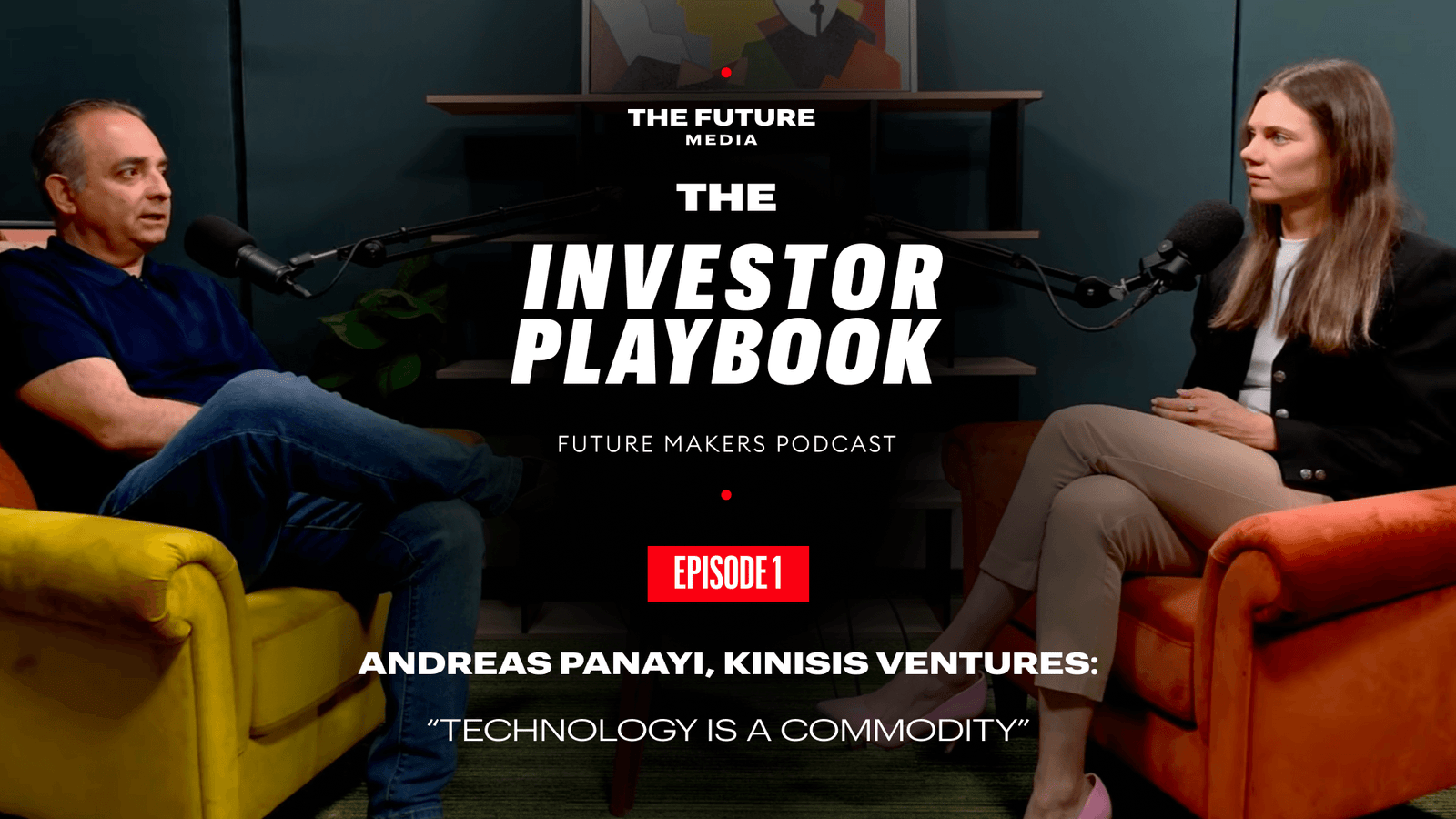
Andreas Panayi is the first guest on The Future Makers: The Investor Playbook. The full conversation, including his views on solo founders, what European startups get wrong about the US market, and why failure is part of the job description, is available to watch now.
The Future Makers Podcast: The Investor Playbook is a series of in-depth conversations with investors about the experiences, instincts, and decisions that shape how they back founders and ideas. Host Annetta Benzar looks beyond the deals to understand how investors think, what influences their judgment, and what founders can learn from the way they see the world.
A production of The Future Media.