


Editorial disclaimer: The views, opinions, and claims expressed in this interview are those of the interviewee and do not necessarily reflect those of The Future Media. The information shared is for general informational purposes and should not be considered legal or tax advice.
Moving abroad does not necessarily mean leaving your tax obligations behind. You might have a new address, a new tax number and even tax residency in another country, while still retaining obligations in the one you left.
Follow THE FUTURE on LinkedIn, Facebook, Instagram, X and Telegram
Alina Kulikovska, co-founder and CEO of RELOC8 ONLINE, offers an example of a UK business owner who relocates to the UAE while his wife, children and company remain in Britain. He has physically moved and may have established tax residency in the UAE, but his continuing ties to the UK could still affect his tax status there.
According to Kulikovska, people often underestimate the importance of those ties when planning a move. Family, property, employment and business interests can complicate a change of tax residency, sometimes leaving individuals with obligations in more than one country.
“It’s not only about taxation. It’s about changing your entire life system,”
she says.
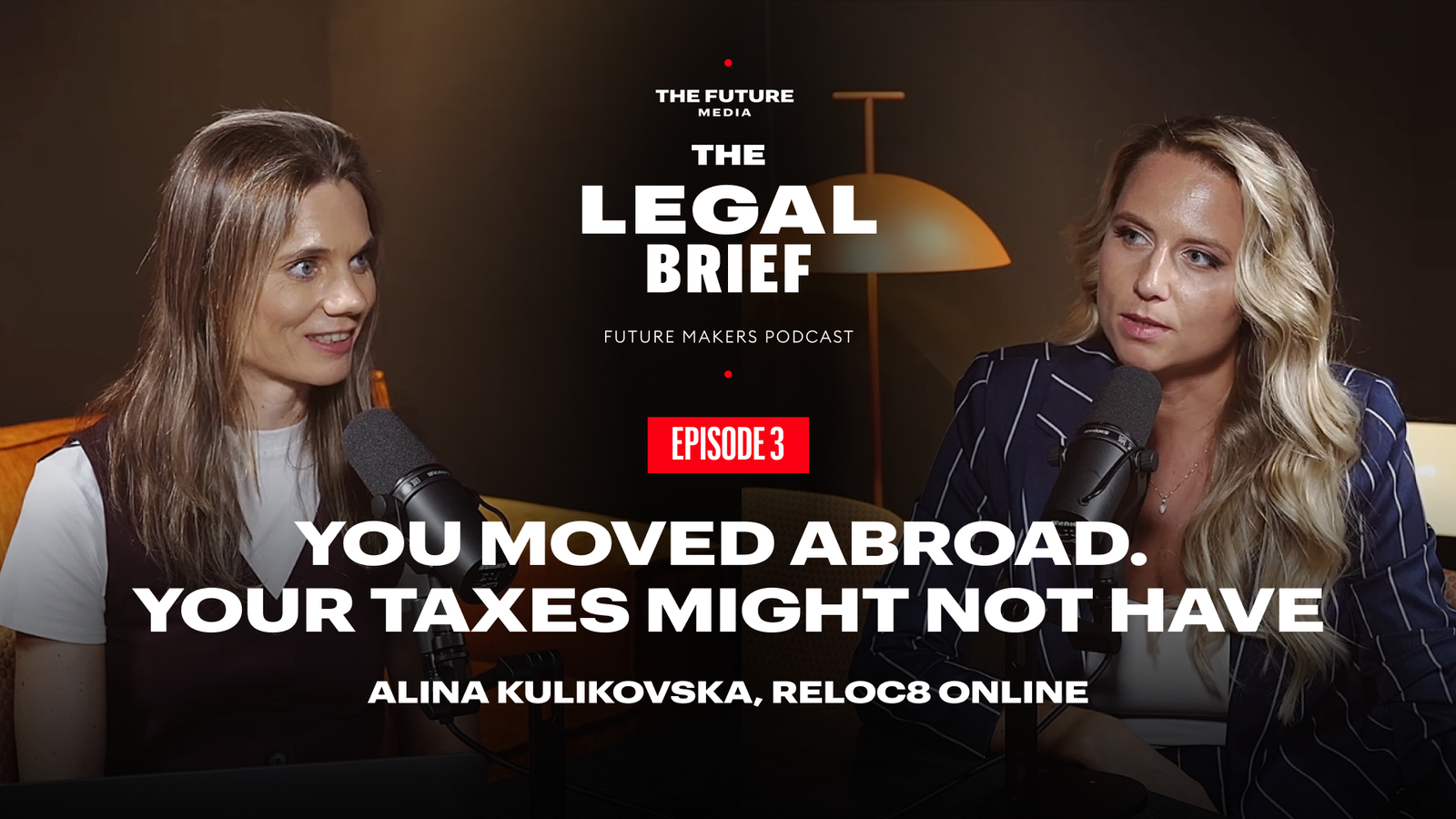
In this episode of The Future Makers: The Legal Brief, Kulikovska discusses the complications of changing tax residency, the challenges facing people who work across borders, and how her own experience of relocation led her to build a legal technology company.
The following conversation has been edited for length and clarity.
About The Guest
Alina Kulikovska is an international corporate and tax planning adviser and the co-founder and CEO of RELOC8 ONLINE, a Cyprus-based legal technology company. Her work covers corporate law, compliance, tax planning and relocation strategy, with experience across more than 30 jurisdictions.
She studied international law in Ukraine and initially pursued a career in corporate law before moving into international tax planning. Her own relocation from Ukraine to Cyprus, which took approximately three years, later influenced her approach to helping individuals and businesses relocate.
You once wrote that relocation changes your entire life system. What did you mean by that, particularly in relation to your own move from Ukraine to Cyprus?
I think my biggest advantage right now is that I went through relocation myself. My relocation process wasn’t easy. It took me about three years to relocate fully to Cyprus.
At that time, my main goal was to find a good employer who would pay me a salary and help me with a work permit and a visa that would allow me to stay in Cyprus.
Back then, a sunny climate, the beach, a good company to work for, and a nice salary were important to me.
But moving completely changed my life. I came from Kyiv, where everything is fast because it’s a big city. Here in Cyprus, everyone is chilled. The lifestyle is totally different.
I’m very proud that RELOC8 ONLINE has two founders, and both of us went through the relocation process. We know how difficult and sometimes complicated it can be. It’s not only about taxation. It’s about changing your entire life, your lifestyle, the people around you. You lose friends and need to find new ones in a new country.
Many years ago, relocation for me was about having a good job and a nice lifestyle in Cyprus. But then I realised that I was earning a salary and receiving benefits. My accountant told me, “You know what? You have some tax benefits.”
I thought, okay, I have tax benefits. How can I use them?
And if I have these benefits, there are probably other people who have the same benefits but don’t know about them. Maybe this is something I need to tell them about.
Cyprus attracts a lot of new people and new tax residents, but not that many people know about its advantages. Everyone knows about Dubai, but not so many people know about Cyprus.
What do people usually misunderstand before they change their tax residence, and what is the hardest part of leaving one country’s tax system behind?
We think that we are going to move to another country, get a tax number there, and that’s it; we are a new tax resident. But it also depends on moving out of your own country.
If you are a citizen of the United States, you are a tax resident of the United States as long as you have the passport, so it is quite difficult for US citizens to change their tax residency.
The same goes for people moving from the UK, the Netherlands, or Denmark. The point is that we have some ties with the country, and once we move out, we need to either cut those ties or structure our lives in a way that gets us some benefits from them.
The main ties can be family members, property, business, employment, anything that keeps us attached to the country. Unfortunately, people do not pay enough attention to the need to cut their ties with the country they are leaving.
Say someone has lived in the UK all his life and decides to move to Dubai. He has a business in the UK and plans to keep it. He also has a wife and children. He says, “I’m going first, and in a couple of years I’ll bring you and the kids to the UAE.”
Technically, he has moved out of the country and is a tax resident in the UAE. But because his family and business are still in the UK, from the UK’s perspective, he is a tax resident of the UK.
So a person can be a dual tax resident, or a tax resident of three or four countries, depending on how many ties they have with each country. This is the biggest problem we are facing.
The OECD has suggested that technology has effectively turned many people into frontier workers, even when they do not physically cross a border. What are tax systems still getting wrong about how people now work?
The OECD is not a government that can say this is a new tax system or legislation that should be implemented. What it does is look at the current economic situation and business relationships around the world, and then tell tax authorities that there is a situation they need to pay attention to.
People are moving around while continuing to work in countries other than the ones where they live. Governments need to pay attention and make their own decisions about what to do with those people.
After COVID, a lot of people started moving around. They realised that they could be digital nomads, live in Spain or Portugal and work for a US company or another European company.
There are no questions for the companies, but there are a lot of questions for individuals who work like that.
Say you live in Spain but provide services to a company in the UK or the Netherlands. For those companies, nothing changes. They continue paying you either a salary or a service fee, and it is the responsibility of the individual to be recognised as a tax resident in the country where they are permanently living.
If I live in Cyprus, I will be considered a tax resident of Cyprus, and I have to report in Cyprus that I earned money from a company in the US.
Then I need to think about how to minimise my personal income tax. I might need to build a structure or an arrangement that will help me do that.
But originally, nothing changes for the company. It continues to pay me either a salary or a fee for my services.
RELOC8 ONLINE is a legal technology company rather than a traditional law firm. How does AI fit into the work, and what remains with the lawyer?
We are not just a law firm that helps people sort out taxation and tax residency. We are building a platform that, with the assistance of AI, will make the process of relocation smooth and easy, in the same way as booking a holiday on Booking.com.
RELOC8 ONLINE has two co-founders, and both of us went through the relocation process ourselves. We decided to combine the legal side, which involves complicated day-to-day conversations with clients, with technology.
Most people don’t know where they want to relocate. They talk to friends and search online, where they find conflicting information. One person recommends Portugal, another says Malta, Spain or Cyprus. But everyone’s circumstances are different.
We realised that AI could help our clients find solutions much faster. We have built a system that can help them make that decision within a couple of minutes.
Of course, we cannot change how long governments take to process documents. But we can reduce the time people spend deciding where to go.
Our platform helps people find a destination based on their lifestyle, family situation, and business arrangements. It takes them from not knowing where they want to go to having an answer in just a couple of minutes.
But the technology we are building is a helper to the lawyer. It is not something that is going to take over from us as a legal team or as legal tax advisers. AI helps accelerate the process and solve many smaller issues that would otherwise require a lot of attention. It allows us to do that work faster and better.
In the full episode, Kulikovska discusses why she doubts a harmonised EU tax system will arrive within five years, the relationship between tax considerations and quality of life, and the challenges of protecting clients’ personal data when using AI. She also considers how faster relocation processes could support Cyprus’s ambitions to attract international technology professionals.
WATCH OR LISTEN TO THE FULL EPISODE
The Future Makers: The Legal Brief is a series of in-depth conversations with legal professionals about the profession, its blind spots, its clients, and the technology that is reshaping how the work gets done. Host Annetta Benzar looks past the credentials to understand how lawyers think, where they are ahead of the curve, and where they are being left behind.
A production of The Future Media.