

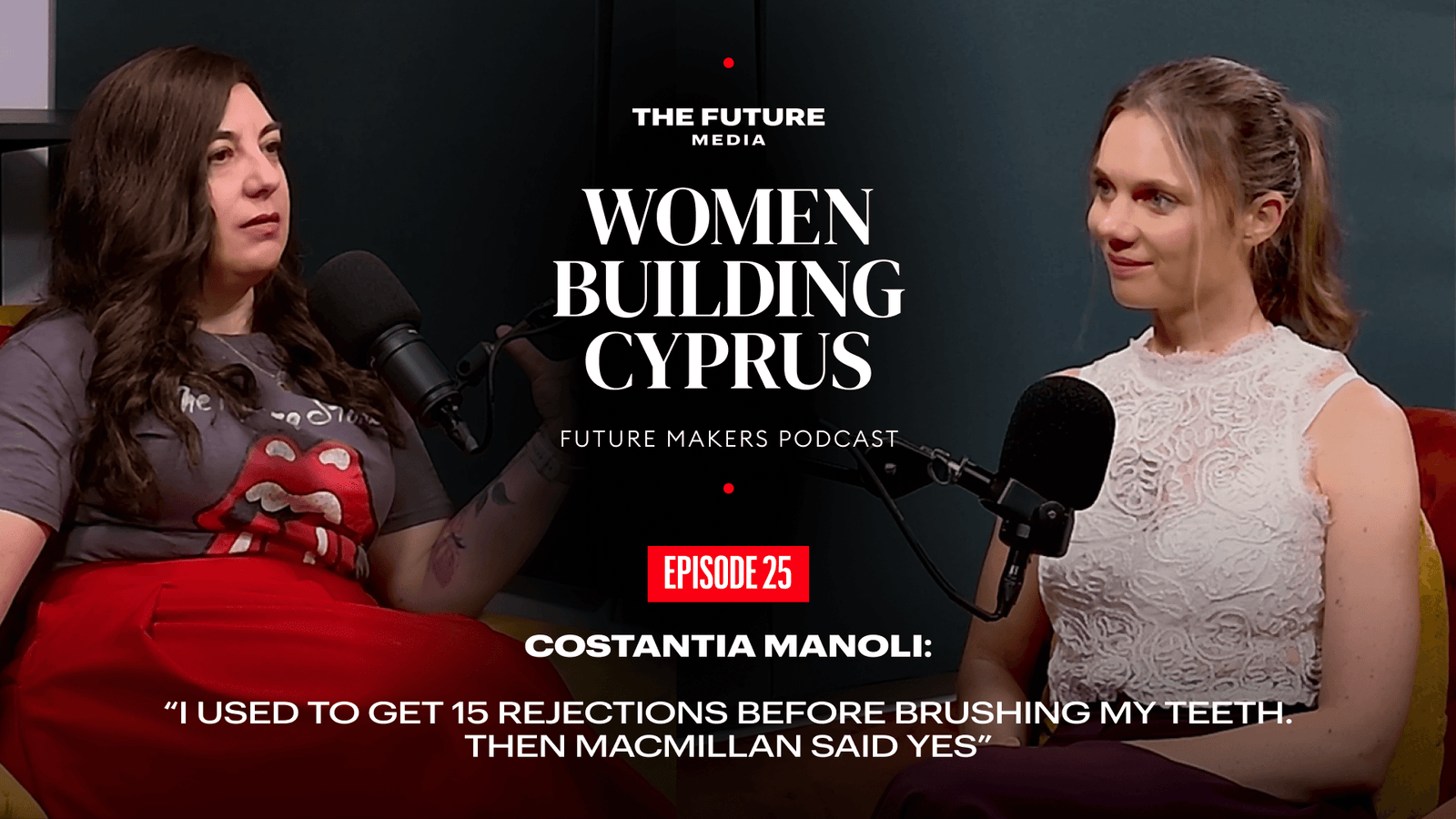
Most people know the story of JK Rowling being turned down by twelve publishers before Harry Potter was finally picked up. The media called it one of the great rejection stories in publishing history. “I’d get fifteen before brushing my teeth,” she says. That is the difference between writing and publishing, especially if what you have your heart set on is a children’s picture book. Frustration grows into self-doubt, into a cold, numbing feeling of failure day after day, month after month, and sometimes even years pass by before finding an agent, then more years to find a publisher. Then even more years to find an editor willing to make an offer. But of course, some very special ones make it. Costantia Manoli is now one of the rare Cypriot authors to have broken into the American children’s publishing industry, and she has done it with one of its biggest houses: Macmillan Roaring Brook. But successful as she is, she refuses to let go of the roots that got her there.
Follow THE FUTURE on LinkedIn, Facebook, Instagram, X and Telegram
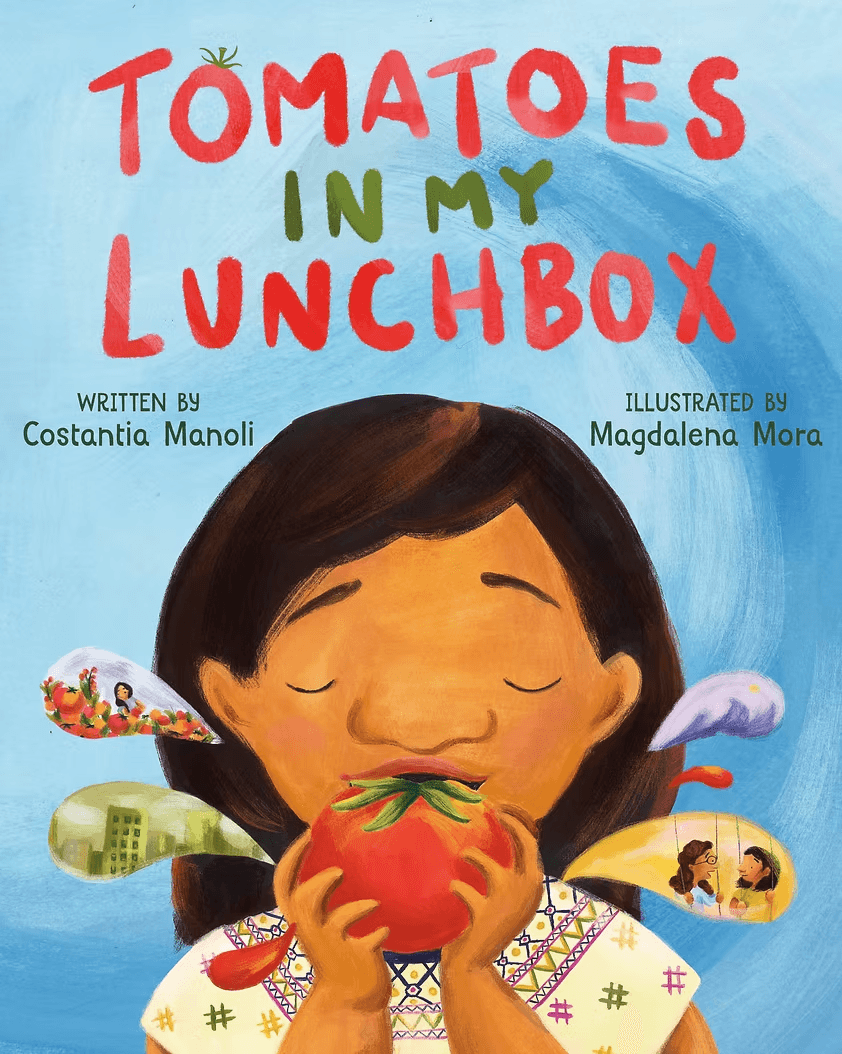
Costantia Manoli is the award-winning author of Tomatoes in My Lunchbox and The Fig Tree, both published by Macmillan Roaring Brook. She was a finalist for the 2023 Ezra Jack Keats Writers Award and won the inaugural Stephen Fraser Encouragement Award from the SCBWI the same year. In 2025, she was a finalist for the Study UK Alumni Award in the Culture and Creativity category and for the Cyprus Diaspora Award in the Literature category. Born in the UK to Cypriot parents, she now calls a small Cypriot village outside Larnaca town home, teaching English at a local private school and writing children’s books that are read to children in classrooms across several continents.
Manoli’s parents left Cyprus for London after the 1974 war. Her father had been on the front line and stayed on in the army before joining her mother in the UK. Costantia was born in London and spent the “picture-book years” of her life there. Her parents encouraged their children to maintain a connection to their roots. There was the Friday Club at Haringey College, where Anglo-Cypriot parents drank coffee while the kids did what kids love to do: run riot. Greek school. Greek dancing at church halls and dinner dances across London, in stoles and holding gizzes, “performing what most Anglo-Cypriots of my generation would have experienced.” Manoli has, she is honest to admit, a difficult relationship with the Greek language. “I can speak Greek fluently, but I do stumble,” she says, “and I find it embarrassing. There is a bit of shame that goes with that as well.” She has lived in Cyprus far longer than she has ever lived anywhere else. She still defaults to English when she orders in a restaurant.
At nine, the family moved back to Cyprus. Costantia was a shy child. “That was the word that was used in the 80s. Shy. And it was not used in a positive way. I was told, ‘Don’t be shy.’ Okay, I’ll just stop being shy.” When her parents decided to move their family back to Cyprus, Manoli decided it was time to try to be a different Costantia. She was not going to be shy anymore. She did not know how she was going to stop, but she was going to. She was nine years old. “It’s something I’ve had to work on every single day since,” she says. “It’s not something you just stop or get rid of. It’s something you learn to manage. And there’s a lot of smoke and mirrors involved.”
What she means by smoke and mirrors is to behave in a certain way, and people start treating you in that way. When they treat you in that way, the cycle reinforces itself so you end up with an appearance of confidence and no apparent social anxiety, when in fact you are managing crippling anxiety on the inside.
“You live up to that image you’ve created. It’s healthy in a way. You find ways to manage those issues. The flip side is that it’s still there. It doesn’t go away. I still have to talk myself down from what would now be called anxiety,”
she explains.
The women who shaped her earliest understanding of what a woman could be were, at first, her mother and her older sister, both of whom she describes with heartfelt warmth. But the real turning point for Manoli was being taught by female teachers for her A-Levels. “These educated women talking in such an eloquent way, with all this knowledge and understanding.” Her own parents had gone straight to work from school. Manoli, her sister and her brother were the first generation in the family to be educated all the way to university. Watching her A-level teachers, women the same age as her parents but living completely different lives, was, as Manoli puts it, an eye-opener.
After studying English in the USA and the UK, she returned to the island, started to teach, got married, and life went on. The need for creativity was there the whole time, however. She had always painted, always drawn, always been the “artist” in her family and friends’ groups. What she did not do, until much later, was write for publication. That came after her children were born, while she was on maternity leave and, she is embarrassed to admit, bored. “Babies are demanding, and it’s this fog of love and nappies and milk, and it’s wonderful, but when you take yourself out of it for just a moment, you think, what am I doing with my time?” She started crocheting small animals. Then she started reading more children’s books because she had babies to read to. Then during one of those underslept mornings, she got to thinking, as you do. Staring at the pile of children’s books by her baby’s cot and needing to get through the next hours of the day, she wondered if she could write a children’s book. Like, how hard could it be? It’s just a couple of words and some pretty pictures, right?
“It is the hardest thing I have ever done,” she says now, laughing at her early naivete. What she had underestimated was not the actual writing, though that was already extraordinary. The picture book form, she quickly discovered, was closer to poetry than to prose. Every word had to earn its place. The form was so tight; there was no room for any extra words. What she had really underestimated was the publishing industry.
The path into publishing runs, for almost every children’s picture book writer, through an agent, and very few of the major publishers will accept unsolicited manuscripts. The agent is the first gatekeeper. After having no luck doing it on her own to sign with one, Manoli joined a community of children’s writers called “12 x 12,” where members at a certain tier of membership could submit to a small rotation of agents each month. She applied for a diversity scholarship, hesitating over whether her Cypriot identity qualified as diverse in the American publishing sense. “That comes back to the whole postcolonial hybrid identity. Are we diverse? Are we not? I don’t know.” The scholarship organisers said yes. She was awarded the scholarship, so she began submitting each month.
In June 2019, she submitted to Jennifer Weltz, president of the Jean V. Naggar Literary Agency (JVNLA) in New York, and signed soon after. Within a couple of weeks, Manoli received an offer for Tomatoes in My Lunchbox from Connie Hsu at Roaring Brook, Macmillan. Then, because signed contracts in publishing take months, especially when the world is about to go into lockdown, it took several years and a two-book contract before the actual books arrived in the world. Tomatoes in My Lunchbox came out first. The Fig Tree followed in the summer of 2024.
Tomatoes in My Lunchbox is a story about the first day of school, threaded with themes about belonging, the immigrant experience, and the universal need to find a place to call home.
The Fig Tree is a different kind of book. It is set along the Green Line that has divided Cyprus since 1974, and it grew out of two intertwined sources. The first was Costantia’s own family history. Her father served on the front line in the war. Manoli carried that intergenerational awareness of division throughout her whole life, especially into her extensive work in bicommunal peace-building programmes that took Cypriot students from both sides of the island to the United States to live and study together. The second source is more painful. One of those students, a young Turkish Cypriot woman named Christiana, developed a deep friendship with a Greek Cypriot girl during one of the programmes. Christiana died in a car accident on the other side of the line in her early 20s. Manoli had just had her own first daughter. “She was such a beautiful, bright young woman. So much love and kindness and potential. And she just died.”
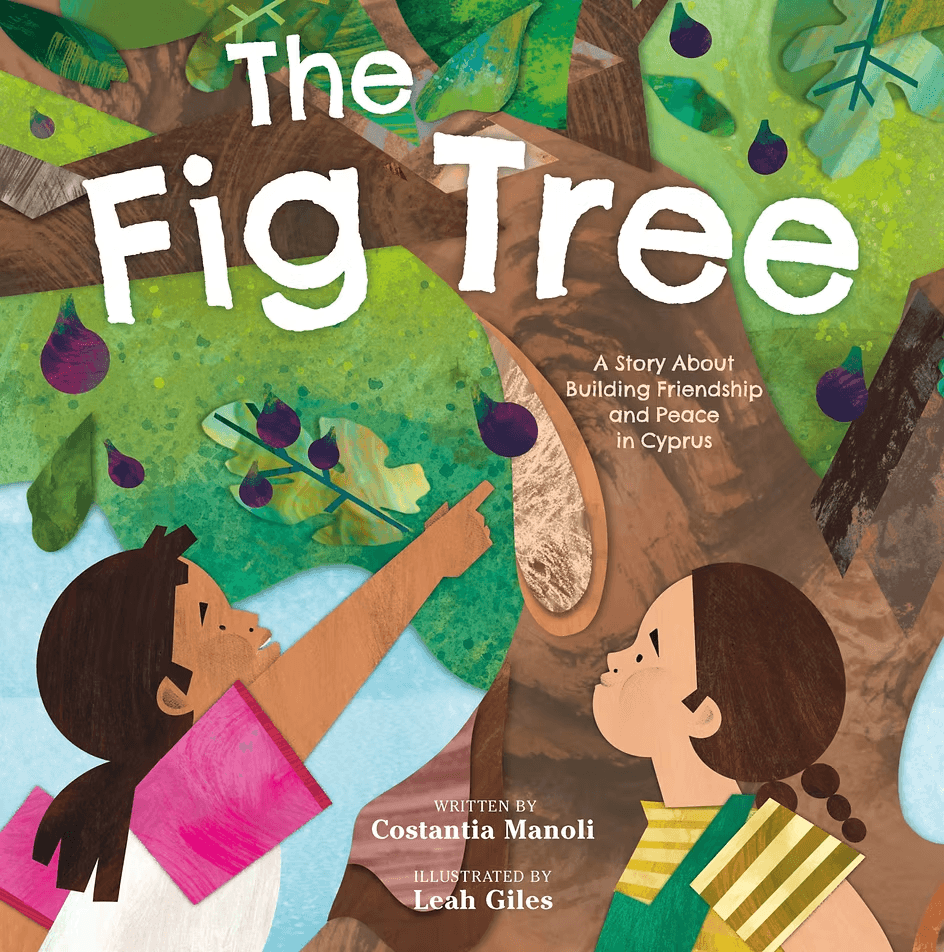
What Costantia found herself thinking about, in the months and years after, was what actually resolves conflicts between peoples. Politics, in her observation, has not managed to find a way to move forward. Perhaps there is a political solution to Cyprus, she says, but so far, none has been found. Something in the combination of Christiana’s death, the friendships she had watched form across the island’s divide, and staring out at the barbed wire outside her kitchen window, all fed into what eventually became The Fig Tree. Manoli rewrote it no less than ten thousand times. Her editor at Roaring Brook eventually asked her, one day, why she did not try writing from the perspective of a tree. “I’ve been thinking about writing a tree book,” she said. She tried it. It worked.
What Costantia keeps returning to, in the interview and in her wider public work, is the distinction between process and product. Publishing is a product-focused industry. A book is a tangible thing you can sell, hold, market, review. But writing itself, and every other art form she can think of, is fundamentally about the process, not the product. The product is what you are left with at the end, and if the product succeeds, wonderful. If it does not, you have still done something. You have still made something out of nothing. This is why she is genuinely worried about AI. “The focus with AI is product. It’s not process. What is the point of the product if there is no process? It’s just a thing. There’s no meaning to it.”
She does not hold back when it comes to people who believe posting AI-generated images or texts online makes them artists.
“You did not make that. You put together a prompt. You did not make that. And AI did not really make it either. AI just ripped off everybody else and put together a bad composite of other things and created this thing that you now feel proud to put out. But why? What’s the purpose of it?”.
Her concern is not about trying to maintain an aura of sacredness around creativity. It is about what art actually does.
“The thing that draws us to art, any kind of art, is not the product. It is what we see in it. It is how we understand it. It is what resonates with us. If something is being created by AI, what are you resonating with? Nothing.”
The future Costantia is working toward is one where the humanities and the arts are loved and appreciated again, and where children in particular are given access to what art gives a person. That is the ability to make sense of themselves, to find themselves in a story, to be happy sitting quietly with a book and come out changed. She has access to young minds through her teaching, and she takes the responsibility of that seriously. “I feel the responsibility perhaps even more than I did in previous years,” she says. “Young people need to know AI is not the solution. It’s not the answer.” She wants them to read. To create if they can. If not, at least to experience. Go and watch a play. Go to an art exhibition. Live it.
“And then, you know, if you want to make something, make something. It doesn’t have to be a song on the radio or a painting on someone’s wall or a book. Just do it anyway.”
Costantia Manoli is a guest on The Future Makers: Women Building Cyprus. The full episode, including her reflections on postcolonial identity, why she is worried about what AI is doing to young minds, and how she rewrote The Fig Tree ten thousand times to arrive at a story told from the perspective of a tree, is available to watch now.
The Future Makers Podcast is a series of in-depth conversations about how future-makers are made, in Cyprus and beyond. Host Annetta Benzar sits down with people who are a leading force in our shared future and looks past the titles. Together, they travel back to the people and moments that shaped them, walk through the choices and challenges they are living through now, and look ahead to the futures they are trying to build.
A production of The Future Media.