
“When you lose, don’t lose the lesson.”
Anna Koukkides-Procopiou kept that line above her desk for years. Though far from the typical motivational “go, get it girl” that is sold in bulk these days, it is these words that the former Minister of Justice returns to find her way back out of any not-so-bright moment in her life. As the eldest of four children, the one everyone looked up to and towards, the expectation was that she, a good student, would follow the path of all good students of her generation. That is, to become a doctor. Anna chose history instead. And then politics. She learnt the hard way to take the road less travelled by. Lost parts of herself for a moment. But she has not, by her own account, lost the lesson.
Follow THE FUTURE on LinkedIn, Facebook, Instagram, X and Telegram
Anna Koukkides-Procopiou is the President of the Politeia think-tank, the founder of Women Act Cyprus, and a former Minister of Justice and Public Order of the Republic of Cyprus. She holds degrees in Economics and History from UCL, a Master’s in International Relations from LSE, a certificate in Religion and Politics from the MacMillan Center for International and Area Studies at Yale, and is a professionally certified Political Risk Analyst by Teneo Intelligence, one of the biggest political intelligence providers in the world. In the past, she worked as a Consultant on the Turkey/Cyprus project of the Europe and Central Asia Program of the International Crisis Group.
She has served as an accredited Cyprus expert for the World Bank and is a member of the UN Senior Women Talent Pipeline in New York. Anna is also a member of Exxon Mobil’s Global Women in Management team, based in Washington DC.
But before she could even imagine where life would take her, Anna was a young woman rebelling. When she told her family she wanted to study history, the reaction was predictable. “What can you do with it?” She did it anyway, combined it with Economics at UCL, and set a precedent she has carried ever since.
“I do not have a fear of changing things when I don’t like them, and that is not usual in Cyprus,”
she says.
The British education system she entered was unforgiving in a way she now values. No makeup exams. No second chances. If you failed, you came back in June. “There was no forgiveness,” she says. “You had to go, and you had to deliver.” If anything, she sharpened her resilience.
Her career moved in ways nobody could have scripted. From co-building a think tank to jumping into the corporate world at Aphrodite Hills, where she arrived knowing nothing about real estate or golf courses and left years later as Operations Manager when the company had grown from thirteen employees to five hundred. Each door, she says, was opened by someone who saw something in her that crossed the boundaries of what she already knew.
“Your benchmark cannot be Cyprus. Your benchmark needs to be what’s happening outside in the rest of the world,”
she says.
When the president called and asked her to become Minister of Justice and Public Order, she did what she suspects most men in her position never do. She sat down and went through the portfolio honestly. Security — a decade of expertise. Gender-based violence and trafficking — familiar ground. Human rights, international law, sanctions — she knew them well. The judicial reform process was the one gap. Doubt crept in; she almost stepped away from the offer. Finally, she said yes.
What followed was a year of work she still remembers with a smile that reaches her eyes. A plan for the prison building drawn up by May. The national archives, which she found scattered across warehouses in Nicosia in a state she describes as “a disgrace for the Republic,” moved to the Deputy Ministry of Culture to be treated as a national treasure. Trafficking brought under the Ministry of Justice’s remit. Seventy percent of the five-year targets set by the president completed or substantially underway within twelve months. “I feel proud of the things we achieved in the space of a year,” she says.
But the other part of the story, the part that says more about the environment she was working in, is harder to tell without feeling anger. The media would not leave her alone. There was fair and far between coverage of the actual work she was doing and more on what she wore. There were headlines about things she never said. There was a story about an empty chair at a meeting of twenty people. A chair that was not even present, next to a person who was never meant to be there in the first place. She contacted the journalist directly. He ignored her. She contacted the editor. Same reaction. “This story was running,” she says. “Despite twenty witnesses backing me up.” She lost her trust in the media, and almost in truth itself. How could she not, when her own words were being thrown back in her face as false?
She has learnt her own lesson from her experience.
“In politics rarely do people care about the actual work. It has to do a lot with networking, with agendas, with hidden stories the public never gets to hear.”
Going in with the assumption that good work would be enough, that, she says, was “a naive impression.” She would go in with zero expectations next time.
The conversation then moves somewhere few public figures are willing to go. She has spent years working on the question of why a substantial number of Greek Cypriot women voted “no” in the 2004 Annan referendum. It’s an anomaly, she says, because the research suggests women tend to push for peace. She and fellow researcher Sophia Papastavrou ran focus groups to understand the logic behind the vote. What they found was not hardened opposition to the referendum. In fact, they were not even informed on how to contribute to the political process. “Men talk about guarantees and armies,” she says. The women, when finally asked, talked about everyday problems like walking alone outside at night. The fear they still had around their safety post-1974, which flowed into every aspect of their life, including the choices they made to protect themselves, their families, and their communities, in the only way they knew how.
This fear is rarely talked about or addressed by the systems that promise security to all in a democratic state. Anna Koukkides-Procopiou and Sophia Papastavrou’s research showed that between 0.5% and 1% of the Greek Cypriot female population was raped by the Turkish army in 1974. “How could we have never dealt with this?” she asks. “Why are we not talking about this?” Anna refused to call these women victims; they are survivors. She believes Cyprus has not done nearly enough to vindicate them or give them their dignity back.
“How can you have democracy if you don’t have democracy for all?” Cyprus ranks last in the European Union in terms of gender inclusion. Its parliament has the lowest female representation in the EU. Since the Republic was founded in 1960, only ten percent of all ministers appointed have been women. “What kind of democracy is this?” she says. It is not a rhetorical question.
“Each one of us has a duty and a responsibility as an active citizen to try and improve society and the world we live in. Just a little bit more than we have found it,”
she says.
And her final value, which is the last lesson she shares, “You are what you do. Don’t tell me who you are. I can see what you do.”
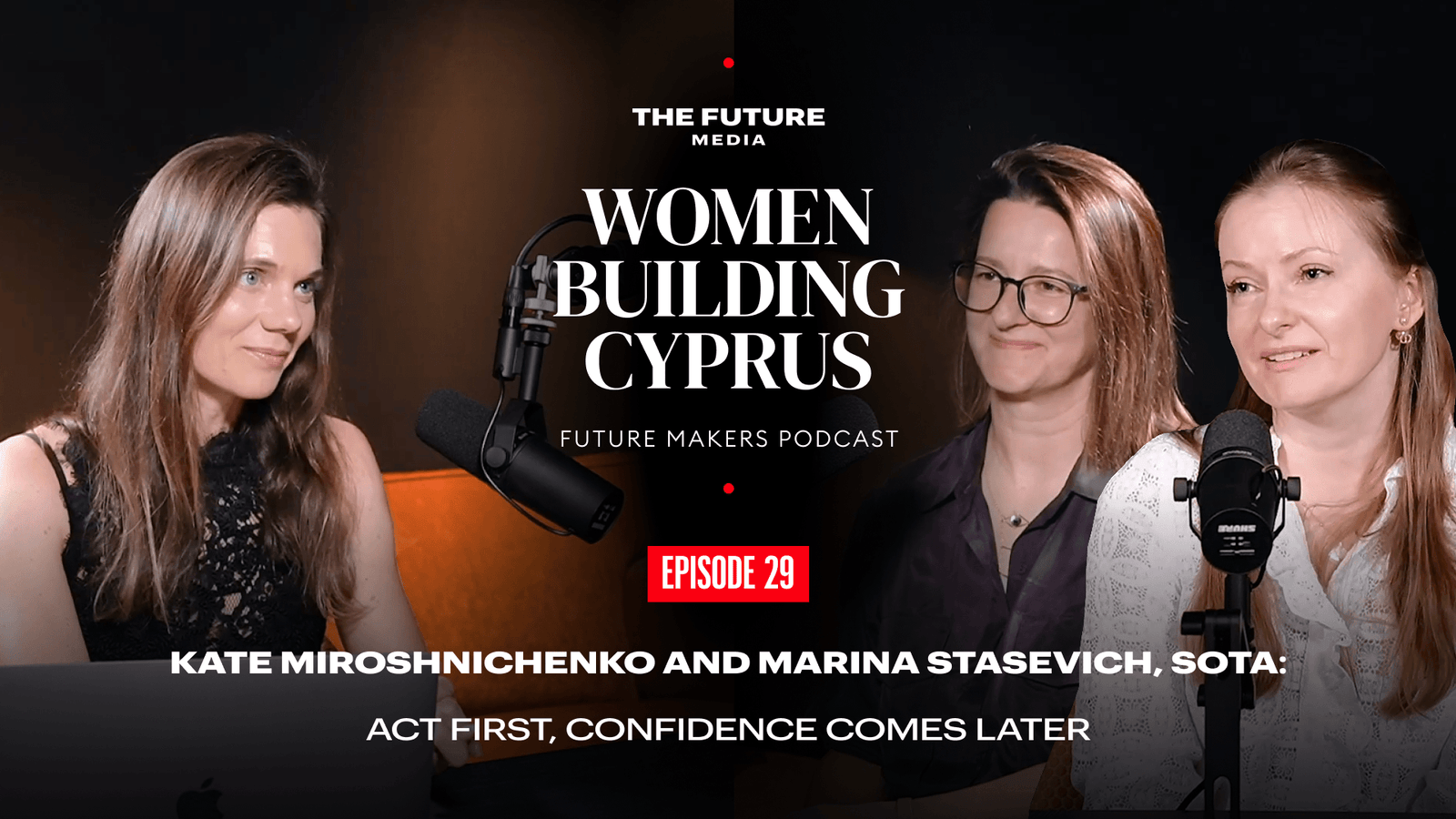
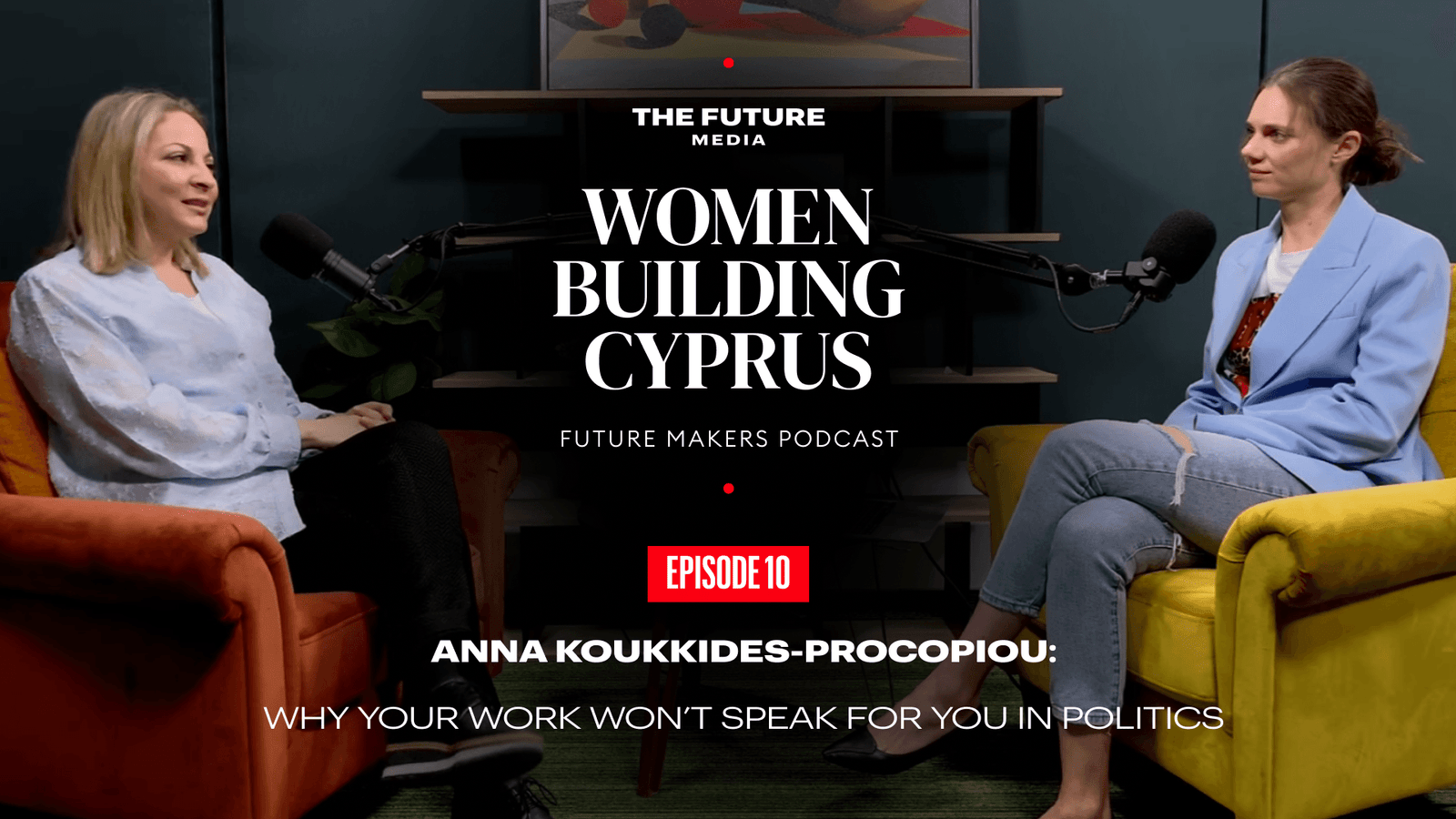
Anna Koukkides-Procopiou is a guest on The Future Makers: Women Building Cyprus. The full episode, including her account of the empty chair story, her research on women and the Cyprus peace process, and her argument for why security in Cyprus still lacks a doctrine, is available to watch now.
The Future Makers Podcast is a series of in-depth conversations about how future-makers are made, in Cyprus and beyond. Host Annetta Benzar sits down with people who are a leading force in our shared future and looks past the titles. Together, they travel back to the people and moments that influenced them, walk through the choices and challenges they are living through now, and look ahead to the futures they are trying to build.
The first season, Women Building Cyprus, follows women whose lives and decisions are changing what this island can be.
A production of The Future Media.