Breaking news

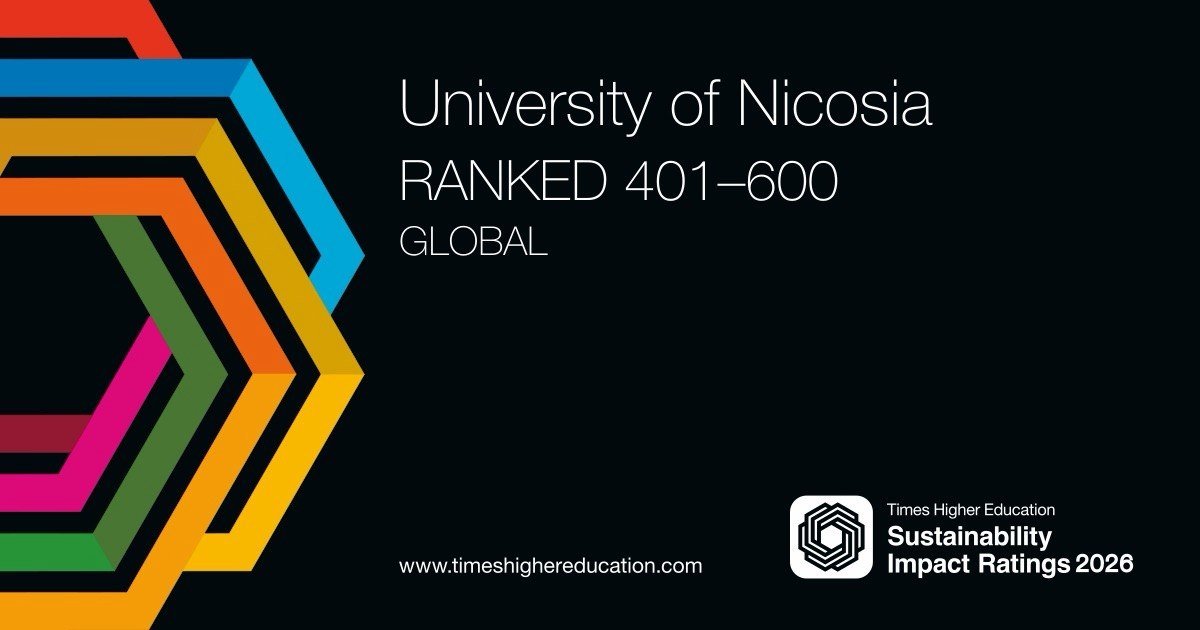
University Of Nicosia Ranked In The Global Top 600 In THE Sustainability Impact Ratings 2026

UNIC placed in the 401-600 band worldwide, strengthened its position among universities in Cyprus and Greece, and recorded standout results in SDG 10, SDG 11 and SDG 17

79b21d8c 03dc 44b3 a795 ed61e7618c17

The University of Nicosia (UNIC) has earned another important international distinction in the Times Higher Education (THE) Sustainability Impact Ratings 2026, ranking in the 401-600 band globally among 1,646 universities from 116 countries and territories evaluated across 17 individual SDG tables and one overall ranking.

This result places UNIC in the global Top 600 and reinforces the University’s standing as one of the region’s most internationally engaged higher education institutions. Based on the published results, UNIC is one of the universities from Cyprus and Greece to secure a place within this band, underlining both its regional strength and its growing international visibility.

UNIC’s strongest performances in this year’s results were recorded in SDG 10: Reduced Inequalities, SDG 11: Sustainable Cities and Communities, and SDG 17: Partnerships for the Goals, where it ranked in the 101-200 band globally. It also achieved a 301-400 result in SDG 3: Good Health and Wellbeing and SDG 16: Peace, Justice and Strong Institutions.

Particularly significant was UNIC’s strong result in SDG 17: Partnerships for the Goals, an indicator that carries special weight in the overall methodology of the THE Sustainability Impact Ratings. This performance highlights the University’s growing capacity to build meaningful academic, research, and societal partnerships that create measurable impact at both local and international level.

Commenting on the result, the Rector of the University of Nicosia, Professor Philippos Pouyioutas, said:

“This is a highly significant result for the University of Nicosia and one that we are proud to share. Our placement in the global Top 600 of the THE Sustainability Impact Ratings 2026 reflects the University’s sustained commitment to meaningful impact through education, research, outreach, and collaboration. Our particularly strong performance in Reduced Inequalities, Sustainable Cities and Communities, and Partnerships for the Goals demonstrates the values that define UNIC as a modern, outward-looking university, committed to contributing in practical ways to society and to the global sustainability agenda.”

Among the universities from Cyprus, UNIC is one of the universities included in the global Top 600, while across Cyprus and Greece it stands among the universities recognised for strong performance in this year’s sustainability-focused results. This positioning adds further weight to UNIC’s profile as a university that combines academic quality with social contribution and international engagement.

For the University of Nicosia, this latest recognition marks another important step in its continuing international development, highlighting the strength of its academic environment, the breadth of its partnerships, and the increasing impact of its contribution to sustainable progress.

Meta’s Muse Charm Is More Than A Gimmick — It’s A Bet On Fashionable AI

Meta’s newly announced Muse Charm is already prompting a familiar question: is this a clever attempt to make AI feel more approachable to mainstream consumers, or simply the latest entry in a growing graveyard of flashy hardware that failed to catch on?

Early reactions have been mixed. But one thing is clear: the form factor is timely. In a market increasingly shaped by aesthetics, personalization, and nostalgia, the Charm arrives with the right visual language for the moment.

A Device Designed For A Generation That Likes To Carry Its Personality

For Gen Z consumers, especially, the idea of technology as an accessory is hardly far-fetched. In the post-Labubu era, dangling objects have become cultural currency — from keychains and mini plush toys to beauty products reimagined as bag charms. The appeal is not purely decorative. These items function as signals of identity.

That is precisely why the Charm may resonate. Like the beauty-bag charm trend seen across products such as lip glosses, hand sanitizers, and fragrances, the Muse Charm blends utility with self-expression. It is not just a device. It is a style object.

Hailey Bieber’s Rhode lip case helped push that idea into the mainstream by turning a lip product into something closer to a fashion accessory. The brand’s commercial success underscored how powerful that overlap can be: beauty and utility are no longer separate categories, but increasingly part of the same consumer logic.

The same goes for Labubu, the fuzzy collectible that evolved from niche toy to global phenomenon. While demand for the character may have cooled, the broader bag-charm category has not. Analysts now expect the global market for these accessories to surpass $1 billion by 2030.

The Charm Fits A Wider Retro-Tech Revival

Meta’s Muse Charm also taps into a broader retro-tech movement that has been gaining momentum. Digital cameras, flip phones, iPods, CDs, cassette tapes, wired earbuds, and even landline phones are all finding new life among younger consumers who are increasingly skeptical of always-on, algorithmically optimized technology.

That skepticism has created room for objects that feel tangible, controllable, and personal. For many young people, especially women driving a great deal of this trend, physical tech offers something the digital world often does not: a sense of ownership.

That is part of the appeal behind the growing popularity of so-called cyberdecks, DIY portable computers that are often decorated with jewels, flowers, stickers, pearls, and other embellishments. The point is not just function. It is intimacy.

The Apple Watch Trend Shows The Market Already Exists

There is another, more immediate reference point for Muse Charm: the growing TikTok-driven trend of turning older Apple Watches into keychains, pendants, and bag accessories. Across Amazon, Walmart, eBay, and Etsy, thousands of such products already exist, ranging from practical straps to decorative cases.

In many cases, these items are being worn less as gadgets and more as fashion objects. That distinction matters. It suggests the market is already primed for devices that blur the line between technology and accessory — especially when the technology is small enough to personalize and visible enough to signal taste.

In that sense, Meta is not inventing a new behavior so much as trying to package an existing one.

Meta’s Biggest Challenge Is Not Design. It Is Trust.

Still, good timing does not guarantee success. The biggest obstacle facing Muse Charm may not be product-market fit, but Meta itself.

The company has spent years eroding consumer trust through repeated privacy controversies, regulatory penalties, and public scrutiny over harms to minors. That history is difficult to separate from any new device that asks users to invite Meta even deeper into their daily lives.

And that is the central tension. If Muse Charm is positioned as a free or low-cost AI companion, the real currency may not be the hardware itself but the data it generates. Meta has said it plans to monetize Muse through a small transaction fee, but the broader business model is unmistakable: highly personalized advertising powered by highly personal behavior.

For consumers, the calculation may come down to a familiar tradeoff. The device may be playful, fashionable, and culturally on point. But whether users are willing to trust Meta with another layer of their lives is a far harder question.

That may ultimately determine whether Muse Charm becomes a breakout product — or just another well-designed gadget that could not overcome the baggage of the company behind it.

Aretilaw firm
The Future Forbes Realty Global Properties
Uol
eCredo

Become a Speaker

Become a Speaker

Become a Partner

Subscribe for our weekly newsletter