

In olive-growing towns, there’s a predictable rhythm to the season. Trucks queue, presses run, oil flows. Then the yards empty, and a dull quiet settles around the mill. What doesn’t fade is the smell. As the hours pass and the sun continues to beat down on the piles upon piles of olive residue, the smell thickens. It stops being just a nuisance. Poorly managed residues can ferment and leach, and if the only options for disposal are dumping or burning, the issue turns from an inconvenience for the neighbours into a wider environmental and public-health concern.
The scale of the problem is what makes it hard to ignore or treat as a local concern. The European Commission estimates the EU produces 67% of the world’s olive oil and has around four million hectares dedicated to olive cultivation, concentrated largely in Mediterranean member states. The result is an extensive and recurring residue stream. A recent peer-reviewed review states that olive pomace, the main solid by-product of extraction, accounts for approximately 35% to 40% of the weight of olives processed. Other research estimates olive-processing wastes globally at close to 40 million tonnes a year, with wastewater volumes large enough to be treated as a standalone environmental management issue.
Follow THE FUTURE on LinkedIn, Facebook, Instagram, X and Telegram
The EU does not lack policy on where these streams should go. The Waste Framework Directive hierarchy prioritises prevention, reuse and recycling over disposal. The Commission’s circular economy agenda is designed to keep resources in higher-value use for longer rather than treating them as an “end all.” However, the residue stream under these policies is still treated as a waste problem, and there is still no straightforward, accessible and cost-efficient route to recovery, not option “C,” which is why dumping or burning remains the comfortable default.
Pit-to-Table, a Cyprus-based climate-tech and innovation company, is taking olive pits and transforming them into a surface material for interiors and furniture applications. The aim is to repurpose low-value “waste products” into interior boards and panels, with a wider mission to reframe and redirect waste streams into higher-value products rather than a disposal nuisance.
In this interview for The Future Media, founder Mustafa Afsaroglu of Pit-to-Table explains how his team is turning olive pits into a usable material, what it takes to meet real-world performance expectations in interiors and furniture, and why circularity only scales when the product works on site, not just in a lab.
1. To begin, how do you introduce yourself and Pit-to-Table?
I’m Mustafa Afsaroglu (Mus), co-founder of Pit-to-Table, alongside Yağmur Fellahoglu and Buğra Ebeler.
We are a Cyprus-based climate-tech and materials innovation company that takes olive oil waste and turns it into durable panels for interiors, construction, and furniture. Our current product is Pit-Board.
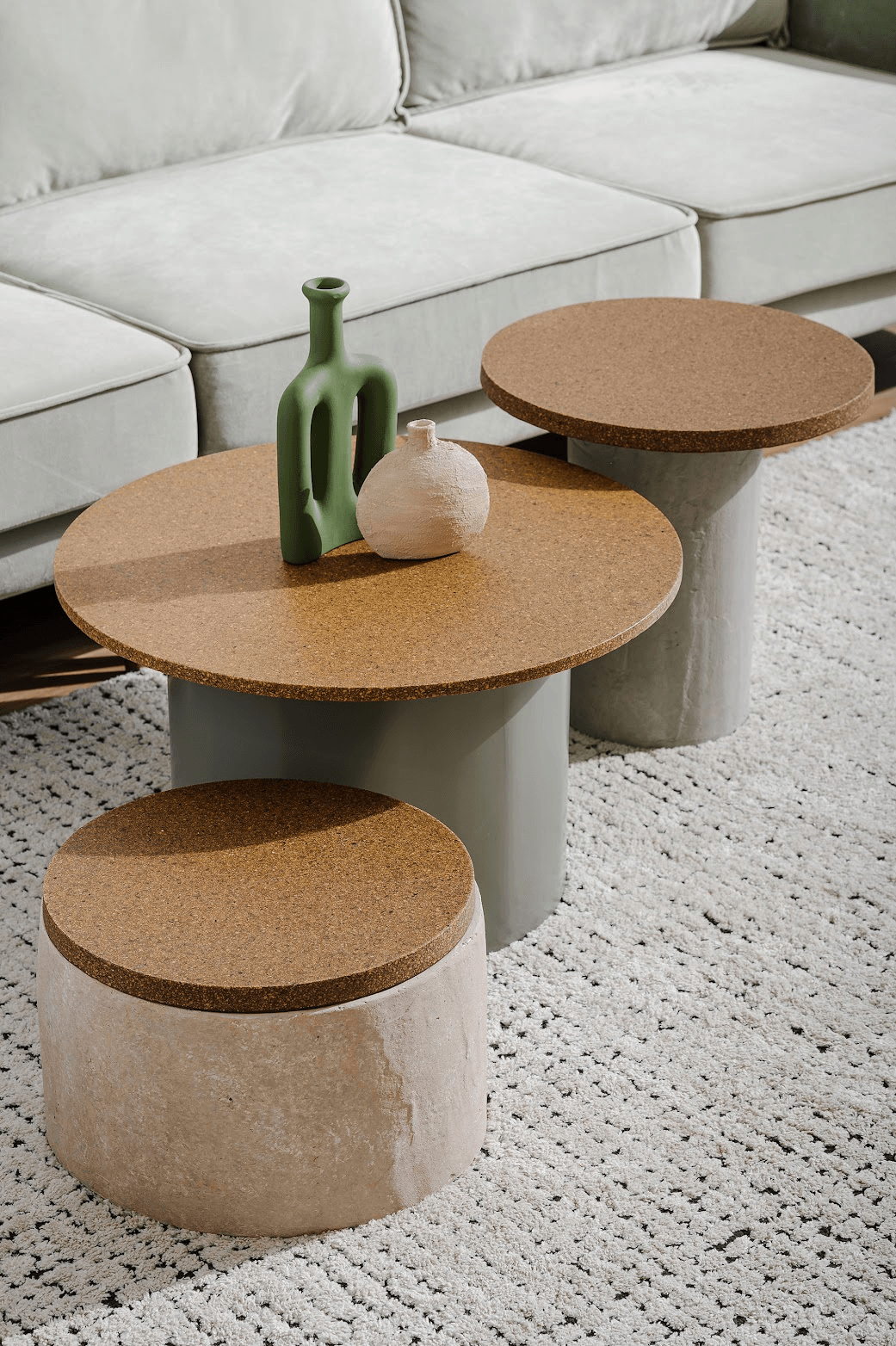
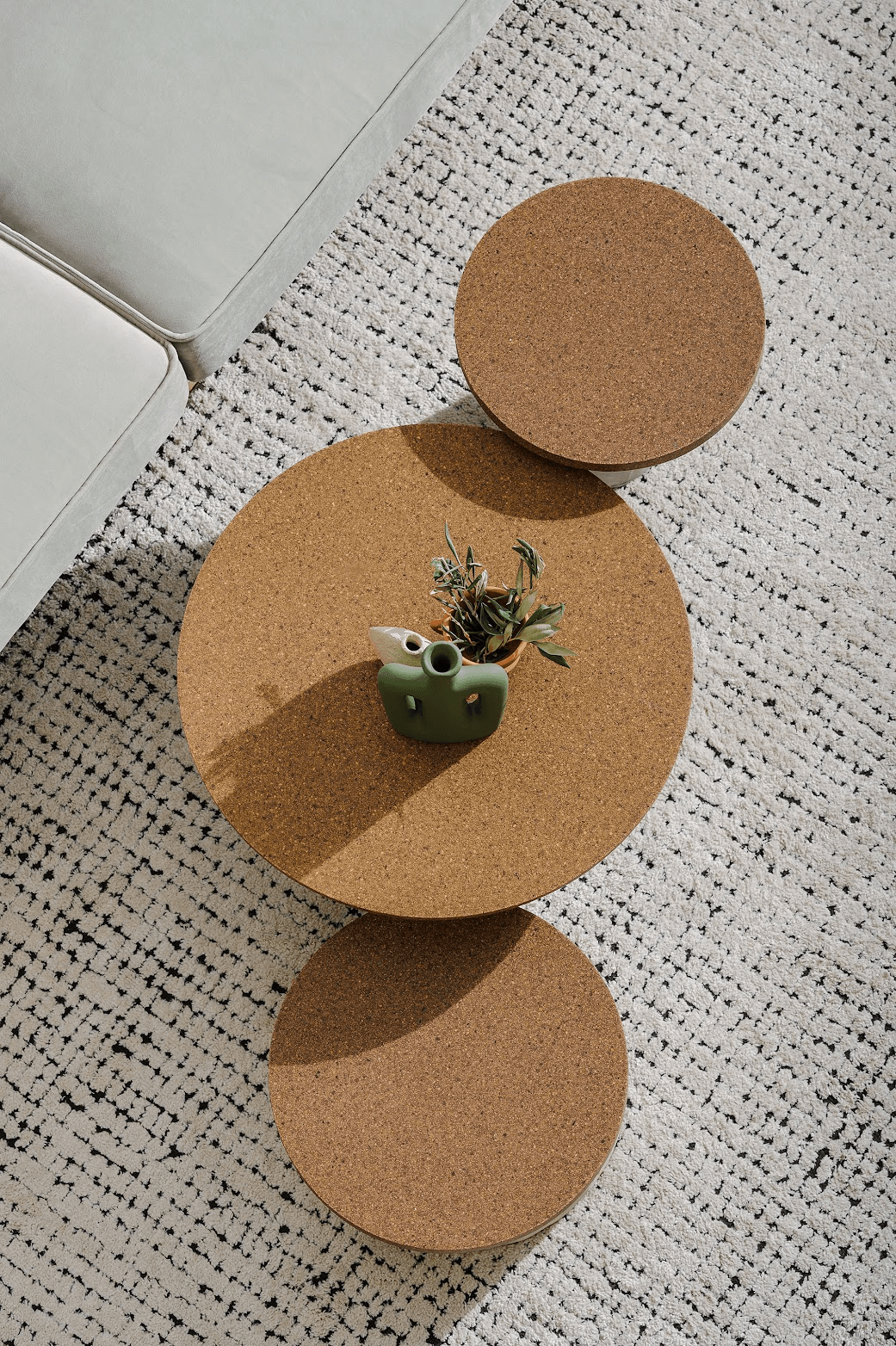
At the core of what we do is waste repurposing. Even though we are producing panels today, the bigger mission is to understand waste streams and what they can become. That is why we’re already exploring other applications too, from pit tiles to acoustic and decorative formats.
2. You spent years in the London design world before returning to Cyprus. What did that chapter look like, and how did it influence the way you think about materials, waste, and design?
London definitely shaped my standards.
I moved to the UK after high school, studied interior design in Bournemouth, and then stayed in the London design world for years. It exposed me to complex projects and demanding environments, whether that was workplace and hospitality work, all the way to global supply chains and high-end materials. I worked on projects like Google’s headquarters in Dublin and Facebook’s offices in London, and I learned what “performance” means in real-life construction.
That experience also made me obsessed with materials. I kept searching for new technologies and surfaces for projects, going to design trade shows from Chicago to Milan and spending time in showrooms across Europe. I was always drawn to materials with a story, and not just the default solution that gets shipped from far away.
When I came back to Cyprus, I didn’t just see olive pits as agricultural waste. I saw a raw material being overlooked.
3. Can you tell the origin story of Pit-to-Table? When did the idea first appear, and what made you decide to pursue it as a real business?
For me, it starts in childhood. I grew up in Cyprus, in Morphou, where olive oil wasn’t just food, it was part of our upbringing. Every harvest season, we would collect olives, take them to the mill, and wait for our oil. I remember mountains of waste accumulating outside the mills. And the smell. I will never forget the smell. At the time, it was just part of the landscape.
Years later, after working in the London design sector and seeing the surge in demand for sustainable materials, those memories came back. We were importing boards and surfaces from across Europe and beyond, while sitting on tonnes of organic waste each season. I kept thinking: why can’t we make something here and export it to the world?
The turning point was joining UNDP’s Youth Innovation Factory / Venture Building programme, based in the buffer zone at Ledra Palace. Over three intense months, my team and I developed a business plan, built a serious prototype, and pitched it. Winning gave us the external validation we needed to take our idea seriously. It wasn’t just a design experiment anymore; it had real commercial logic and momentum.
The team formation also happened fast. One of my closest friends is a management consultant in the UK, and through her network, we brought in an engineering counterpart. We applied together, got accepted, and that is how Pit-to-Table began. Even the name came out of that moment. We needed something that communicated the story quickly, and “Pit-to-Table” did.
4. What specific problem are you trying to solve?
We focus on two main problems.
First, agricultural waste. Olive pits often go to the landfill or are burned. When waste piles sit outside mills for extended periods of time, it affects the surrounding areas. It becomes a breeding ground for flies, and you can imagine the smell. When the waste is burned, however, it releases carbon. The direction of climate policy is tightening, so treating burning as the default endpoint is going to be harder to justify in the next few years.
Second, the construction sector’s environmental impact.
Construction is often mentioned as contributing around 40% of global carbon emissions. We also cut down billions of trees for wood-based products used in furniture, construction, and interiors. We aim to reduce that pressure by creating a circular alternative that keeps performance high while cutting waste and long supply chains.
5. For people who haven’t seen or been in contact with it, how would you describe Pit-Board as a material?
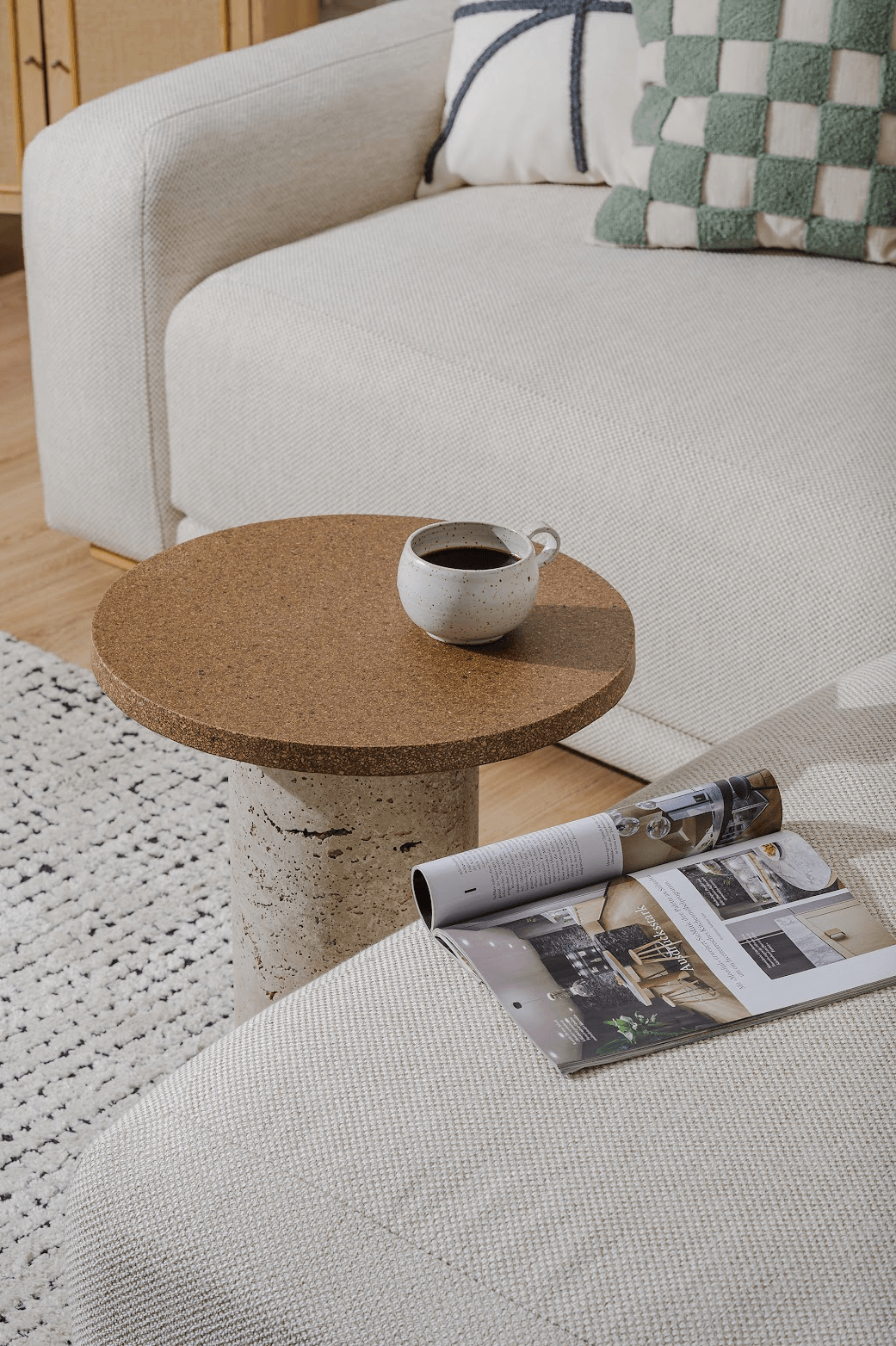
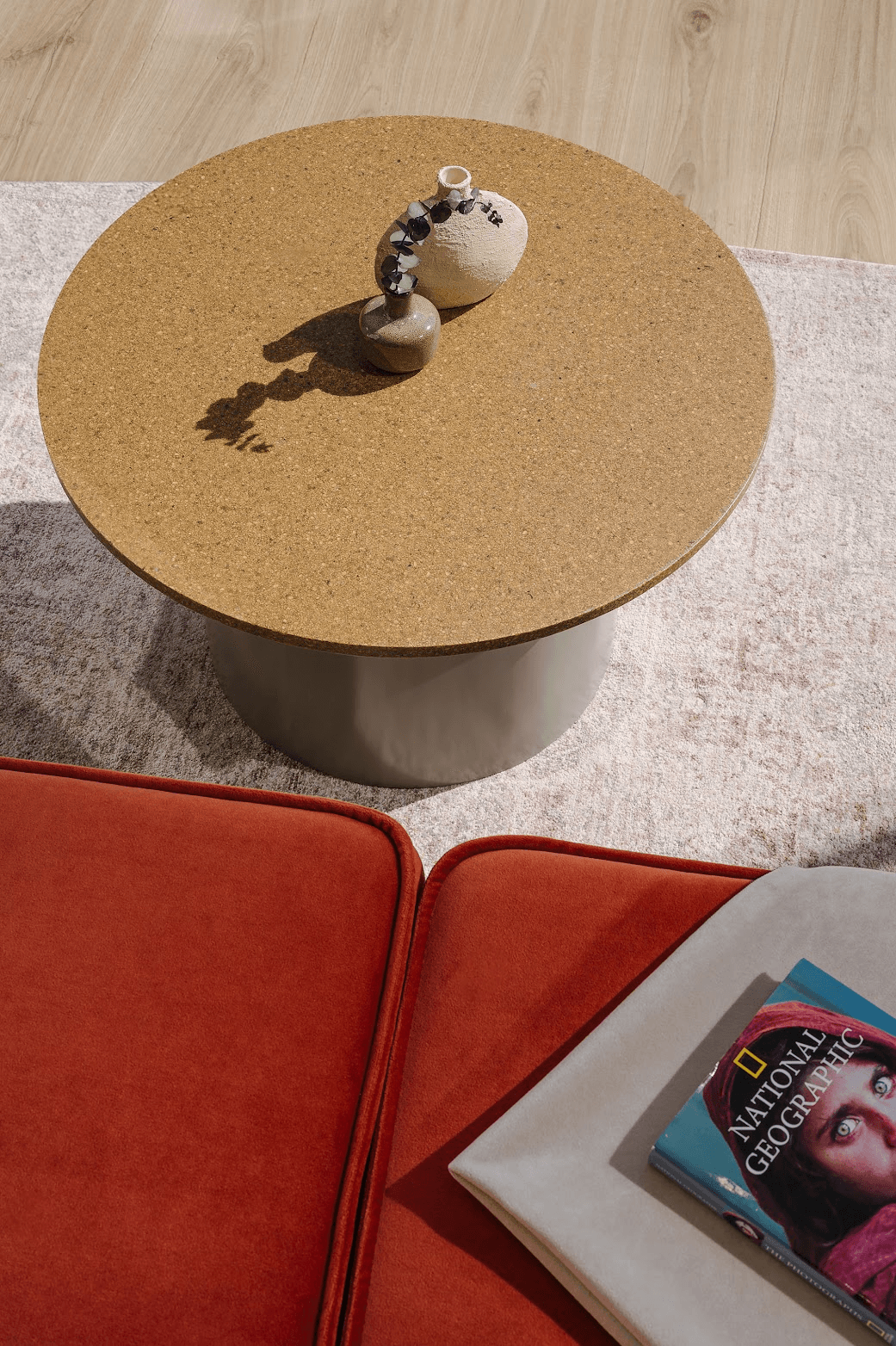
Pit-Board is made from roughly 60% olive pits and 40% bio-resin, which are pressed into panels. When looking at it in photos, people sometimes assume it’s cork because it has that natural aesthetic, but when they touch it, they are surprised by how smooth and non-porous it feels.
One of the advantages of this material is that it doesn’t absorb moisture the way MDF does. It has been independently tested for moisture resistance in Spain. When you cut through it, you can see it has a terrazzo-like quality. You can see the pits in the cut material. It is designed for high-use interior applications like worktops, cabinetry, retail surfaces, and furniture.
6. What was it about olive pits that made you think they could become a material?
Part of it was memory and part of it was design instinct. Growing up among olive groves, I had seen the waste my whole life. Once I developed that instinct and lens of an interior designer, I could look at the “waste” through new eyes, not as a dead end but as potential. When you work with the pits, even before you press anything, you can see there’s a warm tone and a texture to them. When they’re processed and cut, they create a speckled, terrazzo-like look that feels natural rather than manufactured.
The other part is Cyprus itself.
We import so many surfaces and boards into the island, while sitting on tonnes of this organic by-product every season. It felt obvious that this should be a local material story, not a disposal problem.
7. What is the lifespan of the material? And…does it smell like olives?
It doesn’t smell like olives. We clean the pits, and once the material is processed and pressed, there is no trace of an olive smell.
In terms of lifespan, the goal is a long service life for interior uses. The material is moisture resistant, and it is maintainable. If the surface gets tired over time, you can sand and re-oil it for a refresh rather than replacing the whole panel.
We also think about end-of-life. When a board reaches the end of its use, we plan to take it back, mechanically recycle it, and then feed it back into production.
8. Who are you building Pit-to-Table for, and why did you start the business as a B2B service rather than selling directly to consumers?
We started B2B, targeting architects, designers and contractors, because that is where the leverage sits. If you convince one homeowner, you change one kitchen. If you convince one architect, you influence dozens of projects. We want to sit at the top of the influence chain, where decisions are made early and at scale.
We are also working with furniture manufacturers as a parallel route, because they can integrate Pit-Board into their own products and expand reach.
9. Can we talk about cost?
Yes, and it’s important to be honest about it. Pit-Board sits on the premium side, not at the level of marble or granite, but above laminate and “IKEA-level” surfaces. It isn’t cheap to make since we buy the waste from farmers rather than treating it as free, and the bio-resin is an expensive input.
At the same time, within the global circular-surfaces category, we are trying to keep it accessible. The aim is to sit toward the lower end of premium compared with some international competitors who work with recycled plastics, textiles or wood offcuts.
10. Your supply chain and story are deliberately bicommunal. Why was that cultural element important?
From the beginning, it was important this wasn’t a product made on one side of the island for the other.
Olive trees don’t recognise borders. We source pits from farmers across Cyprus, which includes both Greek Cypriot and Turkish Cypriot producers. That meant building trust from scratch, and it was hard at the beginning. Farmers were sceptical, and with some it took a lot of convincing.
But something shifted as the story became real, rather than just a vision. We started getting farmers reaching out to us, not only from Cyprus but also from places like Greece and the Middle East, asking how they can be part of the supply chain.
Interestingly, we didn’t even set out to sell locally at first. We assumed the product would be too premium for the Cyprus market. But we now get steady demand from both sides of the island: restaurants, hotels, and individuals who want it for their homes. That is meaningful because it shows people aren’t just supporting “a sustainable idea.” They are genuinely desiring the product.
11. What have been the hardest parts of turning this into a manufacturing business in Cyprus?
Without question, politics and bureaucracy.
Doing things in the north was our starting point for premises, but it is difficult. There is a lot of registration, paperwork, and running between offices, and it can make R&D feel almost impossible because you can’t always start small. You have to be registered before you even test properly. In a bicommunal setting, you also face political friction from both sides, and even practical issues like getting the Green Line trade set up became a full-time project.
Access to funding is another major challenge, especially as a physical manufacturer. It is not only that hardware is harder to fund than software. It’s also that if you are not inside the usual networks, you can miss opportunities. Language can be a barrier, too, because some funding and ecosystem information is still largely communicated in Greek.
And we are on an island. If you are manufacturing physical products, importing machinery and tools adds time and cost. We have tried to compensate by being hands-on. For instance, since launching Pit-Board in May 2025, we have attended multiple international design trade shows ourselves, without a big machine behind us.
12. You’ve worked with organisations like SocialTech Lab, UNDP, NEEMA Labs and CYENS. How has that support helped, and what do you still wish existed for circular-product founders?
Support organisations gave us validation at our most critical moments, SocialTech Lab in particular.
They helped with funding, R&D support, mentorship, and credibility. But I also want to mention the less visible help from our community. Introductions, troubleshooting, and small practical favours to keep the momentum going. When you are building a physical product, community can be the difference between stalling and moving forward.
Sometimes it is as simple as asking someone to call a producer because they don’t speak English. Sometimes it is being introduced to a carpenter, an engineer, or a new programme. That network effect is everything.
What I still wish existed is stronger manufacturing infrastructure support. What I mean is, shared industrial equipment, easier access to prototyping machinery, and more patient capital for circular, physical products. Cyprus needs more of that, not only support for digital startups.
13. You have argued that designers and architects are powerful decision-makers. What would you like them to start doing differently when choosing materials?
Architects and designers are big influencers, especially on large developments.
I want decision-makers, including developers and clients, to ask three questions: where does this material come from, how far did it travel, and what happens at the end of its life?
Certifications like BREEAM and LEED help, but I would love to see people go beyond tick-box compliance and become genuinely curious. When you put meaningful materials into spaces, they become conversation starters. I remember designing a bar where we used recycled CDs on seating, and the client said customers constantly asked about it. It became a hook.
That is the power of material stories. Imagine being able to say, this tabletop is made from organic waste. It doesn’t look “wasteful,” but it carries that story. When it comes to specification, I hope people look beyond just cost and lead times to the full value and impact of a material.
14. What has this journey taught you about entrepreneurship, and what would you say to other founders in Cyprus?
Patience. Circular manufacturing moves slowly, and you have to persevere through iterations and setbacks.
It’s not about perfection; it’s about persistence and surrounding yourself with the right people. Mentorship can turn into real long-term support.
My advice is, don’t wait forever for the right moment. No one is going to pay you to do it. You have to create the conditions yourself. And keep an eye on opportunities through UN and EU bodies. There is more happening than people realise, but you have to actively look for it.
15. Looking ahead a few years, what is your vision for Pit-to-Table?
I want Pit-to-Table to become a globally recognised materials brand for the built environment. Not a novelty “sustainable option,” but a go-to material people trust because it performs, looks great, and we deliver.
Even though our early target market was the UK, publishing and trade shows opened unexpected doors. We have already seen demand from countries like the Netherlands, Poland and Romania, and we have had inquiries from as far as Australia and the US.
Our growth model will move toward licensing and regional production, rather than manufacturing only in Cyprus and shipping thousands of kilometres. The idea is to replicate the system in other olive-producing regions, such as Southern Europe, the Middle East, and the Americas, using local waste streams and producing locally.
Product-wise, panels are just the beginning. We are developing other applications like tiling and acoustic panelling, and when people asked for flooring at the recent Surface Design Show, we started running flooring tests. Right now, it is primarily for interiors, but we are also exploring outdoor-use requirements. The scalability is there because designers keep imagining new uses, and we want to keep meeting that demand.