

Outside, the last rays of the sun are dimming as the streetlight comes on. It’s a weekday evening, and Limassol’s streets are packed: suit-attired bodies rushing to beat the after-6 traffic jam, mothers picking up their sons from karate, and fathers hand-in-hand with their daughters’ music lessons, and then there are those just starting their shifts.
But one office is not ready to close just yet. Even though most of their colleagues are on their way home, the lights inside are still shining bright, and the energy is growing by the minute. But it’s not the energy of the usual staff meetings; it’s not the usual faces of staff meetings. For one, these faces are a little too young to be on the payroll just yet.
Follow THE FUTURE on LinkedIn, Facebook, Instagram, X and Telegram
A group of nine to twelve-year-olds take turns eagerly presenting their own games to a room of their fellow classmates, teenagers clad in matching T-shirts with the words “Ninja” on the back, and parents. This is not a typical classroom, but KidIT is not a typical “after-school club.”
Let’s zoom out of Cyprus for a moment and move to Brussels, March 2021. The European Commission set two EU-wide targets in its 2030 Digital Compass on 9 March 2021: at least 80 percent of adults with basic digital skills and 20 million ICT specialists by 2030. Those goals were later made law in the Digital Decade Policy Programme, adopted on 14 December 2022 and published in the Official Journal on 19 December 2022. By 2023, the EU was still short of both goals. Only 56 percent of adults had at least basic digital skills. The ICT specialist workforce stood at 9.8 million people, and women held only a mere 19.4 percent of those roles.
The gaps begin in school. More than 40 percent of EU students aged 13 to 14 lack basic digital skills today, far from the target of under 15 percent by 2030. Member states have committed significant funding, including an estimated €28.3 billion for digital skills and education through the Recovery and Resilience Facility, yet the outcomes depend on actual implementation in classrooms and training for teachers.
Now back to Cyprus. Tech accounts for about 16 percent of Gross Value Added. Yet the local pipeline has not kept pace. Cypriot nationals made up 88 percent of the ICT workforce in 2015 and about 50 percent in 2024. ICT graduates are 2.7 percent of total graduates in Cyprus, compared with 4.5 percent across the EU.
This is the problem KidIT is trying to tackle. Founded in Ukraine in 2015 and now active in Cyprus, the program focuses on ages 5 to 13 and teaches creation in real workplaces, supported by teen mentors called Ninjas. It’s a movement with a mission: to transform kids from passive consumers of technology into active creators and nurture a global mindset.
In this interview with The Future Media, Yulia Tarasova discusses how KidIT grew from Ukraine to Cyprus, Spain, and Denmark, building the Ninja pathway, and what the incoming MIT program could unlock for teenagers here.
Could you start by telling us a bit about your background and how you first moved into tech and then into education?
My journey began in game development, and I’ve spent over two decades in the industry. I worked with game studios, organized major industrial conferences in Eastern Europe and the United States. I also had the invaluable experience of living in Silicon Valley, soaking up the tech scene from its very heart.
But then, the story took a more personal turn. After building a company and seeing it through to a successful exit, I became a parent. Suddenly, I found myself facing a new challenge: how to guide my own children in a world where they were practically born surrounded by technology. I wanted to make sure they used tech as a tool, like a pen they could pick up to create, express themselves, or even design their own games.
In a way, it was my own need as a mom, combined with my industry background, that sparked this shift into education. And that’s really how it all started.
When I looked at what was on the market, I noticed a pretty significant gap in tech education. Most options were just straightforward coding classes aimed at older kids. But the real need was much deeper. It wasn’t just about teaching children how to code but also helping them manage technology as a tool for creating something meaningful.
Beyond that, it was about developing a whole range of soft skills: communication, creativity, collaboration, teamwork, and critical thinking. I wanted to create a program that didn’t just teach kids to code but actually empowered them to use tech as a creative and collaborative tool for whatever they dreamed up. That was the real starting point.
What drew you to create KidIT in Cyprus, and what were the first steps you took to get it started?
It all started with my own kids. I realized that my children, these digital natives, were growing up in a completely different universe of tech interaction than I had, even with my years in the industry.
At the time, there wasn’t really anything ready-made that addressed this need. ScratchJr had just appeared from MIT, so I used that as a base. I realized it wasn’t just about the kids; it was about building a strong parent community as well, adding soft skills focus to education —communication, creativity, teamwork. I wanted them to understand that what they were doing was globally relevant and to connect them to the real world of IT.
The first steps were to partner with IT companies and hold classes right inside their offices so kids could see that world firsthand. We also teamed up with major conferences so kids could present their projects and get real feedback from industry experts. We took them to places like Los Angeles and Amsterdam, letting them see that their work was valued far beyond the classroom.
I was incredibly lucky to have the perfect co-founder, Nadya Andrushchenko. She was a student at that time and had an amazing way of connecting with kids. Together, we created a new kind of educator we called “Ninjas.” They are young people who work alongside the kids. They bring not just educational guidance but also a personal connection that traditional classrooms often miss. That’s really how KidIT got off the ground.
I’m also very fortunate with my business partners. In Cyprus, I have Natalia Kriventsova, our CFO, and the best Parent Coordinator in the world, who helps grow the parent community and operations.
In your own words, what is KidIT’s mission today, and what are the main goals you are trying to achieve?
Our core vision hasn’t changed. We remain steadfast in our mission to transform kids from passive consumers of technology into active creators and nurture a global mindset. What’s evolved is that we’ve expanded our focus. Initially, we worked mostly with families and kids aged 5 to 13, but now we’re making that full circle of innovative tech education by guiding teenagers right up to their first internships in IT companies.
In other words, we want to immerse kids in tech from a young age, give them the right mindset and tools, and help them see possibilities far beyond their immediate surroundings. It’s not about taking kids out of Cyprus; it’s about helping them realize they have access to global opportunities no matter where they are.
Can you talk about some of the main projects you have run in the previous years and the impact you have seen on the students and parents?
This is the heart of what KidIT does. Measuring the impact can be tricky because we’re working with such a precious audience—young kids from as early as five years old. We’re essentially helping shape their interests and giving them a world of possibilities. Not all of them will grow up to be IT specialists, and that’s not our aim. Our goal is to show them what’s out there and let them find what they love.
Over the past decade, we’ve seen kids who started with us become Ninjas themselves, returning as young educators and making KidIT their first professional job. That’s a huge full-circle moment.
We’ve had kids present their projects at international conferences, get feedback from big names like Minecraft, and really gain the confidence to share their ideas with the world. We run annual kids’ game hackathons focused on social topics, teaching them that tech can be used for good. One especially memorable project was when our kids built an arcade game machine and installed it in a refugee center, bringing joy to other children and getting the opportunity to share how technology can be used for good.
We’ve also connected teenagers directly to industry experts at events like the Reflect Festival, creating a tailored GenZ track where they can learn about different industries and career paths.
In short, the impact we see is about broadening horizons, building a global mindset, and helping both kids and parents become part of a larger tech community.
How do local companies take part in your work, and what forms of support have helped most?
When it comes to how local companies support KidIT, I have to give huge credit to all the amazing partners who have been with us over the years. The core idea of our project in Cyprus is to offer free tech education to families, and to make that possible, we rely on funding from local IT companies. These companies have not only provided financial support but have also opened their doors to let us hold classes in their offices, giving kids a unique firsthand experience of what it’s like inside a real tech environment.
We’re deeply grateful to partners like TechIsland, Exness—who were actually our very first partner here—payabl., Space307, and JetBrains. In fact, with JetBrains, we’ve co-created robotics programs and are now co-organizing the arrival of MIT’s MISTI program in Cyprus. We’ve visited companies like Wargaming, MyGames, Toonbox, and it’s been incredible to see how these companies have welcomed our kids for a tour of their premises.
I should also mention that we’ve had some truly incredible workshops inside the companies. For instance, at Space307, we held workshops on AI for kids, as well as sessions on design and marketing. It was unbelievably unique for the kids to learn directly from industry experts who were eager to share their knowledge with the younger generation. It’s those kinds of hands-on, inside-look experiences that really make our partnerships so special and impactful.
In short, the best partnerships come from like-minded companies that support us in various ways—financially, with expertise, and by opening their doors. It’s that spirit of community and shared vision that’s helped us thrive.
Which projects are you running in 2025, and what are you learning from them so far?
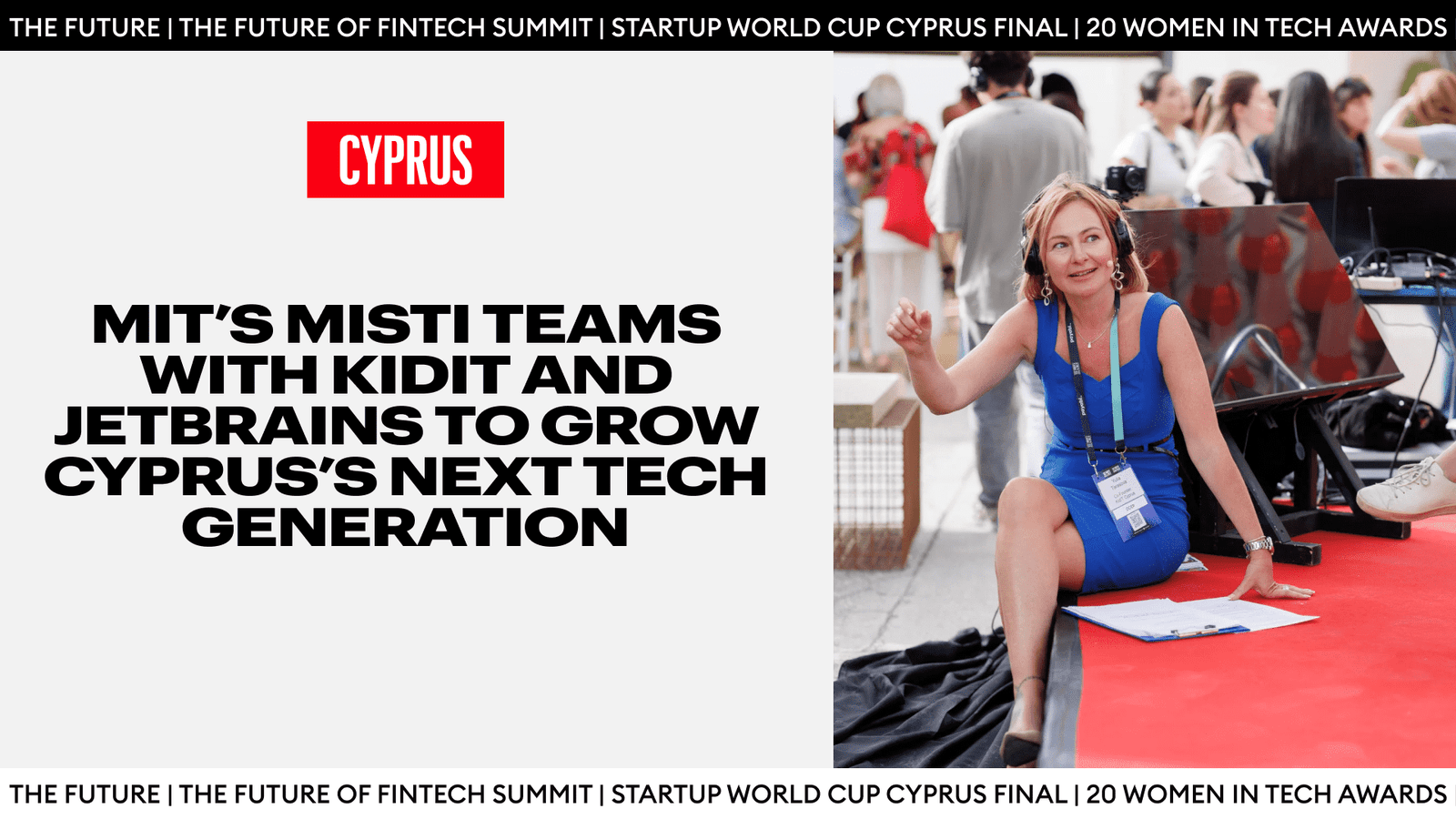
Looking at 2025 and ahead to 2026, the highlight project is definitely the arrival of MIT in Cyprus. In January 2026, for the first time, MIT’s prestigious MISTI Global Teaching Labs program will be landing here. That means over three weeks, in three different cities, across the University of Cyprus, Cyprus University of Technology, Neapolis University, and Lumio Private School, MIT students will team up with top local university students to deliver a hands-on robotics and STEM curriculum. It’s the first time Cyprus has been on MIT’s map, and it’s going to be a free program for all participants. We’re really excited to see it come to life.
Of course, we’re continuing our regular KidIT season as well. We kicked off in late September 2025 with weekly classes inside IT companies for various age groups, and the interest has been huge—we had around 190 applications in just under 24 hours. We have a full calendar of classes, events, game hackathons, and co-organized programs with industry leaders like TheSoul Publishing.
We’re also launching a new service called Tech Bridge Teens Consulting to help parents and teenagers map out their tech journeys, connect them with internships, and guide them through the opportunities ahead.
How did the collaboration with MIT come together?
I love sharing this story because it truly shows how powerful partnerships create transformative opportunities. It all began with an initial conversation with Kirill Krinkin, Advisor of the Program and JetBrains representative, who had already been running the MISTI program in other countries. During our discussion, I asked, “Why don’t we bring that incredible expertise to Cyprus? With the booming tech ecosystem here, the timing is perfect.”
We worked closely with JetBrains to split responsibilities: they focused on co-creating the curriculum with MIT and local universities, while we took charge of partnerships, negotiations, and all local logistics. Soon after, we received strong support from TechIsland, Exness, Space307, and Mellow — partners who immediately saw the vision and helped secure the funding needed to bring this ambitious project to life. Their commitment allowed us to expand the program to a unique three-city rollout and make it completely free for teenagers across the island.
The real turning point came when MIT visited Cyprus, saw the energy, the institutional collaboration, and the strong industry ecosystem, and decided to send their students. That moment sealed everything.
We waited until Cyprus officially appeared on MIT’s MISTI website before making the announcement.
Right after this milestone, another extraordinary moment followed:
Cyprus received official support from the Ministry of Education. This historic endorsement expands our reach to public schools and allows us to share this opportunity with many more families, educators, and students across the country.
We also gained the powerful support of the Cyprus Computer Society, a key national driver of digital skills and STEM education.
Applications are open on our website www.kidit.pro, and following the Ministry’s endorsement, the deadline has been extended until December 1.
This gives even more teens the chance to join this once-in-a-lifetime program. Catch your opportunity to apply!
Looking ahead, what are your priorities for KidIT over the next two years, and what impact do you hope to have on Cyprus’s IT sector and the wider education landscape?
Looking ahead, we recognize that we’re living in a dynamic and unpredictable era, where long-term plans are more flexible than ever. Our priority for KidIT over the next two years is to stay agile and responsive to the evolving landscape, especially with the rise of AI and the continuous shift in educational paradigms.
Our mission remains to provide innovative, tech-focused education, but we understand that the methods and formats may evolve. We’re committed to staying aligned with the latest trends, ensuring that we adapt and integrate cutting-edge developments into our programs.
In the coming years, we aim to deepen our collaborations with families, businesses, universities, and schools, building a robust ecosystem that supports tech education for kids and teens. We’re also focused on bringing the best expertise and opportunities to Cyprus while creating bridges that connect our youth with global opportunities.
Additionally, we’re expanding KidIT beyond Cyprus, bringing our model to other regions, like Scandinavia, and building a global network. This expansion will enrich the tech community and help create a more interconnected and innovative landscape.
In short, our vision is to continuously evolve, adapt, and expand, ensuring that we remain at the forefront of tech education and contribute meaningfully to Cyprus and beyond.