“I was not fearless.”
Marianna Hadjiandoniou was 25, working as an HR manager at a Cypriot company, recruiting for an IT role. She reviewed the applications before handing them over to the hiring manager to draw up the shortlist.
Follow THE FUTURE on LinkedIn, Facebook, Instagram, X and Telegram
The shortlist was not what she expected. “There were no women. No women, you can imagine.”
Hadjiandoniou went through the shortlist and stopped. One female applicant had more relevant experience than some of the selected candidates. Without hesitating, she challenged the hiring manager. When the hiring manager pushed back, she became more direct: “Look, you are the hiring manager. I’m the HR manager. So I’m going to include this lady for an interview for the specific position.”
When the candidate arrived, he refused to come out of his office to greet her.
Hadjiandoniou was not having it. She excused herself, marched straight to his office, opened the door, and told him to come directly to the interview because the woman was waiting.
“If I didn’t fight for that IT position, that organisation would be male-dominant forever,” she says, reflecting on what gave her the incentive to fight for what was then, a stranger.
The candidate got the job and, Hadjiandoniou says, went on to excel. Hadjiandoniou, meanwhile, was called into the CEO’s office and spent two hours defending why she had gone against the hiring manager. She was one of the only women at her level in the company, and she knew the decision could have consequences for her own career. In our conversation, she says this is the first time she has told the story publicly.
She did not have the financial security to lose her job. But just holding the title of HR manager meant little to her if she was unwilling to act when she saw discrimination.
Today, Hadjiandoniou has more than 20 years of experience in human resources and is the founder of PERHA, a Cyprus-based HR consultancy. She holds a Master’s degree in Human Resource Management from the University of Surrey and is a member of the CIPD. Her work has ranged from HR strategy and workplace discrimination to diversity, equity and inclusion. Alongside PERHA, she holds a number of volunteer business and community roles, including serving as Secretary General of the Cyprus National Paralympic Committee, an active member of the BPW Cyprus Federation of Business and Professional Women, and an accredited trainer by Cyprus’s Human Resource Development Authority, an Executive Committee Member of the Cyprus International Businesses Association (CIBA), a Member of the Committee and Vice President for Technology and Innovation within the Limassol Chamber of Commerce and Industry, and a non-executive Director of the Board of Directors of CYENS Centre of Excellence. Her outstanding leadership in HR was recognized in 2023 at the international ‘The Leadership Awards’, in London. She also received the title ‘Woman of the Year’ at the prestigious international awards, Rewards 2024.
Before Hadjiandoniou was advising companies on workplace culture, however, she was pushing against a set of expectations that were a lot closer to home.
Hadjiandoniou grew up in Cyprus in a close-knit community where the expected path for a daughter was fairly straightforward. “There was a right pathway for women,” she says. “Finish your studies, return to Cyprus, find a good man, marry, and have children.”
Hadjiandoniou had other plans.
After her studies, rather than accepting a secure public-sector or banking career her family wanted her to settle into (in Cyprus), she took a junior role at a Big Four firm in London.
“There was a period of time when I got only support from my mom,” she says. Her father worried about his only daughter living abroad and urged her to return to the island. Hadjiandoniou’s response was to keep going and prove that she could make the decision work.
That instinct, to make the decision and then accept responsibility for it, followed her through the rest of her professional and private life.
“I was not always creating the life that others would accept as the right life. I wanted to create the life that was mine. I took ownership of all the decisions that I made,”
she says.
Eventually, she did return to Cyprus, where she encountered a much narrower definition of the HR profession than the one she had trained for in London.
She remembers HR departments being largely occupied with clocking employees in and out and processing annual leave forms. She wanted to talk about career paths, training, benefits and the way people developed inside organisations.
Hadjiandoniou began exploring what HR could do and implementing change gradually. “Very small baby steps,” she explains.
She read extensively about what companies abroad were doing and began introducing those ideas where she could. International companies were often more receptive to conversations around equality, inclusion, and diversity. In most locally based Cypriot companies, she found there was more resistance to change.
The IT recruitment story came during those early years.
The resistance did not end when the candidate was hired. Hadjiandoniou remembers criticism and bullying from colleagues who questioned why an HR manager dared to believe she should influence the shortlist.
In time, she says, the company did thank her for the candidate and for the contribution that woman made to the IT department. But that eventual validation did not change how much Marianna believed she had been risking by challenging the decision.
Years later, Hadjiandoniou would face a different kind of risk.
After deciding to divorce, she chose to stay out of work for four years to focus on raising her twin boys. That meant going from a managerial career to dealing with Cyprus’s Social Insurance Services as an unemployed parent, while relying heavily on her own parents financially.
“I was very proud because it was my own decision,” she says. “It was about taking ownership of it.”
When she was ready to return, she decided that she would wait for another HR role rather than take whatever job became available first. But the only positions that would even consider her for an interview came with a lower title than the managerial role she had left.
She felt she had to prove herself once again.
Employers saw the career gap. They also saw a divorced single mother and questioned whether she could manage eight or ten hours of work a day. Hadjiandoniou remembers sitting through interviews and being prodded and prompted to answer questions about her personal family responsibilities.
“Yes, I am a divorced woman. Yes, I’m a single mom. And yes, I have responsibilities outside of work,” she recalls telling employers. What she wanted was the chance to show that those facts did not determine what she could contribute professionally.
The four-year break came with a trade-off, but one she remains comfortable with.
When she eventually did return to work, she says, she went back “guilt-free”. She did not feel guilty about long working hours or business trips because she had made a conscious decision to devote those earlier years to her children.
Her life today hardly resembles the neat version of “balance” often sold to working parents.
She wakes at 5 am. Her first task of the morning is to head to the gym at 6 am for an early morning workout. Business lunches are usually off the table because lunchtime is when she collects her sons. If a lunch does happen, she has to rearrange her whole day to find time with them later.
And despite spending years advising other people on work-life balance, Hadjiandoniou is honest about her own record.
“I’m very good at teaching that,” she says. “But I still need a lot of work on myself.”
Eventually, she made another decision that moved her outside the relative security of employment.
Starting PERHA was more than taking a personal entrepreneurial risk. Five or six colleagues moved with her. They had families, responsibilities, and careers of their own.
“That was a huge challenge and a huge risk,” she says.
She rejects the idea that PERHA revolves around her alone. Together, the team advises CEOs and leadership teams on many of the workplace issues Hadjiandoniou spent years dealing with from inside companies. That work also means she is still frequently one of the only women presenting to leadership teams where most of the people across the table are men.
Some things have changed, however.
“Fifteen years ago” and today are not the same, she says. People listen more readily. She has the career history and experience to command attention in a way she could not at 25.
But one personal habit has endured.
“I still wear trousers on the first meeting,” she says. “Always.”
At later meetings, she allows herself more freedom. She may wear a skirt or a dress the next time. No one is telling her that she has to wear a suit. The suit remains a habit she has not quite been able to move past, even after years of challenging assumptions about women in the workplace.
“Sad,” she says. But her vulnerability makes her admission even more powerful. She doesn’t pretend to have all the answers or have everything right, but it’s her kind of right.
Her final advice returns to the idea that has followed her throughout the conversation: ownership.
“Don’t create a life that looks right. Create a life that is yours,”
she says.
Study something because you want to. Knock on the door for the job. Leave the job if you decide it is time. Make a decision other people may not understand and accept that it belongs to you.
And keep going. Because, as Hadjiandoniou puts it, if you stop, you never find out what might have happened next.
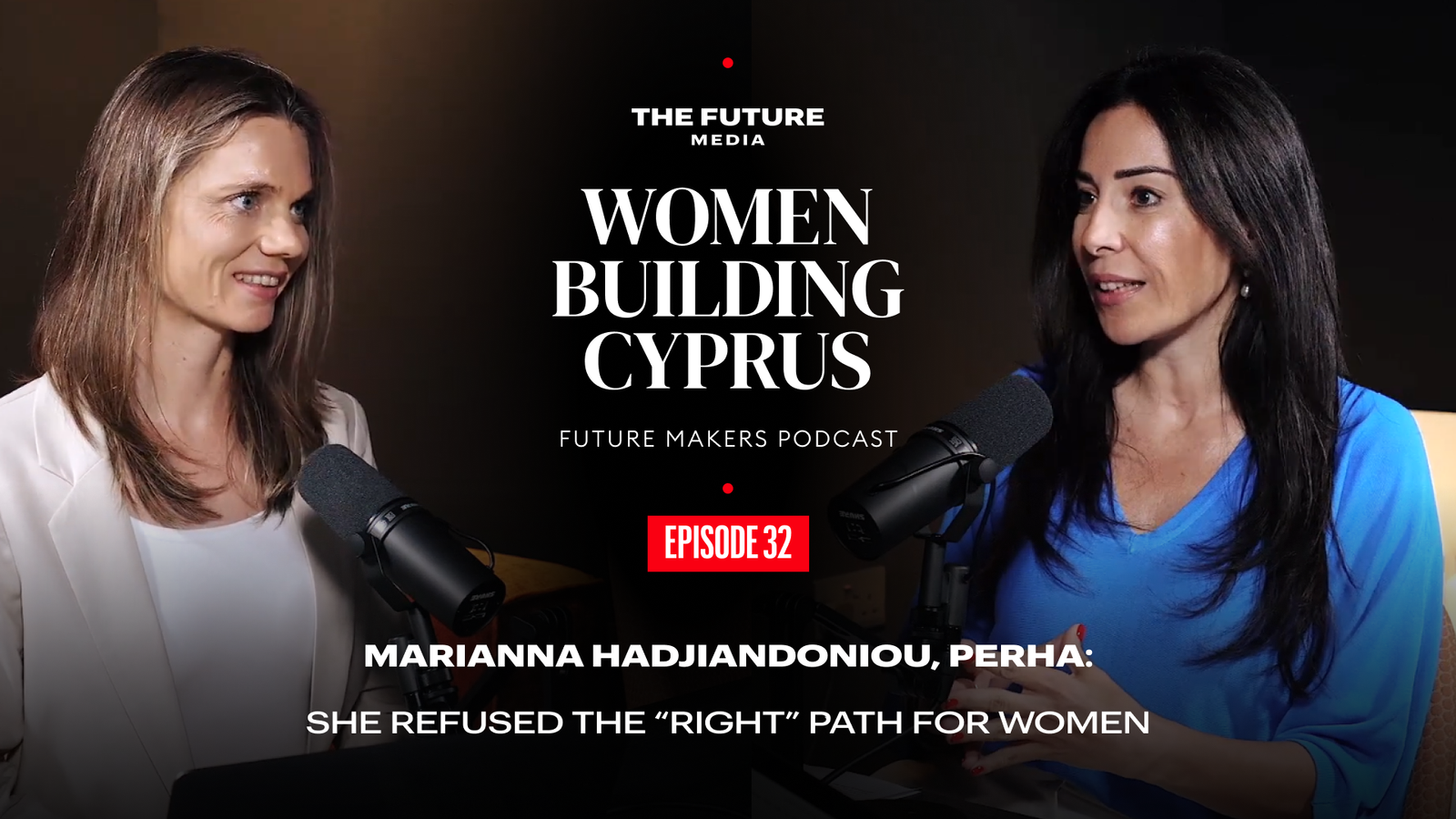
Marianna Hadjiandoniou is a guest on The Future Makers. In the full episode, she discusses her early career in HR, confronting discrimination at 25, returning to work after a four-year career break, building PERHA, motherhood, workplace flexibility and the choices that have shaped her life.
The Future Makers is a podcast series of in-depth conversations about how future-makers are made, in Cyprus and beyond. Host Annetta Benzar sits down with people who are a leading force in our shared future and looks past the titles. Together, they return to the people and moments that shaped them, examine the choices and challenges they are living through now, and look ahead to the futures they are trying to build.
A production of The Future Media.