


“I didn’t have any women to ask for advice.”
There’s an often-cited line in Jodi Picoult’s 2003 novel, Second Glance, that defines what a hero is: “Heroes didn’t leap tall buildings or stop bullets with an outstretched hand,” the text states, “They bled, and they bruised, and their superpowers were as simple as listening, or loving. Heroes were ordinary people who knew that even if their own lives were impossibly knotted, they could untangle someone else’s. And maybe that one act could lead someone to rescue you right back.”
Follow THE FUTURE on LinkedIn, Facebook, Instagram, X and Telegram
Katya Solov was lost. She was home with two young daughters, trying to keep up with housework and the question of her paused corporate career. And then there were the small things that were actually really big things. Like questions around vaccines for children, whether this or that chemical was safe. How to find time to rewrite her CV between scarce nap times. Even after hours of research on the internet, she was just as confused as she started out that morning. Not because she wasn’t intelligent; she had a law degree and a career under her belt. But the mass of information being thrown at her from different online sources overwhelmed her. What she needed was the one thing she didn’t have: another woman to directly ask advice from.
She needed a hero. But since none were available, Katya Solov decided to eventually build her own through the app, Miranna. This is her attempt to be that woman she needed at her own time of need, for the women who come after her.
Katya Solov is the founder and CEO of Miranna, a coaching and microlearning app built for women navigating career, family, and wellbeing. Before founding Miranna, she spent more than a decade as a legal specialist in venture capital and tech across Eastern Europe. She is a graduate of the Founder Institute Zurich chapter and now mentors early-stage founders through its Cyprus chapter. She also runs Female Founder, a Russian-language media channel for women entrepreneurs with more than 11,000 subscribers, and is the mother of two daughters.
Solov was born in 1987, in the final years of the USSR, which, she says, shaped her outlook on life. “My generation of millennial Russian women are the result of this period,” she says. “Adaptability is our main skill. From childhood, you understand that the world is not so friendly. You have no promise for the future.”
Her mother worked, as most women in the USSR did. “Right from my childhood, she said the same thing every time,” Solov says. “You have to be financially secure by yourself. Don’t build your life leaning on men.”
However, the culture would fold into itself. In the same breath, the more traditional script was still expected to be upheld. A girl would be told to stand on her own feet, and then reminded that finding a good husband was her main goal. Solov spent years trying to make the two ideas fit. “You try to combine in your head all of these things,” she says. “And you just don’t understand how to do this.”
Solov was 21 when she entered a Russian venture fund as a junior lawyer. It was 2009. The environment was not welcoming for a woman, to say the least.
“It was completely a man’s world,”
she says.
In that world, she says, money, power, and decision-making were mostly held by men. Women were there, but rarely at the top. They held posts such as assistants, HR specialists, accountants, and support figures. Solov does not remember seeing women top managers around her.
The culture around her was brutal enough that behaviour she now recognises as misogyny did not even have words to describe it.
“Misogyny was everywhere,” she says. “But we didn’t even know the word misogyny.”
If there was a woman present in a meeting, she says, she might, by default, be asked to make coffee for everyone. That was treated as normal. To survive that kind of environment, she says, a woman had to develop a tough shell.
“You had to be bold,” she says. “You had to sometimes be more rude than you needed just to do your work.”
The experience changed her. It taught her how the world operated. And later, it also taught her that survival mode is not your personality. It is something a person can learn, but then, through hard work, can unlearn.
“You don’t need to be in this surviving mode anymore. You have to tune yourself,”
she says.
When Solov eventually left the venture fund, it was not because of a dramatic breaking point. The team changed. The environment changed. She felt it was simply her time. She later worked with a business angel syndicate and saw that the same kind of work could happen in a different culture and at a different pace.
The contrast surprised her. She began to form her own understanding of what a healthy work environment can look like without romanticising the startup experience.
Her own first startup was in legal tech, where she was invited to join by friends. The company went through an accelerator in New York but eventually failed.
But she treated the experience as a lesson.
“I understood that, okay, I can do this,” she says. “It is tough. It is really not a super easy journey.”
The failure had also developed her skills in marketing, product, business-building, and all the parts of a company she had not had to think about as a lawyer. It also prepared her for the idea that would later become Miranna.
The first version of Miranna was a mentorship platform. It connected women who were combining professional lives with motherhood to other women who needed to speak to someone who had already lived through something similar.
Then came 2022. The platform closed, part of its infrastructure was sold, and Solov started again from scratch. This time the idea was to create an app, with coaches on board and a microlearning layer to cut through the noise and get to the heart of knowledge.
When asked about how she balances Miranna, legal work, and raising two children, she laughs.
“It’s not possible. Balance is some kind of fairy tale,”
she says.
What exists instead, in her life, is priority management. Some months, work takes over. During those periods, she says, she may not know what lessons her child has or what is in their lunchbox. Other times, like when one of her daughters is sick, work takes the backseat.
“You are constantly moving from one to another,” she says. “That’s it. That’s not balance.” But somehow she makes it work.
This does not mean the guilt of not giving her all to one aspect of herself disappears. Solov says she still falls into that trap, but she has become more accepting of what is possible.
“I’m just okay to be in the middle,” she says. “I’m not pretending to be the number one.”
Her daughters know she will not spend every five minutes of their lives with them. That, she says, is their family dynamic. It is not failure. It is the arrangement that allows their life to work.
That may be the real hero behind Solov’s story. Women do not need to be told they can balance everything. Most have already experienced the cost of trying. What they need is the permission to stop pretending the balance exists, and the tools to decide what comes first today.
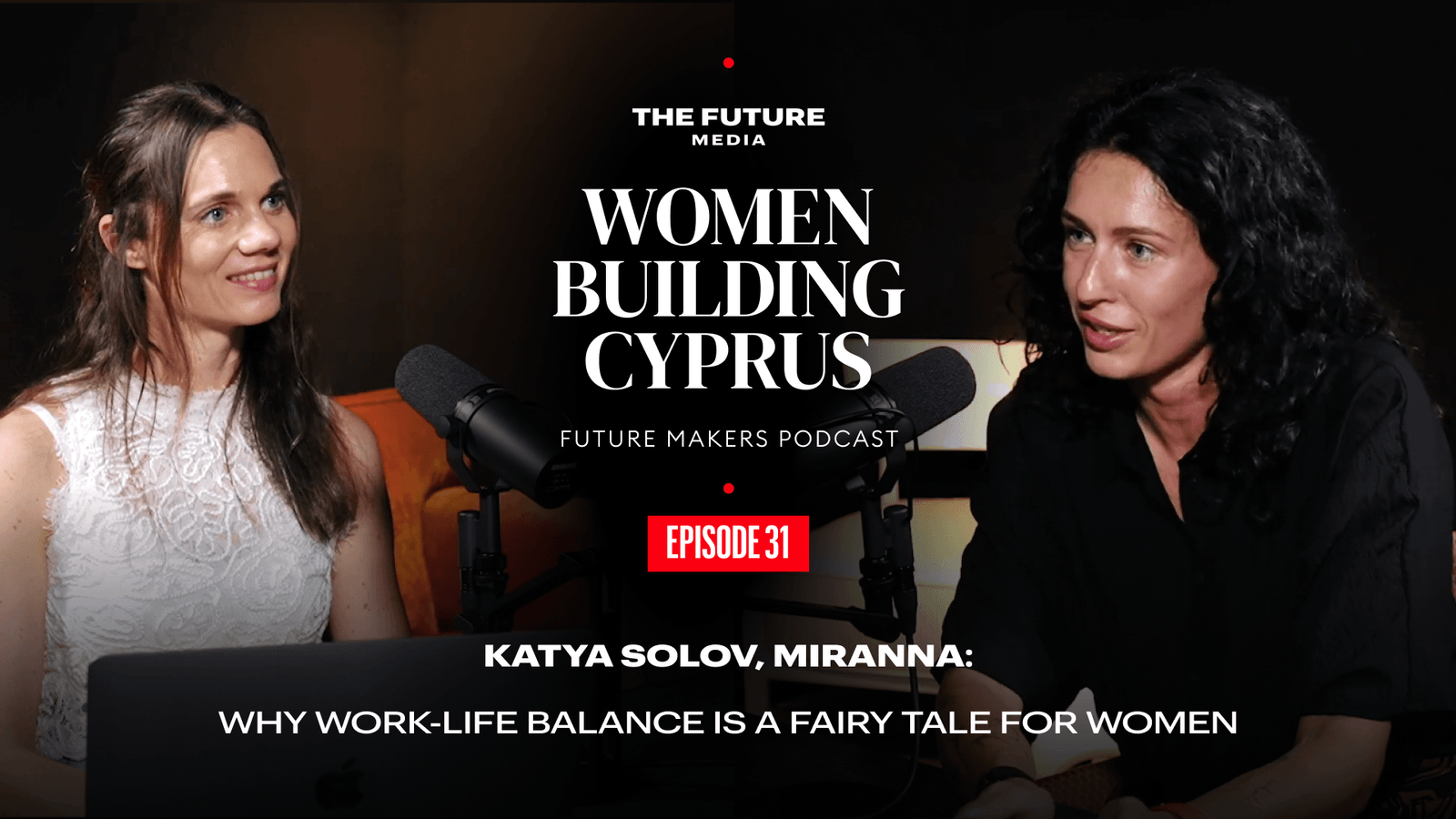
Katya Solov is a guest on The Future Makers: Women Building Cyprus. The full episode, including her reflections on Soviet adaptability, venture capital, motherhood, Miranna, bootstrapping, Cyprus, and why balance is a fairy tale, is available to watch now.
The Future Makers Podcast is a series of in-depth conversations about how future-makers are made, in Cyprus and beyond. Host Annetta Benzar sits down with people who are a leading force in our shared future and looks past the titles. Together, they travel back to the people and moments that shaped them, walk through the choices and challenges they are living through now, and look ahead to the futures they are trying to build.
Women Building Cyprus follows women whose lives and decisions are changing what this island can be.
A production of The Future Media.