


When Max Krupyshev first entered the crypto industry in 2013, the market was still overwhelmingly a story about one asset: Bitcoin. Trading and mining were where the money was made, and tokenisation still had a while to go before it could reach anything close to mainstream. The idea of using crypto as an actual payment rail was more hearsay, a myth. The infrastructure was not ready for it. Krupyshev says the idea only began to feel like a ‘tangible’ business case in late 2014 and early 2015.
More than a decade later, the crypto market in which he has now built a professional career looks very different. Bitcoin is only one part of it. Another part, and increasingly the part that is getting more attention from those looking at crypto for commercial purposes, is stablecoins. These digital assets are designed to track the value of another asset, usually a fiat currency such as the US dollar or euro. Stablecoins currently have a combined market capitalisation of around $292 billion. As of 23 September 2026, Tether’s USDT accounted for approximately $183 billion and USDC for around $75 billion.
Follow THE FUTURE on LinkedIn, Facebook, Instagram, X and Telegram
For Krupyshev, the bigger change is in the culture of use, especially by companies.
“Crypto processing,” he says. “Right now is pretty much stablecoin processing mostly.”
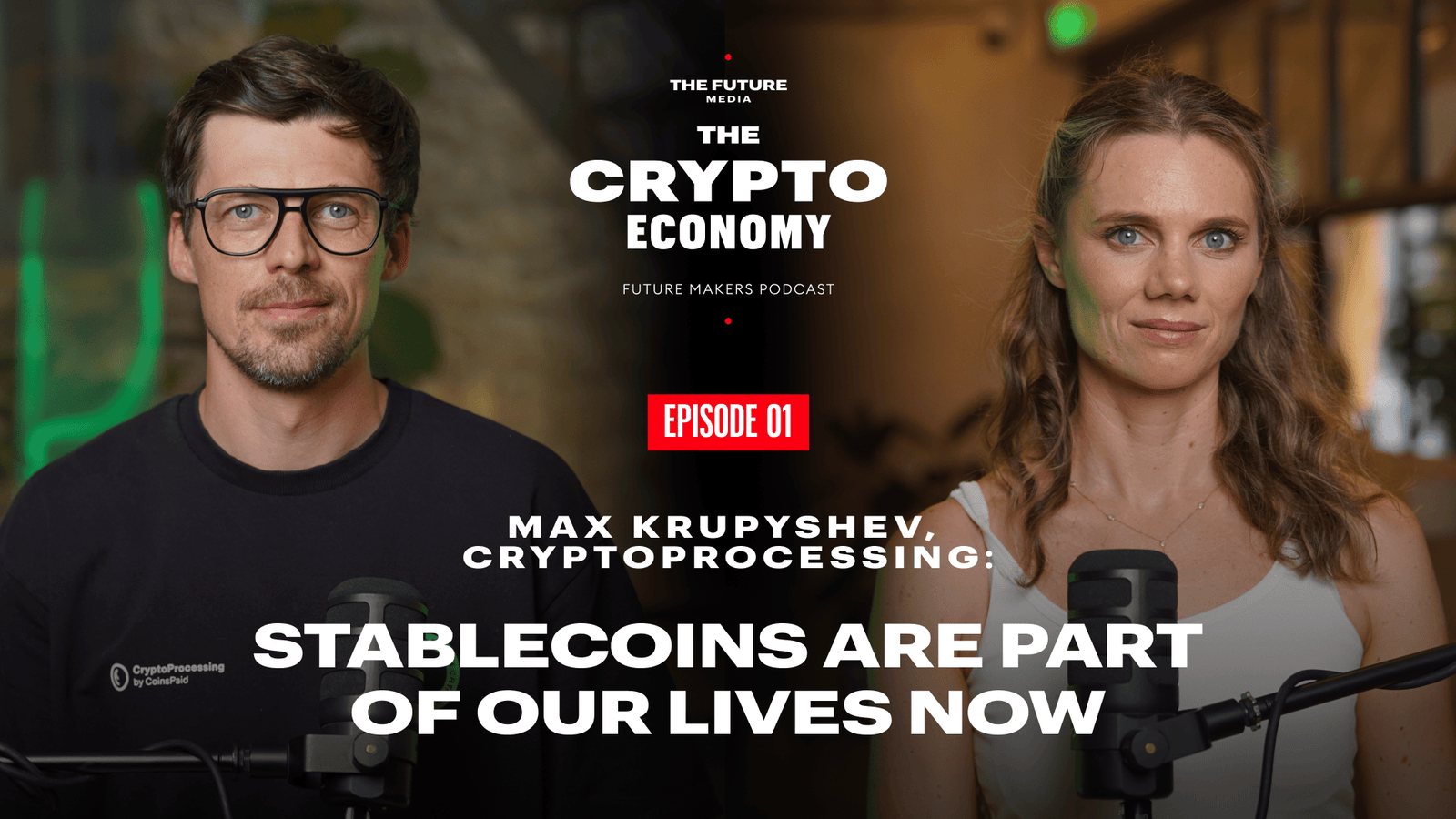
Max Krupyshev is the Executive Leader of CryptoProcessing and has worked in digital assets since 2013. His early work included building Bitcoin wallets and later working with CEX.io, at the time primarily in trading and mining. Today, he focuses on payment infrastructure that connects digital assets with businesses and the conventional financial system.
Speaking on The Future Makers: The Crypto Economy, Krupyshev argues that the rise of stablecoins is changing both the language and the commercial use of crypto. Part of the change, he says, is branding, and this shift is more deliberate than it first appears.
Cryptocurrency, as a category, has carried years of associations that larger enterprises are not too eager to inherit or to which they even connect their name. Volatile markets. Trading cycles. Speculation. Krupyshev says large companies are trying to separate that history from the language they use around payments.
“The branding idea now [is] that all the big corporations and enterprises really say, ‘You know what? That history belongs to cryptocurrencies. This new industry about payments, about integration into the financial ecosystem, belongs to stablecoins.’”
However, the technology underneath the rebrand has not changed as drastically as the etymology. Stablecoins can use the same blockchains, protocols, wallets, and supporting infrastructure as other cryptocurrencies. The difference lies in the asset itself. Stablecoins are issued under a defined structure and are designed to maintain their value against a reference asset, while assets such as Bitcoin fluctuate independently and often dramatically.
Volatility is an obvious problem when it comes to payments. Most people do not plan their spending around the changing value of an investment asset. Krupyshev highlights the point by comparing Bitcoin with other commodities.
“The majority of people, maybe 99.9% of people, they don’t think in ounces of gold when they’re planning to buy a house, buy a car, or even buy a coffee,” he says. “No one is thinking about the barrels of oil that it will cost to buy. So, of course, thinking in bitcoins, in ethereums and so on is a very unnatural thing for us, because we grew up in a world where fiat money existed.”
Stablecoins can still be transferred through blockchain-based wallets, but their value is tied to a familiar currency rather than moving independently like Bitcoin. Krupyshev describes them as combining elements of both systems: money that can be held and transferred through a wallet without being stored in a conventional bank account, but with a value linked to a currency people already use.
Their roots, however, remain firmly inside the crypto economy that produced them. The Bank for International Settlements reported in its 2026 Annual Economic Report that crypto trading remains the main use case for stablecoins, with their use as real-world payment instruments still comparatively limited. The BIS also found that the performance of stablecoins in cross-border payments varies once fees, spreads and the cost of moving money into and out of crypto are taken into consideration.
However, the path stablecoins took from trading tool to something businesses can transact in is worth following, as it explains why the payments story is now getting so much of the spotlight. Early stablecoins gave cryptocurrency traders a way to move out of Bitcoin without withdrawing money into a bank account every time. Once more people held them, they began transferring stablecoins directly to each other. Then entrepreneurs who were already comfortable with the technology began using the same mechanism for business transactions.
“Entrepreneurs, suppliers, clients and so on started to pay each other B2B bills,” Krupyshev says. He gives examples ranging from sponsorship payments to software, marketing and events. As those transactions increased, businesses needed infrastructure that could receive stablecoins, convert them and, where necessary, move funds back into euros or dollars. Krupyshev sees these developments as a connection between the two systems rather than one replacing the other.
“This economy is moving very, very quickly,”
he says.
Cyprus is also becoming more active in the conversation through its fintech, payments, forex, software and gaming sectors. Many of the companies Krupyshev describes serve customers outside the island, which means some encounter stablecoins even when crypto is not part of their core product.
“Their clients might want to pay them in crypto,” he says, pointing to sectors including private jet rentals, villas and event spaces. “They have to be exposed to cryptocurrency transactions.”
His argument is not that every business in Cyprus is adopting stablecoins, nor that crypto is close to replacing established payment methods. His definition of adoption is narrower.
Towards the end of the conversation, Krupyshev is asked whether success for the crypto economy would mean paying for coffee directly from a crypto wallet rather than using a card.
“We are not aiming here to replace the cards completely,” he says.
Instead, he points to companies with international customer bases beginning to support crypto alongside other forms of payment.
Stablecoins have become a substantial part of the crypto economy, but they remain small compared to conventional banking and payment systems. The BIS estimated annual stablecoin transaction volume at $28 trillion in 2025, noting that the figure includes large volumes of crypto-market activity and transactions between wallets controlled by the same party. Volumes are far lower once transfers between wallets owned by the same party are removed.
Banks, card networks, payment companies and businesses are continuing to test where stablecoins actually fit. Regulators are examining the risks that could accompany wider use. The BIS acknowledges potential applications in payments, but also points to questions around financial stability, regulation and the role stablecoins can play within the monetary system.
Krupyshev has watched the change from inside the industry. Crypto began for him in a market centred on Bitcoin, mining and trading. Today, his work is increasingly focused on what happens when digital assets are used for payments.
Stablecoins have already moved far from the exchanges where they first gained traction. How much of the wider payments market they eventually capture remains open.
Max Krupyshev is a guest on The Future Makers: The Crypto Economy. In the full episode, he discusses the evolution of crypto payments, the rise of stablecoins, how businesses began using them for B2B transactions, Cyprus’s place in the market, and what wider adoption could look like.
The Future Makers: The Crypto Economy is a podcast series of in-depth conversations on crypto as a new financial and internet economy, moving across topics such as exchanges, digital assets, stablecoins, wallets, token models, infrastructure, regulation and what adoption really looks like. Host Annetta Benzar sits down with the executives, founders, and builders working across the industry.
A production of The Future Media.