“I don’t want to be a good girl anymore.”
It took Kateryna Biloruska until her thirties to begin questioning the script she had grown up following. Being a good woman meant putting everyone else’s needs before her own.
Follow THE FUTURE on LinkedIn, Facebook, Instagram, X and Telegram
Part of that expectation came from her post-Soviet upbringing. Her own wishes were supposed to come last. And wanting something for herself? That was selfish.
By her late teens, she was also facing another pressure. She had to choose a university and a profession before she had any real idea of what she wanted to become.
Today, Biloruska wants girls to have something she often felt was missing from her own adolescence. She wants them to have the freedom to explore their choices without feeling they must already have all the answers.
Through FEM (Future Empowered Minds), the leadership programme she founded for teenage girls, her goal is to give them access to mentors, new experiences and opportunities to discover what they are capable of.
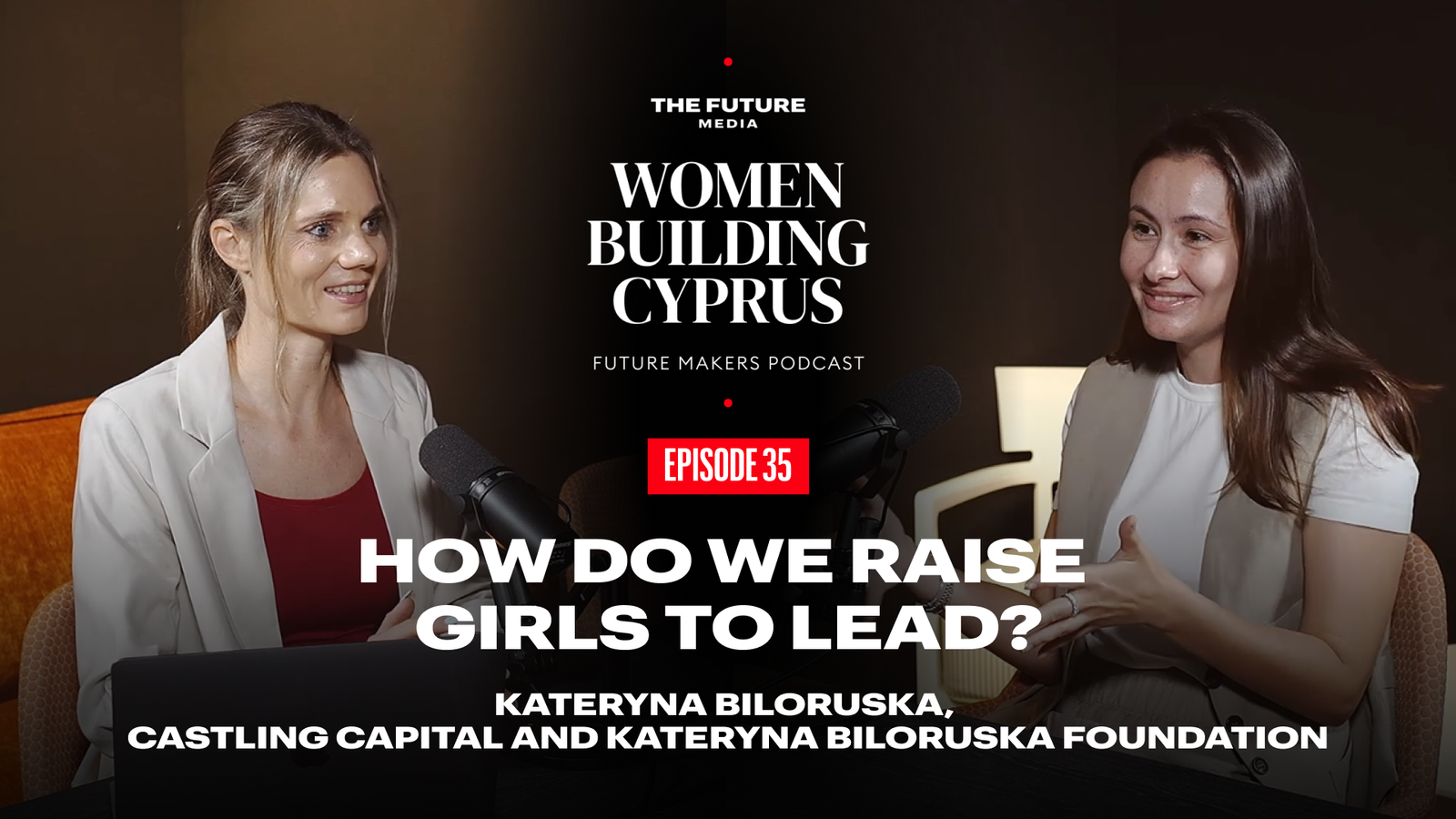
In this episode of The Future Makers: Women Building Cyprus, Biloruska reflects on the expectations that directed her life, her twelve years in the corporate world, the difficult decision to leave it behind and her hopes for the next generation of young women.
The following conversation has been edited for length and clarity. The views, opinions and claims expressed are those of the interviewee and do not necessarily reflect those of The Future Media.
About The Guest
Kateryna Biloruska is a private investor and philanthropist. She founded Castling Capital, which manages investments across public and private markets, and the Kateryna Biloruska Foundation, which supports education, personal development and opportunities for young people.
She also leads FEM (Future Empowered Minds), an international leadership programme for teenage girls, and serves as chairwoman of the International Relations Committee of the Cyprus National Paralympic Committee. Through her foundation, she supports sporting initiatives for children, including programmes for children with disabilities.
I would like to start by looking back at your early life. Kierkegaard said that we live life forwards but understand it backwards. How does that apply to you?
Lately, I reflect a lot on the past. When I started working on the FEM programme and decided to work with teenage girls, it was because I remembered myself at that age. I think those years really shape our mindset and the steps we take in the future.
I know it was quite challenging for me. The biggest question [I kept getting] was who I wanted to become, and I never knew the answer.
Even now, because we are learning all our lives, though I have found what I love and enjoy professionally, I’m still searching for something else that will make me feel complete.
So I decided that, with the knowledge I already have, I have to help the future generation figure out who they are. I want to give them tools to move forward and make things easier for them than they were for me.
You cannot rely only on society, family or the teachers around you. Maybe that will change for future generations, but for my generation it was quite challenging because they were not helping you. They were putting pressure on you.
They were telling you all the time that you had to decide, whether the university or higher education institute and then your profession. Otherwise, you would end up cleaning the streets.
You think, okay, I have to decide very quickly, between fifteen and seventeen, because I need to prepare for university and my future profession.
It’s horrible pressure for young kids.
Now, as an adult woman, I understand where I needed my family or community to support me and they didn’t or couldn’t, because they simply didn’t have that knowledge.
Our parents usually think they are doing their best for us, and they really want to. But sometimes they don’t understand what we need.
It’s the same with society, schools and teachers. They want to help, but they don’t always know the right way.
You spent twelve years in a technology company, progressing from account manager to board member. How did you feel as a woman working in that corporate environment?
It was challenging, to tell you the truth, because women were a minority in senior positions.
I’m not the kind of woman who is very strong-minded, or loud, or who can openly say things that might make other people feel bad.
I’m very soft, and I tried to use that soft power in business as well. Sometimes that was challenging.
But I cannot say I faced those challenges to the same extent as other women, because I was also a shareholder of the company. That status helped me move forward with the ideas I believed were important.
We had a really good corporate culture. We cared about people, and that was part of my responsibility.
But it was still a technology company, with more men and fewer women. Women often worked in roles that supported the men in doing their jobs.
What made you finally decide that you wanted to leave that world?
A lot of things changed in my life.
First, the business itself changed, and I felt that it no longer fitted my principles. We also had some disagreements with the partners.
And my private situation changed because I became a mother. I became a mother twice in one year. There is an eleven months difference between my children. I realised that the business wasn’t as strong as it had been before. If I wanted to succeed there and keep it going, I would have to live there.
But on the other hand, I had two small children, and I didn’t want to miss their early years. You have to decide, and I decided to be a mother and watch my children grow up.
You cannot earn all the money in the world. Sometimes you have enough, and you can do other things. It was my decision, but you still struggle because your life changes completely.
It wasn’t an easy period. When you’re pregnant, you think, I’ll work it out. I’ve seen how others do it. I can combine work and children. Someone will help me. But then the children have minds of their own.
I clearly remember being with my first daughter and feeling completely lost. I was afraid because I didn’t know what to do with the baby. I hadn’t taken a break from work. I thought, okay, I need a few days away from the office, but I’m still here. You can call me, you can message me.
Then I realised that you cannot be fully present in both places at once. It’s impossible. At least for some time, you have to choose, adapt and understand your new role as a mother. It changes your mindset.
You also need time to accept that your life will never be as it was before. I think I’m still accepting that from time to time.
Where did the idea for FEM come from, and why did you decide to start it in Cyprus?
The idea came from inside, because I remember my teenage years and I know that girls at that age really need support. Why girls? Yes, all children need support, but I think girls struggle more with their choices, and we women have more stereotypes around us.
That’s why I think it’s important to support girls at this very sensitive age. I also really enjoy working with women, and maybe that’s because I have daughters.
Our foundation has sporting programmes where we work with boys and girls to help them develop their potential through sport. You can teach children leadership, tolerance, discipline and many other things.
But when I was thinking about the leadership programme, it was important for me to work specifically with girls. There are still not enough women leaders in the world. We see progress from year to year, but it isn’t perfect.
I think this is an important programme for Cyprus, but we weren’t aiming only at Cyprus.
From the beginning, we positioned FEM as an international leadership platform because I believe cross-cultural experience is important for girls. They need to see that people with different backgrounds and mentalities do things differently.
Sometimes you don’t understand why someone isn’t answering your emails or why they respond in a particular way. But for them, that’s normal. It doesn’t necessarily mean they don’t want to cooperate with you.
Of course, we have a strong focus on schoolgirls here because I’m based in Cyprus, and I want to do something good for the society in which my children are growing up. I want to change it.
We also have a large percentage of Ukrainian girls because I’m originally Ukrainian, and this is the kind of support I can give Ukraine now.
I want to support its future leaders, teachers, medical professionals, whoever these girls become. We don’t know what they will do in the future. We just want to give them opportunities and tell them they can do whatever they want.
In the FEM programme, you bring together women mentors from very different professions, rather than presenting the girls with one idea of what a female leader should look like. What are you hoping the participants learn from those experiences?
We’re not aiming to create a career guidance programme or provide academic education. They already have school for that. Our main task is to motivate them to move forward and equip them with tools.
Exposing girls to different professions and women from different fields is something we wanted to do from the beginning. What I can give them is contact with women who already have experience and are willing to share it.
There are a lot of people in my life who are willing to share their experience with the next generation. I just give them that opportunity, and then they do everything themselves.
I think that’s beneficial for everyone. The girls gain access to these women, and the women have an opportunity to share their knowledge and see what it’s like to work with the future generation.
At our last camp, we changed the format slightly, and we liked the result very much. We used a learning-by-doing concept. My main aim was to bring together as many people from the local community in Cyprus as possible.
The programme has two parts. There are workshops where girls actually do something, and motivational talks where they can find inspiration. I also wanted different local businesses to become involved.
Of course, we need financial support, but my main aim was to bring the community together around the development of the next generation. We had organisations from very different fields contributing real-life challenges for the girls to work on during the camp.
That’s important because the girls get real experience. They can see that they are able to work with actual companies and contribute their knowledge and ideas. But it’s also good for the businesses themselves.
They get an opportunity to see how the next generation thinks, because these girls are their future consumers and employees. FEM gives businesses an opportunity to test ideas and learn from the girls, almost like a focus group.
So the experience works both ways.
What message do you have for young women who are looking towards their futures and may be afraid or unsure about making their decisions?
You are enough. Just realise that you are enough.
A lot of women, and girls as well, are always thinking, I don’t have this diploma, I don’t speak two languages, I don’t know this or that.
These thoughts are really bad for us.
That doesn’t mean we shouldn’t learn, study or gain new skills. But to be a leader, to be successful in your career or your family life, you first have to realise that you are enough as you are.
Then you can make yourself better by doing sport, studying something, reading a book or taking a course.
I dream of building a future where every girl knows she is worth something, where every girl has the possibility of a quality education and where every girl has her own voice.
WATCH OR LISTEN TO THE FULL EPISODE
The Future Makers Podcast is a series of in-depth conversations about how future-makers are made, in Cyprus and beyond. Host Annetta Benzar sits down with people who are a leading force in our shared future and looks past the titles. Together, they travel back to the people and moments that shaped them, walk through the choices and challenges they are living through now, and look ahead to the futures they are trying to build.
Women Building Cyprus follows women whose lives and decisions are changing what this island can be.
A production of The Future Media.