
It was supposed to be a quiet Friday afternoon. Just a couple of tasks to tick off. An email or two to answer. Monday’s to-do list to complete. But then the resignation email arrived. Short. No fluff. Completely unexpected, but was it really out of the blue? The work was still getting done. Deadlines were still being met. According to the employee, however, all was not OK. They had already mentally checked out weeks ago. The email was just a formality.
Missing an employee’s mental exit is not just unfortunate or awkward for a manager. It is expensive. SHRM’s benchmark estimate puts the cost of replacing an employee at anywhere from 50% to 200% of annual salary, depending on the role. That range is wide because replacement costs are rarely just recruitment. There is also the loss of knowledge walking out the door, the disruption to team cohesion, the morale hit to the people remaining, and the fall in productivity.
Follow THE FUTURE on LinkedIn, Facebook, Instagram, X and Telegram
The hiring process is also slow, which makes every departure even more painful. SmartRecruiters’ 2025 benchmarks report the global median time to hire at 38 days. In Germany, the median is stretched to 55 days. France sees it at 39 days. The UK at 40 days. Meanwhile, Gallup states that 50% of employees globally are either watching for or actively seeking a new job.
The bigger problem, according to Alexandros Manolis, co-founder of Teamistry, is that turnover is often the final symptom of a longer slide. The warning signs are there, but they are often missed or, worse, ignored. Gallup’s State of the Global Workplace 2025 estimates that disengagement cost the global economy $438 billion in 2024. Global employee engagement stands at 21%. In Europe, it’s shockingly lower still at a mere 13%.
Today, as teams are becoming more distributed and decentralised, the slow drift is easier to miss and even more difficult to correct. It’s all the more common to see managers slip into reactive routines. Small changes in the tone of their team is too quiet to hear. Participation and initiative stop registering. Someone’s Slack responses get left on read. Ghosted. Employees who used to offer ideas now nod indifferently during meetings. By the time they resign, there is no convincing them to stay.
At Teamistry, this is referred to as the “decentralized trap,” where disengagement and misalignment would build over time, completely unnoticed by leadership, until someone resigned. Only then would the company realise something had been wrong. But by then, it was too late.
Teamistry is built for that gap between what leaders see and what teams are actually experiencing.
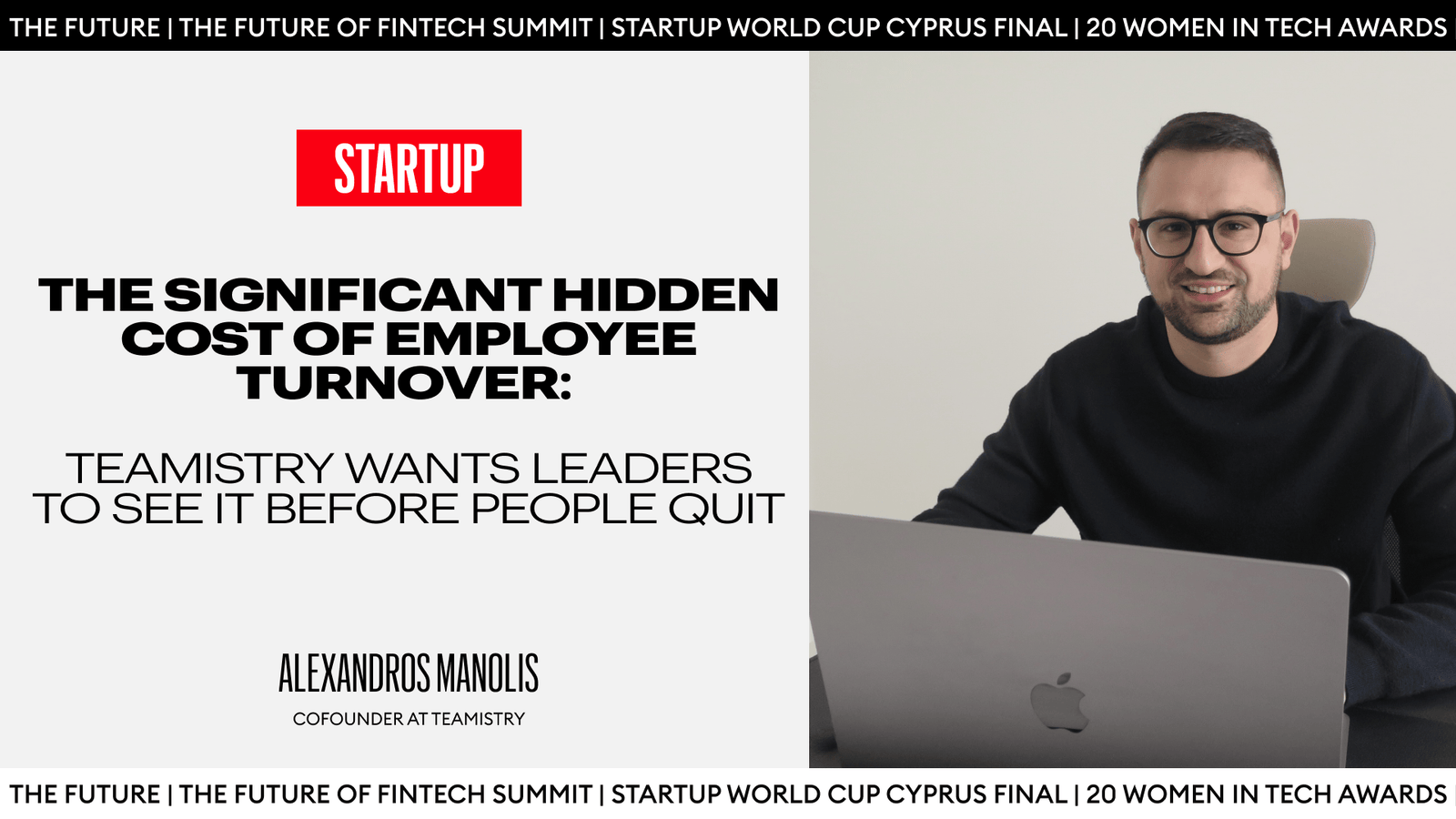
In this interview with The Future Media, Teamistry co-founder Alexandros Manolis explains why he believes turnover has become a hidden six-figure cost for decentralised SMEs, how Teamistry helps solve this problem, and why he’s scaling from Cyprus to the rest of the world.
For readers meeting you for the first time, can you introduce yourself and what you were doing before Teamistry?
My name is Alexandros Manolis. I am of Greek Cypriot origin, born and raised in Johannesburg, South Africa, and now based in Cyprus. Before creating Teamistry, I worked in the financial services industry, specifically in the deal advisory space with a specific focus on M&A.
In terms of my academic background, I hold a Bachelor of Commerce from the University of Stellenbosch, an MBA from the University of Cyprus, and I am a CFA charter holder.
What was your relationship with entrepreneurship before Teamistry?
This is my first formal entrepreneurial role. But in every role I’ve had, I operated through what I would call an intrapreneurial lens. I looked for ways to innovate from within established organisations. I have always found myself being drawn to initiatives that create lasting value for the wider good of society, rather than ticking off the next quarter’s numbers.
Teamistry argues that turnover is a hidden six-figure cost for SMEs with decentralized teams. What were you seeing in companies that convinced you this was the problem worth building around?
I saw it over and over again. How disengagement and misalignment in teams often went completely unnoticed by leadership. Then someone would resign. Only then would the company realize something was wrong, but by then it was too late. The result? At a minimum, a costly employee turnover.
It’s what we call the “decentralised trap.” As teams become more distributed, visibility fades. Managers are forced into reactive routines. Alignment slips, performance declines and even the most loyal people disengage, feeling unnoticed and unsupported.
The impact is not just financial, however. There is also the loss of institutional knowledge, productivity and team cohesion, which creates a ripple effect across the other departments. Turnover is not just an HR issue, but a strategic blind spot, one worth building a solution around.
What is Teamistry’s mission, and what change are you trying to create inside SMEs that struggle with retention and engagement?
Our mission is to help SMEs unlock the full potential of their people. Most SMEs know their teams are their biggest assets. But they don’t have the tools to actually manage that asset properly.
We are building a tool that facilitates a culture of engagement, performance, and innovation. We enable leaders to get the best out of their teams and, in doing so, we aim to transform how SMEs approach retention and engagement from reactive fixes to proactive, culture-driven growth.
Where do existing tools fall short (Slack, spreadsheets, HRIS, engagement surveys, quarterly reviews)? What gap are you closing?
Most existing tools are not designed with decentralized SMEs in mind. While these tools capture data and metrics, they don’t provide the functionality that drives performance and innovation. Teamistry closes this gap by being built with business leaders in mind to actively support engagement, performance, and continuous improvement within modern SMEs.
Let’s take our “Sync-In” feature, for example. Teams spend a couple of minutes at the beginning of the week submitting asynchronous updates on a variety of different metrics, such as their feeling going into the week, workload, work location, among other things. The platform then visualizes team health on dashboards that leaders can review instantly. From there, leaders can address any challenges that have come up, align on priorities, and celebrate wins.
It’s a straightforward system that is lean, continuous, and actionable. It’s built for how modern high-performing SMEs actually work.
What signs do you look for that suggest a team is drifting toward burnout, conflict, or attrition? And how do you design this so it supports leadership rather than feeling like monitoring?
We look for early signals. These can include shifts in team morale, what we call “vibe checks.” Rising workload. Workload deviation within a team, when one person is buried deep in tasks, and another is coasting. Drops in peer recognition.
The aim here is to support leadership, rather than create an atmosphere of surveillance. Leaders get actionable insights through easy-to-understand, continuous metrics that bring patterns they may not have been aware of previously to the surface without adding friction. This can help them have better conversations with their teams.
What is the role of AI in Teamistry, and where does the product remain human?
AI plays a key role in Teamistry’s long-term vision. We aim to use AI and advanced analytics to unlock deeper insights from the data we capture, helping teams continuously improve how they operate. As the product evolves, AI will be introduced thoughtfully, based on validated user feedback, to ensure it delivers real value. Ultimately, this will enable leaders to better understand, support, and empower their teams.
By integrating AI across features, we are working toward a more holistic, hybrid system where insights are connected rather than siloed. This helps organizations not only identify patterns but also better predict outcomes such as turnover risk or employee disengagement.
At the same time, Teamistry remains fundamentally human. The product is built around trust, genuine conversations, and authentic team dynamics, which ensure that AI enhances, rather than replaces, the human relationships at the core of strong teams.
What has been your experience building in Cyprus? What has been an advantage, and what has been the biggest constraint?
The startup ecosystem here is growing. There is a supportive environment for early-stage innovation. Our experience building locally has been largely positive. Cyprus has been a great market to test and validate ideas before scaling.
We have been pleasantly surprised by how willing and receptive local SMEs have been in trying our product and providing valuable feedback. That openness has been invaluable.
The main constraint has been the relatively small market size, which makes scaling beyond Cyprus essential for long-term growth. We have always known that. But starting here has given us a strong foundation to build from.
What does success look like for Teamistry?
Success for Teamistry means helping decentralized SMEs reduce employee turnover by empowering teams to become more engaged, more aligned, more innovative. We want to see leaders build stronger, more connected teams that consistently outperform their peers.
Right now, our focus is on establishing a strong presence locally by onboarding ambitious, high-performing SMEs before expanding into larger markets such as Dubai, South Africa and the UK.