“Failure is not an option here for a woman,” Georgia Solomou says.
She is reflecting on the early years of her career, when she was building her career in the IT and cybersecurity sector in Cyprus, the Middle East, and Africa. Twenty years ago, the industry looked very different. At regional conferences, client meetings, and cybersecurity discussions, she could be one of the only women present.
Follow THE FUTURE on LinkedIn, Facebook, Instagram, X and Telegram
There were no Women4Cyber chapters or 50×50 initiative around her then, and no mentorship network she could turn to and say, “You know what this feels like.”
“We needed to prove ourselves before the opportunity came to us,” she continues. “That was really tough.”
The pressure was not only to do the job well. It was to do it knowing that a woman’s mistake would be judged much more harshly.
“Society is not as forgiving of a woman as it is of a man when she makes mistakes.”
Georgia Solomou is Managing Partner of OSPHERA, a partner company of ChannelIT, and founder and president of Women4Cyber Cyprus. She has 20 years of experience in technology security across Europe, the Middle East and Africa, working with governments, financial institutions and enterprises on fraud prevention strategies. Her expertise spans total fraud protection, threat landscape assessment, cyber threat intelligence, email security, authentication, transaction analysis and endpoint protection.
She also co-leads the European regional working group of the global 50×50 initiative, led by the Center for Cyber Safety and Education, which aims to increase women’s participation and leadership in cybersecurity. Through Women4Cyber Cyprus, part of the broader Women4Cyber Foundation under the European Cyber Security Organisation, she works to raise awareness, create professional development opportunities, and build community in the field. She is also the Cyprus country leader for Playbook Global Women’s Leadership Network.
But before all of that, Solomou was an only child growing up in what she describes as a disciplined environment. She was taught to take responsibility for her decisions but also to trust her instincts.
“I was always driven by passion. I was following my instinct,”
she says.
She carried that discipline into cybersecurity, a field where trust is hard-earned, and pressure is constant. It is also a field where women are still too often treated as exceptions before they are treated as experts.
In 2006, Solomou started her own distribution company serving the Middle East and Africa. Then she met her husband, who was already working in security, and the direction of her work changed.
“I got the inspiration from him,” she says. “I need to admit that.”
Together, they moved deeper into cybersecurity, concentrating on fraud prevention and solutions. Looking back now, even she sounds slightly startled by the decision.
“When I think of that now, I say, ‘Oh my God, did I really do that?’”
It was not easy. She was building in a male-dominated industry, in a period when women in cybersecurity were far less visible than they are now. She remembers walking into conferences and meetings, especially in the Middle East, and being the only woman in those rooms.
She also remembers the support that gave her the confidence to keep taking her place at those tables.
“My main supporter was my husband,” she says. “It’s very important to have somebody by your side, giving you confidence and supporting you at every step.”
This is an important point that highlights Solomou’s definition of inclusion. She does not believe women can transform an industry still largely controlled by men by working separately from them. Yes, women need each other. But they also need men to open doors, share space and take part in the change.
“In order to succeed in a male-dominated industry, of course you need to have supporters from the other side as well,”
she explains.
Women4Cyber Cyprus, which Solomou launched a little over a year ago, was created to give women tools she did not have when she started. It provides visibility, mentorship, and community. A platform where a woman entering cybersecurity does not have to imagine herself alone.
The need, she says, is still obvious. According to Solomou, women make up around 12% of the cybersecurity field in Cyprus. Across Europe, she says, the figure is about 22%.
“So there is a lot still to be done,” she says.
That work, says Solomou, has to begin before women reach the labour market. If girls do not see cybersecurity as an option early, they are less likely to imagine themselves in the field later. That is why Women4Cyber Cyprus has also worked with HackShield, an online gaming platform, in collaboration with the Office of the Commissioner of Communications.
“We need to educate the young generation from the very early stage,” Solomou says. “We also need to give options to the kids.”
Asked why many women still do not consider cybersecurity as a career, Solomou starts with a misconception. People often assume cybersecurity is a purely technical field. However, that is not true. The field involves different kinds of work, different kinds of thinking, and different routes in.
The barriers, she believes, are both structural and internal. The system has to change, but girls also have to be shown early that they have the same options as boys. Education is key here.
That same word, education, returns when the conversation moves to artificial intelligence. Solomou is not dismissive of AI; she sees its value in health, cybersecurity, and many other fields. What concerns her is the way people use technology without enough understanding of what it can and cannot do.
The issue, she says, is how people use it. “It cannot replace the human factor,” she says. “It cannot replace human relationships. It’s here to add value. But we need to adopt AI more responsibly.”
That responsibility should not be taken lightly in both the professional and personal spheres.
Her concern with what happens to human identity and relationships as AI assumes a greater role in daily life also plays out on a more personal level. As a mother of three, she says she has tried to show her children that gender should not narrow their choices. She also wants them to question gender stereotypes, especially when it comes to women and motherhood.
“I never gave them the impression that, okay, I’m a mother of three kids, I have to sit back. Of course I have to take care of them, but this is not the only thing that a mother can do,”
she says.
She encourages her children to chase their dreams. She also asks them to understand hers.
“I want them to also support me in this effort as well,” she says. “When you don’t ask for support, you cannot expect it.”
For girls looking at cybersecurity and wondering whether there is space for them, Solomou’s answer is already visible in the work she is doing. The rooms may still be male-dominated. The pressure may still be uneven. But the woman who once walked into those rooms alone is now building support networks so that others do not have to.
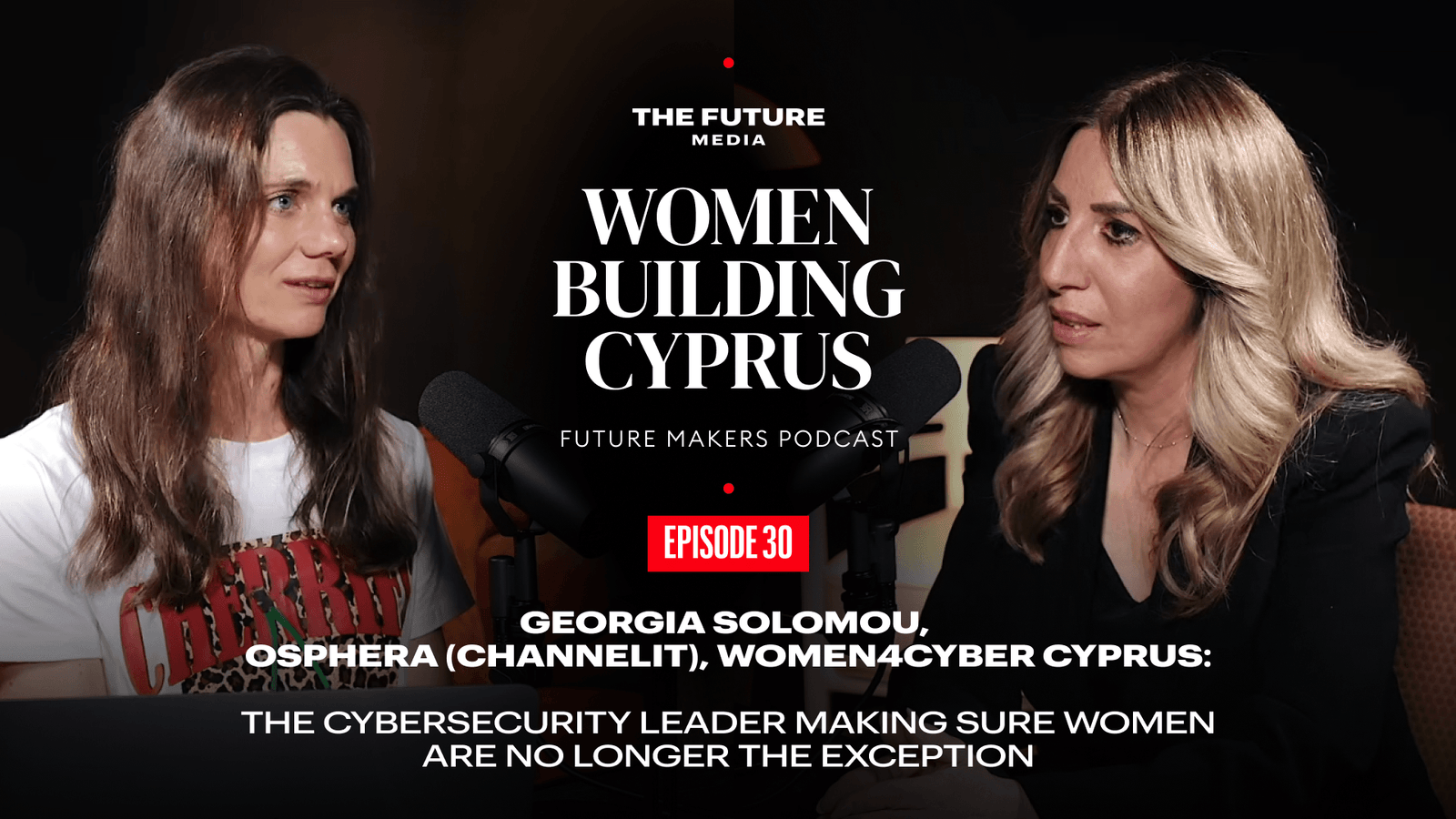
Georgia Solomou is a guest on The Future Makers: Women Building Cyprus. The full episode, including her reflections on women in cybersecurity, Women4Cyber Cyprus, digital safety, AI, male allies, motherhood, and why Cyprus can play a stronger role in cybersecurity, is available to watch now.
The Future Makers Podcast is a series of in-depth conversations about how future-makers are made, in Cyprus and beyond. Host Annetta Benzar sits down with people who are a leading force in our shared future and looks past the titles. Together, they travel back to the people and moments that shaped them, walk through the choices and challenges they are living through now, and look ahead to the futures they are trying to build.
Women Building Cyprus follows women whose lives and decisions are changing what this island can be.
A production of The Future Media.