In Europe, youth entrepreneurship remains a paradox: high aspiration, low activation.
In 2022, just 7% of Europeans aged 20–29 were self-employed, half the rate of the working-age population as a whole. Though 39% of youth (15–30) say they prefer self-employment to traditional work, only about 5% are actively working on a start-up, (nascent entrepreneurship), and 4% run a business under 42 months old, bringing the EU’s total early-stage entrepreneurial activity (TEA) for 18–30-year-olds to 9% (GEM 2018–2022). Nearly three in four young would-be founders, 73%, identify access to finance as their primary obstacle to getting their business idea off the ground, while fewer than half feel they have the practical skills to navigate even the earliest stages of startup life. Another factor, that is the fear of failure, is also on the rise, affecting 49% of potential entrepreneurs globally (GEM 2024), slamming the brake on potential.
Follow THE FUTURE on LinkedIn, Facebook, Instagram, X and Telegram
The Cyprus story is a little more nuanced, though. The island’s youth early-stage entrepreneurial activity (TEA) for ages 18–30 stands at 9%, above the EU average of 7%—but hides the divergence among 18–44-year-olds, where TEA reaches 12.4%, suggesting a concentrated burst of early initiative. More significantly, Cypriot youth report markedly higher confidence: 22% expect to start a business in the next three years (versus the EU’s 12–12%), and over 50% believe they have the skills to do so (compared with 40–42% across the bloc). Notably, only 7% of young entrepreneurs building on the island are driven by necessity. Less than half the EU average of 18%, suggesting instead an uptick of opportunity-led, ambition-driven ventures.
Aspiration alone won’t scale, unfortunately. With an estimated 1,000–2,000 young self-employed individuals across a 1.2-million population, structural gaps continue to limit both appetite and opportunity for scaling. Funding, while available through schemes like MECI’s Youth and Women Entrepreneurship (up to €120,000 for under-30s) and RIF’s Future Founders Academy, funds are unevenly distributed. Mentorship is few and far between. Culturally, entrepreneurship is still often read as deviation, not direction, and not encouraged.
Which is why what’s unfolding at ground level demands attention.
Across the island, a new generation of founders is stepping forward. They are not waiting for perfect conditions and are not relying on safety nets. They are bootstrapping in a high-cost, low-subsidy environment. They are building across the full spectrum of the island’s commercial fabric, from agile marketing studios and reimagining food and beverage for local and global palates, to opening unique retail concepts, and developing tech tools.
This Future Media Young Entrepreneurs Take The Spotlight series turns the lens toward those who are rewriting the script, not with venture capital backing or inherited advantage, but with inspiring determination, iterative creativity, and the kind of relentless hard work that transforms side hustles into scalable businesses.
Because the question isn’t whether youth entrepreneurship in Cyprus can scale.
But what happens when the ecosystem finally meets them where they stand?
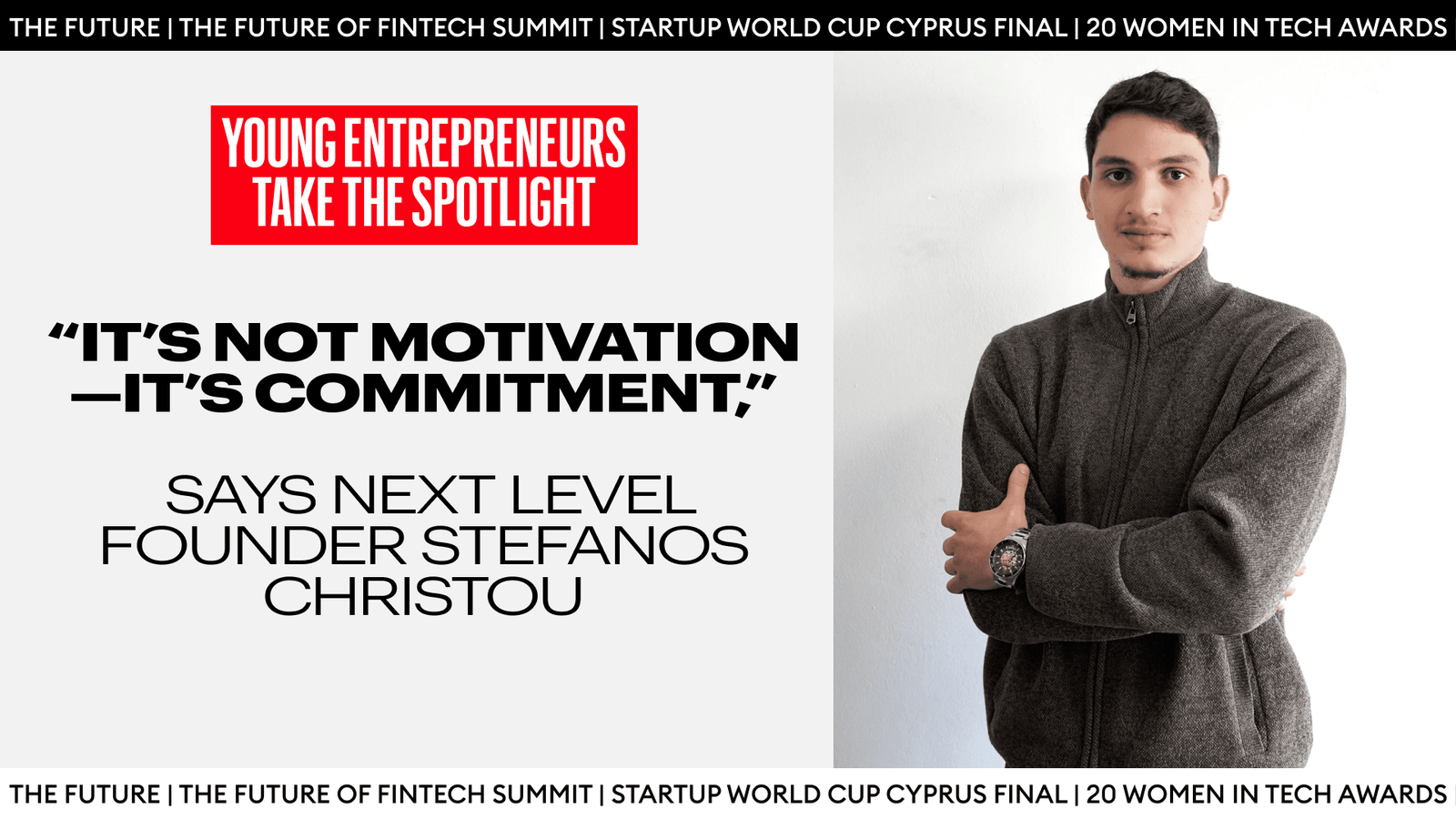
Our second interview is with Stefanos Christou, 23, Founder and Managing Director of Next Level, a Nicosia-based group that began as a marketing agency and has since expanded to include Noesis, a software development company, and Greekmanizer, an AI humanizer platform. With a focus on building scalable, globally oriented businesses, Next Level now serves clients across Cyprus, Greece, the UAE, the US, Belgium, and the Netherlands, supporting ambitious founders and teams looking to scale, enter new markets, or strengthen their digital presence, while actively planning its own next stage of expansion.
1. What made you decide to start a business in Cyprus?
I’ve been working on different kinds of projects since I was 17, from web scraping and sourcing products from China to building one of the first NAO robots in Cyprus. But marketing became a real passion at 18, when I realized how deeply it is connected to data. What fascinated me was the idea that, by following the data, you can completely transform a business and, in many cases, the life of the person behind it.
That insight stayed with me. Even today, I still get goosebumps when a client tells us how much we’ve changed their business, or just their day-to-day reality. Unfortunately, data continues to be a tool that many companies and marketing agencies don’t fully use. For us, it’s never been an add-on or a trend. It’s the foundation of everything we do.
When I decided to start the marketing company in Cyprus, I brought in one of my oldest friends, Panagiotis, from the very beginning. That decision shaped the entire vision. I realized that my goal wasn’t just to build a successful company, but to build it together with people I trust and respect, many of whom are my best friends. We each had skills and potential we hadn’t fully discovered yet, and I wanted to create an environment where we could push each other, grow fast, and build something meaningful together, not just profitable.
For me, succeeding alone was never the objective. The journey is far more powerful (and honestly, far more enjoyable) when you’re building something ambitious with people who challenge and believe in you.
2. What have been the toughest parts of building and running your business here, and how have you dealt with those challenges so far?
One of the biggest challenges was proving to Cypriot entrepreneurs that age is not a disadvantage. In my case, it became an advantage.
Cyprus’s entrepreneurial landscape has long been dominated by family-run businesses, and young founders are still rare. From the beginning, I knew I had to change that narrative. In the first two years, meetings and negotiations were difficult. My age often led many people to underestimate me, or worse, to overlook what I was saying.
That challenge only intensified when we stepped early into industries like politics and real estate, which are entrenched with strong interests and intense competition. It was not only proving yourself against established companies, but also against long-standing mindsets. I quickly realized that if I wanted to succeed, I couldn’t just be good enough. I had to be ten times better than the competition.
So, I started cold-calling the companies myself. When people asked my age, the responses ranged from laughter to outright rejection and, in some cases, outright rudeness. Those moments stayed with me.
But so did the work. By consistently delivering real results, not just in Cyprus but internationally, the portfolio spoke louder than assumptions. Today, many of the same people are calling our office, asking to set up meetings.
What was once seen as a weakness became part of our credibility.
3. On the days when it feels hard to keep going, what keeps you moving, what really fuels your hustle?
Honestly, most days are hard. That never really changes. But I don’t see stopping as an option because what I’m building no longer affects just me.
My best friends are fully committed to this, too. Their lives, their time, and their future are tied to the decisions I make every day. Because of that, I feel a responsibility to always lead by example. To be the first one to show up, to stay disciplined, and to keep going when things get difficult. Over the past four years, there hasn’t been a single day that I haven’t worked. I’ve worked from airports, taxis, and even hospitals. Not because I enjoy exhaustion, but because the mission doesn’t pause.
At the same time, I’m deeply motivated by my family. I want to prove to my father and my mother that the sacrifices they made, emotional and financial, to raise me were worth it. That what they gave me, turned into something real. That pressure is heavy, but it’s also a privilege.
What truly fuels me, though, is a constant need to prove something. Not to the world, but to myself, that the things I dreamed of are actually achievable. To my friends, that trusting me was the right decision. To my family, that they raised someone who doesn’t quit when things get hard and even unbearable.
And finally, I’m driven by a deeper conviction that success doesn’t have to follow a predefined path. You don’t need to fit into the existing system to win. If the traditional routes don’t make sense to you, you can build your own.
That belief shapes how I work, how I think, and how I build companies.
It’s not about motivation. It’s about commitment.
4. No one builds alone. Who or what has been part of your support system (people, communities, programmes, even places) that has made a real difference?
Everything we’ve built at Next Level is built with my best friends. From the beginning, the people in key managerial positions have been people I’ve known my entire life. I couldn’t have done this without Panagiotis Malekos, our Creative Director; Ploutarchos Alonefti, our Operations Director; and Alexandros Hadjipavlou, our Content Director. Trust at that level can’t be replaced by contracts or titles.
This is also why we were able to scale the way we have. We don’t operate like a typical company. We work on Christmas, New Year’s, and public holidays. Not because anyone is forced to, but because we all share the same vision. I carry the responsibility of setting the direction; they commit because they trust the process and the long-term goal we’re building toward.
Outside the company, my family has shaped who I am. My father taught me discipline, respect, and loyalty from a very young age. Those values are deeply embedded in how I lead and how I treat people. My mother has always trusted that I know my own path, even when it wasn’t the easiest or most conventional one. My sister is a constant source of motivation for me and a reminder of why I push myself so hard.
Next Level, as it exists today, could never have been built alone. It’s the result of trust, shared sacrifice, and people who chose not just to believe in the same vision, but to walk the journey together.
5. What advice would you give to another young entrepreneur in Cyprus who wants to start something of their own but is hesitating?
If you want to reach a certain level, don’t take advice from people who have never been there. That doesn’t mean you stop listening, but you must be very selective about whose opinions you allow to influence your decisions.
Most of the time, you already know what you need to do. Some of the choices you make will be wrong, and that’s normal. Often, those mistakes are necessary. They’re lessons you couldn’t have learned any other way, and they fundamentally shape how you think and operate later on.
So, seek education. Seek advice. But above all, trust your instincts. Be your toughest critic. Hold yourself accountable every single day. You can’t control what others do, but you can control your own habits: waking up early, working with deep focus, reading, learning, and constantly improving your skills are all things fully within your power.
Entrepreneurship isn’t an easy path. There are no shortcuts. It doesn’t get easier with time; you just get stronger.
If this is something you truly want, there are no excuses. You fight through the difficult periods. You stay disciplined. And you keep your circle small as you move forward.