

In Europe, youth entrepreneurship remains a paradox: high aspiration, low activation.
In 2022, just 7% of Europeans aged 20–29 were self-employed, half the rate of the working-age population as a whole. Though 39% of youth (15–30) say they prefer self-employment to traditional work, only about 5% are actively working on a start-up, (nascent entrepreneurship), and 4% run a business under 42 months old, bringing the EU’s total early-stage entrepreneurial activity (TEA) for 18–30-year-olds to 9% (GEM 2018–2022). Nearly three in four young would-be founders, 73%, identify access to finance as their primary obstacle to getting their business idea off the ground, while fewer than half feel they have the practical skills to navigate even the earliest stages of startup life. Another factor, that is the fear of failure, is also on the rise, affecting 49% of potential entrepreneurs globally (GEM 2024), slamming the brake on potential.
Follow THE FUTURE on LinkedIn, Facebook, Instagram, X and Telegram
The Cyprus story is a little more nuanced, though. The island’s youth early-stage entrepreneurial activity (TEA) for ages 18–30 stands at 9%, above the EU average of 7%—but hides the divergence among 18–44-year-olds, where TEA reaches 12.4%, suggesting a concentrated burst of early initiative.
More significantly, Cypriot youth report markedly higher confidence: 22% expect to start a business in the next three years (versus the EU’s 12–12%), and over 50% believe they have the skills to do so (compared with 40–42% across the bloc).
Notably, only 7% of young entrepreneurs building on the island are driven by necessity. Less than half the EU average of 18%, suggesting instead an uptick of opportunity-led, ambition-driven ventures.
Aspiration alone won’t scale, unfortunately. With an estimated 1,000–2,000 young self-employed individuals across a 1.2-million population, structural gaps continue to limit both appetite and opportunity for scaling.
Funding, while available through schemes like MECI’s Youth and Women Entrepreneurship (up to €120,000 for under-30s) and RIF’s Future Founders Academy, is unevenly distributed. Mentorship is few and far between. Culturally, entrepreneurship is still often read as deviation rather than direction and is not encouraged.
Which is why what’s unfolding at ground level demands attention.
Across the island, a new generation of founders is stepping forward. They are not waiting for perfect conditions and are not relying on safety nets. They are bootstrapping in a high-cost, low-subsidy environment. They are building across the full spectrum of the island’s commercial fabric, from agile marketing studios and reimagining food and beverage for local and global palates, to opening unique retail concepts, and developing tech tools.
This Future Media Young Entrepreneurs Take The Spotlight series turns the lens toward those who are rewriting the script, not with venture capital backing or inherited advantage, but with inspiring determination, iterative creativity, and the kind of relentless hard work that transforms side hustles into scalable businesses.
Because the question isn’t whether youth entrepreneurship in Cyprus can scale.
But what happens when the ecosystem finally meets them where they stand?
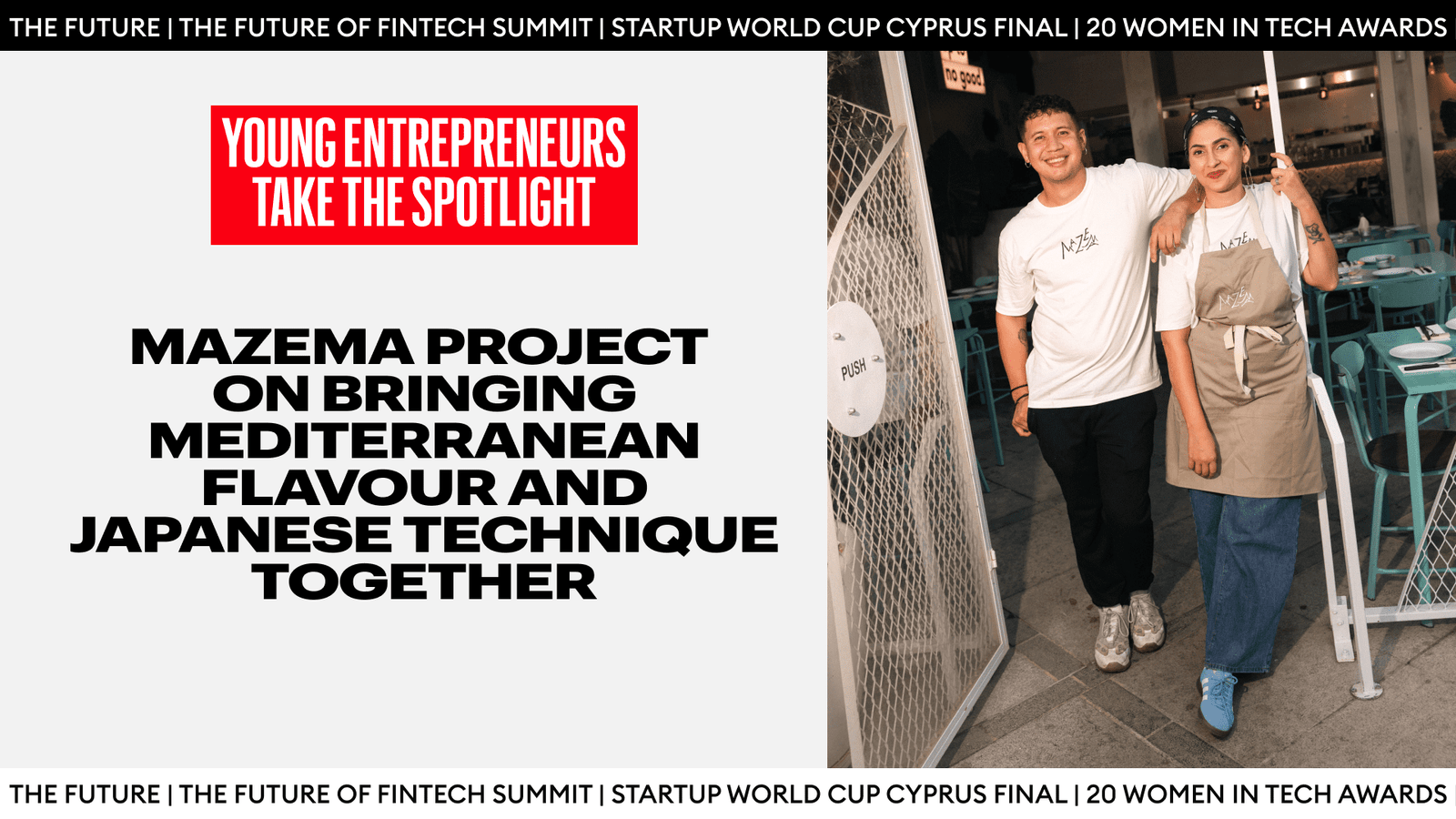
This interview features the dynamic duo behind Mazema Project, Christina Christofi and Stefanos Angel Sachpazis. Former MasterChef contestants, they bring together two culinary worlds: Christina’s Mediterranean flavours and seasonal ingredients, and Angel’s Japanese cuisine and technique. Based in Cyprus, the Mazema creates intimate dining experiences that bring people together through and because of food, weaving culture, memories, and stories on the plate.
1. What made you decide to start a business in Cyprus?
Cyprus felt like the right place to build something personal. It’s home, but it’s also a place where there’s space to experiment, combine cultures, and create something new. The ingredients, the people, and the slower rhythm gave us the freedom to build a project that reflects both of us.
2. What have been the toughest parts of building and running your business here, and how have you dealt with those challenges so far?
One of the hardest parts has been balancing creativity with reality. Cyprus is a small market, so you constantly have to adapt, rethink formats, and stay flexible.
There were moments where things didn’t go as planned, but we learned to pivot, simplify, and focus on what truly connects with people.
3. On the days when it feels hard to keep going, what keeps you moving, what really fuels your hustle?
Seeing people connect with what we do. When someone experiences our food, asks questions, or comes back again, it reminds us why we started. Creating meaningful moments through food is what keeps us going, even on the hard days.
4. No one builds alone. Who or what has been part of your support system?
Our families and close friends have been incredibly supportive.
5. What advice would you give to another young entrepreneur in Cyprus who wants to start something of their own but is hesitating?
Don’t wait until everything feels perfect. Start small, stay honest, and allow your idea to evolve.
Cyprus may be small, but that also means you can build real connections if you stay true to your vision.