
In Europe, youth entrepreneurship remains a paradox: high aspiration, low activation.
In 2022, just 7% of Europeans aged 20–29 were self-employed, half the rate of the working-age population as a whole. Though 39% of youth (15–30) say they prefer self-employment to traditional work, only about 5% are actively working on a start-up, (nascent entrepreneurship), and 4% run a business under 42 months old, bringing the EU’s total early-stage entrepreneurial activity (TEA) for 18–30-year-olds to 9% (GEM 2018–2022). Nearly three in four young would-be founders, 73%, identify access to finance as their primary obstacle to getting their business idea off the ground, while fewer than half feel they have the practical skills to navigate even the earliest stages of startup life. Another factor, that is the fear of failure, is also on the rise, affecting 49% of potential entrepreneurs globally (GEM 2024), slamming the brake on potential.
Follow THE FUTURE on LinkedIn, Facebook, Instagram, X and Telegram
The Cyprus story is a little more nuanced, though. The island’s youth early-stage entrepreneurial activity (TEA) for ages 18–30 stands at 9%, above the EU average of 7%—but hides the divergence among 18–44-year-olds, where TEA reaches 12.4%, suggesting a concentrated burst of early initiative. More significantly, Cypriot youth report markedly higher confidence: 22% expect to start a business in the next three years (versus the EU’s 12–12%), and over 50% believe they have the skills to do so (compared with 40–42% across the bloc). Notably, only 7% of young entrepreneurs building on the island are driven by necessity. Less than half the EU average of 18%, suggesting instead an uptick of opportunity-led, ambition-driven ventures.
Aspiration alone won’t scale, unfortunately. With an estimated 1,000–2,000 young self-employed individuals across a 1.2-million population, structural gaps continue to limit both appetite and opportunity for scaling. Funding, while available through schemes like MECI’s Youth and Women Entrepreneurship (up to €120,000 for under-30s) and RIF’s Future Founders Academy, funds are unevenly distributed. Mentorship is few and far between. Culturally, entrepreneurship is still often read as deviation, not direction, and not encouraged.
Which is why what’s unfolding at ground level demands attention.
Across the island, a new generation of founders is stepping forward. They are not waiting for perfect conditions and are not relying on safety nets. They are bootstrapping in a high-cost, low-subsidy environment. They are building across the full spectrum of the island’s commercial fabric, from agile marketing studios and reimagining food and beverage for local and global palates, to opening unique retail concepts, and developing tech tools.
This Future Media Young Entrepreneurs Take The Spotlight series turns the lens toward those who are rewriting the script, not with venture capital backing or inherited advantage, but with inspiring determination, iterative creativity, and the kind of relentless hard work that transforms side hustles into scalable businesses.
Because the question isn’t whether youth entrepreneurship in Cyprus can scale.
But what happens when the ecosystem finally meets them where they stand?
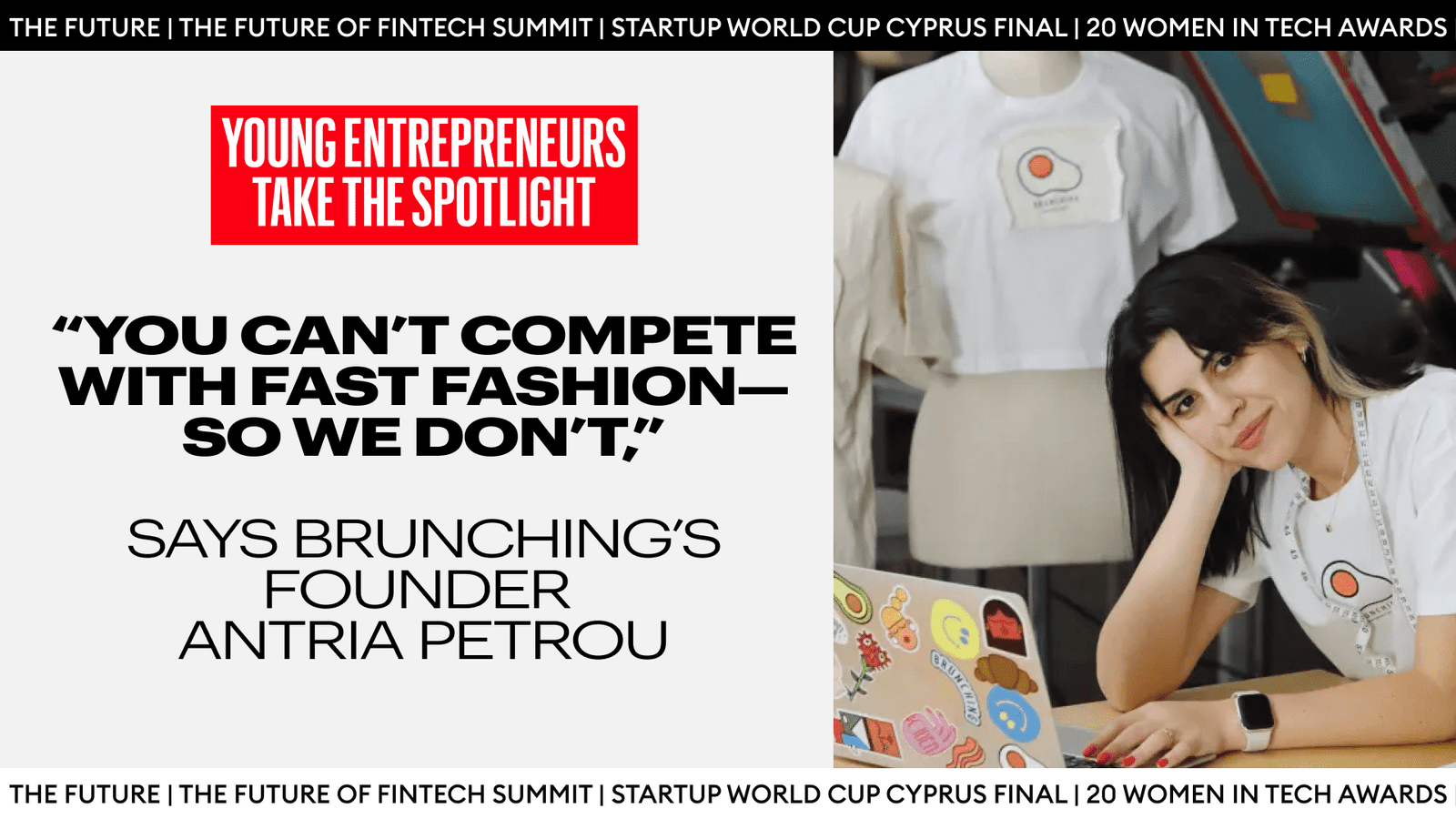
Our next interview is with Antria Petrou, founder and designer of the Cyprus-based lifestyle and streetwear brand, BRUNCHING, inspired by brunch culture, food, and everyday joy. They create unisex, wearable art for people who love colour, creativity, and feel-good design. The online store produces and sources locally from its warehouse in Larnaca.
1. What made you decide to start a business in Cyprus?
The initial idea and early designs began in London. By the time I decided to turn BRUNCHING from a concept into a real brand, I moved back to Cyprus. Building it here felt right, close to my people and my roots.
I knew Cyprus would be a challenging market because it’s small, and not everyone immediately understands unconventional concepts. But I remember asking my pappou (grandpa) if I should go for it, and his answer was a clear yes. That moment gave me the confidence to believe that if one person truly gets it, others will too.
2. What have been the toughest parts of building and running your business here, and how have you dealt with those challenges so far?
One of the biggest challenges was starting fully self-funded, using my own pocket money, without savings, capital, or investors. In the early stages, without proof of success, funding simply wasn’t an option. This made everything more difficult, from producing collections to hiring employees and eventually transitioning BRUNCHING into my main focus.
To sustain the brand, I worked a full-time job while also taking on small design projects on the side, just to bring additional income back into the business. The bigger the brand grows, the more investment it requires, so consistently reinvesting was essential.
At the same time, I’m a graphic designer, not a business or finance expert. I had to learn everything as I went along, from social media and photography to fabrics, patterns, manufacturing, pricing, logistics, and above all, finances. For a long time, I balanced all of this while working full-time in an office, managing BRUNCHING, and trying to maintain a personal life.


The fashion industry itself is also extremely challenging and constantly changing. As a small business, you often don’t have strong bargaining power with manufacturers, which means higher production costs. Competing with fast fashion prices is simply not realistic.
To deal with these challenges, we chose transparency. We openly communicate our journey and strategies with our clients, often through social media, so they understand what it really takes to run a small brand and continue creating. That honesty has helped build trust and a strong, supportive community around BRUNCHING.
3. On the days when it feels too hard to keep going, what keeps you moving, what really fuels your hustle?
My family, friends, and team believed in me from the very beginning, sharing their time, knowledge, and patience. My mom still helps with deliveries and packaging, often staying up late with my dad to label products and count stock. My partner has also been a constant source of encouragement, always supporting me, wearing the brand, sharing ideas, pushing me forward on difficult days, and celebrating the good ones.
But the truth is, without our clients and the community around BRUNCHING, we wouldn’t be here. Seeing people genuinely connect with the brand, send messages, comment, or stop us just to share their excitement or say congratulations, gives real meaning to all the effort.
Cyprus is small and comes with its limitations, especially when it comes to market size and logistics, but I believe in the brand and the community growing around it too much to ever stop.
4. No one builds alone. Who or what has been part of your support system?
My close circle has been essential. My team, my family, and friends who showed up with their time, skills, and emotional support when it mattered most. I truly believe that without them, BRUNCHING wouldn’t exist in the way it does today.


Cyprus itself has also played a role. Being a small place means relationships are more personal, and when people believe in what you’re building, they genuinely show up. I put a lot of faith in teamwork, and my goal is to build a creative team of artists and people with different expertise who believe in BRUNCHING, want to grow together, and add their own magic touch to make the brand even more tasty.
5. What advice would you give to another young entrepreneur in Cyprus who wants to start something of their own but is hesitating?
Start before you feel ready. You will never feel fully prepared. Be patient, especially in Cyprus. Growth may be slower, but that doesn’t mean it isn’t real.
Learn as much as you can, accept that mistakes are part of the process, and surround yourself with people who believe in you on the days you don’t. Most importantly, listen to your clients. You might start with one idea, but if you stay open, that idea can evolve into something even stronger. It’s not about control or ego, it’s about listening and creating something people genuinely connect with.
I truly believe that when you create something with quality and intention, and you believe in it deeply, you will eventually find the people who understand what you’re doing. For me, consistency is key. Showing up, even on the hard days, is what builds trust, confidence, and long-term growth.
Trust what you’re building, feel it, and let that belief push you forward.
Cyprus is not always the most supportive environment for creators, and that’s the honest truth. At the same time, it’s a place where an incredible number of talented artists and creative brands are born. I’m proud to be a Cypriot artist because I truly believe that from this island, great things come. There is real potential here. With stronger support from those who can open doors, invest, and believe in creative work, these artists and brands could grow not only locally but internationally. Cypriot creativity deserves the space and backing to travel far beyond the island.