
Cyprus climbed six places to 34th in the StartupBlink Global Startup Ecosystem Index 2026. StartupBlink recorded a 62.7% annual increase in the country’s index score and estimated its startup ecosystem to be worth $4.2bn. It was Cyprus’s third consecutive year with the highest annual climb among EU countries.
According to Filippos Kyprianou, Director of Plug and Play Cyprus, the measure of progress is whether Cyprus-based startups can win customers abroad, grow their revenue and attract established international investors.
Follow THE FUTURE on LinkedIn, Facebook, Instagram, X and Telegram
Founders should be able to pursue that ambition without relocating to London, Berlin or the United States, he argues. However, international expansion requires more than confidence and ambition. Companies also need a strong foundation of returning customers, people capable of selling in several markets, and a plan that accounts for the additional cost and time involved.
“You’re not building a company for Cyprus,” Kyprianou says. “You’re building a company from Cyprus to serve global markets.”
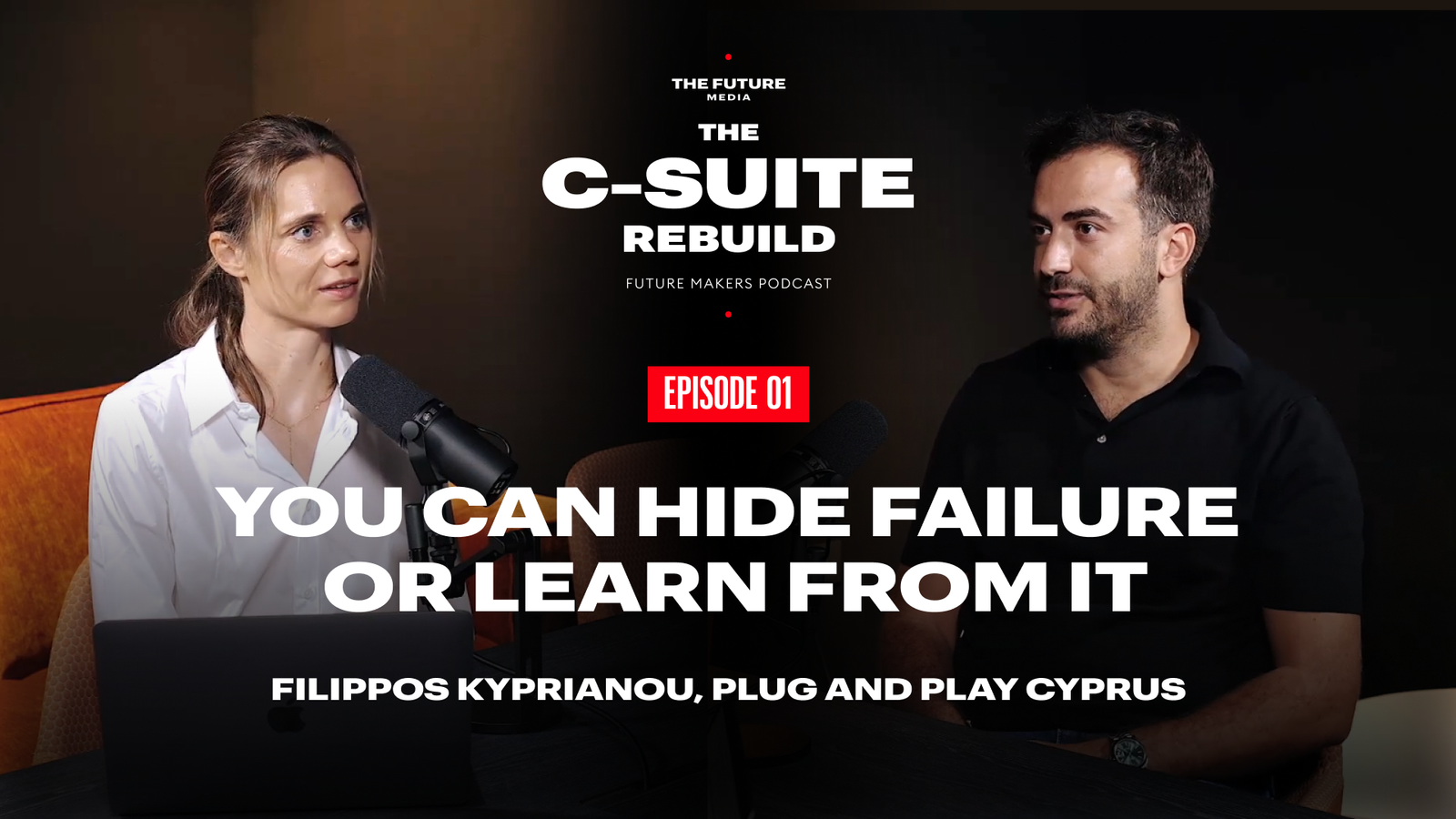
In the first episode of The Future Makers: C-Suite Rebuild, Kyprianou discusses what founders need, where Cypriot startups lose momentum, and how to tell whether a company is genuinely ready to enter another market.
The following conversation has been edited for length and clarity.
About The Guest
Filippos Kyprianou is Director of Plug and Play Cyprus. He began his career at Deloitte before moving into corporate innovation at the Lloyd’s Register Accelerator. He later helped build and expand Vonage’s startup programme and worked at an MIT spinout before joining Plug and Play.
You have worked across several sides of the startup journey. What has that taught you about what founders need?
I think what founders need has evolved quite a bit over the past 10 or 15 years, and even more over the past five with the advent of AI and large language models.
Ten or 15 years ago, even with YouTube and Google, founders needed more information. Advice was much more necessary than it is today.
Nowadays, what founders need even more is access. By access, I mean access to the next customer, the next investor or a corporate partner they can innovate with.
I also think being a founder is quite a lonely job, whether you have a co-founder, are doing it alone, or have a small team. Your partner at home or your friends cannot really empathise. Working in a large company is not the same as working at a startup.
Founders also need access to other founders who have built companies, succeeded and failed. That creates a support mechanism and helps them understand that they are not alone.
When it comes to startup programmes such as the one we have launched in Cyprus with Plug and Play, it is important that we treat startups as our customers. We are here to serve the ecosystem and the startups within it.
How do you change the mindset of founders who grow up in Cyprus and may feel limited by the size of the island? How do you cultivate that global mindset?
There are many layers to that. From Plug and Play’s perspective, we can open their eyes to what is possible and give them access to our international network. One warm introduction could lead to their next customer. Another could lead to their next investor.
There are also parts of our education that need to change, starting with younger generations. What my mother and grandmother always told me was that you have to finish school, go to university, get a safe and stable job, and climb the ladder.
Being a risk-taker is not necessarily presented as the best choice. There is foundational work we can do with younger generations to show them that starting a company can allow them to solve more interesting problems.
Failure is not a bad thing. How you perceive and respond to failure makes the difference. You can hide it, or you can learn from it.
We also need to show people that they can be ambitious. Being born on a small island does not mean that you have to build a company only for Cyprus. You will hear me say this again and again: you are not building a company for Cyprus. You are building a company from Cyprus to serve global markets.
People often describe Cyprus as a growing startup ecosystem. What would convince you that it had matured?
I think the government, the Research and Innovation Foundation, and the Deputy Ministry of Research, Innovation and Digital Policy have done a very good job of establishing the foundations for more startups and more jobs. We have also seen Cyprus moving higher in the StartupBlink rankings.
For me, what would demonstrate further growth is what happens at the micro level. If we start talking about startups in the same way that startups are discussed in the United States, we will be talking about companies with customers in different markets, growing revenue and tier-one investors on their cap tables.
The metric for me is not simply the number of startups. It is whether startups based in Cyprus are serving customers across Europe, Asia and the United States while growing their revenue and customer base.
That would show that the ecosystem had matured further and that we were no longer looking only inside Cyprus.
How do you help a founder recognise that their company may not be ready for international growth?
That is a good question. I think it is very difficult to tell a founder that because they may not listen to you. The reality is that they know their company much better than somebody looking from the outside.
I would try to work with them to understand the data behind the decision. Do they have happy, returning customers in their existing market? If they do not have returning customers, expanding could mean that they churn even more customers. They risk turning the company into a churn machine.
Do they have the people they need? If they have an enterprise sales model, can their team sell, or are the founders doing all the selling? If it is only the founders, they cannot be in Munich, São Paulo, and Hong Kong at the same time.
Do they have a plan for the new market, or are they simply going to show up? Have they calculated how their unit economics would work if the sales cycle were six months longer than in their current market?
Asking those probing questions and looking at the data can create a light-bulb moment for the founder. They may realise that they need to fix customer churn before considering expansion. They may also find that localisation is causing the churn and that moving into a different market could help reduce it.
Do you advise founders to start locally, or are there cases where they can pursue international customers from the first day?
It really depends on what they are building.
People now have access from everywhere. My personal view is that you have to think from day one about where you want the company to be five years from now.
If you are building a developer tool, the characteristics of your customers may be very similar whether the developer is Cypriot or American. Depending on whom you are building for, you could go international from the first day.
If you are building a highly local product, you may need to establish yourself in the first market before moving into others. It also depends on how much funding you have. You may have enough funding to pursue several expansion routes at the same time.
Every startup is different. Depending on how you want to build the company, you need to make decisions from day one that will help you reach where you want to be five years from now.
In the full episode, Kyprianou discusses what he looks for beyond a founder’s pitch deck, why corporate-startup projects fail, and how Plug and Play Cyprus plans to work across maritime, fintech, AI, energy, and gaming. He also addresses the expectations surrounding Plug and Play’s arrival in Cyprus and the results by which he wants its work to be judged.
The Future Makers: C-Suite Rebuild features conversations about rebuilding leadership, restructures, turnarounds, scaling, culture repair, governance, crises and succession. Host Annetta Benzar speaks with the executives, founders and operators doing that work from inside their organisations.
A production of The Future Media.