Breaking news

Europe’s Talent Divide: Northern Capitals Dominate As Southeastern Regions Lag Behind

Europe’s high-skilled workforce is showing a stark geographic split. According to Eurostat, about 80 million EU workers—roughly 44% of those aged 25 to 64—are highly skilled, encompassing managers, technicians, and knowledge professionals. However, the distribution of this talent is anything but uniform.

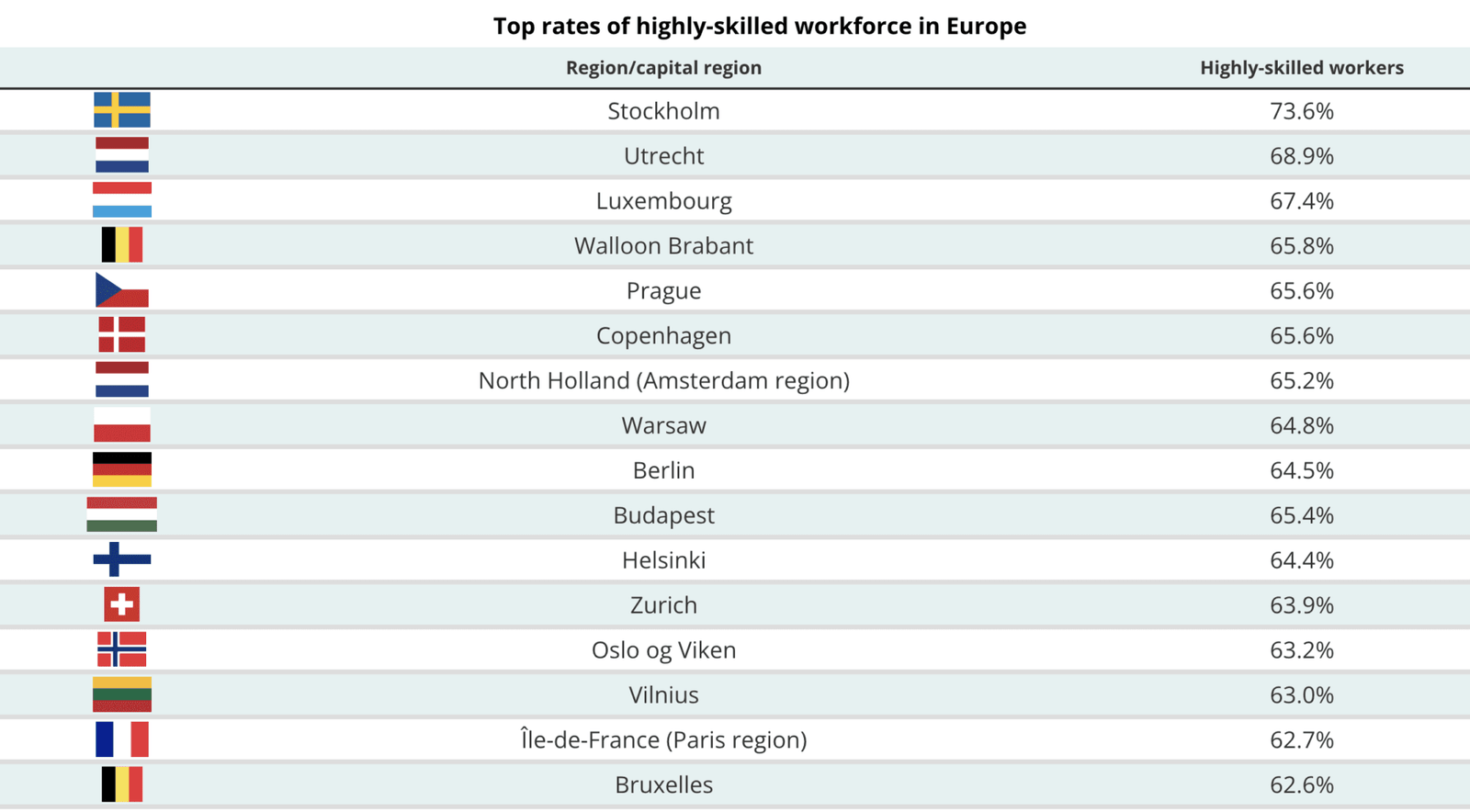
Across the continent, capital and major urban centers are the magnets for top-tier talent. Northern European capitals are leading the charge: Stockholm tops the list with a remarkable 74% share of highly skilled workers, followed by Utrecht at 69%, Luxembourg at 67%, and clusters in Belgium’s Brabant Wallon, Copenhagen, and Prague, all hovering around 66%. These regions are thriving hubs of innovation and expertise, where robust economic ecosystems continue to attract and nurture a competitive workforce.

image 76

In contrast, rural areas and former industrial heartlands—particularly in southeastern Europe—are struggling to keep pace. In 24 EU regions, less than one-third of the workforce is highly skilled. Regions such as Sterea Elláda (Central Greece) report a mere 21.8%, while the Ionian Islands and Romania’s Sud-Muntenia stand at 22.3% and 22.8% respectively. This uneven distribution highlights significant challenges for economic development and competitiveness in these areas.

The data underscores a critical takeaway for policymakers and business leaders alike: the future of Europe’s economic landscape will be heavily influenced by the ability to bridge this talent gap. As northern capitals continue to lead in innovation and skill, southeastern regions face an urgent need for strategic investments and initiatives aimed at elevating their human capital.

In a rapidly evolving global economy, understanding and addressing this talent divide is not just an economic imperative—it’s a blueprint for sustainable growth and regional balance across Europe.

Webflow Strengthens Marketing Suite With Acquisition Of AI-Powered Vidoso

Strategic Acquisition For Enhanced Marketing

Webflow, a leading software platform for website building and hosting, has acquired AI-driven content-generation platform Vidoso to advance its suite of marketing offerings. The move signals Webflow’s strategic shift from being recognized solely as a website builder and CMS provider to emerging as a holistic, agentic marketing platform.

Integrating AI With Content Creation

Vidoso, founded in 2024, uses large language models to help organizations generate marketing materials such as images, presentations, video clips, blog posts and social media content. One of the platform’s features allows users to convert long-form content, including keynote presentations or panel discussions, into shorter formats such as video clips and blog posts. Following the acquisition, Vidoso’s four-person team will join Webflow, and the technology is expected to be integrated into the company’s broader content and marketing tools

Driving Operational Efficiency In A Competitive Market

Webflow has raised more than $330 million in funding and has previously expanded its marketing capabilities through acquisitions and partnerships. Earlier initiatives included the acquisition of personalization platform Intellimize and the launch of integrations with advertising platforms such as Google Ads. The company is operating in an increasingly competitive market as startups develop AI tools for marketing automation. Competitors in this space include companies such as Kana, Hightouch and Blueshift. Webflow CEO Linda Tong said the company aims to build a platform that connects brand management, demand generation, product marketing and content development within a single system.

Closing The Gap With Branded AI Content

Vidoso’s CEO, Sharad Verma, explained that earlier iterations of AI delivered generic content that lacked alignment with individual brand systems. “Frontier models are trained on the average of the internet, not on the specifics of your brand,” Verma stated, emphasizing how Vidoso’s platform addresses this shortfall by ensuring consistent, governed, and production-ready content that aligns with existing marketing workflows.

A Forward-Looking Vision

Webflow views the acquisition as part of a broader shift toward AI-assisted marketing tools that combine content creation with performance insights. According to Tong, integrating these capabilities into a single platform allows companies to create marketing assets while analyzing their performance and refining future campaigns.

Uol
Aretilaw firm
The Future Forbes Realty Global Properties
eCredo

Become a Speaker

Become a Speaker

Become a Partner

Subscribe for our weekly newsletter