



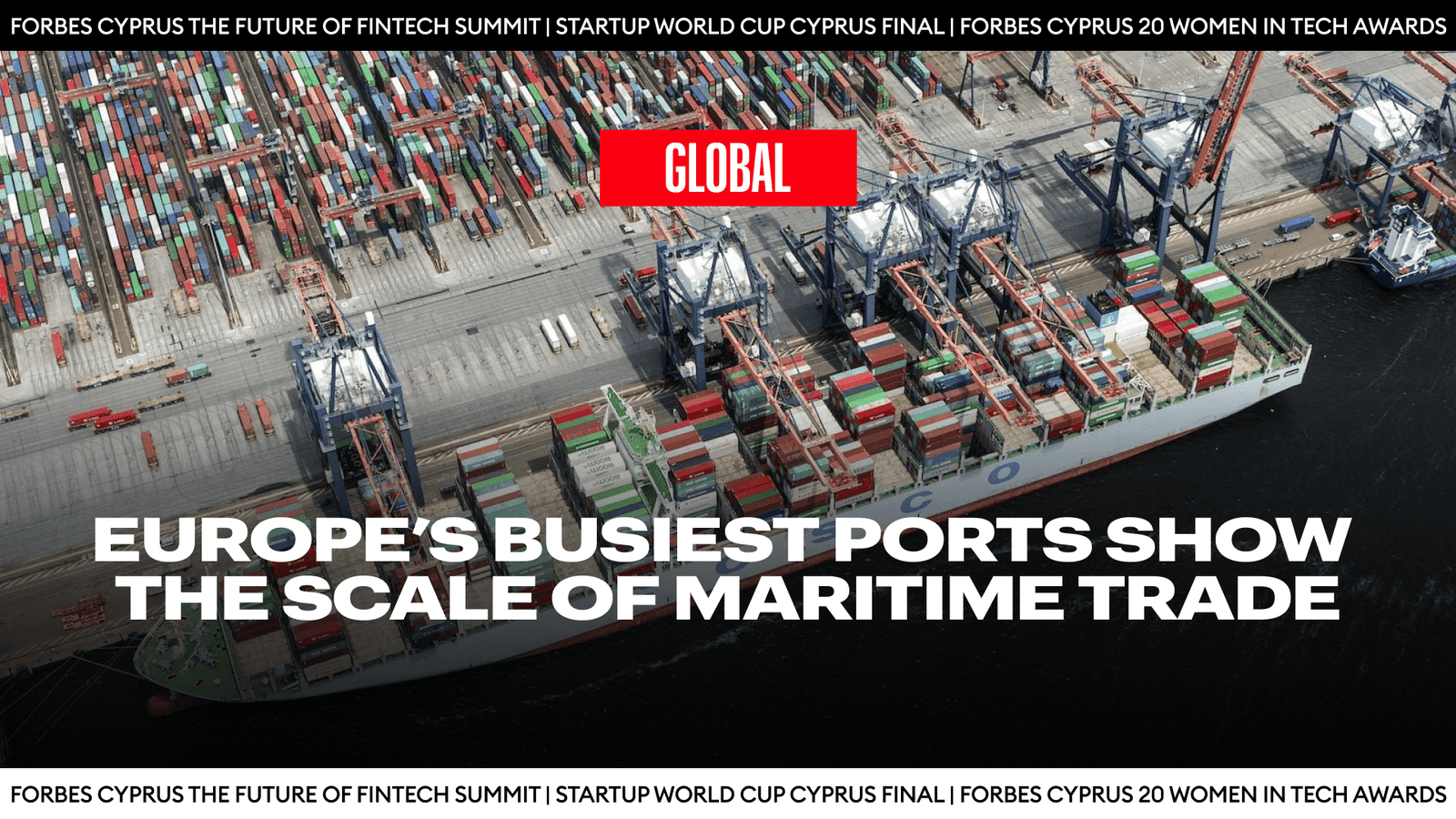
Maritime transport carried roughly 13 billion tonnes of goods worldwide in 2024, highlighting its central role in global trade and supply chains. EU ports handled about 3.4 billion tonnes, or 26% of the global total, while nearly 90% of the bloc’s external freight trade is carried by sea.
Rotterdam And Antwerp-Bruges Lead The EU
Rotterdam was the EU’s busiest port in 2024, handling 397.3 million tonnes of goods. Antwerp-Bruges ranked second with 243.7 million tonnes, putting the two northern European hubs well ahead of the rest.
Follow THE FUTURE on LinkedIn, Facebook, Instagram, X and Telegram
Hamburg ranked third at 97 million tonnes, followed by Spain’s Algeciras at 81.5 million tonnes and Amsterdam at 78.8 million tonnes. France’s HAROPA port complex, covering Le Havre and Rouen, handled 76.6 million tonnes, while Gdansk recorded 71 million tonnes.
Marseille and Valencia followed with 66 million and 64.5 million tonnes, respectively. Romania’s Constanta completed the top 10 at 57.6 million tonnes, reflecting the Black Sea’s role in Europe’s wider trade network.
Europe’s Second Tier Of Major Ports
Several ports handled between 40 million and 56 million tonnes in 2024. Barcelona recorded 55.5 million tonnes, followed by Trieste at 53.5 million, Genoa at 47.4 million and Sines at 44.1 million.
Piraeus handled 43.7 million tonnes, while Germany’s Bremerhaven recorded 42.5 million. Sweden’s Göteborg handled 38.5 million tonnes and Dunkerque in France 36.8 million.
Netherlands Leads By National Port Volume
Looking at total cargo across each country’s ports, the Netherlands ranked first with 538.1 million tonnes in 2024. Italy followed with 488.6 million tonnes and Spain with 486 million tonnes, putting all three well ahead of the rest of the EU.
Belgium ranked fourth at 274.9 million tonnes, followed by Germany at 273.9 million and France at 269.8 million. Greece, Sweden and Poland each handled more than 100 million tonnes, showing the breadth of Europe’s maritime network.
Turkey Expands The Regional Picture
Including EU candidate countries and EFTA members puts Turkey in second place with 524.7 million tonnes, behind the Netherlands. Norway ranked eighth with 212.1 million tonnes and handled 212.1 million tonnes.
The European Commission has described maritime transport as a long-standing driver of European economic development. Its role now extends beyond moving cargo, with ports increasingly tied to supply chains, energy security and industrial policy.
In March 2026, the Commission adopted two strategies focused on competitiveness, sustainability, security and resilience across the EU’s waterborne sector, including ports, shipping and shipbuilding.