



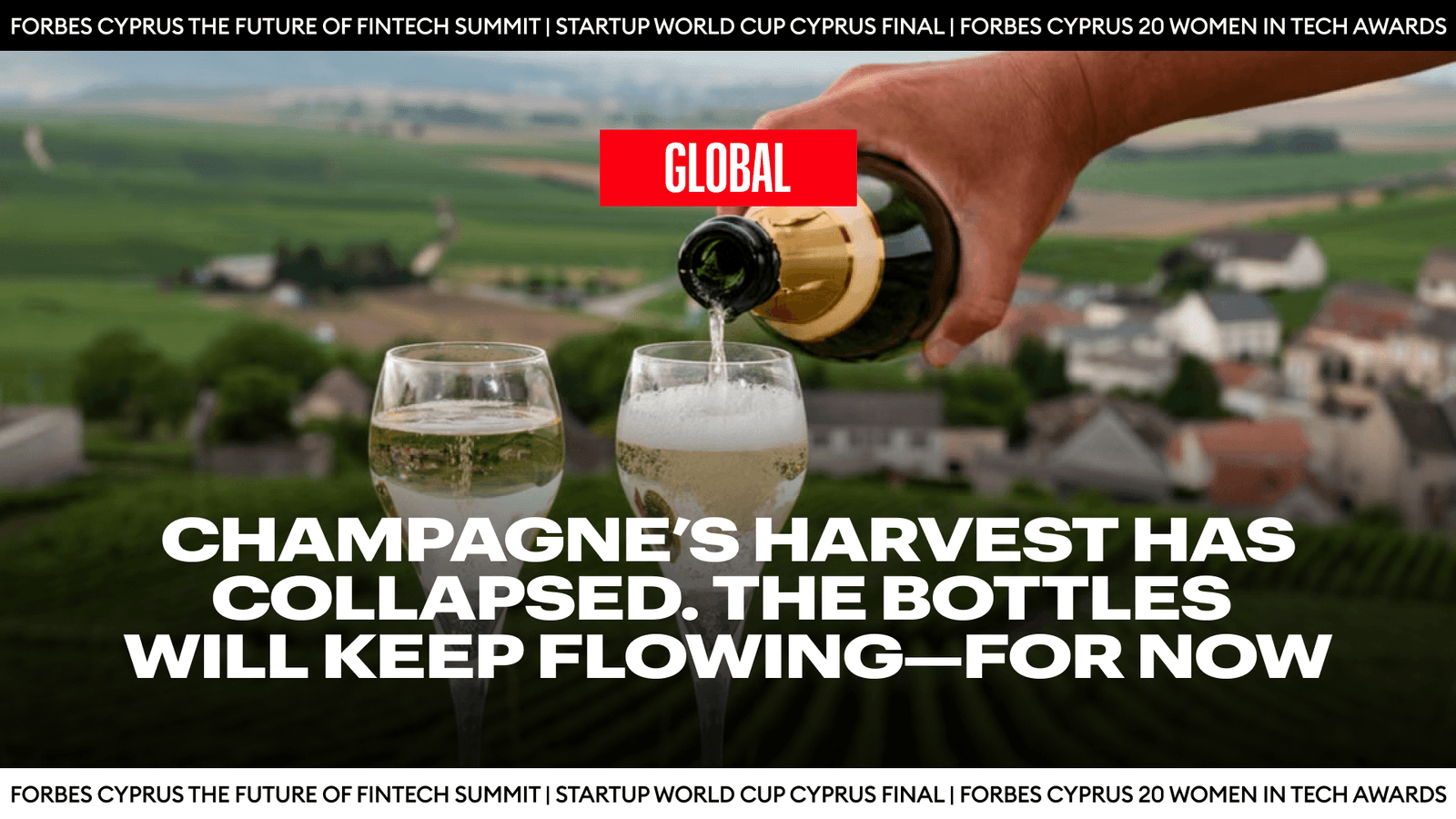
Champagne is heading toward one of its smallest harvests in decades, with production from this year’s grapes forecast to fall 48%. Consumers, however, are unlikely to see an immediate equivalent drop in bottle availability because producers can draw on inventories and reserve wines.
That gap reflects Champagne’s long production cycle. Wines from earlier harvests can help offset poor yields and keep supplies flowing when weather damages the current crop.
Follow THE FUTURE on LinkedIn, Facebook, Instagram, X and Telegram
France’s Wine Crop Faces A Major Decline
France’s wine production is forecast at 3.39 billion liters in 2026, according to preliminary estimates from Agreste, the Agriculture Ministry’s statistics arm. That would be 6% below 2025 and 28% below the 4.72 billion liters produced in 2023.
If confirmed, it would be France’s smallest crop since 1957. Vineyard area has fallen 2.5%, but drought and repeated heatwaves have had a greater impact by reducing yields per hectare.
“Evidence strongly suggests that heat and drought, through lower yields per hectare, are the dominant explanation for this year’s exceptionally low harvest,” said Jean-Marie Cardebat, a Bordeaux University professor affiliated with INSEEC Business School.
Champagne Harvest Forecast To Fall 48%
Champagne is among the hardest-hit regions. Production from this year’s harvest is forecast to fall from 2.57 million hectoliters in 2025 to 1.34 million in 2026. Protected Champagne production is expected to decline 49% to 1.24 million hectoliters, 47% below the five-year average.
Those figures refer to wine made from 2026 grapes, not bottles immediately reaching consumers. Frost in Aisne, followed by hail and drought since March, severely reduced yields, while average grape-bunch weight fell to its lowest level in 20 years.
Jura is forecast to see production fall 36%, while Bourgogne-Beaujolais is expected to decline 33%. Burgundy Pinot Noir losses exceed 50%, according to Agreste.
Reserve Wines Can Cushion The Supply Shock
The industry had set the 2026 permitted yield at 8,800 kilograms per hectare, about 2% below the 2025 limit, as producers managed softer demand and inventories. Actual yields are now expected to average no more than about 7,000 kg/ha, according to the Syndicat Général des Vignerons de la Champagne, which would be the lowest level since the 1980s.
Growers cannot replace grapes lost below the permitted yield, but Champagne houses can use reserve wines to offset part of the shortfall. Cardebat said the region had lost roughly half of a normal harvest, but that would not mean an immediate 50% decline in sales because producers have substantial stocks.
He estimated the missing production at about 140 million 75-centiliter bottles, representing roughly €2.7 billion in potential commercial value based on average turnover per bottle shipped in 2025. Cardebat stressed that this is not an immediate revenue loss because reserves can cushion the impact.
The longer-term risk is repeated poor harvests, which could gradually reduce stocks, increase costs and make it harder to supply all markets.
Smaller Harvest Could Help Rebalance Wine Supply
Producers are already facing higher energy, labor, machinery and financing costs, while lower yields spread fixed costs across fewer bottles. Prolonged shortages could also create opportunities for alternatives such as Prosecco and Crémant.
France is simultaneously dealing with excess supply in parts of the wine sector, particularly red wine, as consumption declines. A smaller harvest could therefore help bring inventories closer to demand and reduce pressure for further vineyard removals.
“Economically, lower productivity is bad for producers, but lower aggregate supply can help rebalance a market suffering from excess production,” Cardebat said.
Champagne is better positioned than some regions because of its global brand, relatively high margins and reserve system. Bordeaux, the South-West and parts of Languedoc-Roussillon face greater structural pressure from weak demand, low prices and vineyard removals.
For Champagne, reserve stocks should limit the immediate effect on bottle supply. The bigger test will be whether harvests this small become recurring rather than exceptional.