Opens in a new tab

Breaking news

Mark Zuckerberg Surpasses Larry Ellison to Become the Third Richest Person

Mark Zuckerberg has officially surpassed Oracle co-founder Larry Ellison to claim the title of the third richest person in the world, according to Forbes’ real-time billionaires list.

Key Insights

Zuckerberg’s fortune saw an impressive increase of over 4%, reaching $217.7 billion after Monday’s stock market close, while Ellison’s wealth dipped slightly by 0.3%, totaling $209 billion. This shift in rankings was closely tied to the performance of their respective companies’ stocks: Meta’s share price rose by approximately 4% to $630.20, while Oracle’s stock dropped by 0.3% to $165.78.

On Friday, January 3, Zuckerberg and Ellison briefly swapped positions, but by the end of the day, Ellison held the higher rank. Despite this, Zuckerberg’s rise marks a significant shift in the upper echelons of the billionaire rankings.

Elon Musk remains the wealthiest person globally with $425.2 billion, followed by Amazon’s Jeff Bezos with $241 billion.

A Changing Fortune for Ellison

Just a couple of months ago, Larry Ellison’s wealth topped $228 billion, tying him with Bezos for second place. However, in early December, Oracle’s stock suffered a major setback after a financial report revealed disappointing results, causing Ellison’s fortune to dip by $15 billion. Ellison, who owns approximately 40% of Oracle, serves as the company’s chairman, chief technology officer, and co-founder.

In contrast, Zuckerberg, who owns about 13% of Meta, continues to serve as the company’s CEO and chairman.

Political Winds and Tech Fortunes

In the wake of Donald Trump’s victory over Kamala Harris in the November election, the fortunes of several tech leaders have surged. Ellison saw a $12 billion boost in the weeks following the election, while Bezos gained $7 billion. Musk saw the most substantial increase, with his wealth rising by nearly $21 billion in the immediate aftermath.

Meta’s Strategic Moves

On Monday, Meta made waves by announcing that UFC President Dana White will join its board of directors. Zuckerberg shared the news on Facebook, alongside the additions of Exor CEO John Elkann and former Microsoft executive Charlie Thornhurst. Zuckerberg expressed confidence in the company’s future, citing vast opportunities in artificial intelligence, wearables, and the evolution of social media. With these new board members, Meta aims to chart a bold course forward in these rapidly growing sectors.

Toyota’s Woven City Opens Its Doors: A Glimpse into the Future of Urban Living

On Monday, Toyota reached a major milestone with the completion of the first phase of its ambitious Woven City project. Nestled at the base of Japan’s iconic Mount Fuji, this futuristic “smart city” is set to welcome its first 100 residents this fall, with plans to expand the population to 2,000 over time.

Key Highlights

Woven City, Toyota’s groundbreaking “smart city,” is being developed at the foot of Mount Fuji in Japan. Announced in 2020, this innovative urban environment will serve as a testing ground for cutting-edge technologies in a real-world setting. The city is designed to explore advancements in key areas such as:

  • Autonomous Vehicles: Streets will be divided into distinct zones for pedestrians, cyclists, and self-driving cars, ensuring seamless mobility for all.
  • Robotics: The city will host robots designed to assist with daily tasks and infrastructure maintenance.
  • Artificial Intelligence (AI): AI will be integrated to manage everything from smart homes to energy grids, enhancing the city’s efficiency.
  • Internet of Things (IoT): A network of interconnected devices and systems will form the backbone of Woven City, fostering a truly integrated urban environment.

Design and Sustainability

The city’s innovative architecture comes from Danish architect Bjarke Ingels and his renowned studio, Bjarke Ingels Group (BIG). With a focus on sustainability, most of the buildings will feature eco-friendly materials like wood. The city will run on hydrogen fuel cells and solar power, aiming to reduce its environmental impact. Initially, Woven City is expected to attract around 2,000 residents, mainly engineers, researchers, and technologists, who will be actively engaged in the city’s ongoing development and testing.

A Vision for the Future

For Toyota, Woven City is more than just a high-tech hub; it’s a prototype for what future cities could look like. The name “Woven City” embodies the concept of interlacing various forms of mobility and technology into the urban fabric, creating a harmonious balance between traditional city life and futuristic innovation. Toyota envisions this city as a model for more sustainable, connected, and technologically advanced ways of living.

Toyota Chairman Akio Toyoda shared his excitement for the project at the CES technology conference in Las Vegas, saying, “This year, residents will begin moving in as we slowly bring Woven City into operation. We want to accelerate the pace at which new technologies can be tested and developed in Woven City.”

Looking to the Stars

In addition to its work on Woven City, Toyota is exploring the frontiers of space. At CES, Toyoda also revealed that Toyota is looking into the development of orbital rockets. Through its subsidiary, Woven by Toyota, the company is investing 7 billion yen ($44.4 million) in Interstellar Technologies, a Japanese private space company focused on launching satellites.

Toyoda emphasized the need for more than just one car company leading technological advancements, referencing Tesla and its CEO Elon Musk’s ventures into space with SpaceX. “We are also exploring the possibility of rockets because the future of mobility should not be limited to Earth or to one car company,” Toyoda remarked.

Interstellar Technologies, founded in 2013, has already completed seven launches of its small MOMO suborbital rockets, with the company’s sights set on developing larger rockets like the ZERO and DECA series to deliver spacecraft into orbit.

Toyota aims to leverage its expertise in mass production to help Interstellar Technologies create cost-effective rockets, potentially giving the company a competitive edge in the global launch market. Toyota’s new space ambitions position it alongside rivals like Mitsubishi, whose subsidiary Mitsubishi Heavy Industries has developed the H3 series rockets, designed to rival SpaceX’s Falcon 9 in terms of cost and capability.

UK Business Confidence Plummets Amid Post-Budget Fallout

British businesses faced a rocky December as economic growth nearly stalled, and job cuts surged at the fastest rate in nearly four years, a reflection of shaken confidence following the government’s October budget.

The latest S&P Composite Purchasing Managers’ Index (PMI) for the UK edged down to 50.4 in December, barely clinging above the crucial 50-point threshold that separates growth from contraction. This was the lowest reading since October 2023 and just a hair below November’s 50.5, reinforcing concerns about the country’s economic trajectory.

Budget Blues Weigh Heavy

The slowdown follows Finance Minister Rachel Reeves’ budget announcement on October 30, which introduced hefty tax hikes for businesses to finance increased public spending. The impact has been profound, with a slump in corporate morale reverberating through the economy. According to recent data, Britain’s economy stagnated in the three months leading up to September. The Bank of England’s forecast of flatlining growth in the final quarter of 2024 appears to align with these PMI figures.

Tim Moore, Economics Director at S&P Global Market Intelligence, highlighted the persistent gloom:
“December saw no improvement in business optimism following the budget, with growth expectations for the year ahead stuck at November’s 23-month low.”

Job Cuts Hit Hard

Companies slashed jobs at a rate not seen since January 2021, during the height of COVID-19 lockdowns. Rising costs, including a looming increase in employer social insurance contributions set for April, were the main driver of these cuts, according to S&P Global. Nearly one in four firms reported a reduction in payroll, marking the sharpest decline in over 15 years outside of pandemic conditions.

Costs Climb, Optimism Fades

The PMI’s measure of future output hit its lowest point since December 2022, mirroring the uncertainty sparked by former Prime Minister Liz Truss’ “mini-budget.” Meanwhile, input costs for businesses rose at their fastest pace since April, squeezing margins further.

Sectors across the board felt the strain. December’s services PMI, a significant contributor to the composite index, was revised down to 51.1 from an earlier estimate of 51.4. Manufacturing fared even worse, with its PMI dropping to an 11-month low of 47.0, down from an initial 47.3.

Looking Ahead

While business groups have criticised the budget’s immediate impact, some economists believe increased government spending could provide a short-term boost to the economy in 2025. For now, however, companies are grappling with an increasingly challenging environment, where rising costs and regulatory pressures continue to erode confidence.

This ongoing turbulence leaves many questioning how long UK businesses can tread water in such stormy conditions.

Romania and Bulgaria Officially Join the EU’s Schengen Zone

As of Wednesday, January 1, 2025, Romania and Bulgaria have become full members of the European Union’s Schengen free-travel area, marking a historic expansion of the bloc. Land border controls were officially scrapped, allowing residents to travel seamlessly across participating countries without passport checks.

A Celebratory Moment at the Danube

Fireworks illuminated the night sky at the Friendship Bridge, a key crossing over the Danube River near the Bulgarian town of Ruse, as the interior ministers of both nations symbolically lifted the barrier at midnight. This crossing, a critical route for international trade, is often plagued by bottlenecks, but the removal of land checks is expected to ease congestion.

“This is a historic moment,” declared Bulgarian Prime Minister Dimitar Glavchev. “From Greece in the south to Finland in the north and as far west as Portugal, we can now travel without borders.”

A Long Road to Schengen Membership

Although border checks for air and sea travel were removed in March 2024, land checks had remained in place until Austria recently lifted its veto. Austria had previously argued that additional measures were needed to curb irregular migration.

Romania and Bulgaria’s journey to Schengen membership has been long, as they faced years of opposition despite meeting the technical criteria. The recent development is a major milestone, cementing their place in the EU’s free-travel area.

Schengen: A Borderless Vision

The Schengen area, initially established in 1985 between France, Germany, Belgium, the Netherlands, and Luxembourg, now encompasses 25 of the EU’s 27 member states, along with Iceland, Liechtenstein, Norway, and Switzerland.

However, not all EU countries participate. Ireland has opted out, and Cyprus remains outside the Schengen zone. Despite being an EU member since 2004, Cyprus faces challenges in meeting all the technical requirements for Schengen membership, partly due to its complex political situation. These challenges include strengthening border security and immigration controls.

Cyprus continues to work towards full Schengen membership, but the political and logistical factors involved present significant hurdles, and the timeline for its integration remains uncertain.

This historic expansion of the Schengen area, however, reinforces the EU’s vision of a borderless Europe, further uniting the bloc and streamlining travel and trade across its member states.

Trina Solar Sets New World Record for Solar Technology Efficiency

China’s Trina Solar (688599.SS) has achieved a groundbreaking milestone in solar technology, setting a new world record for conversion efficiency in its n-type fully passivated heterojunction (HJT) modules. The company announced the achievement on Monday, following certification by Germany’s Fraunhofer CalLab, a leading solar research institute.

A Leap Forward in Efficiency

In laboratory tests, Trina’s HJT modules demonstrated an impressive 25.44% efficiency. This refers to the percentage of sunlight converted into usable electricity, a key metric in solar technology. By enhancing cell efficiency, solar installations can be downsized while costs are reduced, offering a significant advantage in the renewable energy market.

The technology behind the achievement, known as passivation, involves covering surface defects on solar cells to improve their performance. According to Professor Martin Green from the University of New South Wales, Sydney—whose lab previously held the efficiency record for decades—the result underscores the promise of HJT as a next-generation solar technology.

“In the long run, it’s all about efficiency,” Green said. “Even if some technologies are initially more expensive, costs tend to drop quickly as the industry adapts and scales up.”

Trina Solar’s Vision

Trina Solar’s Chairman and CEO, Gao Jifan, emphasised the company’s commitment to advancing passivated solar technology through ongoing research and development. “This achievement strengthens our leadership in solar technology, and we will continue to push the boundaries of innovation,” he stated.

The Future of HJT Technology

While HJT technology currently represents a small share of the market—estimated at 7% of high-efficiency solar cell capacity in 2024, rising to 9% by 2026—it holds significant potential. However, it faces stiff competition from TopCON (Tunnel Oxide Passivated Contact) technology, which is projected to dominate the market over the next five years.

This milestone not only represents a breakthrough for HJT technology but also sets a new benchmark for the photoelectric conversion efficiency of single-crystalline silicon solar cell modules, Trina noted in its statement.

As the race for efficiency continues, innovations like these are expected to play a crucial role in shaping the future of renewable energy.


How Many Months of Salary Do You Need to Buy a House in Europe?

The answer depends largely on where you live. A recent report by BestBrokers compares property prices across Europe to average salaries, offering insights into how many months of income it would take to afford a home.

Where in Europe is Buying a Home Most Affordable?

Denmark leads the pack as the most affordable country in Europe for homebuyers. According to the report, purchasing a 100-square-metre property in Denmark costs the equivalent of 114 net monthly salaries, making it the shortest saving time in Europe.

The report considered factors such as average net income, inflation, and “real” mortgage interest rates—mortgage rates adjusted for inflation. It’s important to note that the calculation assumes no spending on food, housing, childcare, or other expenses, offering a purely theoretical outlook.

Interestingly, despite ranking as Europe’s most affordable housing market, Denmark also holds the title of the most expensive EU country for goods and services, with prices 43% above the EU average in 2023, according to Eurostat. Still, Denmark’s relatively high average earnings—seventh in Europe—offset these costs.

Following Denmark, Ireland, and Sweden rank as the second and third most affordable European countries to buy a home. A 100-square-metre property costs the equivalent of 123 and 129 net monthly salaries in these nations, respectively—roughly 10 years of annual earnings.

Which European Countries Make Saving for a Home the Hardest?

At the opposite end of the spectrum are the Czech Republic and Slovakia, where saving for a home takes considerably longer. In Slovakia, for example, buying a 100-square-metre property costs 297 net monthly salaries—nearly 25 years of earnings. Even if someone managed to save half their income every month, it would take 50 years of disciplined saving to afford a home.

Where Are Homes the Most Affordable Globally?

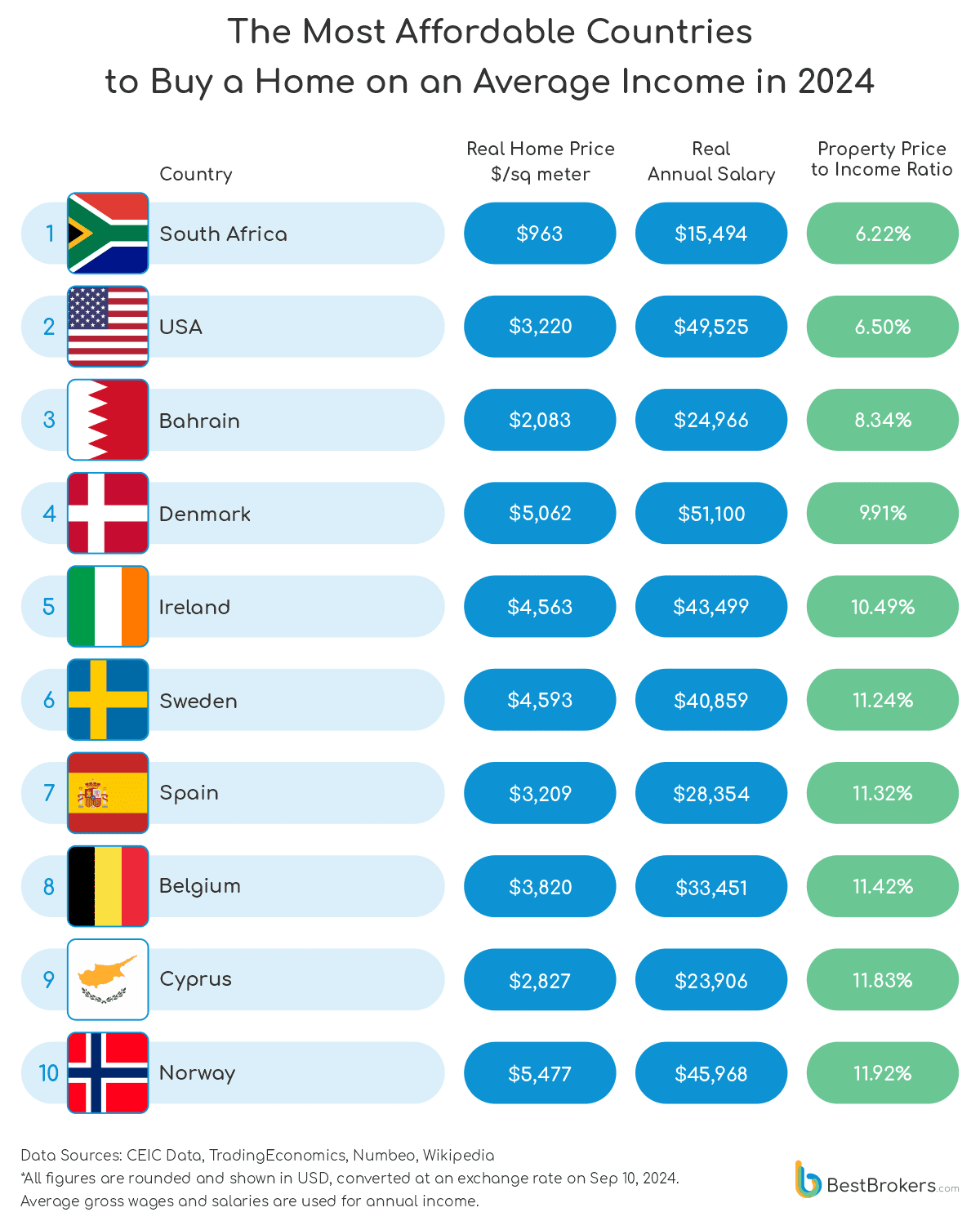
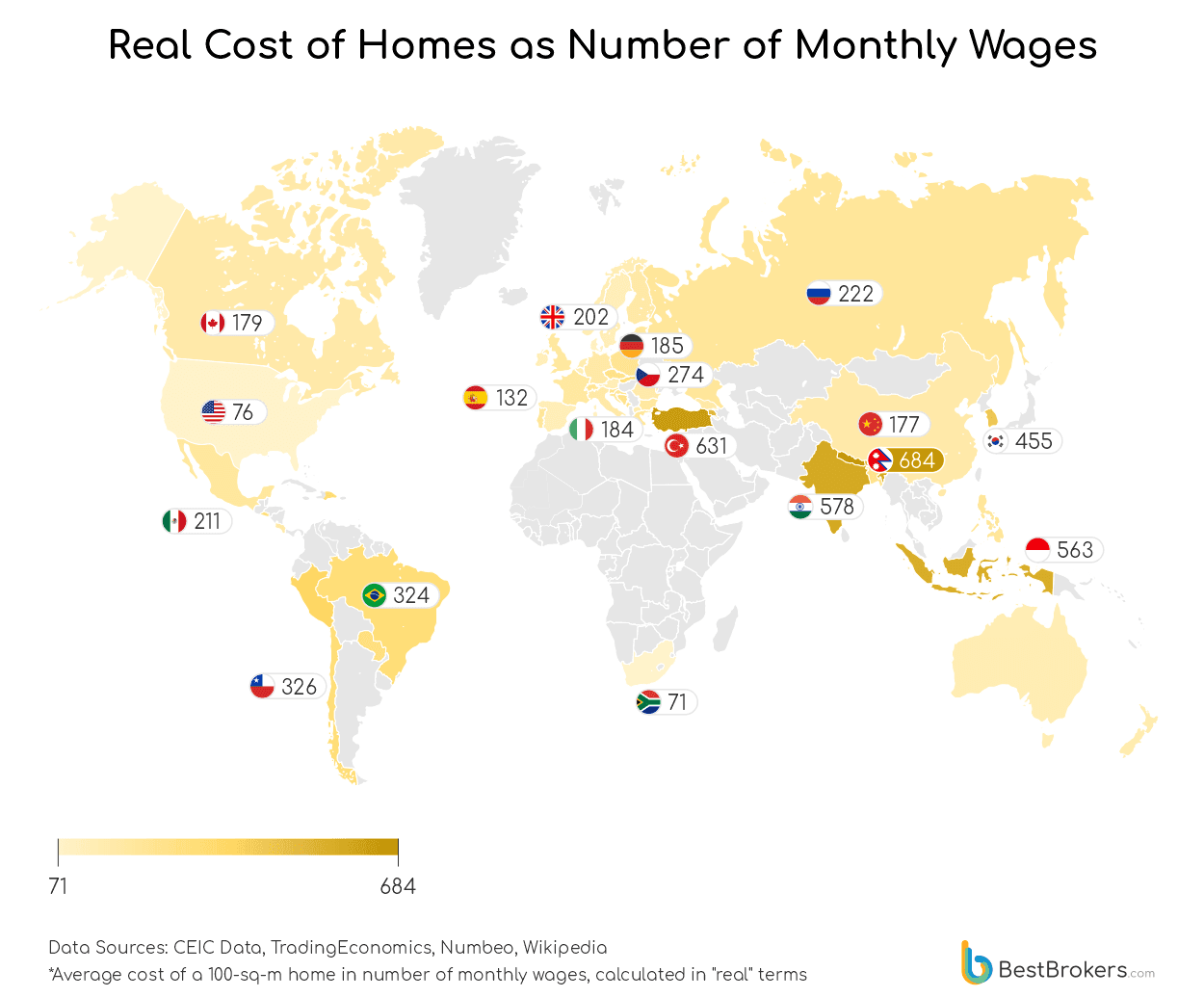
Globally, South Africa emerges as the most affordable country to buy a home. A 100-square-metre property costs 71 times the average monthly salary, making it the fastest place in the world to save for a house. The United States comes second, requiring 76 monthly wages—equivalent to approximately six years of annual income. However, property affordability varies greatly between states in the U.S., with some regions significantly more expensive than others.

image 34

The World’s Least Affordable Housing Markets

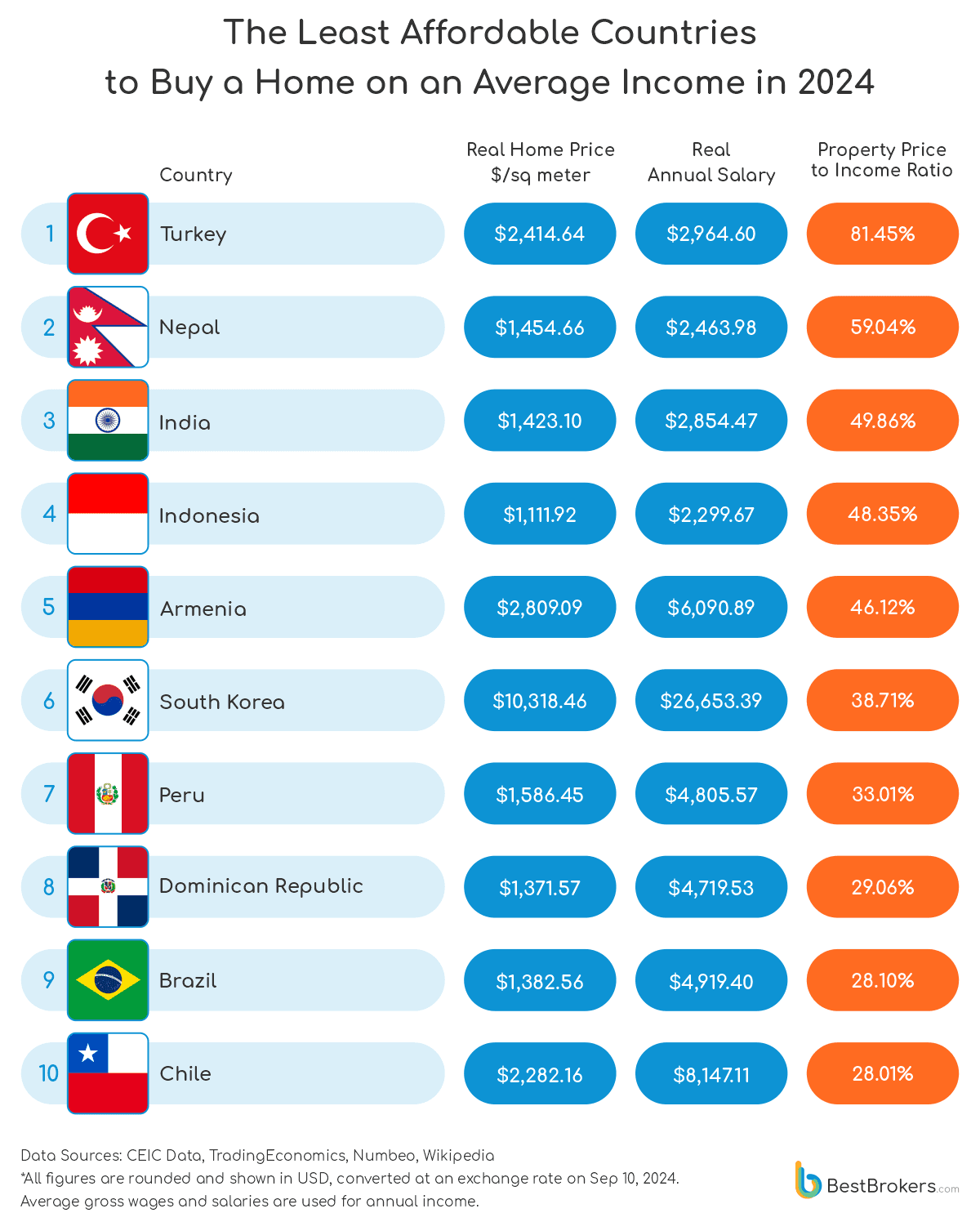
On the flip side, Nepal holds the title for the least affordable housing market, where a 100-square-metre home costs a staggering 684 monthly salaries. Turkey follows closely behind, with homes priced at 631 net wages, or over 52 years of income.

image 33

How Many Monthly Salaries Does a 100-sq-metre Home Cost Around the World?

image 32

Final Thoughts

This report sheds light on the stark disparities in housing affordability across Europe and the world. Whether you’re planning to buy a home in Denmark or dreaming of saving in Slovakia, understanding the cost-to-salary ratio is crucial for making informed financial decisions.

Disclaimer: The information provided does not constitute financial advice. Always conduct your own research to ensure it aligns with your personal circumstances. While we strive to deliver expert-backed guidance, reliance on this content is at your own risk.

Breaking Barriers: New EU Rules to Boost Gender Balance on Corporate Boards

The European Union has taken a significant step toward gender equality in the boardroom with a directive on gender balance that officially came into force at the end of 2024. Announced by the European Commission, the legislation aims to ensure more equitable representation of men and women on corporate boards across member states.

Key Highlights

  • The directive mandates that women must make up at least 40% of non-executive directors and 33% of all directors in large European companies.
  • Member states were required to adapt their national legislation to align with the directive by December 28, 2024, with companies expected to meet these targets by June 2026.
  • The selection processes for board appointments must be transparent, ensuring equal consideration for all candidates. In cases where male and female candidates are equally qualified, the directive stipulates that preference should be given to the woman.
  • Unsuccessful candidates can request information about the selection criteria, promoting accountability in the hiring process.
  • Companies failing to comply with the directive’s requirements could face fines or even annulment of disputed board appointments.
  • EU member states are tasked with maintaining a public registry of companies that achieve these gender balance goals, as well as designating authorities to monitor, promote, and support progress.

The Bigger Picture

Currently, women hold an average of 34% of board positions in the EU. While progress has been steady since 2010, the pace varies significantly across member states, with some seeing stagnation in recent years, according to the European Commission.

Spotlight on Cyprus

Cyprus is gradually making progress in enhancing gender representation in leadership roles. While the island nation has traditionally faced challenges in achieving gender balance, recent years have seen a growing recognition of the importance of equality in corporate governance.

Currently, women occupy approximately 20% of board positions in major Cypriot companies, with some sectors, such as finance and tourism, showing more noticeable improvements. However, this figure still lags behind the EU average of 34%.

To align with the EU directive, Cyprus is working on implementing transparent board selection processes and promoting policies that encourage women to step into leadership roles. Local initiatives, including mentoring programs and leadership training for women, are gaining traction and aim to address the systemic barriers that have historically limited female participation at the top levels of management.

Cyprus’s progress, though slower compared to some EU nations, reflects a broader cultural and structural shift toward inclusivity. As the EU deadline approaches in 2026, the hope is that Cyprus will achieve significant strides in gender equality, paving the way for more balanced representation in corporate leadership.

Conclusion

The EU’s gender balance directive represents a pivotal step in addressing gender disparities in corporate leadership. By fostering transparency and accountability, these new rules aim to create more inclusive boardrooms and drive meaningful progress in the years ahead.

Cyprus Announces Largest Pension Increase Since 1996

In a significant move to enhance the financial well-being of its retirees, Cyprus has approved a notable increase in pensions, set to take effect in January 2025. Labour and Social Insurance Minister Yiannis Panayiotou detailed the adjustments, highlighting a 5.94% rise in the basic component and a 1.49% boost in the supplementary component of Social Insurance Fund pensions. 

This adjustment marks the most substantial increase in the basic pension segment since 1996, reflecting the positive trajectory of the Cypriot economy. Minister Panayiotou emphasized that the government’s citizen-centric policies are yielding tangible benefits, significantly enhancing daily life. 

The specifics of the pension adjustments are as follows:

  • Full Basic Pension: Monthly payments will rise from €483.77 to €512.50.
  • Minimum Pension for Beneficiaries Without Dependents: An increase from €411.20 to €435.62 per month, impacting over 14,000 individuals.
  • Social Pension: A boost from €391.85 to €415.13 monthly, benefiting nearly 18,000 recipients. 

These enhancements are directly linked to the recent growth in average insurable earnings, which have seen the most significant rise in the past three decades. Minister Panayiotou noted that the average salary increase in 2023 surpassed those of the previous 30 years, leading to a corresponding uplift in pension contributions. 

The government remains committed to further strengthening the adequacy of wages and pensions, ensuring that economic progress translates into improved living standards for all citizens.

Nocturnal Tourism: Chasing The Northern Lights Becomes A Growing Trend

The Northern Lights have captivated travelers for centuries, but recent solar activity has made this natural phenomenon more spectacular than ever. NASA reports that this year’s solar cycle has led to the strongest displays of the Northern Lights in 500 years, with the peak continuing into 2025 and 2026. This incredible solar activity is driving a new travel trend—nocturnal tourism, where the night sky is the main attraction.

Key Facts

NASA and the National Oceanic and Atmospheric Administration (NOAA) confirmed that the Sun’s 11-year cycle had reached its “solar maximum,” leading to an increase in space weather phenomena like solar flares and electromagnetic radiation. These events are responsible for more frequent and intense geomagnetic storms, which in turn cause the stunning Northern Lights displays. According to NASA, this solar peak will last until 2026 and gradually decline by 2030.

This year also saw the strongest geomagnetic storm in two decades, contributing to the brightest and most powerful Northern Lights in recent history. These awe-inspiring displays are expected to continue attracting visitors who want to witness them firsthand.

Night Tourism: The New Trend in Travel

Nocturnal tourism, a term inspired by night-themed art, has surged in popularity this year. Booking.com named it as a top travel trend for 2025. Nearly two-thirds of travelers expressed interest in visiting destinations for stargazing, cosmic events, and other night-focused activities. This trend is not just about celestial displays; it also includes other nighttime activities such as city tours, truffle hunting, and moonlit picnics by the sea.

Luxury travel company Wayfairer Travel noted a 25% rise in nocturnal tourism requests, with travelers booking experiences to view the Northern Lights in Norway and Iceland, night diving in Australia’s Great Barrier Reef, and wildlife safaris in Zambia and Kenya. The company also mentioned an increasing interest in stargazing in Chile’s Atacama Desert and other remote, light-pollution-free locations.

Where to See the Northern Lights in 2025

To fully experience the Northern Lights, clear skies and minimal light pollution are essential. Most of the year, the aurora borealis can be seen in Alaska and northern Canada, but next year offers an ideal time to visit Iceland and Norway. Other top destinations include Lapland in Finland, Tromsø in Norway, Abisko in Sweden, and Thingvellir National Park in Iceland. Europe’s largest stargazing park in Northumberland, England, is another prime location to chase the Northern Lights.

In Search of Darkness

Nocturnal tourism is rapidly growing as travelers seek to witness the natural beauty of the night sky. This pursuit of darkness often leads them to remote and isolated locations to escape light pollution. For the best experience, many travelers choose to stay away from larger groups and opt for accommodations where artificial lights can be minimized. The darkest skies during the new moon provide the best conditions for viewing celestial wonders such as the Northern Lights, the Milky Way, and other cosmic phenomena.

As the trend of nocturnal tourism grows, more travelers are discovering the magic of the night sky. Whether chasing the Northern Lights, stargazing, or experiencing once-in-a-lifetime cosmic events, 2025 is set to be an exciting year for those eager to explore the world after dark.

Yahoo Finance Names Robinhood Markets Stock Of The Year For 2024

Yahoo Finance has named Robinhood Markets (HOOD) the stock of the year for 2024. The company, led by Vlad Tenev, saw its stock surge over 190% after boosting its profitability and expanding its portfolio.

Key Facts

According to senior analyst Patrick Molly from Piper Sandler, Robinhood Markets’ growth is just beginning. The reason? 75% of Robinhood’s customer base consists of young people who are more inclined to try new products, driving further growth for the company. One of the key drivers of growth over the past year has been Robinhood’s new web-based trading platform, which opens access to 50% of the retail market that was previously unavailable to users.

Key Number

$32.94 billion — Robinhood’s market capitalization. The company’s shares are currently trading at $37.26.

Key Story

Vlad Tenev has become one of the billionaires whose wealth soared following Donald Trump’s election victory. Robinhood’s stock rose nearly 20% after the election results, boosting Tenev’s wealth by almost $300 million, reaching $1.9 billion. According to Forbes, his current net worth stands at $2.3 billion.

Robinhood has introduced several new products and launched margin trading in the UK in 2024. The company also debuted a securities lending product in the UK last September, allowing users to earn passive income from their stock holdings. Additionally, Robinhood began offering EU customers the ability to transfer cryptocurrencies to and from its platform.

What is Robinhood?

Robinhood is an online brokerage that offers commission-free services, allowing users to buy and sell stocks, cryptocurrencies, and other assets. The company was founded in 2013 by Vlad Tenev and Baiju Bhatt with the mission to democratize finance, making financial services more accessible to the general public.

What’s Next?

In June, Robinhood announced its acquisition of Luxembourg-based crypto platform Bitstamp to leverage the company’s exchange technology and expand its global presence. The deal, valued at around $200 million, is expected to close in the first half of 2025.

Aretilaw firm
Uol
The Future Forbes Realty Global Properties
eCredo

Become a Speaker

Become a Speaker

Become a Partner

Subscribe for our weekly newsletter