Breaking news

Cyprus Nears US Visa Waiver Program As Refusal Rate Drops Below 3%

Cyprus has achieved a significant milestone in its efforts to join the US Visa Waiver Program, with the 2024 visa refusal rate for Cypriot citizens reported at just 2.16%. This figure, announced by the US Department of State, is well below the program’s required threshold of 3%, marking a crucial step toward visa-free travel for Cypriots.

Progress Towards Inclusion

Deputy Minister to the President, Irene Piki, highlighted the importance of this development, stating that Cyprus has met a “key prerequisite” for its inclusion in the program. She credited the progress to successful technical consultations between Cyprus and the United States over the past year.

Piki reaffirmed the government’s commitment to securing Cyprus’ inclusion in the program by 2025, allowing Cypriots to travel to the US for tourism and business without the need for a visa.

Support from US Officials

US Ambassador to Cyprus, Julie Fisher, also acknowledged the milestone, describing it as a significant step forward. She expressed optimism that Cypriots would soon enjoy the benefits of visa-free travel to the US.

What’s Next?

The Cypriot government plans to continue its focused efforts to meet all remaining requirements, ensuring the process stays on track. This achievement underscores the growing cooperation between Cyprus and the US, paving the way for stronger ties and easier travel.

As Cyprus moves closer to this goal, the prospect of visa-free access to the US represents an important development for both business and leisure travellers.

European Parliament Approves Nearly €200 Billion Budget For 2025

The European Parliament has officially approved the European Union’s 2025 budget, amounting to an impressive €199.4 billion. The budget reflects a 6% increase compared to 2024, showcasing the EU’s commitment to addressing key challenges and investing in its future.

Focused Investments

The budget prioritises programmes designed to enhance citizens’ quality of life, foster competitiveness, and address pressing challenges. Over €230 million has been added to key initiatives, including:

  • “Erasmus+” Programme: An additional €422 million will support education, training, youth, and sports across the EU.
  • “Horizon Europe” Programme: A €20 million boost for scientific research and innovation.

Support for Strategic Goals and Crisis Management

  • Funding is allocated to Ukraine aid and critical technology investments through the Strategic Technology Platform for Europe (STEP).
  • Financial provisions for Next Generation EU interest payments are included.
  • Additional resources are set aside for natural disaster emergency aid and humanitarian crises, both within and beyond EU borders.

This ambitious budget underscores the EU’s strategic focus on fostering innovation, supporting education, and responding to global and regional challenges. By securing substantial funding increases across critical programmes, the EU aims to ensure sustainable growth and resilience in the face of uncertainty.

Asian Stocks Dip As Dollar Wavers Before Thanksgiving

Asian markets saw subdued activity on Thursday, with investors exercising caution amid mixed economic signals and the upcoming US Thanksgiving holiday, which is expected to thin trading volumes. The MSCI Asia-Pacific Index edged down 0.07%, while Japan’s Nikkei rose modestly by 0.46%.

The cautious tone in markets reflects uncertainty over the Federal Reserve’s policy path. US data showed that while consumer spending in October outpaced expectations, progress in reducing inflation toward the Fed’s 2% target has stalled. This, combined with the potential for renewed trade tariffs under the Trump administration, raises questions about the Fed’s flexibility to continue rate cuts in 2024.

While a 25-basis-point rate cut in December is still widely expected, divisions among Federal Open Market Committee members signal uncertainty about future policy moves. Traders currently assign a 65% probability to a December cut, with further easing anticipated through 2025.

In South Korea, the central bank surprised markets by lowering its benchmark interest rate for a second straight meeting, aiming to support an economy hindered by weak growth and slowing inflation. The South Korean won depreciated following the decision.

The yen fell 0.3% to 151.615 per dollar but remained near a recent one-month high as expectations for a Bank of Japan rate hike next month boosted the currency’s outlook. Meanwhile, the euro held steady after gaining 0.7% in the previous session, supported by cautious comments from European Central Bank officials advocating a measured approach to rate adjustments.

In commodity markets, oil prices remained steady after a ceasefire agreement between Israel and Hezbollah alleviated supply concerns. Brent crude hovered at $72.80 per barrel, and US West Texas Intermediate stayed at $68.70. Gold prices softened slightly to $2,626 per ounce.

With inflation concerns, policy uncertainties, and global events shaping sentiment, traders remain hesitant to take bold positions, preferring to wait for clearer signals in the weeks ahead.

South Korea Leads the Way: 10% Of Workforce Replaced By Robots

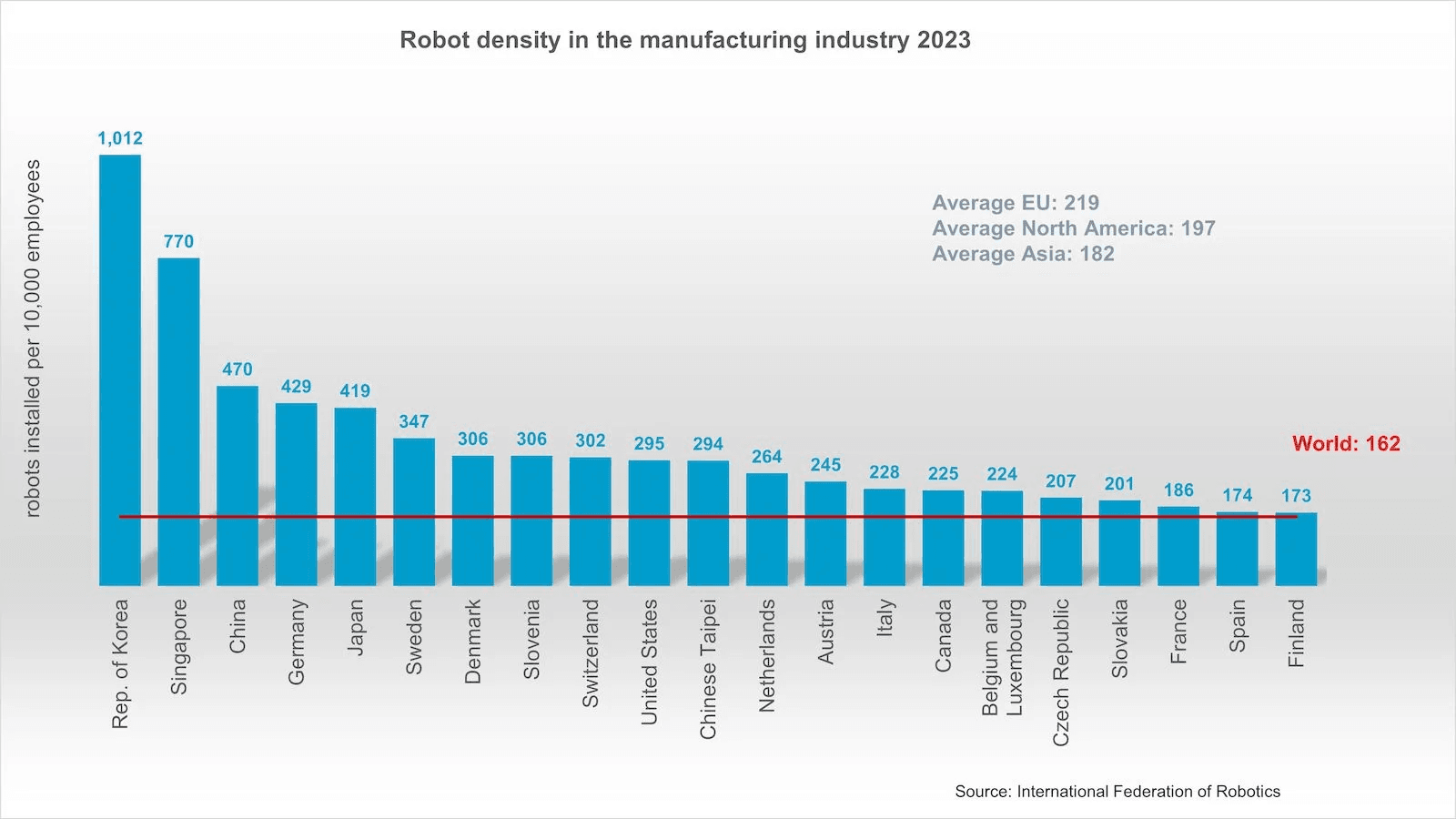
South Korea has made history as the first country to have robots account for over 10% of its industrial workforce, marking a milestone in automation and technological advancement. This achievement highlights the nation’s proactive approach to addressing a declining working-age population due to persistently low birth rates.

Key Facts and Figures

According to the World Robotics 2024 report, South Korea now boasts a staggering 1,102 robots per 10,000 employees—the highest robot density globally. This figure is more than double that of every other country in the ranking, except Singapore, which follows with 770 robots per 10,000 workers.

image 22

Since 2018, robot density in South Korea has grown by an average of 5% annually. The nation’s electronics and automotive industries, two major pillars of its economy, are among the largest consumers of industrial robots. Globally, robot density has also seen significant growth, doubling over the past seven years from 74 to 162 units per 10,000 employees.

Expanding Beyond Factories

South Korea’s use of robots extends far beyond manufacturing. Robots now operate in diverse fields, including healthcare, hospitality, agriculture, and even defense. Hospitals employ robots to assist with surgeries, while restaurants use them for food preparation and delivery.

Government’s Vision and Investment

This progress has been fueled by substantial investment from the South Korean government, which views robotics as a solution to its workforce challenges. Earlier this year, the Ministry of Trade, Industry, and Energy introduced the Fourth Intelligent Robot Basic Plan, committing $2.4 billion to the development of the robotics sector by 2030.

The plan outlines a strategic approach to integrating robots into critical industries, such as logistics, healthcare, and social safety. It also sets an ambitious target to increase the local production of core robot components from 44% to 80% by 2030, ensuring a self-reliant and competitive robotics industry.

A Model for the Future

South Korea’s advancements in robotics illustrate how technology can address societal challenges like population decline while driving economic innovation. With its continued investment and adoption of robots across various industries, the country is setting a benchmark for others to follow in the age of automation.

Full report here.

Crypto Market Declines: Over $180 Billion Wiped Out In A Day

The cryptocurrency market faced a significant downturn as Bitcoin retreated further from the highly anticipated $100,000 milestone. Investor profit-taking following a post-election rally triggered a sharp drop, erasing $182 billion from the market’s capitalization, which now stands at $3.35 trillion.

Key Developments

  • Bitcoin Drops: The price of Bitcoin declined 3.6% in the last 24 hours to just above $92,311, marking a 6.2% loss for the week.
  • Election Rally Reversed: The drop follows a rally spurred by the election of Republican Donald Trump, whose administration promised crypto-friendly policies. The optimism pushed Bitcoin close to $100,000, peaking at $99,000.
  • Altcoins Follow Suit: Other major cryptocurrencies also saw declines. Ether, the second-largest token, fell 4.2% to $3,346, while Solana’s Sol token dropped 8.9% to $231.88.

Broader Context

Bitcoin has surged 122% year-to-date, buoyed by favourable macroeconomic factors. The SEC’s approval of spot Bitcoin ETFs in January and the cryptocurrency’s halving event in April have been major catalysts. Central banks’ interest rate cuts and increased market liquidity have also provided a supportive backdrop for digital assets.

Looking Ahead

Despite the current slump, market analysts remain optimistic about Bitcoin’s long-term potential. Many believe the cryptocurrency still has room to rise, with the $100,000 benchmark viewed as an achievable milestone.

As the crypto market adjusts, investor sentiment will likely hinge on regulatory developments and macroeconomic trends in the coming months.

Cyprus Embarks On Strategic Rebranding To Enhance Global Appeal

Cyprus is set to redefine its image on the global stage with a bold rebranding initiative. Announced by President Nikos Christodoulides, this campaign aims to elevate the nation’s international reputation, targeting key sectors such as business, tourism, and education. Against strong economic performance and international credit upgrades, the initiative aligns with the government’s vision of transforming Cyprus into a hub for global investment and sustainable growth. Below, we break down the main elements of this ambitious plan.

Key Points of the Rebranding Campaign

  1. Targeted International Messaging
    The campaign will focus on strategic communication to highlight Cyprus’s strengths as an investment destination. It aims to showcase the nation’s stable economy, competitive business environment, and quality of life to attract global investors, tourists, and students.
  2. Leveraging Economic Success
    Recent credit upgrades by agencies like Moody’s, elevating Cyprus to the ‘A’ category for the first time in 13 years, reinforce its credibility as a secure and thriving economy. These achievements will be central to the country’s new narrative.
  3. Enhanced Living Standards
    The government uses economic progress to promote tangible benefits such as improved housing, better wages, and access to high-quality education and healthcare. These developments are integral to Cyprus’s positioning as an ideal place to live and work.
  4. Focus on Sustainability and Innovation
    Initiatives like renewable energy projects and digitising public services underline Cyprus’s commitment to a sustainable and modern future. These efforts further enhance the country’s attractiveness to environmentally conscious businesses and residents.
  5. Expanding Diplomatic Ties
    By establishing closer economic relationships with countries like the United States, Greece, Kazakhstan, and Armenia, Cyprus aims to tap into new markets and strengthen its global presence.

The rebranding of Cyprus is more than just a facelift; it’s a transformative strategy designed to unlock the nation’s full potential. By capitalizing on its economic achievements, fostering innovation, and building global partnerships, Cyprus is positioning itself as a destination of choice for investors, tourists, and professionals. This initiative signals a new chapter for the country, rooted in stability, growth, and a forward-looking vision.

Warren Buffett Sets Plans To Donate Entire $149 Billion Fortune

Warren Buffett, the renowned investor and chairman of Berkshire Hathaway, has taken further steps to ensure his vast fortune is given away after his death, solidifying his lifelong commitment to philanthropy.

Key Highlights

  • Buffett, 94, intends to donate 99.5% of his remaining wealth, valued at approximately $149.7 billion as of Friday, to a charitable trust managed by his three children: Susie, 71, Howard, 69, and Peter, 66.
  • In a letter to Berkshire shareholders on Monday, Buffett revealed three potential successors for the trustee role in case his children are unable to fulfil their duties. These individuals, who are slightly younger than his children and trusted by the family, would oversee the distribution of the fortune.
  • He has also announced an additional $1.14 billion donation in Berkshire Hathaway stock to four family foundations.

“I never wanted to create a dynasty or follow a plan that would last beyond my children. But these heirs are on the waiting list. I hope Susie, Howie, and Peter themselves distribute all my assets,” Buffett wrote in his shareholder letter.

Since 2006, Buffett’s total charitable donations have surpassed $58 billion. His philanthropic efforts include substantial contributions to family foundations and the Bill & Melinda Gates Foundation, which has received over $43 billion from him. To date, he has donated 56.6% of his Berkshire shares.

Buffett, who has helmed Berkshire Hathaway since 1965, still owns 14.4% of the company’s stock. He plans to continue giving shares to five foundations throughout his lifetime.

Upon his passing, his children will have roughly a decade to distribute the remaining wealth, working unanimously to decide how the funds will serve philanthropic purposes.

Buffett’s commitment to giving emphasizes his belief in using wealth to create meaningful change. By entrusting his children to allocate his assets, he ensures his philanthropic legacy will adapt to future challenges while remaining true to his values.

Cyprus Real Estate Market Surpasses €2 Billion in Transactions Amid Global Challenges

The Cyprus real estate market has demonstrated remarkable resilience, recording €2 billion in transactions by mid-2024, according to a recent report by Delfi Partners & Company. Despite global economic uncertainty, the sector remains a pillar of stability, bolstered by robust local activity and a steadying inflation rate.

“Strong domestic engagement and stabilizing economic factors have enabled the market to adapt and thrive, even in the face of broader challenges,” the report highlighted.

A notable indicator of the sector’s strength is the 32.5% year-on-year surge in building permits during the first half of 2024, reflecting a vibrant development landscape. However, delays stemming from recent municipal reforms are expected to temper growth in the latter half of the year, potentially slowing the approval of new permits.

Real estate sales to local buyers saw a 13% increase from January to September 2024 compared to the same period in 2023. This uptick in domestic activity helped offset a 13.4% decline in sales to international buyers, attributed to ongoing geopolitical tensions and global economic uncertainties.

Despite the drop, international investors still made up 44% of total real estate sales, underscoring Cyprus’ enduring appeal as a prime investment hub.

“The market is shifting, with local buyers playing a more prominent role while international interest, though diminished, remains significant,” said Michalis Loizou of Delfi Partners & Company. “This evolution highlights the adaptability of Cyprus’ real estate sector, which continues to present opportunities despite global headwinds.”

The report also noted that by mid-2024, transaction values had exceeded pre-pandemic levels, with the average property deal reaching €340,790—higher than in 2019.

Geographically, Limassol maintained its lead as the busiest district for real estate activity, contributing 32% of total sales. It was followed by Nicosia with 22% and Larnaca with 21%.

Looking ahead, Delfi Partners projected continued growth for the Cypriot economy, aided by stable inflation and potential interest rate cuts. “With these factors in play, along with the dynamic real estate sector, Cyprus remains an attractive destination for investors seeking stability and growth in a competitive market,” the report concluded.

Cyprus Ship Registry Achieves 14% Growth In 2024

Deputy Minister of Shipping Marina Hadjimanolis reported that the Cyprus ship registry had grown 14% since September 2023 during a discussion of the Ministry’s 2025 budget at the Finance Committee of the House of Representatives. She described this milestone as a testament to the effectiveness of the Ministry’s strategic initiatives.

Since September 2023, 161 vessels, with a combined capacity exceeding 4 million tons, have been registered under the Cyprus flag. Hadjimanolis attributed this success to targeted outreach to new markets in Asia and the Americas, addressing challenges posed by Turkey’s embargo on Cypriot-flagged ships.

The Deputy Ministry’s proposed budget for 2025 includes €18.5 million in expenditures, with 55% allocated to advancing its primary strategic goals. Among the most significant investments is the €5.5 million subsidy for the Limassol-Piraeus ferry service, which will continue operations for three more years.

These results highlight Cyprus’ growing reputation as a key player in global maritime trade, focusing on expanding market opportunities and sustaining vital shipping links.

Eurobank Set To Solidify Control Of Hellenic Bank With Expanded Stake

Eurobank is poised to increase its stake in Hellenic Bank to an impressive 93.47%, following agreements to purchase additional shares from Demetra Holdings Plc and Logicom Services Limited.

In an official announcement, Eurobank detailed its agreements to acquire a 24.66% stake (101,794,409 shares) in Hellenic Bank for approximately €493 million, pricing each share at €4.843.

Breaking down the deal, Eurobank will purchase 88,064,705 shares (21.33%) from Demetra for roughly €426 million and 13,729,704 shares (3.33%) from Logicom for around €66 million.

The acquisition is contingent upon regulatory approvals and the consent of Demetra’s General Assembly. The transaction is expected to be completed no sooner than February 8, 2025, six months after the finalization of a mandatory tender offer. Until then, Demetra and Logicom will retain full legal and beneficial ownership of the shares, including associated rights.

Additionally, the agreed price of €4.843 per share will apply to transactions with the Cyprus Union of Bank Employees (ETYK), the Cyprus Bank Employees Welfare Fund, the Cyprus Bank Employees Health Fund, and the Financial Sector Provident Fund, as confirmed in a November 7 announcement.

Currently holding a 55.962% stake in Hellenic Bank, Eurobank’s acquisition will bring its total ownership to 93.47% once both the new transaction and ETYK-related deals are finalized.

In compliance with Cyprus’ Takeover Bids Law of 2007, Eurobank plans to initiate a tender offer for all remaining shares of Hellenic Bank at the same price (€4.843 per share). Upon securing over 90% of the bank’s share capital and voting rights, Eurobank intends to invoke its squeeze-out rights under Article 36 of the law, paving the way for the delisting of Hellenic Bank’s shares from the Cyprus Stock Exchange.

Furthermore, Eurobank revealed a separate agreement with Logicom to sell 8.58% of Demetra shares (17,152,353 shares), which Eurobank had previously acquired on November 8. This transaction, valued at approximately €27 million (€1.55 per share), awaits regulatory clearance before completion.

Following announcements by Demetra Holdings and Logicom, the Cyprus Stock Exchange suspended trading of their shares for the day to safeguard investor interests.

This strategic expansion signals Eurobank’s commitment to consolidating its position in the Cypriot banking sector while navigating regulatory processes and market dynamics.

Aretilaw firm
Uol
The Future Forbes Realty Global Properties
eCredo

Become a Speaker

Become a Speaker

Become a Partner

Subscribe for our weekly newsletter