Breaking news

Breaking Barriers: New EU Rules to Boost Gender Balance on Corporate Boards

The European Union has taken a significant step toward gender equality in the boardroom with a directive on gender balance that officially came into force at the end of 2024. Announced by the European Commission, the legislation aims to ensure more equitable representation of men and women on corporate boards across member states.

Key Highlights

  • The directive mandates that women must make up at least 40% of non-executive directors and 33% of all directors in large European companies.
  • Member states were required to adapt their national legislation to align with the directive by December 28, 2024, with companies expected to meet these targets by June 2026.
  • The selection processes for board appointments must be transparent, ensuring equal consideration for all candidates. In cases where male and female candidates are equally qualified, the directive stipulates that preference should be given to the woman.
  • Unsuccessful candidates can request information about the selection criteria, promoting accountability in the hiring process.
  • Companies failing to comply with the directive’s requirements could face fines or even annulment of disputed board appointments.
  • EU member states are tasked with maintaining a public registry of companies that achieve these gender balance goals, as well as designating authorities to monitor, promote, and support progress.

The Bigger Picture

Currently, women hold an average of 34% of board positions in the EU. While progress has been steady since 2010, the pace varies significantly across member states, with some seeing stagnation in recent years, according to the European Commission.

Spotlight on Cyprus

Cyprus is gradually making progress in enhancing gender representation in leadership roles. While the island nation has traditionally faced challenges in achieving gender balance, recent years have seen a growing recognition of the importance of equality in corporate governance.

Currently, women occupy approximately 20% of board positions in major Cypriot companies, with some sectors, such as finance and tourism, showing more noticeable improvements. However, this figure still lags behind the EU average of 34%.

To align with the EU directive, Cyprus is working on implementing transparent board selection processes and promoting policies that encourage women to step into leadership roles. Local initiatives, including mentoring programs and leadership training for women, are gaining traction and aim to address the systemic barriers that have historically limited female participation at the top levels of management.

Cyprus’s progress, though slower compared to some EU nations, reflects a broader cultural and structural shift toward inclusivity. As the EU deadline approaches in 2026, the hope is that Cyprus will achieve significant strides in gender equality, paving the way for more balanced representation in corporate leadership.

Conclusion

The EU’s gender balance directive represents a pivotal step in addressing gender disparities in corporate leadership. By fostering transparency and accountability, these new rules aim to create more inclusive boardrooms and drive meaningful progress in the years ahead.

Cyprus Announces Largest Pension Increase Since 1996

In a significant move to enhance the financial well-being of its retirees, Cyprus has approved a notable increase in pensions, set to take effect in January 2025. Labour and Social Insurance Minister Yiannis Panayiotou detailed the adjustments, highlighting a 5.94% rise in the basic component and a 1.49% boost in the supplementary component of Social Insurance Fund pensions. 

This adjustment marks the most substantial increase in the basic pension segment since 1996, reflecting the positive trajectory of the Cypriot economy. Minister Panayiotou emphasized that the government’s citizen-centric policies are yielding tangible benefits, significantly enhancing daily life. 

The specifics of the pension adjustments are as follows:

  • Full Basic Pension: Monthly payments will rise from €483.77 to €512.50.
  • Minimum Pension for Beneficiaries Without Dependents: An increase from €411.20 to €435.62 per month, impacting over 14,000 individuals.
  • Social Pension: A boost from €391.85 to €415.13 monthly, benefiting nearly 18,000 recipients. 

These enhancements are directly linked to the recent growth in average insurable earnings, which have seen the most significant rise in the past three decades. Minister Panayiotou noted that the average salary increase in 2023 surpassed those of the previous 30 years, leading to a corresponding uplift in pension contributions. 

The government remains committed to further strengthening the adequacy of wages and pensions, ensuring that economic progress translates into improved living standards for all citizens.

Nocturnal Tourism: Chasing The Northern Lights Becomes A Growing Trend

The Northern Lights have captivated travelers for centuries, but recent solar activity has made this natural phenomenon more spectacular than ever. NASA reports that this year’s solar cycle has led to the strongest displays of the Northern Lights in 500 years, with the peak continuing into 2025 and 2026. This incredible solar activity is driving a new travel trend—nocturnal tourism, where the night sky is the main attraction.

Key Facts

NASA and the National Oceanic and Atmospheric Administration (NOAA) confirmed that the Sun’s 11-year cycle had reached its “solar maximum,” leading to an increase in space weather phenomena like solar flares and electromagnetic radiation. These events are responsible for more frequent and intense geomagnetic storms, which in turn cause the stunning Northern Lights displays. According to NASA, this solar peak will last until 2026 and gradually decline by 2030.

This year also saw the strongest geomagnetic storm in two decades, contributing to the brightest and most powerful Northern Lights in recent history. These awe-inspiring displays are expected to continue attracting visitors who want to witness them firsthand.

Night Tourism: The New Trend in Travel

Nocturnal tourism, a term inspired by night-themed art, has surged in popularity this year. Booking.com named it as a top travel trend for 2025. Nearly two-thirds of travelers expressed interest in visiting destinations for stargazing, cosmic events, and other night-focused activities. This trend is not just about celestial displays; it also includes other nighttime activities such as city tours, truffle hunting, and moonlit picnics by the sea.

Luxury travel company Wayfairer Travel noted a 25% rise in nocturnal tourism requests, with travelers booking experiences to view the Northern Lights in Norway and Iceland, night diving in Australia’s Great Barrier Reef, and wildlife safaris in Zambia and Kenya. The company also mentioned an increasing interest in stargazing in Chile’s Atacama Desert and other remote, light-pollution-free locations.

Where to See the Northern Lights in 2025

To fully experience the Northern Lights, clear skies and minimal light pollution are essential. Most of the year, the aurora borealis can be seen in Alaska and northern Canada, but next year offers an ideal time to visit Iceland and Norway. Other top destinations include Lapland in Finland, Tromsø in Norway, Abisko in Sweden, and Thingvellir National Park in Iceland. Europe’s largest stargazing park in Northumberland, England, is another prime location to chase the Northern Lights.

In Search of Darkness

Nocturnal tourism is rapidly growing as travelers seek to witness the natural beauty of the night sky. This pursuit of darkness often leads them to remote and isolated locations to escape light pollution. For the best experience, many travelers choose to stay away from larger groups and opt for accommodations where artificial lights can be minimized. The darkest skies during the new moon provide the best conditions for viewing celestial wonders such as the Northern Lights, the Milky Way, and other cosmic phenomena.

As the trend of nocturnal tourism grows, more travelers are discovering the magic of the night sky. Whether chasing the Northern Lights, stargazing, or experiencing once-in-a-lifetime cosmic events, 2025 is set to be an exciting year for those eager to explore the world after dark.

Yahoo Finance Names Robinhood Markets Stock Of The Year For 2024

Yahoo Finance has named Robinhood Markets (HOOD) the stock of the year for 2024. The company, led by Vlad Tenev, saw its stock surge over 190% after boosting its profitability and expanding its portfolio.

Key Facts

According to senior analyst Patrick Molly from Piper Sandler, Robinhood Markets’ growth is just beginning. The reason? 75% of Robinhood’s customer base consists of young people who are more inclined to try new products, driving further growth for the company. One of the key drivers of growth over the past year has been Robinhood’s new web-based trading platform, which opens access to 50% of the retail market that was previously unavailable to users.

Key Number

$32.94 billion — Robinhood’s market capitalization. The company’s shares are currently trading at $37.26.

Key Story

Vlad Tenev has become one of the billionaires whose wealth soared following Donald Trump’s election victory. Robinhood’s stock rose nearly 20% after the election results, boosting Tenev’s wealth by almost $300 million, reaching $1.9 billion. According to Forbes, his current net worth stands at $2.3 billion.

Robinhood has introduced several new products and launched margin trading in the UK in 2024. The company also debuted a securities lending product in the UK last September, allowing users to earn passive income from their stock holdings. Additionally, Robinhood began offering EU customers the ability to transfer cryptocurrencies to and from its platform.

What is Robinhood?

Robinhood is an online brokerage that offers commission-free services, allowing users to buy and sell stocks, cryptocurrencies, and other assets. The company was founded in 2013 by Vlad Tenev and Baiju Bhatt with the mission to democratize finance, making financial services more accessible to the general public.

What’s Next?

In June, Robinhood announced its acquisition of Luxembourg-based crypto platform Bitstamp to leverage the company’s exchange technology and expand its global presence. The deal, valued at around $200 million, is expected to close in the first half of 2025.

Nvidia Takes The Lead As The Most Profitable Company In 2024

In 2024, Nvidia has cemented its position as the most profitable company of the year, marking a significant milestone in the tech industry. The American company, renowned for its AI chips, has capitalized on the artificial intelligence boom, driving market value and demand for its products to record highs. Nvidia’s rapid ascent underscores the massive growth of AI technologies globally and its central role in shaping the sector’s future.

Explosive Growth in Market Value

Nvidia’s market capitalization has skyrocketed by over $2 trillion in just one year, reaching a staggering $3.28 trillion by the end of 2024. This impressive jump follows a market value of $1.2 trillion at the end of 2023. The tech giant is now the second most valuable company in the world, trailing only Apple, which maintains its lead with a market valuation approaching $4 trillion.

While Nvidia briefly overtook Apple as the most valuable company in 2024, it quickly lost that lead. Despite this, Nvidia’s rise has been nothing short of remarkable. The company’s tremendous success highlights the growing reliance on AI-driven technologies, which are increasingly integrated into industries worldwide.

The Tech Landscape in 2024

The year 2024 proved to be transformative for the entire tech sector. Significant investments in artificial intelligence and its growing demand have helped propel tech companies to new heights. This AI boom has also had a ripple effect on global stock indices. The S&P 500 experienced a 23.3% increase, while the Nasdaq soared by 28.6%. As the year draws to a close, forecasts for 2025 point to continued growth in the sector.

Nvidia’s success mirrors the overall tech industry’s flourishing financial performance. It is not alone in benefiting from AI, as other tech giants have also seen their valuations soar. However, Nvidia’s dominance in AI chip production has positioned it at the forefront of this technological revolution.

Stock Volatility and Resilience

While Nvidia’s growth has been exceptional, it has not been without volatility. In November 2024, the company’s stock experienced a significant dip, falling by up to 3% and wiping out nearly $100 billion in market value. Despite these fluctuations, Nvidia’s stock price has surged by over 830% in the past two years. This meteoric rise has delivered returns that more than double the performance of the next best-performing company in the S&P 500 index during the same period—Meta, which saw a 400% increase.

Despite the occasional setbacks, Nvidia has shown remarkable resilience, proving its ability to navigate the volatile stock market while maintaining its leadership in the AI space.

The Journey of Nvidia

Nvidia’s journey from a humble beginning to industry dominance is a story of innovation and foresight. Founded 31 years ago by three co-founders in a Denny’s diner in Silicon Valley, the company has grown into a powerhouse in the tech world. One of those co-founders, Jensen Huang, who worked as a Denny’s employee before his rise to fame, now serves as Nvidia’s CEO. His leadership has been instrumental in shaping the company’s success, and Huang’s net worth has skyrocketed to $127 billion, placing him among the ten richest people in the world.

Today, Nvidia stands as a testament to the transformative power of artificial intelligence, with its chips driving the AI revolution. The company’s profitability in 2024 reflects its pivotal role in the rapidly evolving tech landscape, and its growth is expected to continue as demand for AI technologies shows no signs of slowing.

Looking Ahead

As Nvidia continues to lead the charge in AI chip production, the company is poised to maintain its position as one of the most influential players in the tech industry. With forecasts for further AI-driven growth in the coming years, Nvidia’s market position is expected to remain strong. As it navigates the challenges and opportunities of a rapidly changing market, the company’s remarkable success story is far from over.

Apple to Pay Nearly $100 Million to Settle Siri Privacy Lawsuit

Apple has agreed to pay $95 million to resolve a class-action lawsuit accusing its Siri voice assistant of violating users’ privacy by illegally recording private conversations and sharing the information with advertisers. The settlement, filed in a federal court in Oakland, California, marks a significant case in the ongoing debate over data privacy and corporate responsibility.

Key Allegations Against Apple

The lawsuit alleges that Siri was inadvertently activated on Apple devices, including iPhones and Apple Watches, leading to private conversations being recorded without user consent. These recordings, according to the plaintiffs, were shared with third parties, including advertisers.

Some plaintiffs reported receiving targeted ads for products shortly after discussing them in private, fuelling suspicions about how their data was being used.

Apple denies the claims, maintaining that it does not intentionally eavesdrop on users or share their conversations with advertisers. Nevertheless, the company chose to settle the case to avoid prolonged litigation.

Settlement Details

  • Apple has agreed to pay $95 million in cash to affected users as part of the settlement.
  • Individuals included in the class action could receive up to $20 per eligible device.
  • Devices covered include iPhones, Apple Watches, and other products with Siri functionality.

The preliminary settlement was filed on Tuesday and awaits approval from U.S. District Judge Jeffrey White.

The Big Number

Apple’s market capitalization, standing at $93.74 billion, highlights the scale of its financial resources. Analysts estimate it will take Apple just nine hours of market activity to recoup the settlement amount.

Wider Implications for Big Tech

This lawsuit is part of a broader trend of legal actions against major tech companies for alleged privacy violations. Google’s parent company Alphabet is facing a similar lawsuit, with plaintiffs accusing its Voice Assistant of eavesdropping on private conversations. That case is being heard in a federal court in San Jose, California, the same district as the Apple lawsuit.

Both lawsuits are being handled by the same law firms, underscoring a growing legal focus on protecting user privacy and holding tech companies accountable.

What’s Next?

The Apple settlement sheds light on how tech giants handle sensitive user data and raises questions about the safeguards in place to protect privacy. As legal scrutiny intensifies, companies like Apple and Google may face increasing pressure to enhance transparency and security measures, setting a new standard for user privacy in the digital age.

The settlement also serves as a reminder for users to remain vigilant about the privacy settings on their devices and to hold corporations accountable for upholding their commitments to data protection.

Tesla Sets Record Sales in China Amid Global Decline in 2024

Tesla’s performance in China reached new heights in 2024, with sales climbing 8.8% to surpass 657,000 vehicles, marking a record-breaking year in the world’s largest auto market. This growth came despite the company experiencing its first annual global delivery decline, down by 1.1%.

China as Tesla’s Growth Engine

China accounted for 36.7% of Tesla’s total deliveries in 2024, solidifying its position as the automaker’s second-largest market. In December alone, Tesla China achieved record monthly sales of 83,000 units, a 12.8% increase from November.

John Zeng, market forecast head at GlobalData, noted that Tesla’s success in China underscores the country’s pivotal role in the global EV market. “China is the only major market showing consistent EV growth, while other regions face stagnation or decline,” he explained.

Indeed, 70% of global EV and hybrid sales in the first 11 months of 2024 came from China, contributing to over 90% of the worldwide growth in the sector during that period.

Global Challenges for Tesla

While China thrived, Tesla faced significant headwinds in other markets:

  • Reduced subsidies in Europe hampered demand.
  • A U.S. shift toward more affordable hybrid models diverted buyers.
  • Increasing competition from Chinese automakers, notably BYD, weighed on global sales.

Despite these challenges, Tesla managed 1.79 million global deliveries, narrowly maintaining its lead over BYD, which sold 1.76 million EVs globally, marking a 12.1% growth.

China’s Competitive EV Market

China’s ongoing EV price war, now entering its third year, has driven Tesla to implement aggressive promotional strategies. The automaker extended a 10,000 yuan ($1,370) discount on loans for its popular Model Y and offered zero-interest financing for some Model 3 and Model Y vehicles. These offers will continue through the end of January.

Meanwhile, BYD continues to dominate with its cost-effective Dynasty and Ocean series. The company exceeded expectations with 4.25 million passenger vehicle sales, a 41% increase from the previous year. However, BYD’s overseas growth faced hurdles, including a 17% EU tariff and investigations in Brazil regarding the treatment of Chinese workers at a factory construction site.

Tesla and BYD in Global EV Leadership

Tesla and BYD remain locked in a fierce battle for EV market dominance. Tesla’s ability to harness China’s surging demand while grappling with global challenges demonstrates its strategic reliance on the Chinese market. However, as competition intensifies and global dynamics shift, Tesla’s adaptability will be key to sustaining its leadership position.

For 2025, all eyes will be on Tesla’s ability to leverage its Chinese success while addressing weaknesses in other regions.

Where in Europe Will House Prices Rise the Most in 2025?

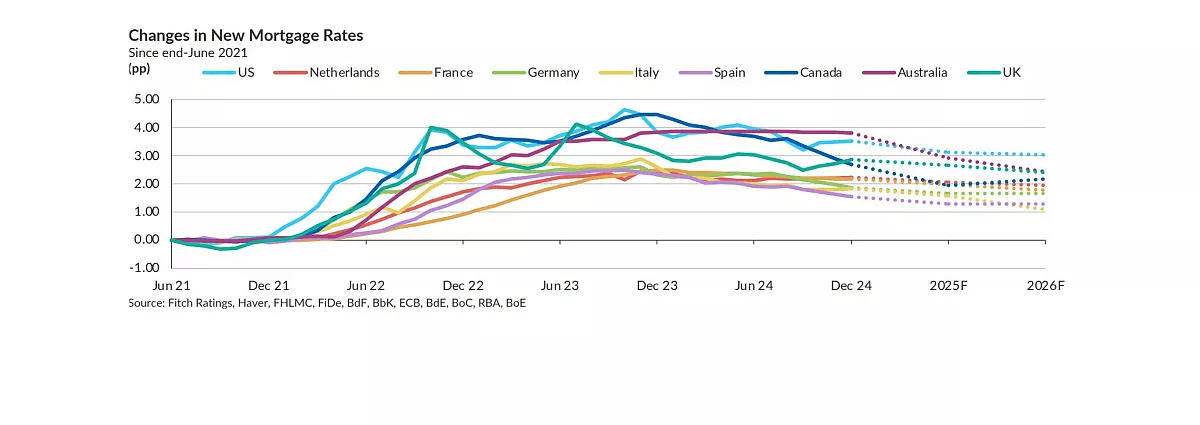
House prices across Europe are set to continue climbing in 2025, propelled by an ongoing supply-demand imbalance. While most countries will see growth, France stands out as an exception, with prices expected to dip temporarily due to affordability issues and political uncertainties. Fitch Ratings’ housing and mortgage outlook for 2025 predicts that nominal home prices will rise in the low to mid-single digits in most countries over the next two years.

Top European Markets to Watch

  • Netherlands: House price growth is projected to slow from the current 13% to 8%-10% in 2025, and 6%-8% in 2026. This still represents one of the fastest growth rates globally, driven by a limited housing supply due to rising material and labour costs. Population growth and shrinking household sizes further fuel demand. Government programmes aimed at supporting first-time buyers could also boost the market, although tighter fiscal policies may temper purchasing power.
  • Spain: House prices are expected to increase by 4%-6% in 2025 compared to 2024, with further growth of 5%-7% anticipated in 2026. Falling interest rates and improving consumer confidence are key drivers, while the housing shortage remains acute, with new construction meeting only half the needs of new household formations.
  • Germany: Modest growth of 2%-4% is forecast for both 2025 and 2026, up from Fitch’s estimate of 1.5% for 2024. Rising rents are making homeownership increasingly attractive, despite moderate wage growth limiting affordability.
  • UK: House prices are predicted to grow by 2%-4% in 2025 and 2026. Declining mortgage rates and strong labour market conditions will support the market, with lenders pricing in policy rates reaching 3.5% in 2025.
  • Denmark: Similar to the UK, house prices in Denmark are expected to rise by 2%-4% in 2025 and 2026, driven by lower interest rates and moderate growth in disposable income.
  • Italy: Slower growth of 0.5%-2.5% is expected in 2025 and 2026. High mortgage rates are dampening demand, while most transactions involve older properties rather than new builds, contributing to limited price increases.
image 31

Key Drivers of Price Growth

  1. Limited Supply: High land, labour, and material costs, along with regulatory barriers, are restricting new housing developments in most markets.
  2. Improved Economic Conditions: Low unemployment, real wage growth, and easing inflation are leaving consumers with more disposable income, driving demand.
  3. Falling Mortgage Rates: Fitch Ratings expects mortgage rates to decline to around 2.5% over the next two years, which will enhance affordability for buyers.

Market Exceptions and Challenges

  • France: House prices are expected to decline in 2025 due to strained affordability and political uncertainties. However, the pace of decline will slow compared to 2024, and prices are projected to rebound in 2026 as the market stabilises.
  • Climate and Regulatory Concerns: Flood risks and EU regulations promoting sustainable construction practices could influence market dynamics, increasing costs while boosting demand for energy-efficient homes.

Global Perspective and Risks

Globally, the strongest home price growth is forecast in the Netherlands, Canada, Brazil, and Mexico. In these markets, factors such as government programmes for first-time buyers and rising construction costs are key drivers.

Despite the expected growth, Fitch warns that unexpected economic challenges, such as higher-than-expected inflation or weaker household income, could disrupt these trends. Rising property taxes, insurance, and maintenance costs may also deter potential buyers.

Europe’s housing market in 2025 will be shaped by the interplay of supply constraints, economic conditions, and regulatory factors. For buyers, investors, and policymakers, staying attuned to these trends will be crucial in navigating an increasingly competitive landscape.

Tourism Revenue in Cyprus Surges to €407.9 Million in October 2024, Marking a 17.7% Growth

Tourism revenue in Cyprus reached an impressive €407.9 million in October 2024, showcasing a robust 17.7% year-on-year growth compared to October 2023, according to the Cyprus Statistical Service.

Record-Breaking Figures for October

Average expenditure per tourist climbed to €888.47 in October 2024, up 9.3% from €812.95 in the same month last year. The United Kingdom continued to dominate as the largest source market, contributing 36.3% of total tourist arrivals.

Key Tourist Markets

  • United Kingdom: Tourists spent an average of €114.99 per day.
  • Poland: The second-largest market, accounting for 8.1% of arrivals, with daily spending at €85.41.
  • Germany: The third-largest market, representing 7.6% of arrivals, with tourists spending €109.22 daily.

Broader Trends in 2024

From January to October 2024, total tourism revenue is estimated at €2,983.8 million, reflecting a 6.5% increase from €2,802.6 million during the same period in 2023.

Additional Insights

In October alone, Cyprus welcomed 459,106 tourist arrivals. Visitors stayed an average of 8.4 days, with a daily expenditure of €105.77.

These figures underscore the continued growth of Cyprus’ tourism sector, driven by higher spending per visitor and strong performance from key source markets.

Cyprus Inflation: Key Shifts In 2024 Consumer Prices

Inflation in Cyprus stood at 1.8% for 2024, according to the latest figures from the Statistical Service. The Consumer Price Index (CPI) for the year saw a modest increase compared to 2023, reflecting subtle but notable shifts in specific economic categories.

In December 2024, the CPI edged up by 0.10 points, reaching 118.31 points from 118.21 points in November. On an annual basis, inflation for December accelerated to 2.6%.

Noteworthy Category Changes

Among the most significant annual shifts, Agricultural Goods recorded a dramatic increase of 16.8% compared to December 2023. Month-on-month, the same category also saw a 2.6% rise, highlighting its continued volatility.

Other prominent contributors included Food and Non-Alcoholic Beverages, which rose by 7.6% year-on-year, and Restaurants and Hotels, up by 4.4% over the same period. On a monthly basis, Food and Non-Alcoholic Beverages also led the way with a 0.7% increase in December 2024.

For the full year, the Restaurants and Hotels category exhibited the most substantial change, growing by 5.4% compared to 2023.

Driving Forces Behind the CPI

The categories that contributed the most to the annual CPI increase were Food and Non-Alcoholic Beverages (1.69 units) and Restaurants and Hotels (0.45 units). Conversely, Clothing and Footwear exerted the most significant downward pressure, subtracting 0.21 units from the index.

On a month-to-month basis, the Food and Non-Alcoholic Beverages category had the greatest influence, contributing 0.16 units to the CPI increase.

Drilling down further, Fresh Vegetables emerged as the leading driver of the December 2024 CPI, with a positive impact of 0.90 units compared to December 2023. Catering Services (0.45 units) and Meat (0.23 units) also played significant roles. However, Potatoes acted as a drag on the index, contributing -0.17 units to the monthly change.

A Closer Look at Inflation’s Roots

Cyprus’s relatively low inflation rate in 2024 masks nuanced economic pressures. Rising food and hospitality costs are shaping consumer experiences, while agricultural price fluctuations add complexity to the inflation narrative. These trends underscore the evolving landscape for both consumers and businesses as the nation heads into 2025.

Aretilaw firm
The Future Forbes Realty Global Properties
eCredo
Uol

Become a Speaker

Become a Speaker

Become a Partner

Subscribe for our weekly newsletter