Breaking news

CES 2025: A Glimpse Into The Future Of Technology

The Consumer Electronics Show (CES) 2025 is back from January 7 to 10 in Las Vegas. Held annually, CES has been at the forefront of technological advancements since its inception in 1967. Over the decades, it has become the stage for unveiling the latest gadgets, revolutionary solutions in the automotive industry, and cutting-edge innovations that shape the future. This year, as always, CES offers a sneak peek into the technologies that will define our lives in the years to come. Among the biggest announcements so far, companies are showcasing AI-powered laptops, smart home devices, gaming tech, and the future of personal computing. Each year, CES sets the tone for what’s next in the world of tech, and 2025 is no exception.

A Hub Of Innovation

CES 2025 has showcased a diverse array of technologies, reflecting the industry’s rapid evolution. From artificial intelligence (AI) and digital health solutions to sustainability initiatives and next-generation mobility, the event has highlighted the multifaceted nature of technological progress. 

Key Highlights

  • Artificial Intelligence: AI continues to be a dominant theme, with companies unveiling AI-powered devices and solutions that promise to enhance various aspects of daily life. 
  • Consumer Electronics: Innovations in consumer electronics have been prominent, including advancements in smart home devices, wearable technology, and personal computing.
  • Automotive Technology: The automotive sector has introduced smart vehicles equipped with advanced sensors and AI capabilities, signaling a shift towards more intelligent and connected transportation solutions.

Looking Ahead

As CES 2025 draws to a close, it is evident that the event has once again underscored the rapid pace of technological innovation. The showcased products and discussions provide a glimpse into the future, highlighting the transformative potential of technology across various sectors. For industry professionals and consumers alike, CES remains a pivotal event, offering insights into the technologies that will shape the coming years.

Deposit And Lending Rates Decline In Cyprus: November Report Highlights

The Central Bank of Cyprus (CBC) has released its latest statistics for November, showing a general decline in both deposit and lending rates, with the notable exception of large corporate loans exceeding €1 million. The report also highlights a surge in new loan activity across various categories, indicating a dynamic shift in the financial landscape of Cyprus.

Deposit Rates See Moderate Declines

Interest rates on deposits for both households and non-financial corporations recorded slight decreases in November:

  • Households: The interest rate for deposits with a maturity of up to one year fell to 1.70%, compared to 1.76% in October.
  • Non-Financial Corporations: Corporate deposit rates also declined, dropping to 1.99%, down from 2.19% in the previous month.

Lending Rates: A Mixed Picture

While most lending rates decreased in November, large corporate loans above €1 million experienced a rise:

  • Consumer Loans: Rates dropped significantly to 6.99%, a notable decline from 8% in October.
  • House Purchase Loans: The interest rate for home loans decreased to 4.50%, compared to 4.62% in the previous month.
  • Corporate Loans:
    • Loans to non-financial corporations for amounts up to €1 million saw a decline to 5.01%, down from 5.45% in October.
    • In contrast, loans exceeding €1 million recorded an increase in rates to 4.97%, up from 4.72%.

New Loan Activity Surges

November saw a significant rise in the total volume of new loans, which increased to €635.7 million, compared to €533.8 million in October.

  • Consumer Loans:
    New consumer loans rose to €25.3 million, of which €22.3 million were classified as pure new loans. This marks an increase from €21.3 million (including €20.2 million pure loans) in October.
  • House Purchase Loans:
    Home loans increased to €129.5 million, with €98.5 million in pure new loans, compared to €115.7 million and €96.1 million, respectively, in October.
  • Corporate Loans:
    • Loans for amounts up to €1 million rose to €73.5 million, including €57.8 million in pure new loans, up from €57.3 million and €41.8 million, respectively, in October.
    • Loans exceeding €1 million also grew significantly to €398.2 million, although pure new loans in this category decreased to €154.5 million, down from €201.8 million in October.

Implications For Cyprus’ Financial Sector

The combination of falling interest rates and increased loan activity reflects evolving financial trends in Cyprus. The lower borrowing costs appear to be encouraging higher loan uptake across sectors, particularly in consumer and housing markets. However, the increase in rates for large corporate loans suggests a nuanced approach by financial institutions in addressing varying market needs.

As businesses and households continue to adapt to changing economic conditions, these trends will be crucial in shaping the trajectory of Cyprus’ financial landscape heading into 2025.

Inflation In Cyprus Climbs To 3.1% In December, Outpacing Eurozone Average

Annual inflation in Cyprus is projected to rise to 3.1% in December 2024, a noticeable increase from 2.2% in November, according to a flash estimate by Eurostat, the European Union’s statistical office. This figure surpasses the eurozone’s average annual inflation rate, which is expected to edge up to 2.4% in December, compared to 2.2% in November.

Key Drivers Of Eurozone Inflation

Breaking down the eurozone inflation data, services are anticipated to record the highest annual rate at 4.0% in December, slightly up from 3.9% in November. Other contributing factors include:

  • Food, Alcohol & Tobacco: Stable at 2.7% compared to November.
  • Non-Energy Industrial Goods: A minor decrease to 0.5%, from 0.6% in November.
  • Energy: A significant recovery, moving to 0.1% in December after recording a deflationary rate of -2.0% in November.

A Closer Look At Cyprus

While eurozone inflation remains relatively subdued, Cyprus faces a sharper increase. The island’s higher inflation trajectory underscores the need for vigilance in monitoring price trends, particularly as global energy and service costs play a critical role in shaping inflationary pressures.

Cyprus Sees Slight Gains In International Investment Position As Current Account Deficit Narrows

Cyprus’ international investment position (IIP) showed modest improvement in the third quarter of 2024, with the net liability position narrowing to €27,789.1 million, compared to €27,875.8 million in the previous quarter. These provisional figures, released by the Central Bank of Cyprus’ Statistics Department, offer insight into the country’s external economic dynamics during this period.

Adjusted IIP Reflects SPE Exclusions

When adjusted to exclude the impact of Special Purpose Entities (SPEs) — which are treated as non-residents for statistical purposes — the IIP revealed a more significant improvement. The adjusted net liability position dropped to €9,945.9 million in Q3 2024 from €10,010.2 million in Q2 2024, underscoring a positive trend.

Current Account Deficit Contracts

Preliminary balance of payments data highlighted a substantial reduction in Cyprus’ current account deficit. The deficit shrank from €369.4 million in Q3 2023 to just €29.6 million in Q3 2024, marking a notable year-on-year improvement.

After adjusting for SPEs, the current account deficit stood at €108.2 million in Q3 2024, a significant reduction from €351.6 million in the same quarter of the previous year. This adjustment reflects a clearer picture of the underlying economic performance, excluding the disproportionate influence of SPEs.

External Debt Insights

Gross external debt fell slightly to €261,534 million in Q3 2024, down from €262,098.6 million in the preceding quarter. However, external assets in debt instruments decreased more sharply, falling to €243,834 million from €249,665.7 million in Q2 2024. As a result, Cyprus’ net external debt climbed by €5,267.1 million, reaching €17,700 million.

When factoring out SPEs, gross external debt was significantly lower, at €59,257 million in Q3 2024, down from €61,077.4 million in Q2. Correspondingly, the net external debt adjusted for SPEs dropped to -€20,789.7 million, compared to -€19,239.7 million in the previous quarter.

Mark Zuckerberg Surpasses Larry Ellison to Become the Third Richest Person

Mark Zuckerberg has officially surpassed Oracle co-founder Larry Ellison to claim the title of the third richest person in the world, according to Forbes’ real-time billionaires list.

Key Insights

Zuckerberg’s fortune saw an impressive increase of over 4%, reaching $217.7 billion after Monday’s stock market close, while Ellison’s wealth dipped slightly by 0.3%, totaling $209 billion. This shift in rankings was closely tied to the performance of their respective companies’ stocks: Meta’s share price rose by approximately 4% to $630.20, while Oracle’s stock dropped by 0.3% to $165.78.

On Friday, January 3, Zuckerberg and Ellison briefly swapped positions, but by the end of the day, Ellison held the higher rank. Despite this, Zuckerberg’s rise marks a significant shift in the upper echelons of the billionaire rankings.

Elon Musk remains the wealthiest person globally with $425.2 billion, followed by Amazon’s Jeff Bezos with $241 billion.

A Changing Fortune for Ellison

Just a couple of months ago, Larry Ellison’s wealth topped $228 billion, tying him with Bezos for second place. However, in early December, Oracle’s stock suffered a major setback after a financial report revealed disappointing results, causing Ellison’s fortune to dip by $15 billion. Ellison, who owns approximately 40% of Oracle, serves as the company’s chairman, chief technology officer, and co-founder.

In contrast, Zuckerberg, who owns about 13% of Meta, continues to serve as the company’s CEO and chairman.

Political Winds and Tech Fortunes

In the wake of Donald Trump’s victory over Kamala Harris in the November election, the fortunes of several tech leaders have surged. Ellison saw a $12 billion boost in the weeks following the election, while Bezos gained $7 billion. Musk saw the most substantial increase, with his wealth rising by nearly $21 billion in the immediate aftermath.

Meta’s Strategic Moves

On Monday, Meta made waves by announcing that UFC President Dana White will join its board of directors. Zuckerberg shared the news on Facebook, alongside the additions of Exor CEO John Elkann and former Microsoft executive Charlie Thornhurst. Zuckerberg expressed confidence in the company’s future, citing vast opportunities in artificial intelligence, wearables, and the evolution of social media. With these new board members, Meta aims to chart a bold course forward in these rapidly growing sectors.

Toyota’s Woven City Opens Its Doors: A Glimpse into the Future of Urban Living

On Monday, Toyota reached a major milestone with the completion of the first phase of its ambitious Woven City project. Nestled at the base of Japan’s iconic Mount Fuji, this futuristic “smart city” is set to welcome its first 100 residents this fall, with plans to expand the population to 2,000 over time.

Key Highlights

Woven City, Toyota’s groundbreaking “smart city,” is being developed at the foot of Mount Fuji in Japan. Announced in 2020, this innovative urban environment will serve as a testing ground for cutting-edge technologies in a real-world setting. The city is designed to explore advancements in key areas such as:

  • Autonomous Vehicles: Streets will be divided into distinct zones for pedestrians, cyclists, and self-driving cars, ensuring seamless mobility for all.
  • Robotics: The city will host robots designed to assist with daily tasks and infrastructure maintenance.
  • Artificial Intelligence (AI): AI will be integrated to manage everything from smart homes to energy grids, enhancing the city’s efficiency.
  • Internet of Things (IoT): A network of interconnected devices and systems will form the backbone of Woven City, fostering a truly integrated urban environment.

Design and Sustainability

The city’s innovative architecture comes from Danish architect Bjarke Ingels and his renowned studio, Bjarke Ingels Group (BIG). With a focus on sustainability, most of the buildings will feature eco-friendly materials like wood. The city will run on hydrogen fuel cells and solar power, aiming to reduce its environmental impact. Initially, Woven City is expected to attract around 2,000 residents, mainly engineers, researchers, and technologists, who will be actively engaged in the city’s ongoing development and testing.

A Vision for the Future

For Toyota, Woven City is more than just a high-tech hub; it’s a prototype for what future cities could look like. The name “Woven City” embodies the concept of interlacing various forms of mobility and technology into the urban fabric, creating a harmonious balance between traditional city life and futuristic innovation. Toyota envisions this city as a model for more sustainable, connected, and technologically advanced ways of living.

Toyota Chairman Akio Toyoda shared his excitement for the project at the CES technology conference in Las Vegas, saying, “This year, residents will begin moving in as we slowly bring Woven City into operation. We want to accelerate the pace at which new technologies can be tested and developed in Woven City.”

Looking to the Stars

In addition to its work on Woven City, Toyota is exploring the frontiers of space. At CES, Toyoda also revealed that Toyota is looking into the development of orbital rockets. Through its subsidiary, Woven by Toyota, the company is investing 7 billion yen ($44.4 million) in Interstellar Technologies, a Japanese private space company focused on launching satellites.

Toyoda emphasized the need for more than just one car company leading technological advancements, referencing Tesla and its CEO Elon Musk’s ventures into space with SpaceX. “We are also exploring the possibility of rockets because the future of mobility should not be limited to Earth or to one car company,” Toyoda remarked.

Interstellar Technologies, founded in 2013, has already completed seven launches of its small MOMO suborbital rockets, with the company’s sights set on developing larger rockets like the ZERO and DECA series to deliver spacecraft into orbit.

Toyota aims to leverage its expertise in mass production to help Interstellar Technologies create cost-effective rockets, potentially giving the company a competitive edge in the global launch market. Toyota’s new space ambitions position it alongside rivals like Mitsubishi, whose subsidiary Mitsubishi Heavy Industries has developed the H3 series rockets, designed to rival SpaceX’s Falcon 9 in terms of cost and capability.

UK Business Confidence Plummets Amid Post-Budget Fallout

British businesses faced a rocky December as economic growth nearly stalled, and job cuts surged at the fastest rate in nearly four years, a reflection of shaken confidence following the government’s October budget.

The latest S&P Composite Purchasing Managers’ Index (PMI) for the UK edged down to 50.4 in December, barely clinging above the crucial 50-point threshold that separates growth from contraction. This was the lowest reading since October 2023 and just a hair below November’s 50.5, reinforcing concerns about the country’s economic trajectory.

Budget Blues Weigh Heavy

The slowdown follows Finance Minister Rachel Reeves’ budget announcement on October 30, which introduced hefty tax hikes for businesses to finance increased public spending. The impact has been profound, with a slump in corporate morale reverberating through the economy. According to recent data, Britain’s economy stagnated in the three months leading up to September. The Bank of England’s forecast of flatlining growth in the final quarter of 2024 appears to align with these PMI figures.

Tim Moore, Economics Director at S&P Global Market Intelligence, highlighted the persistent gloom:
“December saw no improvement in business optimism following the budget, with growth expectations for the year ahead stuck at November’s 23-month low.”

Job Cuts Hit Hard

Companies slashed jobs at a rate not seen since January 2021, during the height of COVID-19 lockdowns. Rising costs, including a looming increase in employer social insurance contributions set for April, were the main driver of these cuts, according to S&P Global. Nearly one in four firms reported a reduction in payroll, marking the sharpest decline in over 15 years outside of pandemic conditions.

Costs Climb, Optimism Fades

The PMI’s measure of future output hit its lowest point since December 2022, mirroring the uncertainty sparked by former Prime Minister Liz Truss’ “mini-budget.” Meanwhile, input costs for businesses rose at their fastest pace since April, squeezing margins further.

Sectors across the board felt the strain. December’s services PMI, a significant contributor to the composite index, was revised down to 51.1 from an earlier estimate of 51.4. Manufacturing fared even worse, with its PMI dropping to an 11-month low of 47.0, down from an initial 47.3.

Looking Ahead

While business groups have criticised the budget’s immediate impact, some economists believe increased government spending could provide a short-term boost to the economy in 2025. For now, however, companies are grappling with an increasingly challenging environment, where rising costs and regulatory pressures continue to erode confidence.

This ongoing turbulence leaves many questioning how long UK businesses can tread water in such stormy conditions.

Romania and Bulgaria Officially Join the EU’s Schengen Zone

As of Wednesday, January 1, 2025, Romania and Bulgaria have become full members of the European Union’s Schengen free-travel area, marking a historic expansion of the bloc. Land border controls were officially scrapped, allowing residents to travel seamlessly across participating countries without passport checks.

A Celebratory Moment at the Danube

Fireworks illuminated the night sky at the Friendship Bridge, a key crossing over the Danube River near the Bulgarian town of Ruse, as the interior ministers of both nations symbolically lifted the barrier at midnight. This crossing, a critical route for international trade, is often plagued by bottlenecks, but the removal of land checks is expected to ease congestion.

“This is a historic moment,” declared Bulgarian Prime Minister Dimitar Glavchev. “From Greece in the south to Finland in the north and as far west as Portugal, we can now travel without borders.”

A Long Road to Schengen Membership

Although border checks for air and sea travel were removed in March 2024, land checks had remained in place until Austria recently lifted its veto. Austria had previously argued that additional measures were needed to curb irregular migration.

Romania and Bulgaria’s journey to Schengen membership has been long, as they faced years of opposition despite meeting the technical criteria. The recent development is a major milestone, cementing their place in the EU’s free-travel area.

Schengen: A Borderless Vision

The Schengen area, initially established in 1985 between France, Germany, Belgium, the Netherlands, and Luxembourg, now encompasses 25 of the EU’s 27 member states, along with Iceland, Liechtenstein, Norway, and Switzerland.

However, not all EU countries participate. Ireland has opted out, and Cyprus remains outside the Schengen zone. Despite being an EU member since 2004, Cyprus faces challenges in meeting all the technical requirements for Schengen membership, partly due to its complex political situation. These challenges include strengthening border security and immigration controls.

Cyprus continues to work towards full Schengen membership, but the political and logistical factors involved present significant hurdles, and the timeline for its integration remains uncertain.

This historic expansion of the Schengen area, however, reinforces the EU’s vision of a borderless Europe, further uniting the bloc and streamlining travel and trade across its member states.

Trina Solar Sets New World Record for Solar Technology Efficiency

China’s Trina Solar (688599.SS) has achieved a groundbreaking milestone in solar technology, setting a new world record for conversion efficiency in its n-type fully passivated heterojunction (HJT) modules. The company announced the achievement on Monday, following certification by Germany’s Fraunhofer CalLab, a leading solar research institute.

A Leap Forward in Efficiency

In laboratory tests, Trina’s HJT modules demonstrated an impressive 25.44% efficiency. This refers to the percentage of sunlight converted into usable electricity, a key metric in solar technology. By enhancing cell efficiency, solar installations can be downsized while costs are reduced, offering a significant advantage in the renewable energy market.

The technology behind the achievement, known as passivation, involves covering surface defects on solar cells to improve their performance. According to Professor Martin Green from the University of New South Wales, Sydney—whose lab previously held the efficiency record for decades—the result underscores the promise of HJT as a next-generation solar technology.

“In the long run, it’s all about efficiency,” Green said. “Even if some technologies are initially more expensive, costs tend to drop quickly as the industry adapts and scales up.”

Trina Solar’s Vision

Trina Solar’s Chairman and CEO, Gao Jifan, emphasised the company’s commitment to advancing passivated solar technology through ongoing research and development. “This achievement strengthens our leadership in solar technology, and we will continue to push the boundaries of innovation,” he stated.

The Future of HJT Technology

While HJT technology currently represents a small share of the market—estimated at 7% of high-efficiency solar cell capacity in 2024, rising to 9% by 2026—it holds significant potential. However, it faces stiff competition from TopCON (Tunnel Oxide Passivated Contact) technology, which is projected to dominate the market over the next five years.

This milestone not only represents a breakthrough for HJT technology but also sets a new benchmark for the photoelectric conversion efficiency of single-crystalline silicon solar cell modules, Trina noted in its statement.

As the race for efficiency continues, innovations like these are expected to play a crucial role in shaping the future of renewable energy.


How Many Months of Salary Do You Need to Buy a House in Europe?

The answer depends largely on where you live. A recent report by BestBrokers compares property prices across Europe to average salaries, offering insights into how many months of income it would take to afford a home.

Where in Europe is Buying a Home Most Affordable?

Denmark leads the pack as the most affordable country in Europe for homebuyers. According to the report, purchasing a 100-square-metre property in Denmark costs the equivalent of 114 net monthly salaries, making it the shortest saving time in Europe.

The report considered factors such as average net income, inflation, and “real” mortgage interest rates—mortgage rates adjusted for inflation. It’s important to note that the calculation assumes no spending on food, housing, childcare, or other expenses, offering a purely theoretical outlook.

Interestingly, despite ranking as Europe’s most affordable housing market, Denmark also holds the title of the most expensive EU country for goods and services, with prices 43% above the EU average in 2023, according to Eurostat. Still, Denmark’s relatively high average earnings—seventh in Europe—offset these costs.

Following Denmark, Ireland, and Sweden rank as the second and third most affordable European countries to buy a home. A 100-square-metre property costs the equivalent of 123 and 129 net monthly salaries in these nations, respectively—roughly 10 years of annual earnings.

Which European Countries Make Saving for a Home the Hardest?

At the opposite end of the spectrum are the Czech Republic and Slovakia, where saving for a home takes considerably longer. In Slovakia, for example, buying a 100-square-metre property costs 297 net monthly salaries—nearly 25 years of earnings. Even if someone managed to save half their income every month, it would take 50 years of disciplined saving to afford a home.

Where Are Homes the Most Affordable Globally?

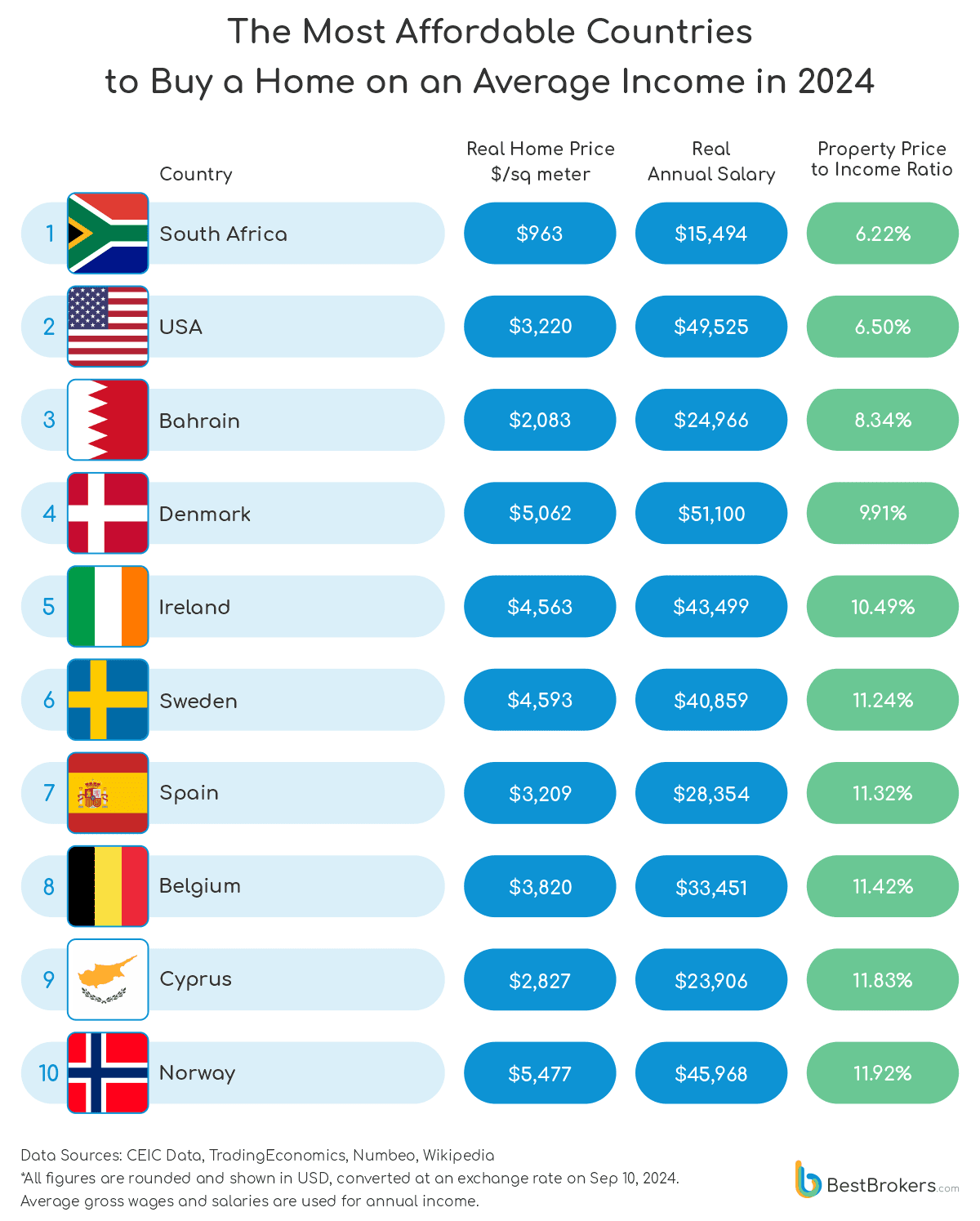
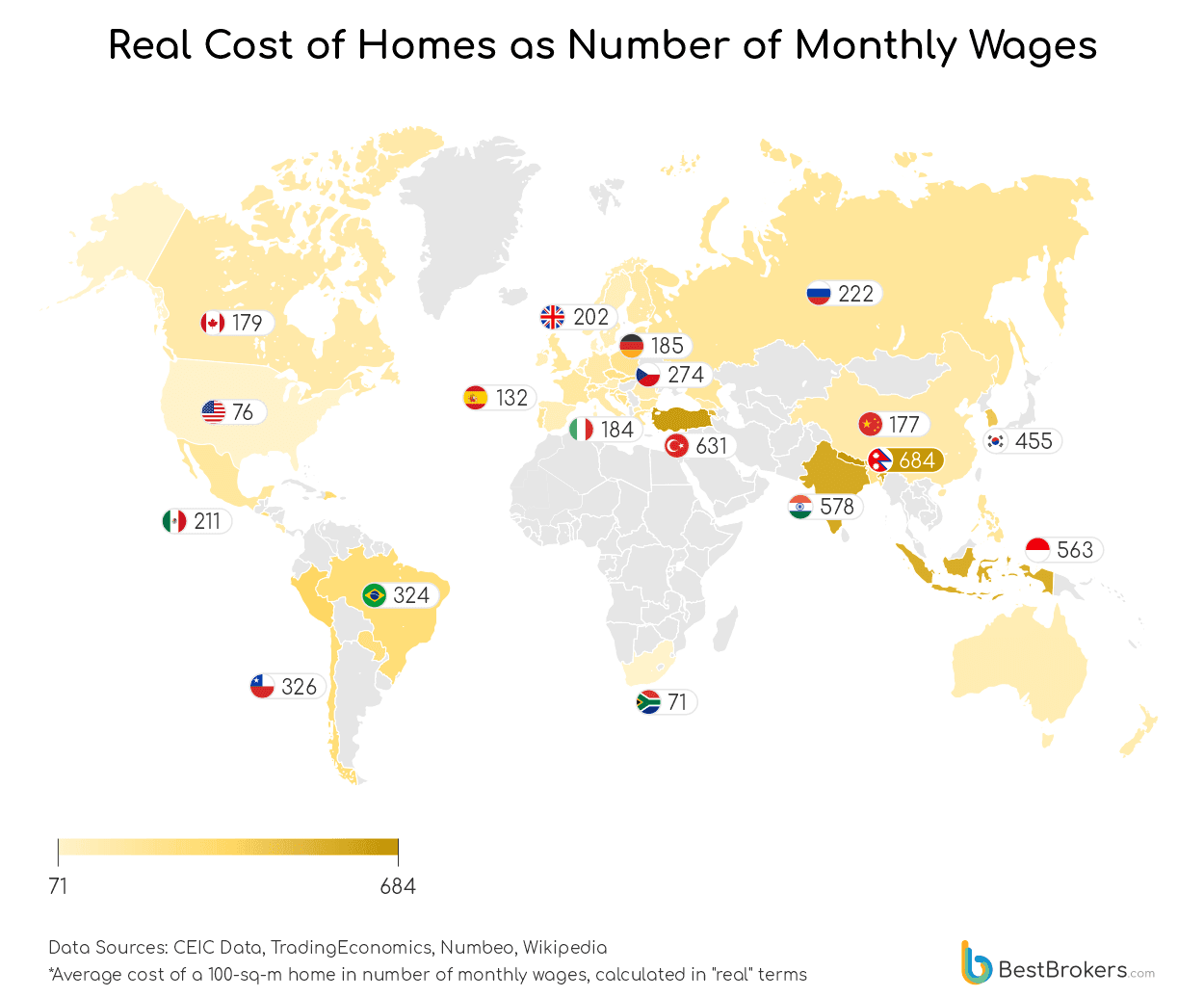
Globally, South Africa emerges as the most affordable country to buy a home. A 100-square-metre property costs 71 times the average monthly salary, making it the fastest place in the world to save for a house. The United States comes second, requiring 76 monthly wages—equivalent to approximately six years of annual income. However, property affordability varies greatly between states in the U.S., with some regions significantly more expensive than others.

image 34

The World’s Least Affordable Housing Markets

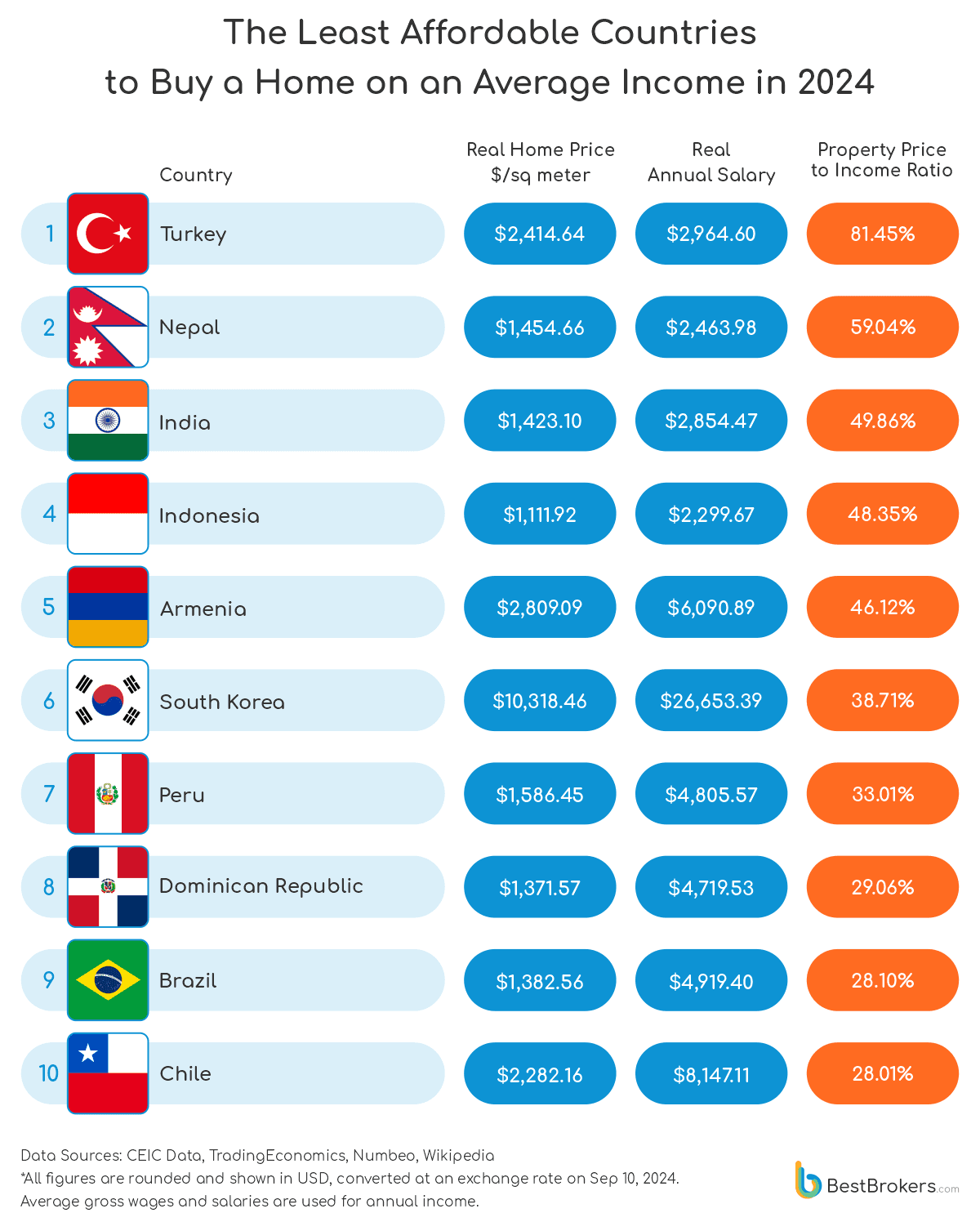
On the flip side, Nepal holds the title for the least affordable housing market, where a 100-square-metre home costs a staggering 684 monthly salaries. Turkey follows closely behind, with homes priced at 631 net wages, or over 52 years of income.

image 33

How Many Monthly Salaries Does a 100-sq-metre Home Cost Around the World?

image 32

Final Thoughts

This report sheds light on the stark disparities in housing affordability across Europe and the world. Whether you’re planning to buy a home in Denmark or dreaming of saving in Slovakia, understanding the cost-to-salary ratio is crucial for making informed financial decisions.

Disclaimer: The information provided does not constitute financial advice. Always conduct your own research to ensure it aligns with your personal circumstances. While we strive to deliver expert-backed guidance, reliance on this content is at your own risk.

Uol
eCredo
Aretilaw firm
The Future Forbes Realty Global Properties

Become a Speaker

Become a Speaker

Become a Partner

Subscribe for our weekly newsletter