Breaking news

Greece Among The Top 8 EU Destinations For Short-Term Rentals In Summer 2024

Greece has secured its spot as one of the eight most popular destinations for short-term rentals in the European Union, reflecting the increasing trend of platform-based tourism, according to Eurostat.

The country’s solid performance in the summer of 2024 aligns with a broader rise in short-term rental bookings across Europe. Eurostat’s latest data reveals an 18% year-on-year increase in bookings through platforms like Airbnb, Booking.com, and Expedia. Greece saw a 14.3% rise in overnight stays compared to 2023, contributing significantly to this growth.

A Surge Across Europe

During the third quarter of 2024, short-term rental bookings across the EU reached 366.2 million overnight stays, with Greece accounting for 26.1 million of these, marking a 14.3% increase over the previous year.

The highest growth rates were seen in Malta (+40.9%), Germany (+26%), and Sweden (+24.6%). France, Spain, and Italy also experienced significant increases in bookings, with year-on-year growth rates of 23.8%, 20.2%, and 15.5%, respectively.

Strong Performance In The Summer Months

Across the EU, the third quarter of 2024 recorded robust growth in short-term rental bookings, with all three summer months showing impressive results:

  • July 2024: 135 million overnight stays, up 16.4% from the previous year.
  • August 2024: 152.2 million overnight stays, a 21.6% increase.
  • September 2024: 79 million overnight stays, rising 14% compared to 2023.

Malta led the EU in August with a 41.4% increase in overnight stays, followed by Germany (+32.7%) and France (+29.9%). Smaller increases were recorded in countries like Croatia (+9.7%), Bulgaria (+12.2%), and Slovenia (+13.6%).

In Greece, August saw a 16% rise in overnight stays, further cementing its status as a top summer destination in Europe.

Greece’s Continued Popularity In Short-Term Rentals
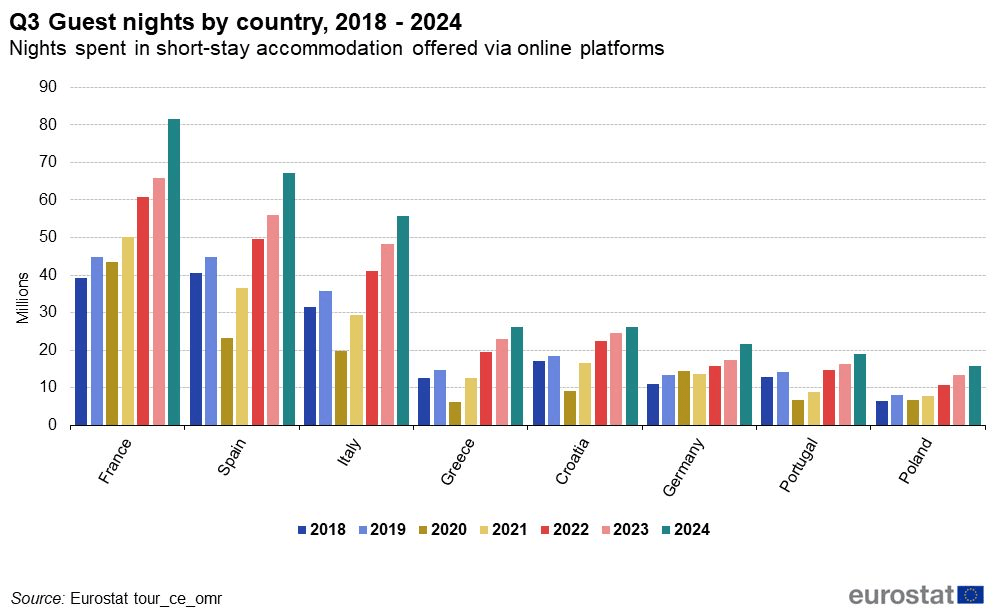
image 44

Greece’s growth in short-term rentals is part of a larger upward trend seen across the EU. The country is now firmly positioned as one of the eight most sought-after destinations for short-term rentals, joining:

  1. France
  2. Spain
  3. Italy
  4. Greece
  5. Croatia
  6. Germany
  7. Portugal
  8. Poland

The Rise Of Platform-Based Tourism

The Eurostat report underscores a broader trend of growing reliance on platform-based tourism, with all eight top destinations surpassing pre-pandemic levels. Greece’s inclusion among these countries highlights its enduring appeal to travellers seeking short-term rentals.

This sustained growth not only underscores Greece’s importance in the European tourism market but also reflects the country’s ability to adapt to evolving travel preferences.

CarVal Reduces Stake In Bank Of Cyprus To 5.9%

Global investment fund CarVal Investors has further trimmed its shareholding in the Bank of Cyprus, now holding 5.9% of the bank’s shares, as disclosed in a recent announcement on the Cyprus Stock Exchange (CSE).

This marks the second reduction in CarVal’s stake within a few months. In October 2024, the firm decreased its shareholding from 9.1% to 6.1%, reflecting its continued divestment strategy.

On Monday, Bank of Cyprus shares closed at €4.74, a slight decrease of 0.21%, with a trading volume of 35,524 shares.

The move by CarVal signals ongoing shifts in the bank’s ownership structure, potentially influencing its future strategic direction and market dynamics.

Drama, Dominance, And Debuts: Highlights From Day Three At The Australian Open

Day three of the Australian Open delivered a thrilling mix of breakout performances, seasoned resilience, and high drama, leaving fans on the edge of their seats.

Fonseca’s Grand Slam Fairytale

The spotlight shone brightest on 18-year-old Joao Fonseca, who made history on his Grand Slam main draw debut. The Brazilian qualifier stunned ninth-seed Andrey Rublev with a dazzling 7-6(1) 6-3 7-6(5) victory, becoming only the second teenager since 1973 to defeat a top-10 ATP player in their debut. With 51 winners and unshakeable composure, Fonseca is now set to face Italy’s Lorenzo Sonego in the second round.

Medvedev’s Meltdown And Redemption

Fifth seed Daniil Medvedev’s match against Thai wildcard Kasidit Samrej was as much about the tennis as it was about his fiery emotions. After smashing his racket and a net camera in frustration, earning a code violation, Medvedev rallied for a hard-fought 6-2 4-6 3-6 6-1 6-2 victory. Reflecting on his turnaround, Medvedev said, “At the end of last year, this match I probably would have lost. Now it’s a new year and new energy … So I’m happy to win this match.”

Steady Hands And Setbacks

Fourth seed Taylor Fritz showcased his clinical form with a commanding 6-2 6-0 6-3 win over compatriot Jenson Brooksby. Fritz, who played a pivotal role in the U.S. United Cup triumph, will next face qualifier Cristian Garin. Despite returning from injuries and a doping suspension, Brooksby was unable to match Fritz’s precision, marked by 34 winners.

Emma Raducanu battled through inconsistency to secure her fourth consecutive second-round appearance, overcoming 26th-seeded Ekaterina Alexandrova 7-6(4) 7-6(2). Despite 15 double faults, the 22-year-old summoned her brilliance when it mattered most and now faces American Amanda Anisimova.

Navarro’s Marathon Victory

In one of the day’s longest encounters, eighth seed Emma Navarro outlasted fellow American Peyton Stearns in a gruelling 7-6(5) 6-7(5) 7-5 contest. Over three hours and 20 minutes, Navarro clawed back from a breakdown in the final set to win four consecutive games and secure her place in the next round. Reflecting on the match, she remarked, “Crazy match today … maybe wasn’t my best, but it feels really special to get the win.”

Other Notable Results

  • Former Wimbledon champion Elena Rybakina cruised past Australian wildcard Emerson Jones 6-1 6-1 under the watchful eye of new coach Goran Ivanisevic.
  • Matteo Berrettini came from a set down to beat Britain’s Cameron Norrie 6-7(4) 6-4 6-1 6-3, earning a second-round clash with Holger Rune, who survived a five-set thriller against Zhang Zhizhen.
  • Gael Monfils triumphed in a French epic against Giovanni Mpetshi Perricard 7-6(7) 6-3 6-7(6) 7-6(5) 6-4.

As the Australian Open unfolds, the third day highlighted the unpredictability and brilliance that make tennis’s first Grand Slam of the year unmissable. From Fonseca’s electrifying debut to Medvedev’s resilience and Navarro’s determination, the tournament promises even more drama ahead.

Non-Performing Loans In Cyprus Banking System Drop To 6.5% In Q3 2024

The ratio of Non-Performing Loans (NPLs) in Cyprus’s banking sector fell to 6.5%, equivalent to €1.6 billion, at the end of September 2024, down from 6.9% (€1.7 billion) in June 2024, according to the Central Bank of Cyprus (CBC).

The coverage ratio for NPLs, reflecting provisions held against these loans, increased slightly to 55.7% (€0.9 billion) by the end of September, compared to 55% in June 2024.

The CBC attributed the reduction in NPLs to several factors:

  • Loan repayments, including debt-to-asset swaps.
  • Successful restructurings, with loans reclassified as performing after probation periods.
  • Loan write-offs are often tied to previously provisioned amounts or accounting set-offs.

Key Highlights

  • Household NPLs: Declined to €900 million in September 2024 (from €916 million in August), representing 8.5% of total household loans. Total provisions for household NPLs accounted for 41% (€388 million) of the total.
  • Total Household Loans: Reached €10.57 billion.
  • Corporate NPLs: Dropped to €658 million in September (from €682 million in August), representing 5.5% of total corporate loans. Of these, €610 million related to small and medium-sized enterprises (SMEs), with provisions covering 75.5% of total corporate NPLs.
  • Restructured Loans: Totalled €1.3 billion at the end of Q3 2024, with €0.7 billion still classified as NPLs.

The steady decline in NPLs reflects ongoing efforts by Cypriot banks to manage credit risk and improve loan portfolio quality, supporting the overall stability of the financial system.

Cyprus Central Bank To Raise Countercyclical Buffer Rate To 1.5% Amid Rising Systemic Risks

The Central Bank of Cyprus (CBC) has announced plans to raise the countercyclical buffer rate (CCyB) from 1% to 1.5%, with the change set to take effect on 14 January 2026. The decision, disclosed on 10 January 2025, aims to strengthen the resilience of the banking sector in light of growing systemic risks.

The CCyB is a regulatory tool that requires banks to maintain additional capital during periods of heightened economic risk. This buffer helps absorb potential losses, ensuring financial stability and the continuous flow of credit to the economy during times of stress.

Rising Risks Prompt Policy Action

The CBC’s quarterly assessment identified an uptick in systemic risks, driven by geopolitical developments, economic turbulence, and potential tail events in the global economy. Factors contributing to this heightened risk include:

  • Escalation of the Middle East conflict.
  • Continued globalization of the war in Ukraine.
  • Growing protectionist measures led to new trade restrictions.

These risks, according to the CBC, threaten the domestic macroeconomic environment and, by extension, the stability of the banking sector.

Broader Concerns At The EU Level

The CBC’s decision aligns with concerns raised by European institutions.

  • The European Systemic Risk Board (ESRB) highlighted in its December 2024 press release the need for enhanced resilience across the EU financial system amid heightened political uncertainty and geopolitical tensions.
  • The European Central Bank (ECB), in its Financial Stability Review, stressed the importance of ensuring banks maintain sufficient capacity to absorb losses during periods of economic stress.

Enhancing Resilience Through Increased Buffers

By raising the CCyB rate to 1.5%, the CBC aims to channel a portion of bank profits towards creating a larger buffer of loss-absorbing capital. This measure is intended to:

  • Strengthen the ability of banks to withstand potential crises.
  • Ensure the uninterrupted flow of credit to the real economy, even in times of economic stress.

The CBC emphasized that the previous rate of 1% was insufficient given the prevailing risk landscape and that the increased buffer will enhance the banking sector’s capacity to navigate future challenges.

This proactive adjustment reflects a broader commitment to safeguarding financial stability in Cyprus while aligning with EU-wide efforts to reinforce the financial system’s resilience.

Cypriot Banks Post €952.5 Million In Profits For Jan-Sep 2024, Driven By Strong Interest Income

Cyprus’s banking sector reported robust performance in the first nine months of 2024, achieving total post-tax profits of €952.5 million, a significant jump from €602.92 million recorded at the end of June. The latest data, published Tuesday by the Central Bank of Cyprus (CBC), highlights strong gains across key financial metrics.

Strong Interest Income Powers Profit Surge

Net interest income, a critical driver of bank profitability, reached €1.53 billion by the end of September 2024, a sharp rise from €1.033 billion just three months earlier. Total net operating income also increased substantially, climbing to €1.88 billion from €1.22 billion at the end of June.

Capital Strength And Asset Management

The Tier 1 capital—a measure of the banks’ financial stability—rose slightly to €6.34 billion by the end of September, compared to €6.31 billion in June. Meanwhile, risk-weighted assets (RWA), a benchmark for evaluating financial risk, declined modestly to €22.83 billion from €22.91 billion over the same period.

Year-Over-Year Comparison

The sector’s nine-month performance is particularly noteworthy given that total post-tax profits for 2023 stood at €1.26 billion. This year’s strong momentum indicates a significant uptick in profitability, suggesting that banks are well-positioned to exceed last year’s results.

The latest figures underscore the resilience of Cypriot banks, reflecting their ability to capitalize on rising interest rates and strengthen their financial foundations.

Britain Aims To Build OpenAI Rival And Become World Leader In AI, Says PM Keir Starmer

Britain is determined to carve out a dominant role in the global artificial intelligence (AI) race, with Prime Minister Keir Starmer’s government pledging to develop a competitor to OpenAI. The ambitious goal positions the UK as a potential world leader in AI.

Key Developments

  • Starmer is set to visit Bristol to announce the UK’s commitment to developing AI capabilities, building on British tech investor Matt Clifford’s “AI Capabilities Action Plan.”
  • The UK government intends to significantly expand its data center capacity to support the growing demand for high-performance AI models.
  • By 2030, the UK aims to boost its sovereign computing capacity—referring to the public sector’s ability to host and manage AI systems—by a factor of twenty.
  • As part of the initiative, the government will provide access to its AI Research Resource program, designed to strengthen the country’s computing infrastructure.
  • Last year, Starmer’s administration chose to prioritize other budget commitments, sidelining £1.3 billion earmarked for major computing projects such as the AI Research Resource and an exascale supercomputer—plans initially set by his predecessor, Rishi Sunak.

Key Insight

“Sovereign AI” is becoming a focal point for policymakers, especially across Europe. The term refers to the strategic development of AI and technologies deemed essential for national security and economic prosperity within the borders of the countries that use them.

Looking Ahead

To fortify its AI infrastructure, the UK government will also create AI growth zones, relaxing building permit regulations in select regions to enable the construction of new data centers. Additionally, the establishment of an “AI Energy Council” will explore how renewable and low-carbon energy sources, such as nuclear power, can support AI growth.

China Considers Selling TikTok’s U.S. Operations To Elon Musk To Avoid Ban

According to a Bloomberg report, the Chinese government is considering a plan in which Elon Musk could take over TikTok’s U.S. operations to prevent the app from being banned. This potential move comes as the U.S. Supreme Court deliberates on a law requiring the Chinese company ByteDance to divest its U.S. business by January 19, under the threat of sanctions on internet service providers supporting TikTok in the country.

This backup plan, still in its early stages, would see Musk, who owns the X platform (formerly Twitter), taking the reins of both X and TikTok’s U.S. operations. However, Chinese authorities have yet to make a final decision, and it is unclear if ByteDance is aware of these discussions or TikTok’s involvement in the plans.

The legal battle over TikTok’s future in the U.S. intensified recently, as the Supreme Court held oral arguments on a law that could ban the app. Signed by President Joe Biden in April, the law has been challenged by TikTok’s legal team on the grounds of violating free speech rights. Meanwhile, the government argues that ByteDance’s ownership poses a national security threat.

With the court likely to support the government’s stance, TikTok may seek a political resolution through former President Donald Trump, who has shifted his position on the app. Despite advocating for a TikTok ban during his first term, Trump has recently reversed his stance and called for a delay in the Supreme Court’s ruling to allow time for a political solution.

In addition to Musk’s potential involvement, last week saw the emergence of “The People’s Bid for TikTok,” a proposal led by billionaire investor Frank McCourt. McCourt’s plan seeks to buy TikTok’s U.S. assets from ByteDance, restructuring the company to prioritize the privacy of American users. This includes moving to U.S.-based digital infrastructure and abandoning the controversial algorithm, addressing national security concerns. The bid is currently seeking backing from private equity firms and large-scale financing from major U.S. banks.

Large UK Companies To Scale Back Hiring And Investment Amid Tax Increases

Large British businesses are preparing to slow hiring and reduce investments at the fastest pace since the COVID-19 pandemic, according to a report released by Deloitte on Monday. The survey points to the impact of substantial tax increases introduced in the government’s October budget, which include a £25 billion ($31 billion) rise in employers’ social security contributions.

Deloitte’s quarterly survey, conducted with 63 of the UK’s largest companies, reflects broader trends also seen in smaller and medium-sized businesses grappling with the tax hike. As cost control becomes a priority, the survey indicates that chief financial officers (CFOs) are scaling back their expectations for corporate investment, discretionary spending, and hiring over the next 12 months.

Ian Stewart, Deloitte’s chief economist, noted, “With cost control to the fore in the wake of the budget, CFOs have trimmed expectations for corporate investment, discretionary spending, and hiring in the next 12 months.”

The survey, conducted from December 3 to December 16, did not account for the recent drop in sterling and the spike in 30-year government bond yields, which have reached their highest levels since 1998. These developments have raised concerns about an economic slowdown since the government’s budget announcement.

Employment intentions among businesses have seen the steepest decline since early 2020, and plans for capital expenditure are at their weakest since Q3 2023. Companies are also showing less appetite for taking on risk, with CFOs showing the least confidence in the economy in more than a year.

Despite this, business optimism has dipped to a two-year low, although the overall sentiment is not as negative as the lows witnessed in 2022 or 2020, according to Deloitte’s findings. While CFOs still consider the UK a more attractive investment destination than the eurozone, the gap has narrowed, with Europe trailing behind the United States as the preferred choice for investment.

In a separate survey, manufacturing trade body Make UK revealed that 57% of manufacturers would consider increasing investment once the government provides further details on its long-term industrial strategy, expected in the first half of 2025.

Stephen Phipson, Chief Executive of Make UK, emphasized the urgency of the government presenting clear and immediate priorities as part of the industrial strategy. He believes it could help boost business confidence and set a positive tone for the year ahead.

Cyprus Positioned As A Top-Tier Investment Spot, Says CEO Of Invest Cyprus

According to Marios Tannousis, CEO of Invest Cyprus, Cyprus continues to solidify its position as a premier destination for global investment. Invest Cyprus plays a pivotal role in guiding businesses through every stage of their investment journey.

In a recent press release, Invest Cyprus detailed Tannousis’ participation in a high-level dialogue with ministers from Greece, Egypt, and Cyprus last week at the Trilateral Summit in Cairo. The discussions centered on fostering bilateral and trilateral cooperation, unlocking funding opportunities, and strengthening economic ties between the three nations.

Speaking on the topic, “Business Opportunities and Activities in Egypt, Cyprus, and Greece,” Tannousis spotlighted Cyprus as a standout investment destination within the EU. He highlighted its economic stability, bolstered by EU membership, and reiterated Invest Cyprus’ commitment to facilitating seamless support for investors aiming to tap into the island’s potential.

Joining Tannousis in presenting the investment landscapes of their respective countries were Hossam Heiba, CEO of Egypt’s General Authority for Investment and Free Zones (GAFI), and Marinos Giannopoulos, CEO of Enterprise Greece. Together, they outlined opportunities and actionable insights for businesses eyeing expansion in the region.

Tannousis underlined the significance of regional partnerships, stating, “By forging strategic alliances between Cyprus, Greece, and Egypt, we are building a collaborative platform that fosters sustainable growth and mutual prosperity, providing businesses with a foundation to succeed and expand in this dynamic region.”

The Trilateral Summit underscored the critical role of regional collaboration in addressing shared challenges and driving economic development. As reaffirmed in the press release, Invest Cyprus remains a cornerstone in the effort to attract international investment, ensuring Cyprus stays at the forefront of economic opportunity in the Eastern Mediterranean.

Aretilaw firm
The Future Forbes Realty Global Properties
Uol
eCredo

Become a Speaker

Become a Speaker

Become a Partner

Subscribe for our weekly newsletter
