Breaking news

Cyprus Aims For Sustainable, Year-Round Tourism Growth

Cyprus is strengthening its position as a high-quality, year-round tourist destination by balancing sustainability, economic growth, and environmental responsibility, according to Akis Vavlitis, president of the Association of Cyprus Tourist Enterprises (Stek).

Speaking at Stek’s annual general assembly, Vavlitis underscored the resilience of the tourism sector and its significant contributions to local communities, employment, and businesses.

Record-Breaking Tourism Figures With Emerging Challenges

Despite geopolitical tensions, Cyprus welcomed a record 4.04 million visitors in 2024, with tourism revenue expected to reach €3.2 billion—accounting for approximately 13% of the country’s GDP. However, Vavlitis highlighted concerns about visitor accommodation trends. Around 35% of tourists—roughly 1.4 million people—chose unregistered short-term rentals or even stayed in the Turkish-occupied north, bypassing licensed hotels.

Additionally, the average length of stay has declined from 10.7 days in 2014 to 8.6 days in 2024—a significant 24% drop.

Diversifying Tourist Markets

In 2024, visitors from the UK accounted for 35% of inbound tourism, while Israel represented only 10% —highlighting the need for market diversification. Vavlitis advocated for targeted strategies to attract high-spending tourists from regions like Saudi Arabia and India to reduce reliance on traditional European markets.

Addressing Tourism Seasonality

A major structural challenge remains seasonality, with winter months accounting for just 16%  of total visitors and 12% of tourism revenue. To counter this, Vavlitis proposed a sector-wide study to identify and develop winter tourism products tailored to niche visitor segments.

Labor Shortages And Infrastructure Gaps

Labor shortages in the hospitality sector were another key issue discussed. With Cyprus’ tourism and hospitality industries expanding rapidly, Vavlitis stressed the importance of hiring workers from third countries to bridge employment gaps. He welcomed the government’s digitalization of foreign worker recruitment processes, which aims to streamline hiring and reduce bureaucratic obstacles.

Regulating Short-Term Rentals And Sustainable Development

Vavlitis also called for a robust regulatory framework to ensure safety and fair competition in the short-term rental market. He urged the government to introduce clear operational guidelines for these accommodations while promoting a strategic spatial planning approach to protect environmentally sensitive areas.

With a clear vision and proactive strategies, Cyprus is poised to enhance its reputation as a resilient, sustainable, and high-quality tourist destination.

OpenAI CEO Rejects Musk’s $97.4 Billion Offer: “We’re Not For Sale”

OpenAI, the company behind the groundbreaking ChatGPT, continues to reject a $97.4 billion offer from a consortium of investors led by Elon Musk. While OpenAI is not publicly traded, it operates under a complex structure that merges both non-profit and for-profit arms. Musk, one of the co-founders, has stated his intention to steer OpenAI back to its non-profit roots, prioritizing the development of AI to benefit humanity.

However, the timing of his bid raises questions, especially considering that Musk also owns xAI, a direct competitor to OpenAI. 

Speaking to Axios, Sam Altman, OpenAI’s CEO, described Musk as a competitor unable to outpace OpenAI in the market, thus resorting to a bid “with total disregard for the mission.”

Despite Musk’s offer, the decision over OpenAI’s future isn’t solely in Altman’s hands. Altman, who also sits on the non-profit’s board, has made it clear he does not hold any stock in the company. His vision for OpenAI’s future involves transitioning to a fully for-profit model to attract more funding for AI research.

However, OpenAI’s board will ultimately decide, and if Musk raises his offer, they may be swayed. The current bid of $97.4 billion is far below OpenAI’s valuation of $157 billion from its most recent funding round in October. Recent talks suggest OpenAI’s value has soared to $300 billion.

Musk’s attorney, Marc Toberoff, stated that the consortium is open to increasing the bid. He also asserted that, as a co-founder and tech leader, Musk is the best candidate to protect and grow OpenAI’s technology.

Musk has been building other AI ventures too, including a collaboration with Oracle, a Japanese investment firm, and an Emirati sovereign wealth fund to develop the Stargate Project—an ambitious $500 billion AI infrastructure initiative in the US.

The project, which was announced at the White House, has attracted attention as the “largest AI infrastructure project in history.” Despite this, Musk, who is a key advisor to former President Donald Trump, has claimed that the project does not have the financial backing it claims, though he has provided no details to back up the assertion.

With such high stakes, the unfolding drama over OpenAI’s future is far from over, and it’s clear that Musk’s bid is only the beginning of a complex and multifaceted competition in the AI space.

Cyprus Bets On EU-Funded Project To Solve Water Scarcity

A groundbreaking European initiative is poised to address Cyprus’ longstanding water challenges. Backed by Horizon 2030 and uniting 39 partners—including the Department of Water Development and the Larnaca Sewerage Board—the Water-Mining project is redefining the potential of desalinated water in drought-prone regions.

Turning Desalination Into A Sustainable Solution

Cyprus relies heavily on desalination, with approximately 70% of its drinking water sourced from these facilities. However, the process is energy-intensive and produces significant brine waste. Enter the Water-Mining project, which leverages innovative scientific methods to transform this byproduct into valuable industrial materials—reducing waste, cutting energy consumption, and increasing the island’s overall water availability.

One of the key figures behind this initiative is Associate Professor Demetris Xevgenos from the Technical University of Delft, who serves as the project’s executive coordinator. He recently presented the results in Lampedusa, Italy—an island entirely dependent on desalination—with overwhelmingly positive feedback. Now, Cyprus is next in line for evaluation and implementation.

From Concept To Implementation

The project, already scientifically advanced, was showcased in Nicosia last November to key stakeholders. The next phase involves a European-level evaluation, with plans to launch the initiative at the Cyprus Electricity Authority’s Vasiliko site. While tendering and commercial management discussions are ongoing, this initiative represents a major step forward in optimizing desalination efficiency.

As climate change intensifies, initiatives like water mining could become essential in securing Cyprus’ water future, ensuring that the island maximizes every drop of its most precious resource.

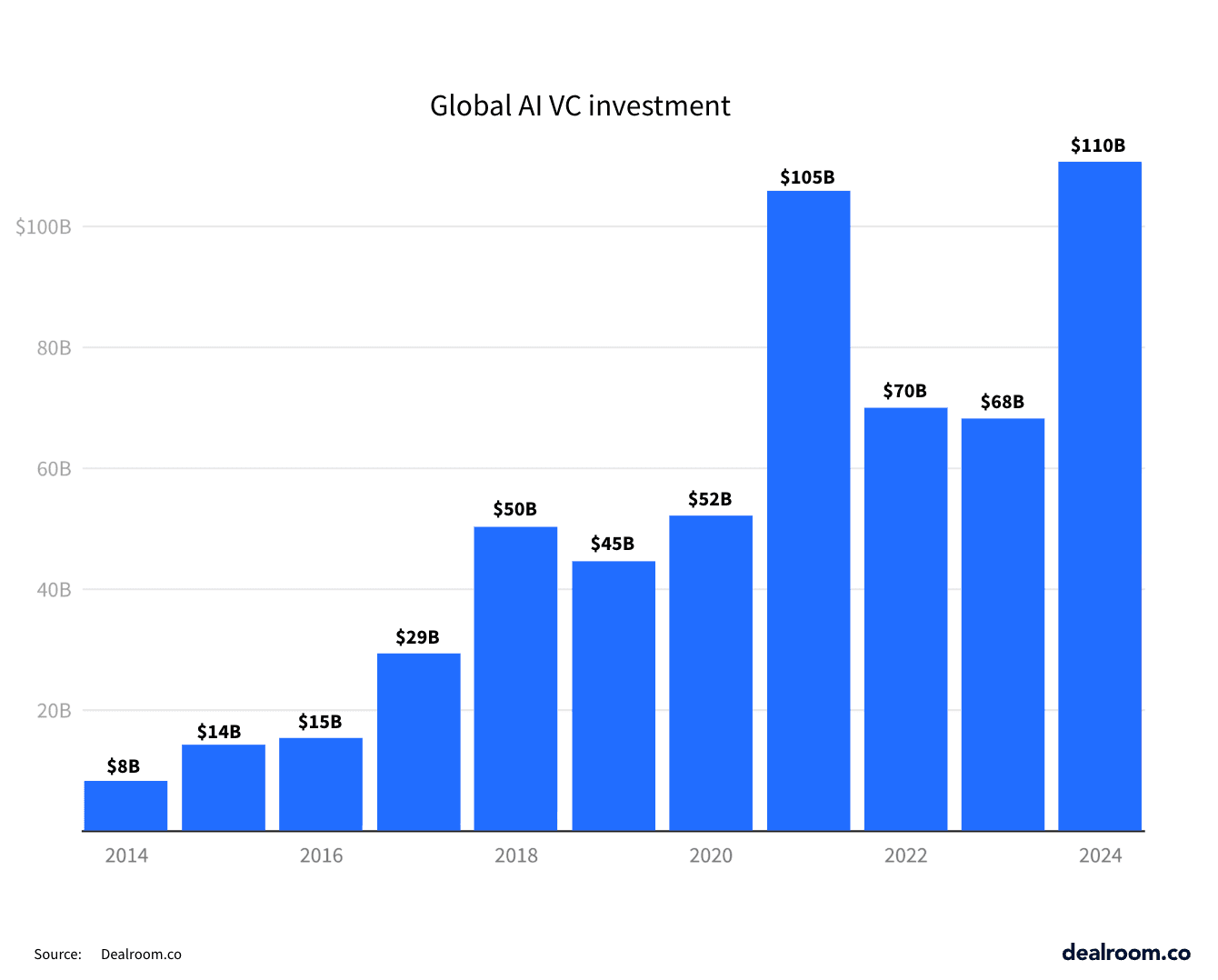
AI Investments Surge 62% to $110B in 2024, While Startup Funding Falls 12%

Artificial intelligence has taken the investment world by storm, with venture capitalists flocking to fund AI-driven startups at unprecedented levels. In stark contrast, the broader tech landscape has seen a decline in funding, highlighting the increasing dominance of AI in the venture capital sphere.

Key Facts

  • AI startups raised an astonishing $110 billion in 2024, marking a 62% surge compared to the previous year, according to new data from Dealroom.
  • Across all technology sectors, privately-backed companies—including startups and scale-ups—secured $227 billion in 2024. This figure represents a 12% drop from 2023, signaling a shift in investor focus.
  • Yoram Wijngaarde, Dealroom’s founder, highlighted that the current AI investment boom surpasses even the marketplace frenzy of the late 1990s and early 2000s in terms of scale and impact. “This is the biggest wave ever by absolute amounts invested,” he said. “There’s never been anything like it.”
image 71

Why AI Is Leading The Charge 

The explosive growth in AI funding can be attributed to its vast, expanding ecosystem. From hardware and infrastructure to applications and foundational models, AI’s reach is broadening, attracting diverse areas of investment.

Notable AI funding rounds in 2024 reflect this diversity. Companies like Anthropic (large language models, generative AI), Waymo (self-driving tech), Anduril (defense), xAI (applications), Databricks (AI data management), and Vantage (data centers and infrastructure) dominated the top fundraising spots.

Despite its high profile, OpenAI did not lead in terms of funding raised last year. That honor went to Databricks, which secured $10 billion, surpassing OpenAI’s $6.6 billion. However, with over $20 billion in total funding to date, and another $40 billion reportedly in the pipeline, OpenAI remains a key industry player, notably due to its viral app, ChatGPT.

Generative AI And Foundational Models: The Key Drivers 

The surge in investment can largely be attributed to generative AI and foundational models—two of OpenAI’s core business areas. In 2024 alone, generative AI companies raised a remarkable $47.4 billion, and foundational AI technology continued to gain ground, overtaking AI applications in both growth and funding over the past two years.

Regional Disparities: The US Leads, Europe Lags 

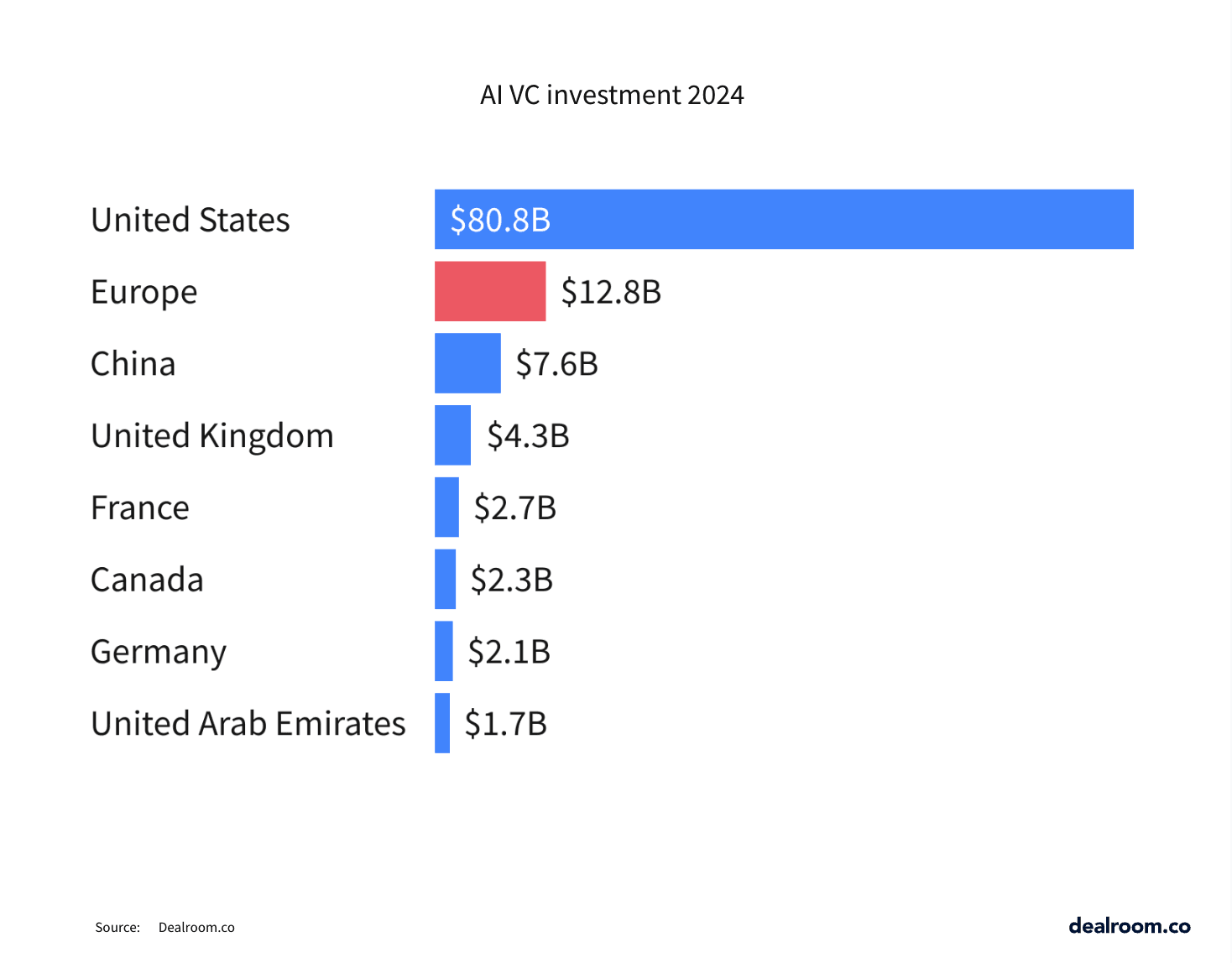
The Dealroom report also sheds light on a regional imbalance in AI funding. In 2024, a staggering 42% of all U.S. venture capital ($80.7 billion) went to AI startups, while Europe received only 25% ($12.8 billion) and the rest of the world secured 18%. China emerged as a key player, investing $7.6 billion in AI startups.

“In Europe, we have a bit of an innovators’ dilemma,” Wijngaarde explained. “We don’t want to replace what we have, which can lead to a less aggressive stance.”

image 72

Open Source AI: A Modest Growth Story 

Another emerging trend in AI investment is the rise of open-source AI projects. While startups building open-source AI raised 12% of total AI venture capital last year, the potential for this sector to expand remains significant, according to Dealroom. However, defining what qualifies as “open-source” is still a gray area. For instance, xAI’s Grok-2, though not open-source, would push the open-source percentage to 22% if included.

The emergence of alternatives like DeepSeek, which built an OpenAI rival for just $50, hints at a potential shift toward more cost-effective, open-source solutions.

Top VC Firms: Leading The Charge 

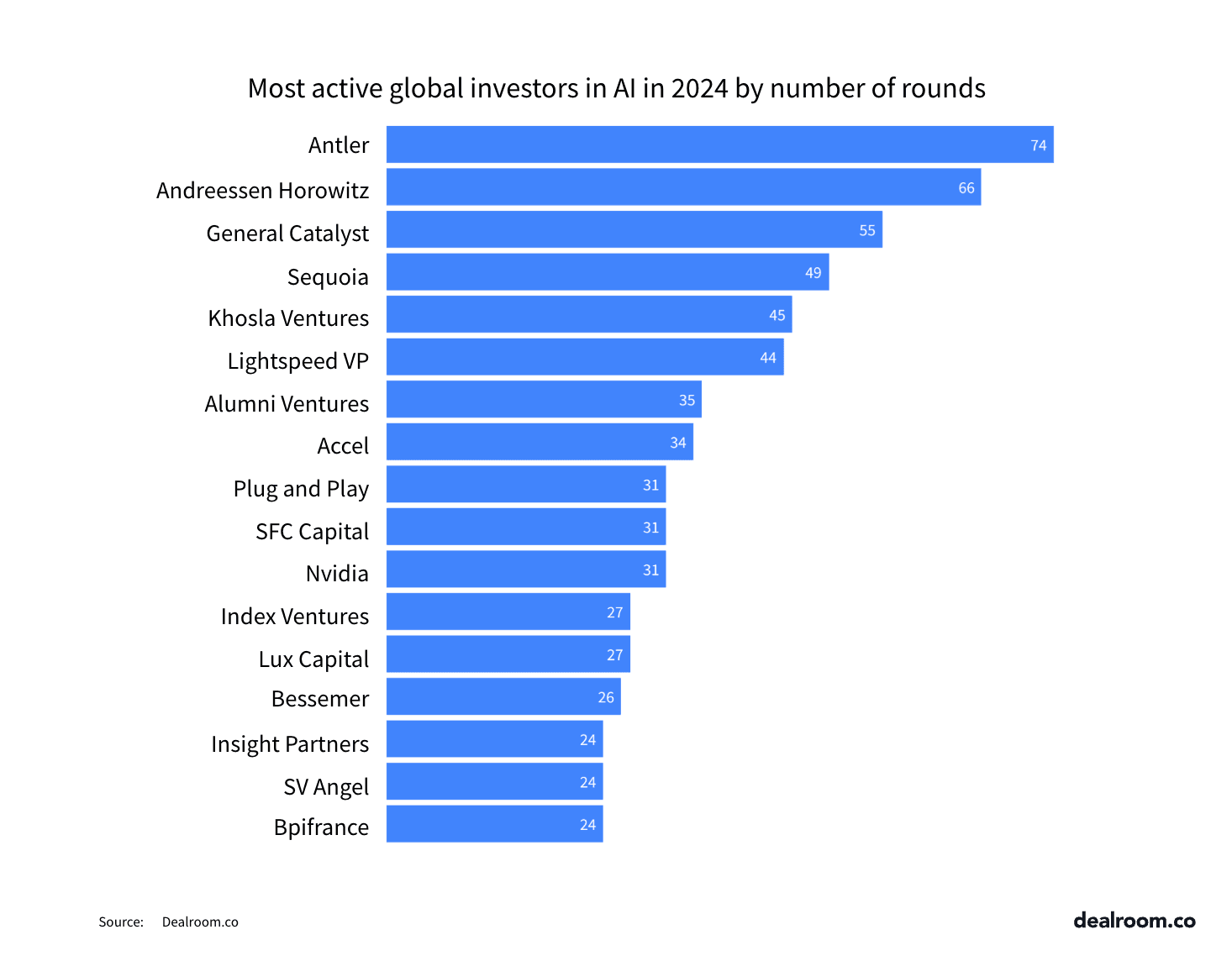
The most active venture capital firm in AI investment last year was Antler, followed by heavyweights like a16z, General Catalyst, Sequoia, and Khosla Ventures.

image 73

Looking Ahead: What’s Next For AI In 2025? 

As we move into 2025, the question remains: How will this AI funding boom evolve? Will the open-source movement gain more traction, or will the dominance of large language models and foundational models continue to attract the bulk of investment? With AI infrastructure still costly to build and operate, it’s clear that the landscape will keep evolving in exciting ways.

What’s certain is that AI remains a central pillar of innovation and investment, shaping the future of technology and business across the globe.

Why the UAE Is Becoming A Premier Destination For Medical Tourism

With a commitment to enhancing its healthcare offerings, the UAE has positioned itself as a leader in medical tourism, catering to a growing global demand. As countries focus on improving the health of their populations, the UAE stands out for its strategic investments in both healthcare infrastructure and its appeal to medical tourists.

According to Statista, the global medical tourism market was valued at $47 billion in 2024, with projections indicating it could exceed $111 billion by 2029. The UAE is setting the bar high, with innovative initiatives such as specialized portals for health tourists and streamlined entry processes for medical visitors.

Tailored Portals And Seamless Experiences

Abu Dhabi and Dubai have launched dedicated online platforms that streamline the process for medical tourists. These portals offer a range of services, including healthcare provider contact information, appointment bookings, hotel reservations, and local transportation. Dubai Health Authority (DHA) introduced the Dubai Health Experience (DXH) brand in 2016, aimed at making the city a global leader in health tourism. The platform offers a curated selection of top-tier treatments in fields such as dentistry, fertility, ophthalmology, and cosmetic surgery.

Meanwhile, in 2018, Abu Dhabi’s Department of Health (DoH) rolled out its own e-portal, showcasing a network of over 40 healthcare facilities that meet the stringent quality standards of the DoH’s JAWDA program. Visitors can explore nearly 300 treatment packages across specialties ranging from routine check-ups to complex surgeries.

Simplified Access With Specialized Permits

To further attract international patients, the UAE offers specialized entry permits for medical tourists and their companions. These permits, which can be single or multiple entries, are sponsored by medical institutions and processed by relevant authorities in the country. Dubai Healthcare City also introduced a new medical visa in January 2024, allowing treatment centers to apply for permits on behalf of patients for stays of up to six months. This move bolsters Dubai’s reputation as a medical tourism hotspot.

The city welcomed 674,000 medical tourists in 2022, generating $270 million in revenue. Wellness tourism is also booming in the UAE, with visitors spending $5.4 billion in 2022—almost double the amount spent in 2020.

Innovation At The Forefront

The UAE’s innovative spirit continues to propel its rise as a medical tourism hub. In 2024, HealthStay.io, the world’s first AI-powered medical tourism solution, launched in partnership with Dubai Health Experience. This startup, part of the Mohammed Bin Rashid Innovation Fund’s Accelerator Program, uses artificial intelligence to automate the medical tourism journey, including selecting treatments and booking appointments.

“The launch of HealthStay.io is a direct result of the support from DXH and DHA, helping us transform Dubai into a global healthcare tourism leader,” said Ruairi Tubrid, co-founder of HealthStay.io. Fatima Yousif Alnaqbi, MBRIF representative, emphasized the importance of accelerator programs in supporting innovative solutions that elevate the UAE’s standing as a center of excellence in healthcare.

Government Commitment To Healthcare Excellence

The UAE’s rapid growth in medical tourism is rooted in its consistent focus on healthcare improvement. Key strategies such as the Emirates Health Services Innovation Strategy 2023-2026 and the National Strategy for Wellbeing 2031 aim to enhance residents’ quality of life and elevate the nation’s healthcare offerings.

Compared to its Gulf Cooperation Council (GCC) counterparts, the UAE leads in healthcare expenditure growth. Projections from Alpen Capital estimate that healthcare spending will reach $30.7 billion by 2027, reflecting the nation’s ongoing dedication to strengthening its healthcare infrastructure. As a result, the UAE continues to attract international patients seeking top-tier medical services.

Salesforce Announces $500M Investment In Saudi Arabia To Boost AI Innovation

Salesforce, the U.S.-based software giant, revealed plans for a $500 million investment in Saudi Arabia, aimed at fueling the country’s AI sector and driving economic growth. The announcement was made on the first day of the LEAP 2025 tech conference in Riyadh.

As part of the expansion, Salesforce will launch its Hyperforce platform, in partnership with Amazon Web Services (AWS). This next-generation platform allows global customers to run workloads locally through a distributed public cloud infrastructure in Saudi Arabia.

In addition to technological innovation, Salesforce aims to upskill 30,000 Saudi nationals in AI and promote women’s participation in the workforce. The company is partnering with Princess Nourah University (PNU), the world’s largest women’s university, to provide AI-focused learning opportunities and workforce development for female students.

This investment aligns with Salesforce’s pledge at the Davos conference to expand its presence in the region, including the establishment of a new regional headquarters in Riyadh.

Growing Demand For AI In Saudi Arabia

The increasing adoption of Salesforce’s AI-powered digital labor platform, Agentforce, by businesses in Saudi Arabia signals a growing demand for AI-driven solutions. The company is also collaborating with key partners like Capgemini, Deloitte, Globant, IBM, and PwC to support digital growth in the country.

On the opening day of LEAP 2025, Saudi Arabia secured $14.9 billion in tech investments, further solidifying its position as a hub for digital innovation.

Salesforce stock rose by 1.4%, closing at $327.2 per share on February 10, 2025, with a market capitalization of $313.1 billion. The company ranks 158th on the Forbes 2024 Global 2000 list.

AI Chip Startup Groq Secures $1.5 Billion Investment From Saudi Arabia

Groq, a U.S.-based AI semiconductor startup, has secured a $1.5 billion commitment from Saudi Arabia to expand its advanced AI chip delivery in the country. The startup, founded by a former Alphabet AI chip engineer, specializes in AI inference chips that optimize speed and execute commands for pre-trained models.

Groq already has a partnership with Aramco Digital, the tech arm of oil giant Aramco, through which they developed a key AI hub in the region in December. The investment will fund the expansion of Groq’s data center in Dammam, with the startup having obtained the necessary licenses to export its chips despite U.S. export controls.

The announcement was made at Saudi Arabia’s LEAP 2025 event, where the country also secured $14.9 billion in AI investments. One of the technologies supported by the Dammam Center is Allam, an AI language model developed by the Saudi government that operates in both Arabic and English.

In August, Groq raised $640 million in a funding round led by Cisco, Samsung, and BlackRock, bringing its valuation to $2.8 billion.

U.S. Vice President Warns Europeans That Heavy AI Regulation Could Stifle Innovation

U.S. Vice President JD Vance warned European leaders on Tuesday that excessive regulation of AI could hinder its growth. He also criticized content moderation as “authoritarian censorship.” As AI evolves, the focus has shifted from safety concerns to geopolitical competition, with nations vying to lead the field.

At an AI summit in Paris, Vance affirmed that the U.S. intends to remain the AI leader, opposing the European Union’s stricter regulatory approach.

Key Takeaways

  • Excessive regulation may harm AI: Vance cautioned that heavy regulations could stifle AI innovation.
  • AI must remain free from bias: He emphasized that U.S. AI should not be used for authoritarian purposes.
  • GDPR compliance costs: Vance pointed to high compliance costs in Europe, especially for smaller companies.
  • U.S. supports fair competition: Vance affirmed that U.S. laws ensure a level playing field for all developers.

Vance warned that excessive regulation could stifle innovation, arguing that AI should remain free from ideological bias and not be used for authoritarian censorship. He criticized Europe’s GDPR for increasing legal costs for small firms and cautioned that stringent safety regulations could solidify the dominance of large tech companies, hindering new competitors. 

While the U.S. supports fair competition in AI, Vance emphasized that laws should prevent the entrenchment of market power. In contrast, European lawmakers passed the AI Act, facing pressure for lenient enforcement. French President Macron called for reduced red tape to boost AI growth, highlighting the growing divide in AI regulation between the U.S., China, and Europe. Vance leads the U.S. delegation at the summit, where nearly 100 countries, including China, India, and the U.S., are seeking common ground on AI policy.

French Wine And Spirits Exports Decline For Second Year In 2024 Amid Weaker Demand And Market Challenges

French wine and spirits exports experienced a second consecutive year of decline in 2024, as demand for premium products dropped and the industry grappled with lower prices, a softer Chinese market, and potential tariff threats, according to the Federation of Wine and Spirits Exporters (FEVS).

Key Essentials

  • Total exports: €15.6 billion ($17.5 billion), a 4% drop from 2023.
  • Volume: Steady at 174 million cases, but value hit hard in key markets, particularly in China.
  • China’s imports: Down 20%, accounting for the largest portion of the decline. Other markets like Singapore and Hong Kong also saw decreases of 25% and 12%, respectively, making up 90% of the overall drop.

French spirits exports were especially affected, falling 6.5% to €4.5 billion. This decline was largely attributed to China’s economic struggles and Beijing’s anti-dumping measures on European brandy, especially French cognac. Sales of cognac saw an 11% drop in value, although the volume only decreased by 1%, supported by restocking in the United States and precautionary purchases in light of fears of new U.S. tariffs on French wine.

The gap between the decline in value and the slight drop in volume is believed to reflect a shift toward younger, less expensive cognac. While this trend has impacted the overall value, it has kept volumes relatively stable.

Exports to the United States, which remains France’s largest export market, showed more resilience, with a 5% increase to €3.8 billion. Despite this growth, the wine sector saw a 3% drop in revenue, totaling €10.9 billion, largely driven by an 8% decline in Champagne sales.

Looking ahead, FEVS Chairman Gabriel Picard highlighted two major uncertainties for the upcoming year: the situation in China and the potential impact of U.S. tariffs. While economic fundamentals in the U.S. appear relatively stable, there are concerns about future tax increases. Regarding China, Picard praised efforts to support the Cognac sector but called for “concrete action” to ease trade tensions ahead of a planned visit from Prime Minister François Bayrou.

Novartis Acquires Blackstone’s Anthos Therapeutics For Up To $3.1 Billion To Strengthen Cardiovascular Portfolio

Swiss pharmaceutical giant Novartis has struck a deal to acquire Anthos Therapeutics, a biopharma company majority-owned by Blackstone’s drug development arm, for up to $3.1 billion. The acquisition is aimed at bolstering Novartis’ presence in the cardiovascular sector, a key focus for the company as its blockbuster heart failure drug Entresto faces patent expiration this year.

Founded in 2019 by Blackstone’s Life Sciences division and Novartis, Anthos was created to develop abelacimab, a promising treatment designed to prevent strokes and prevent recurring blood clots. This transaction underscores Novartis’ commitment to cardiovascular treatments, which is one of five critical therapeutic areas the company is prioritizing.

The deal, which is expected to close by mid-2025, marks a significant step in the evolving partnership between a major pharmaceutical company and private equity, a model that has gained traction in the industry. Novartis will pay an initial $925 million, with potential additional payments up to $2.15 billion, contingent on the successful development of the therapy.

This marks the largest sale of a majority-owned company by Blackstone’s Life Sciences division to date. In December 2023, Blackstone was exploring the sale of Anthos, and the current deal brings the partnership to a close.

Abelacimab is part of a new class of anticoagulants known as factor XI inhibitors, designed to potentially replace established blood thinners like Eliquis (Bristol Myers-Squibb and Pfizer) and Xarelto (Johnson & Johnson and Bayer), both of which are billion-dollar sellers. Other major companies in the factor XI race include Bristol-Myers Squibb and Johnson & Johnson, who are advancing a similar drug candidate, as well as Merck & Co, which is progressing with a mid-stage development candidate. Bayer, meanwhile, faced a setback in 2023 with its factor XI drug.

Nicholas Galakatos, Chairman of Anthos’ board and Global Head of Blackstone Life Sciences expressed pride in the firm’s role in launching and growing Anthos, adding, “We believe abelacimab has the potential to be a leader in the new class of Factor XI anticoagulants and are pleased to have Novartis as a committed partner to advance the development and commercialization of abelacimab for millions of patients at risk of strokes.”

Anthos is currently conducting multiple Phase 3 clinical trials, with data expected in the second half of 2026. While Novartis holds a small minority equity stake in Anthos, the company has not disclosed the exact size of this investment.

Uol
The Future Forbes Realty Global Properties
eCredo
Aretilaw firm

Become a Speaker

Become a Speaker

Become a Partner

Subscribe for our weekly newsletter