Breaking news

Introducing OpenAI’s GPT-4.5: What You Need To Know

OpenAI has just unveiled GPT-4.5, its most powerful language model to date, marking a significant leap forward in AI technology. CEO Sam Altman described the experience as akin to conversing with a thoughtful human, thanks to the model’s enhanced ability to interpret emotional nuances and social cues.

Key Advancements

  • Emotional Nuance: GPT-4.5 is engineered to understand complex emotional cues, resulting in more accurate and contextually aware responses.
  • Improved Accuracy: The new model exhibits a substantially lower rate of errors and misleading outputs compared to earlier versions.
  • Enhanced Performance: Whether it’s writing, coding, or solving practical problems, GPT-4.5 outperforms its predecessors with greater computational efficiency—over 10 times more efficient than GPT-4.

Access And Availability

Currently, GPT-4.5 is exclusive to ChatGPT Pro subscribers at $200 per month, ensuring the highest level of performance for elite users. Sam Altman mentioned that a simultaneous release to ChatGPT Plus users wasn’t feasible due to a temporary shortage of GPUs. However, OpenAI plans to deploy tens of thousands of new GPUs next week, which should eventually extend access to Plus subscribers, priced at $20 per month.

Industry Impact And Future Prospects

Launched just under two years after GPT-4, GPT-4.5 arrives on the heels of OpenAI’s recent introduction of “Operator”—an AI assistant that can manage everyday tasks like ordering groceries or booking tickets. This latest release not only solidifies OpenAI’s leadership in the AI arena but also positions it for further growth. Rumors of a new funding round hint at a potential valuation surge to an astounding $340 billion, making OpenAI a heavyweight in a competitive field where rivals like Elon Musk’s xAI and Anthropic are making their own bids for market share.

As AI technology continues to evolve at breakneck speed, GPT-4.5 sets a compelling new benchmark for what’s possible in digital communication and problem-solving—ushering in a future where intelligent, emotionally aware AI becomes an indispensable part of our everyday lives.

In related tech news, Nvidia’s impressive AI-driven earnings further highlight the advancing AI landscape.

Bitcoin Plummets Below $80,000 Amidst Market Turmoil

Recently, Bitcoin’s value dipped below the $80,000 mark, marking its lowest point since early November. This downturn follows significant sell-offs across the cryptocurrency market and has nearly erased Bitcoin’s post-election gains.

Key Highlights

  • As of early Friday, Bitcoin’s price stood at $78,949 after an 8.5% drop over 24 hours.
  • Within the past week, Bitcoin has seen a nearly 20% decrease in value.
  • Ethereum, the second-largest cryptocurrency, fell by over 11%, reaching about $2,100.
  • XRP, BNB, and SOL cryptocurrencies experienced 9.2%, 7.3%, and 9% drops respectively in the previous day.

The cryptocurrency market is also reacting to President Donald Trump’s economic policy on new tariffs. Bitcoin has dropped 27.3% from its all-time high of $109,114 recorded on January 20, signaling intense volatility.

Nvidia’s AI Surge: Q4 Earnings, Next-Gen Chips, And A Bold Vision For The Future

Nvidia has once again outperformed expectations, riding high on the relentless demand for artificial intelligence. In its Q4 earnings report, the chipmaker delivered a stunning 78% revenue surge, with quarterly revenue hitting $39.33 billion—well above the $38.05 billion forecast. For the full fiscal year, revenue skyrocketed 114% to an impressive $130.5 billion, underscoring Nvidia’s dominant position in the AI revolution.

Looking ahead, Nvidia is projecting first-quarter revenue of around $43 billion, give or take 2%, a clear signal that the growth momentum is set to continue. A major driver behind this performance is the rapid ramp-up of Nvidia’s next-generation AI processor, Blackwell. CFO Colette Kress described the anticipated sales “ramp” for Blackwell as the fastest in the company’s history, with $11 billion already recorded in Q4—primarily led by large cloud service providers, which now account for over 90% of Nvidia’s total revenue.

Nvidia’s strategy is shifting from merely training AI to powering inference, where its chips process real-time AI applications. “Long-thinking, reasoning AI can require 100 times more compute per task compared to one-shot inferences,” Kress noted, highlighting that the vast majority of compute power currently deployed is for inference tasks. CEO Jensen Huang added that while next-generation AI models might demand millions of times the current capacity, the real challenge is in deploying the right chip—not just designing one.

Beyond AI, Nvidia continues to diversify its portfolio. The company’s data center revenue, which reached $35.6 billion—up 93% from a year ago—remains the star of its business, even as its gaming division reported a modest $2.5 billion in sales, down 11% year-over-year. Meanwhile, automotive sales climbed 103% to $570 million, and Nvidia’s networking segment contributed $3 billion, despite a slight 9% decline compared to last year.

In a show of confidence, Nvidia has returned substantial value to shareholders, repurchasing $33.7 billion in shares in fiscal 2025. This bold financial maneuver, combined with strong operational performance, sets a promising tone for Nvidia’s continued dominance in the AI space well into 2025 and beyond.

Nvidia’s robust Q4 results and ambitious forward guidance highlight a clear message: as the world leans further into AI, Nvidia is not only ready to meet that demand but to redefine the very architecture of the digital future.

Marios Georgiou: Illuminating Cypriot Gymnastics On A Continental Stage

In an electrifying moment for Cypriot sports, Marios Georgiou has clinched the title of Male Gymnast of the Year, following a vigorous vote organized by European Gymnastics. This victory underscores Marios’s ongoing dedication and success, resonating deeply within the gymnastics community—not just in Cyprus, but across Europe.

According to the Cyprus Gymnastics Federation, the prestigious accolade was earned through the support of 26,260 votes, amounting to 50.6% after just six days of voting. The federation conveyed their pride, stating, “Marios continues to make us proud with his distinctions and make history in gymnastics!”

Echoing this sentiment, the Cyprus Sports Organisation extended its own congratulations, reinforcing Marios’s impact on Cypriot sports: “Congratulations to Marios Georgiou who continues to make history and leave his imprint on Cypriot gymnastics!”

Further commendations came from President Nikos Christodoulides, who highlighted the significance of Marios’s achievements. “His great distinctions, such as being declared European champion in the combined individual at the European Championships in Rimini, Italy, in 2024, as well as ranking sixth at the Olympic Games in Paris, have brought him to the highest podium in Europe,” the President articulated in his statement.

With athletic prowess like Marios Georgiou’s, Cyprus continues to fortify its place on the world map, heralding a bright future for the island’s sporting landscape.

Europe’s Talent Divide: Northern Capitals Dominate As Southeastern Regions Lag Behind

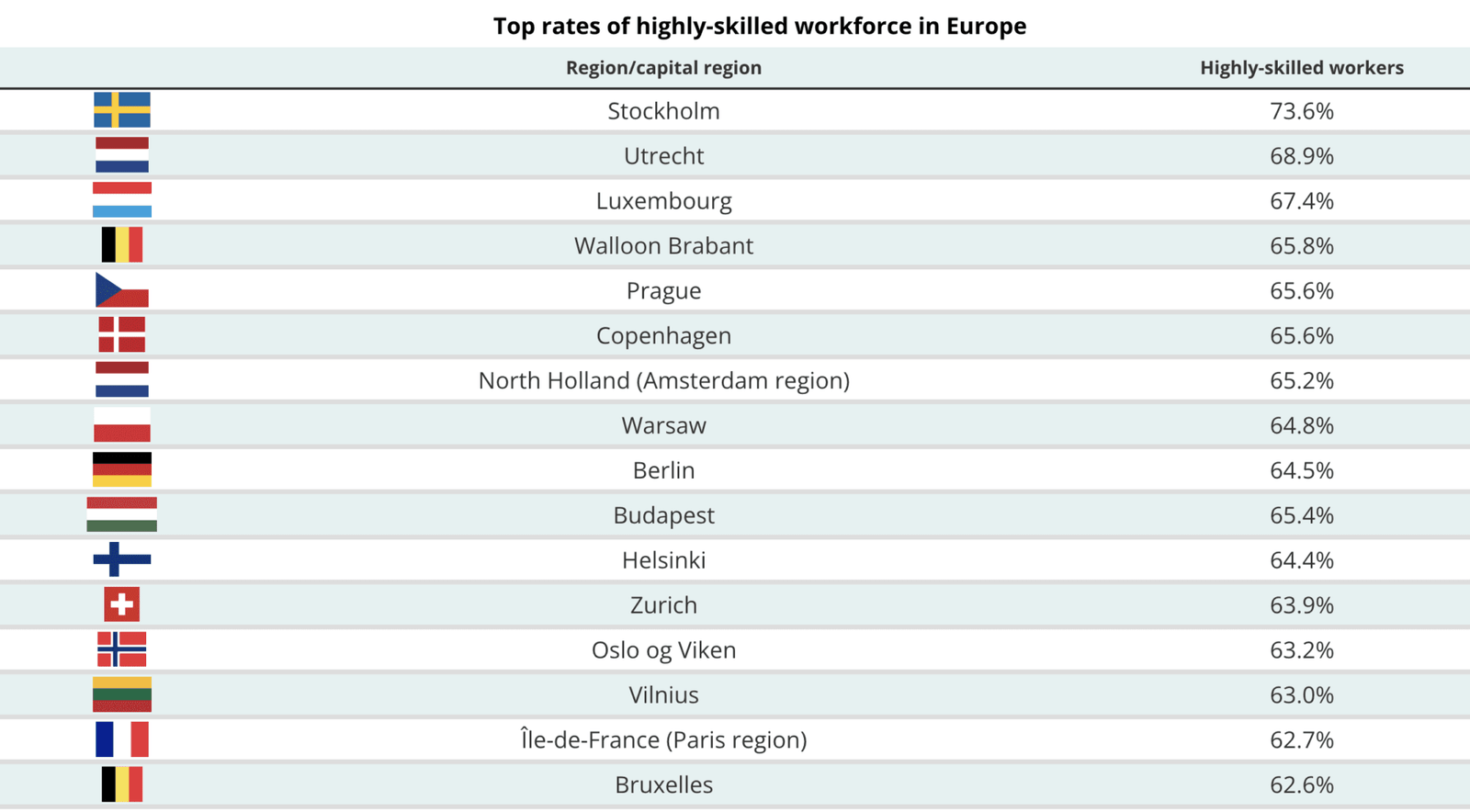
Europe’s high-skilled workforce is showing a stark geographic split. According to Eurostat, about 80 million EU workers—roughly 44% of those aged 25 to 64—are highly skilled, encompassing managers, technicians, and knowledge professionals. However, the distribution of this talent is anything but uniform.

Across the continent, capital and major urban centers are the magnets for top-tier talent. Northern European capitals are leading the charge: Stockholm tops the list with a remarkable 74% share of highly skilled workers, followed by Utrecht at 69%, Luxembourg at 67%, and clusters in Belgium’s Brabant Wallon, Copenhagen, and Prague, all hovering around 66%. These regions are thriving hubs of innovation and expertise, where robust economic ecosystems continue to attract and nurture a competitive workforce.

image 76

In contrast, rural areas and former industrial heartlands—particularly in southeastern Europe—are struggling to keep pace. In 24 EU regions, less than one-third of the workforce is highly skilled. Regions such as Sterea Elláda (Central Greece) report a mere 21.8%, while the Ionian Islands and Romania’s Sud-Muntenia stand at 22.3% and 22.8% respectively. This uneven distribution highlights significant challenges for economic development and competitiveness in these areas.

The data underscores a critical takeaway for policymakers and business leaders alike: the future of Europe’s economic landscape will be heavily influenced by the ability to bridge this talent gap. As northern capitals continue to lead in innovation and skill, southeastern regions face an urgent need for strategic investments and initiatives aimed at elevating their human capital.

In a rapidly evolving global economy, understanding and addressing this talent divide is not just an economic imperative—it’s a blueprint for sustainable growth and regional balance across Europe.

Coffee’s Bitter Future: Trouble Is Brewing For Your Morning Latte

Coffee, the world’s second-most traded commodity, is hitting record highs—and it’s not just an abstract market shift. As coffee futures soar to unprecedented levels, consumers might soon face a bitter reality at the café counter. Rising bean prices, driven by severe weather and supply chain disruptions, are setting the stage for a potential price shock that could make your daily latte far more expensive.

In recent years, the cost of coffee has been on an upward trajectory. The COVID-19 pandemic pushed futures prices higher, and a series of harsh droughts in Brazil and Vietnam have further strained supplies. In December, Brazil—a major exporter of prized arabica beans—was hit by its worst drought in years, sending prices skyrocketing. Meanwhile, robusta beans, often used in instant coffee, have reached their record highs. The consequence? Coffee prices are now more than double their 2023 peak, a trend that promises to tighten consumer budgets even further.

AD 4nXf4PoxRRSiI94DXwQ oRak1yWpj4I4hxKJpNFjaOlU b0rP6vsbwaQeWv6gKZG7i5vDCQmFhb47ZnVBU6lahTBQMjxNT XPQBv2dZd2QRTKwzLpcJd bFH9YdPViHK2aDFmdV Iw?key=DPKiTGBooqSZAXffvaL9mw2r

This surge in commodity prices directly impacts grocery shelves. Studies from the US Department of Agriculture have long shown that every $0.10 rise in coffee futures can immediately translate to a $0.02 hike in the retail price of ground coffee. With the consumer price index already reflecting a 3% increase over the past year—and instant coffee prices up by 7%—the financial pinch is becoming increasingly palpable.

For cafés, the dynamics are a bit different. While the cost of beans is critical, labor costs dominate the price of a latte. Industry giants like Starbucks can mitigate these fluctuations through multi-year contracts and hedging strategies, ensuring they have sufficient supplies on hand. Smaller roasters, however, are far more vulnerable to these swings. Some are even forced to adjust their flavor profiles, blending in lower-quality robusta or even mixing in corn and rice to stretch dwindling supplies—a phenomenon some have dubbed “flavorflation.”

The challenges extend beyond economics. Environmental concerns loom large, as the climate crisis wreaks havoc on coffee harvests worldwide. Extreme temperatures not only shrink yields but also invite diseases like coffee leaf rust, pushing production into decline. For many consumers, this uncertainty has led to genuine anxiety. As one coffee buyer put it, “I catch myself at cup four, wondering if there’ll be any coffee left at all.”

And then there’s the curious case of Dr. Honeybrew, a coffee fortune teller in Manhattan’s East Village. Gazing into his espresso cup, he quipped, “If the Trump family brings a cocker spaniel to the White House, it will be a very good omen for coffee.” While his prediction may bring a smile, it underscores a deeper truth: without decisive climate action and sound policy, the future of our favorite brew hangs in the balance.

Ultimately, the brewing crisis in coffee markets is not just a tale of rising prices—it’s a warning. Without aggressive measures to combat climate change and secure sustainable agricultural practices, the coffee crisis may not be a temporary hiccup but a permanent shift in the way we consume our daily cup of joe.

Abu Dhabi’s Financial Hub Booms: 32% Growth In Company Registrations 

Abu Dhabi Global Market (ADGM) is on a roll, reporting a remarkable 32% surge in company registrations last year. This robust growth highlights the increasing appeal of Abu Dhabi as a strategic base for firms looking to expand their operations across the region and deepen ties with its formidable wealth funds.

Key Growth Drivers

Economic rebound post-pandemic and a business-friendly regulatory environment have set the stage for this surge. Abu Dhabi, home to 90% of the UAE’s oil reserves, is aggressively diversifying its economy. Leveraging vast sovereign wealth—managing nearly $2 trillion—ADGM is capitalizing on this momentum to boost non-oil growth.

ADGM’s latest figures are equally impressive on the asset management front. The financial center now boasts a three-fold jump in assets under management in 2024, with 134 asset and fund managers operating 166 funds as of December, compared to over 1,800 company registrations in 2023.

Regional Magnet For Investors

The influx of firms isn’t limited to traditional banks and hedge funds. The region’s financial hub is drawing in family offices, venture capital firms, and even crypto traders. Notable players such as BlackRock, General Atlantic, and a new family office branch from Apollo Global founder Leon Black have all set up shop, underscoring the strong investor confidence in Abu Dhabi’s business landscape.

Comparative Advantage In The Region

While ADGM is modest in size compared to global giants like New York or London, its performance is notable. The center’s success comes on the heels of a similar boost at the Dubai International Financial Centre (DIFC), which reported a 55% increase in operating profit for 2024, reaching 1.33 billion dirhams ($362.17 million). This trend reflects a broader regional shift as financial hubs in the UAE benefit from strong inflows of companies and heightened demand for commercial real estate.

Looking Ahead

As the UAE continues to position itself as a premier destination for global business, the momentum at ADGM is a clear indicator of the region’s transformative potential. With regulatory reforms and a pro-business environment driving growth, Abu Dhabi’s financial ecosystem is poised for even greater expansion in the years ahead.

In a dynamic market where every advantage counts, ADGM’s 32% growth in company registrations underscores the strategic allure of Abu Dhabi as a launchpad for regional and international business success.

MENA M&A Boom: Record Deal Value And Cross-Border Surge In 2024

The MENA region is riding a wave of renewed merger and acquisition activity, with deal volumes and values reaching record highs in 2024. According to the latest EY MENA M&A Insights report, the region executed 701 deals—up 3% from 2023—totaling an impressive $92.3 billion, marking a 7% increase year-over-year. In particular, the GCC region led the charge with 580 deals worth $90 billion, underscoring its dominance in the market.

Cross-Border Deals Drive The Momentum

Strategic policy shifts, capital market reforms, and a robust drive to attract foreign investments have fueled a surge in cross-border deals, which now account for 52% of total deal volume and a staggering 74% of the overall value. EY’s Brad Watson highlighted that companies are not only looking to grow but also diversify their operations, tapping into larger, emerging markets through these transnational transactions.

Key sectors powering this momentum include insurance, asset management, real estate and hospitality, power and utilities, and technology. Watson emphasized that this cross-border dynamism is enabling MENA companies to forge stronger relationships with partners in Asia and Europe, thereby expanding their market reach.

Landmark Deals Signal Strong Investor Confidence

The UAE, in particular, reported the region’s largest M&A deal of 2024—a monumental $12.4 billion acquisition of Truist Insurance by a consortium including Clayton Dubilier & Rice, Stone Point Capital, and Mubadala Investment. This deal is a clear signal of robust investor confidence, further bolstered by Saudi Aramco’s $8.9 billion stake acquisition in Rabigh Refining and Petrochemical Company, and a $8.3 billion deal for a 60% stake in Zhuhai Wanda Commercial Management Group by PAG, Mubadala, and ADIA.

Preferred Destinations And Sectoral Trends

The UAE continues to be a magnet for inbound transactions, capturing 96 deals worth $7.6 billion—67% of the total deal value—thanks to its favorable business environment and strategic focus on technology sectors like AI, cybersecurity, and digital transformation. The landmark $1.5 billion acquisition of Abu Dhabi’s Group 42 by Microsoft underscores the deepening ties between the UAE and the United States.

Saudi Arabia also remains a hotspot, with significant combined deal volumes alongside the UAE. In 2024, the U.S. emerged as the top target for MENA investors, attracting 41 deals valued at $19.9 billion, while Morocco, Qatar, Bahrain, Egypt, and Kuwait also featured prominently among both target and bidding countries.

A New Era For MENA Business

In 2024, M&A activity in the MENA region has not only rebounded but also accelerated, driven by a blend of strategic reforms and an increasingly interconnected global market. As regional players leverage cross-border opportunities to expand and diversify, the MENA landscape is set to become an even more dynamic arena for growth and investment.

This resurgence in M&A activity is a clear testament to the region’s evolving economic landscape, where ambition meets opportunity on a scale that is reshaping business as usual.

Ramadan 2025 In The UAE: Unwrapping Sacred Traditions And Modern Customs

Ramadan 2025 is set to begin on Saturday, March 1—a time when the UAE and millions of Muslims worldwide will pause to reflect, fast, and reconnect with their spiritual roots. This holy month, marking the Quran’s revelation to the Prophet Muhammad (PBUH) transforms daily life into a rhythm of prayer, charity, and mindful self-discipline.

Key Dates And Rituals

Ramadan’s exact start will be confirmed by the UAE’s moon-sighting committee, but if March 1 holds, the fast will continue until the crescent’s reappearance signals Eid Al Fitr on either March 29 or 30. Eid, the festive culmination of Ramadan, ushers in a time of joyous reunions with family and friends and marks the beginning of Shawwal, the tenth month in the Islamic calendar. Remember, unlike the Gregorian calendar, the Islamic lunar cycle advances roughly 11 days each year, shifting these significant dates annually.

Daily Practices And Cultural Significance

During Ramadan, Muslims abstain from food, drink, and smoking from dawn until sunset, channeling their energy into extra prayers—most notably, the tarawih—and acts of kindness. As dusk falls, the fast is broken with iftar, traditionally starting with dates and water, followed by an elaborate meal that brings communities together. In some regions, antique cannons once signaled the end of the day’s fast—a practice that echoes through history even as modern rituals take shape.

A unique facet of Ramadan is the role of the masaharati, a traditional dawn caller who would wander the streets with a flute or drums to wake people for the pre-dawn meal, a practice that still survives in parts of the Arab world.

Read: When Will Ramadan 2025 Start? UAE Work And School Hours, Public Transport Adjustments And More

Charity And Social Responsibility

Central to Ramadan is zakat al-Fitr, a mandatory charitable donation that every self-supporting Muslim must pay before the Eid prayer. This act of giving ensures that those in need can partake in the celebrations, reinforcing the month’s core values of compassion and communal support.

Guidelines For Visitors

If you’re visiting the UAE during Ramadan, it’s important to be culturally aware. While non-Muslims are not required to fast, respecting local customs is key. Public consumption of food, drink, or smoking is frowned upon during daylight hours. Many establishments adjust their hours, and designated areas might be available for non-fasting guests. When invited to an iftar or visiting a mosque, modest attire and greetings like “Ramadan Mubarak” or “Ramadan Kareem” are appreciated gestures of respect.

As Ramadan 2025 approaches, these traditions and practices offer a window into the rich cultural and spiritual tapestry of the UAE. Whether you’re a participant or an observer, understanding these customs can enrich your experience during this sacred time.

DeepSeek Disrupts Home Appliances: China’s AI Revolution Hits The Living Room

China’s AI breakthrough is now entering the home, as Hangzhou-based DeepSeek’s advanced language models make their way into everyday appliances. Home appliance giants like Haier, Hisense, and TCL Electronics have recently announced plans to integrate DeepSeek’s AI into their products—transforming ordinary devices into next-generation smart appliances.

DeepSeek has already shaken up the AI landscape this year with models that rival Western systems in performance at a fraction of the cost. This achievement is fueling national pride and is seen as a clear rebuttal to U.S. efforts to curb China’s technological progress. DeepSeek founder Liang Wenfeng has received high honors from Chinese authorities, and the company is gearing up to launch its next-generation R2 model, following the success of its R1 inference system.

The impact is already tangible. Beyond just adding voice command features, DeepSeek’s technology promises to deliver unmatched precision. Independent analyst Liu Xingliang explained that a robotic vacuum cleaner equipped with DeepSeek-R1’s semantic analysis could intelligently navigate obstacles. “The device will be able to understand complex instructions like, ‘Gently polish the hardwood floor in the master bedroom, but avoid the Lego bricks,’” Liu said.

As DeepSeek’s AI models continue to gain traction, they’re set to redefine the smart appliance market—bringing a new level of efficiency and sophistication to everyday tasks. The technology not only promises to enhance user experience but also reinforces China’s growing influence in the global AI arena.

The Future Forbes Realty Global Properties
Uol
Aretilaw firm
eCredo

Become a Speaker

Become a Speaker

Become a Partner

Subscribe for our weekly newsletter