Breaking news

Cyprus Faces Democratic Headwinds: A Closer Look At The 2024 Global Democracy Index

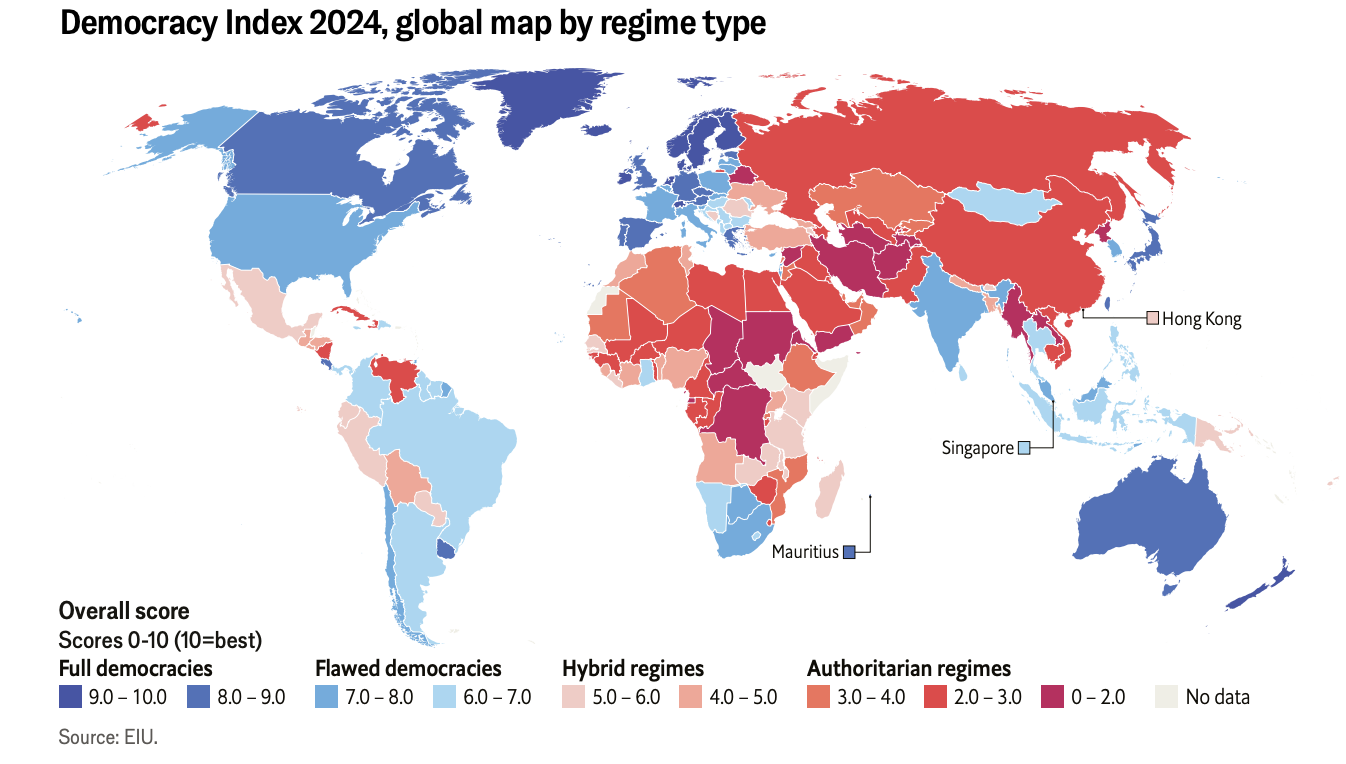
Cyprus has slipped three places to rank 40th out of 167 countries in the 2024 Global Democracy Index, a stark signal of the challenges facing modern democracies worldwide. Developed by the Economist Intelligence Unit, the index classifies Cyprus as a “flawed democracy”—a label shared with nations like Malta, France, the US, Israel, and Serbia. While Cypriots enjoy robust electoral processes and civil liberties—with scores of 9.17 and 8.82, respectively—there are glaring weaknesses. Cyprus’ functioning of government languishes at just 5.36, the lowest among the top 50 nations, reflecting persistent gridlock, corruption, and a growing disconnect between elected officials and the public.

The Anatomy of Democratic Decline

The index, which evaluates countries across five dimensions—electoral process and pluralism, functioning of government, political participation, political culture, and civil liberties—reveals that despite high scores in voting and individual rights, Cyprus faces significant hurdles in governmental performance. Experts warn that outsourcing decision-making to non-elected bodies, from central banks to courts, has further eroded public trust. As citizens feel increasingly disenfranchised, confidence in democratic institutions continues to wane, casting doubts on the ability of traditional systems to deliver effective governance.

Global Context and Regional Comparisons

The broader global picture is equally concerning. Out of 167 countries, 83 registered declines in democratic performance in 2024, while only 37 showed improvement. With over 39% of the world’s population now living under authoritarian regimes—a figure on the rise—many advanced democracies are struggling to meet citizens’ expectations. Western Europe, despite boasting the highest average scores and a quick recovery to pre-pandemic levels, is not immune. Recent elections across the region have highlighted a backlash against incumbents, as voters increasingly lean towards anti-establishment and populist parties.
AD 4nXcTXygFTP clIg6AKQ4a35wFU21c9PmCBBAECsQr5KDclr SbOX9eNYnXrIkr2rQMQ VHqsYIuJ4p7Kf4HMwLG5jYvvyLH03d u2ifIY 6EEt740q9Do1jvsa67OZ7fAvBWUf99?key=9 bK7ve2dSdW0AehbAmSWiQS

Norway, New Zealand, Sweden, Iceland, and Switzerland continue to set the gold standard as “full democracies,” while at the opposite end, conflict-ridden and authoritarian states like Afghanistan, Myanmar, North Korea, the Central African Republic, and Syria illustrate the extremes of democratic decay.

Implications for Cyprus

For Cyprus, the numbers are a mixed bag. With an overall score of 7.38—down three places from last year—and a rank of 22nd among the 27 EU member states, the country excels in electoral processes but lags in effective governance. This imbalance could further undermine public trust, especially if political leaders fail to engage citizens meaningfully in decision-making processes. The report underscores that formal democratic institutions alone are insufficient; a vibrant, responsive democracy demands an active, engaged electorate and leadership that genuinely addresses the concerns of its people.

Looking Forward

The 2024 Democracy Index serves as a wake-up call: while Cyprus retains strengths in ensuring free and fair elections, urgent reforms are needed to enhance governmental performance and restore public confidence. As the global democratic fabric continues to fray—with more than one-third of the world’s population under authoritarian rule—the challenge for Cyprus is clear. Addressing inefficiencies, increasing transparency, and fostering genuine citizen participation are not just ideals but imperatives for a resilient future.

Cyprus’ democratic journey, much like its economic and technological endeavors, will depend on its ability to evolve and meet the expectations of a modern society. In a rapidly changing world, ensuring that democracy delivers tangible benefits to citizens is the ultimate measure of success.

Female Leadership On The Rise: UK Boards Set A New Diversity Record

The UK is experiencing a surge in female representation on corporate boards, yet the number of female chief executives among the 100 biggest listed firms has recently dipped to fewer than 10, highlighting a nuanced picture of progress in gender diversity.

According to the government-backed FTSE Women Leaders Review, women now hold an all-time high of 43.4% of board seats across FTSE 350 companies—up from 42.1% in 2023. Among the 100 largest companies, female board representation has climbed to 44.7%, compared to 42.6% last year. Sponsored by Lloyds Banking Group and KPMG, the report reveals that women occupy 1,275 board roles and 6,743 leadership positions (35% of total roles) at these companies, placing the UK second only to France among G7 nations—France boasts 45.4% representation, bolstered by quota policies.

However, the progress comes with a caveat: the number of female chief executives in the FTSE 100 has slightly declined, with only 19 women at the helm compared to 20 in 2023. The current female FTSE 100 CEOs include prominent figures such as Emma Walmsley at GSK, Jennie Daly at Taylor Wimpey, Amanda Blanc at Aviva, Debra Crew at Diageo, Liv Garfield at Severn Trent, Louise Beardmore at United Utilities, Margherita Della Valle at Vodafone, Milena Mondini at Admiral Group, and Allison Kirkby at BT. Additionally, Stella David, chair of Entain, has stepped in as interim chief executive following Gavin Isaacs’ unexpected departure.

Minister for Investment Poppy Gustafsson summed up the challenge, stating, “Today’s report shows that while the momentum is with us, we have so much further to go. I know from founding my own business how strong female voices inspire positive change throughout an organisation, bringing new ideas and adding greater value.”

At a recent London event, business leaders, ministers, and industry experts gathered to discuss how these trends are fueling a more dynamic economy. Chancellor Rachel Reeves stressed, “The UK is leading the charge for gender equality in boardrooms, but we cannot rest on our laurels. We must break down the barriers that stop many women from reaching top leadership positions.”

As the conversation continues, the government is working closely with businesses to encourage greater female representation in key roles, such as company chairs and CEOs. Despite the slight dip in female FTSE 100 CEOs, the overall trajectory points toward a more inclusive, forward-thinking future in British corporate leadership.

DeepSeek Disrupts AI: Nvidia Faces New Challenge From Bootstrapped Models

DeepSeek has burst onto the scene, shaking up the AI landscape and raising fresh questions for tech giants like Nvidia. After the release of its latest model, DeepSeek-R1, the startup briefly dethroned OpenAI’s ChatGPT as the most downloaded free app on Apple’s App Store—a signal that innovation in AI might soon run on leaner, more efficient models.

A New Paradigm In AI Model Building

DeepSeek’s rapid rise has rattled investors and shifted market sentiment. As Nvidia’s shares tumbled more than 15% in a single day, the spotlight turned to the notion that advanced AI systems might be built with far less compute power than previously assumed. “On one hand, the DeepSeek approach showed that you can optimize your model-building process to require much lower compute power. That has a negative impact on Nvidia,” noted Mohamed Elgendy, co-founder and CEO of enterprise AI platform Kolena. This new wave of bootstrapped foundational models is poised to democratize AI development, potentially expanding the field far beyond the exclusive circle of tech giants.

Nvidia’s Robust Performance Amid Growing Headwinds

Despite the recent shock from DeepSeek’s emergence, Nvidia remains a powerhouse, with its Q4 earnings beating analyst expectations—revenue rose 78% to $39.33 billion, and full fiscal-year revenue surged 114% to $130.5 billion. The company now projects first-quarter revenue of about $43 billion, signaling continued growth driven by its flagship data center business, which now accounts for over 90% of total revenue. Meanwhile, Nvidia’s next-generation AI processor, Blackwell, is experiencing a record ramp-up, with sales already reaching $11 billion in Q4.

However, the AI chip market faces a new twist. CFO Colette Kress explained that “long-thinking, reasoning AI can require 100 times more compute per task compared to one-shot inferences,” highlighting the ever-growing demand for robust infrastructure. CEO Jensen Huang further emphasized that while next-gen models might require astronomical computing capacity, the real challenge lies in deploying them effectively.

Market Competition And Margin Pressures

The competitive dynamics are evolving rapidly. Amr Awadallah, CEO of enterprise AI agent company Vectara, warns that DeepSeek’s lean model-building approach could trigger significant margin compression for AI developers. “Revenue across the industry will continue to grow, but the profit margins for these large AI enablers may shrink considerably,” he said. Investors are already wary, with recent reports of Microsoft scaling back its AI data center expansion, despite its commitment to an $80 billion spend.

Meanwhile, DeepSeek’s performance isn’t without its caveats. Testing reveals that its R1 model hallucinates at a rate of 14.3%—substantially higher than the roughly 2% seen with GPT-4. Yet, industry experts like Elgendy see this as the early phase of a broader trend. “We were operating under the assumption that foundation models require massive resources to build. With DeepSeek, we’re seeing a more efficient approach that could 10x the number of builders and perhaps 100x the number of users,” he projected. This shift could lead to a proliferation of domain-specific models in sectors like healthcare, finance, and research.

A New Era In AI Infrastructure

While Nvidia faces headwinds from these innovative, lower-cost models, it’s clear that competition will only intensify. As the market adjusts to this new paradigm—where traditional, resource-intensive models give way to agile, bootstrapped alternatives—the landscape of AI infrastructure is set for a profound transformation. “The market responded to R1 as if AI was finished,” Huang remarked in a recent pre-taped interview. “It’s exactly the opposite—this is just the beginning.”

As AI continues to evolve, the companies that can adapt to these shifting dynamics and maintain sustainable margins will emerge as the true winners. DeepSeek’s rise is not just a challenge for Nvidia; it’s a harbinger of a more democratized, competitive future in AI development.

Green Monday 2025: Cyprus Embraces Tradition And Renewal

Green Monday marks a turning point in Cyprus as the island gears up for the beginning of Lent on March 3, 2025. This cherished day—akin to Greece’s Clean Monday—ushers in a season of fasting, reflection, and cultural celebration, where locals renew their spirits and connect with centuries-old traditions.

A Time-Honored Ritual Reinvented

Historically, Green Monday signaled the end of Carnival and the start of Lent, a period steeped in spiritual purification. Today, Cypriots observe this day by abstaining from food, drink, and other indulgences from dawn until sunset. It’s a call for inner cleansing, prompting believers to enter Lent with a pure heart and clear intentions. Traditional practices, such as the preparation of ‘lagana’—a special type of unleavened bread with ancient biblical roots—underscore the day’s significance.

Traditions That Define A Culture

On Green Monday, the atmosphere transforms as communities gather for picnics and prayer, and children take to the skies with kites—a time-honored symbol of letting go and starting afresh. Families often venture into the countryside to savor the fresh air and partake in outdoor activities, while the creation of ‘Lady Lent’ (Kyra Sarakosti) by children adds a playful touch to the solemnity of the day.

Traditional culinary delights also take center stage. Signature dishes such as octopus prepared in white sauce (‘Xtapodi Krasato’), tarama salad, semolina pudding, and ‘Mydopilafo’ reflect the region’s rich gastronomic heritage, reserved exclusively for this special occasion.

A Brief Historical Snapshot

Green Monday’s roots run deep. As early as the 4th century, Christians embraced fasting, and by the 5th to 12th centuries, evolving religious practices allowed for a midday break in the fast. Despite the passage of time—and even amidst modern challenges such as recent violent events—the spirit of Green Monday remains unbroken, serving as a reminder of both renewal and resilience.

Observing Green Monday In Cyprus

For those wishing to immerse themselves in this unique celebration, consider joining the locals in simple yet profound traditions:

  • Fly Kites: Ascend to a high vantage point or head to open fields with friends and family to watch colorful kites dance across the sky.
  • Embrace Nature: Take a leisurely trip to the countryside, pack a picnic, and let the fresh air rejuvenate your senses.
  • Craft ‘Lady Lent’: Engage with local customs by creating Kyra Sarakosti, a unique doll fashioned from dough or cardboard. Notably, Kyra is designed without a mouth or ears and features seven legs. Each week until Easter, children ceremoniously trim one of her legs, symbolizing the passage of time and the spirit of renewal.

A Day of Renewal And Joy

Green Monday in Cyprus is more than a day of fasting—it’s a celebration of renewal, community, and the enduring power of tradition. As families gather to share meals, exchange stories, and participate in communal activities, the day reinforces a collective commitment to spiritual and cultural well-being.

For visitors, embracing these customs offers a window into the heart of Cypriot life—a vibrant blend of solemnity and celebration that marks the beginning of an auspicious season. Happy Green Monday, and may it bring a fresh start filled with peace and purpose.

Cyprus Study Uncovers Cellular Shield For Cancer & Genetic Disorders

A pioneering study from the University of Cyprus’s Laboratory of Cellular and Developmental Biology, in partnership with the University of Oxford, is set to redefine medical treatment paradigms. Published in Science Advances, the research uncovers a previously unknown mechanism by which cells fortify their nuclei against external mechanical forces—a discovery with profound implications for cancer treatment and rare genetic disorders.

Redefining Cellular Defense

Traditionally recognized for its role in DNA repair, the ATR protein has now been found to perform an additional, critical function. Researchers demonstrated that ATR relocates to the nuclear envelope, where it triggers the formation of a protective protein network known as nuclear actin. This reinforcement acts as an internal shield, safeguarding the nucleus from mechanical stress—particularly vital in tissues like the lungs, heart, and muscles that are constantly subjected to physical forces.

Read From Research to Reality: Cyprus’ Role In Creating Virtual Twins For Next-Gen Medicine

Transformative Medical Applications

The clinical potential of this breakthrough is immense. Diseases characterized by nuclear fragility—such as certain aggressive cancers, muscular dystrophies, and rare conditions like progeria—could be tackled more effectively by targeting this newly discovered pathway. By enhancing the resilience of the cell nucleus, future therapies might better prevent metastasis in cancer patients and improve outcomes in gene therapies aimed at correcting genetic disorders.

Lead author Dr. Maria Chatzifrangkeskou summed up the study’s significance:

“Our research highlights a crucial cellular mechanism that could serve as the foundation for new treatments in diseases where the nucleus is particularly vulnerable.”

A Catalyst for Future Innovations

This breakthrough not only expands our understanding of cellular biology but also positions Cyprus at the forefront of medical innovation. As scientists shift focus from traditional in vitro methods to in silico models—where large datasets power dynamic simulations of the human body—the implications extend beyond cancer therapy to a broader spectrum of diseases driven by nuclear instability.

Cypriot researchers are already making significant contributions to this field, bolstering the country’s reputation as a key player in Europe’s innovation ecosystem. By pushing the boundaries of how we model and treat complex biological systems, this study offers a glimpse into a future where personalized, predictive medicine is within reach.

This transformative discovery not only redefines how we perceive cellular protection but also opens new avenues for therapies that could change countless lives. With Cyprus leading the charge, the journey from research to revolutionary treatment is well underway.

Unveiling Mars: Ancient Beaches And Oceans Revealed By Modern Technology

The recent insights from the Chinese Mars rover, Zhurong, have captivated the scientific community with its discovery of ancient marine landscapes on Mars. By analyzing data collected after its 2021 landing in Utopia Planitia, researchers have unearthed what appears to be evidence of ancient Martian coastlines and substantial bodies of water.

Zhurong’s advanced radar equipment has revealed geological arrangements remarkably similar to Earth’s coastal formations. The sedimentary rocks discovered exhibit sloped layers typical of ancient beach environments, suggesting dynamic interactions between waves and the Martian surface in bygone epochs. This discovery fuels the hypothesis of vast oceans once inhabiting Mars’s northern plains.

Geological Insights From Zhurong

A thorough investigation of the Mars rover data has illuminated the planet’s dynamic past. Ground-penetrating radar has revealed sedimentary structures indicative of historical wave activity, strengthening the argument for a wetter Martian era.

Professor Benjamin Cardenas from Penn State University emphasized the significance of these findings: “Our discoveries of ancient river deltas and beaches on Mars are pivotal in understanding its geological evolution and assessing its potential for ancient life.” Read more about this scientific milestone here.

Atmospheric Dynamics: The Role Of Wind And Water

The data also confirmed that past wind patterns contributed to shaping Mars’s landscape. This discovery aligns with terrestrial weathering processes, demonstrating that Mars’s historical climate could have supported conditions akin to Earth.

Innovations In Martian Exploration

The innovations brought forth by the Zhurong rover, equipped with ground-penetrating radar, have revolutionized Martian geological studies. University of California, Berkeley’s Michael Manga praised the technology for making these unprecedented discoveries possible, which amplify our understanding of Martian geology and climatic history.

Cyprus Secures €72 Million EIB Loan For Modern Archaeological Museum In Nicosia

The European Investment Bank (EIB) has pledged a significant €72 million loan to the Cypriot government for the construction of a cutting-edge national archaeological museum in Nicosia. This investment is poised to transform the city center into a thriving cultural hotspot, boosting urban regeneration and cementing Cyprus’s position in the global dialogue of archaeology and culture.

A Glimpse Into The Future

The planned Cyprus Archaeological Museum, anticipated to open its doors by 2029, promises to be a beacon of cultural heritage. Located centrally in Nicosia, it will feature expansive exhibition spaces equipped with the latest technologies, showcasing Cypriot history from the Neolithic period to the Christian era. EIB Vice-President Kyriakos Kakouris emphasized the museum’s potential to create a vibrant cultural, recreational, and social nucleus in the heart of Nicosia.

Broader Economic And Cultural Impact

The £72 million for the museum is part of a broader initiative by the EIB Group, which has supported Cyprus with €1.3 billion over the last five years, fostering development in universities, infrastructure, and more. In 2024 alone, the group disbursed €225 million, including funds for university-campus developments in Limassol and Paphos and crucial road-network enhancements.

As noted by Finance Minister Makis Keravnos, the museum project is more than just an architectural addition; it’s a crucial step for the Cypriot government and its citizens, affirming the country’s commitment to celebrating its rich historical tapestry.

Explore how Cyprus is turning into a European cultural and digital hub, as highlighted in this fascinating article.

Implications For Real Estate And Urban Development

The ripple effects of the museum’s construction extend into the real estate market and urban planning, offering potential incentives for property investment in the vicinity—an area to watch closely for both locals and foreign investors alike.

Alpha Bank’s Bold Cyprus Expansion: €205 Million AstroBank Acquisition Sparks Growth

Alpha Bank is set to acquire AstroBank for a total of €205 million, significantly boosting its foothold in the Cyprus market.

This transaction will be carried out through Alpha Bank Cyprus Ltd, enhancing the Alpha Bank Group’s profitability prospects. It’s estimated that the acquisition will add over €100 million annually to recurring net profits. Furthermore, Alpha Bank anticipates a 5% boost in Earnings Per Share (EPS), a 60-basis-point rise in Return on Tangible Equity (RoTE), and a stellar 40% return on regulatory capital, making it a pivotal moment in its growth strategy.

Market Impact and Future Prospects

On completion, expected in Q4 2025 pending regulatory approvals, Alpha Bank Cyprus will command around 10% of the market share.

Cyprus’ promising economic landscape, with a real GDP growth projected to outpace the wider euro area, positions it as an attractive market for expansion. This acquisition underscores Alpha Bank’s dedication to cementing its presence in Cyprus.

Curious about Cyprus’ innovation landscape? Discover how Cyprus Seeds is driving regional innovation.

Central Bank Governor Highlights Limited Competition In Cyprus’s Banking Sector

“Competition in the banking sector is limited, resembling an oligopoly more than perfect competition,” says Christos Patsalides, the Governor of the Central Bank of Cyprus. He noted that current legislation restricts the CBC from supervising interest rates or bank charges.

Challenges Unique To Cyprus

Governor Patsalides cited that the small size of Cyprus’s economy often causes delays in interest rate adjustments. “Unlike in Europe’s major economies, our prices move slower,” he remarked to Parliament on February 27.

Lending rates in Cyprus are notably higher compared to other Eurozone countries, attributed to this limited competition. However, new loans are increasing yearly, reaching a substantial €4.5 billion in 2024.

Liquidity And Lending Restrictions

Patsalides pointed out that Cyprus banks flaunt the highest surplus liquidity in the Eurozone, a significant improvement from the liquidity deficit observed during the 2013 crisis. However, stringent lending restrictions by the ECB mean loans require clear proof of repayment capability.

Looking Forward

Patsalides referenced a recent Central Bank circular that nudges banks to consider their operating environment when setting their pricing policies, reminding them to factor in reputational risks.

January Brings Shift In Financial Flow: Deposits Down, Loans Mixed

In a notable reversal from the previous month, January 2025 witnessed a net decrease in total deposits by €211.3 million, contrasting sharply with December 2024’s net increase of €977.4 million, according to the latest data from the Central Bank of Cyprus.

The decline was reflected in the annual growth rate of deposits, which stood at 6.9%, slightly up from 6.6% in December 2024, bringing the total outstanding deposits to €55.7 billion. This January decrease was particularly noted among Cyprus residents, who saw a drop of €81.2 million. Despite this, household deposits actually rose by €111.1 million, while non-financial corporations’ deposits fell by €57.1 million.

Conversely, total loans experienced a net decrease of €45.6 million, a stark contrast to the €503.2 million increase in December 2024. Yet, the annual growth rate of loans rose to 3.2%, up from 2.8% in December. Loans to households decreased by €10.2 million, while those to non-financial corporations showed a promising increase of €64.4 million.

For those keen on Cyprus’ emerging innovation sectors, our related article offers an insightful look at the island’s broader economic potential—unlocking opportunities that extend well beyond traditional financial metrics.

eCredo
Aretilaw firm
Uol
The Future Forbes Realty Global Properties

Become a Speaker

Become a Speaker

Become a Partner

Subscribe for our weekly newsletter
