Breaking news

DoorDash Expands with $3.9 Billion Acquisition of Deliveroo

LONDON — The food delivery landscape is abuzz as American giant DoorDash announces its takeover of British counterpart Deliveroo, marking an impressive £2.9 billion ($3.9 billion) deal. This strategic move is a monumental push to expand DoorDash’s footprint across Europe.

Deliveroo, renowned for revolutionizing how we order groceries and meals through its intuitive app, has accepted an offer valuing each share at 180 pence, a substantial 44% premium over its previous closing price. The deal elevates Deliveroo shares to a three-year high, signaling strong market confidence.

With uncertainties shadowing Deliveroo since its rocky public debut—one marked by a significant 30% drop—this acquisition may redefine its trajectory in the burgeoning food delivery sector.

Strategic Global Expansion

This landmark agreement is not just a testament to the consolidation within the food delivery industry but also underlines the quest for global dominance. DoorDash CEO Tony Xu expressed elation over the prospects this merger heralds, stating, “Together, we’ll cater to a diverse customer base across more than 40 countries, serving over a billion people.”

The acquisition is part of DoorDash’s broader vision of strengthening its international presence, having previously acquired Finnish app Wolt. This aligns with industry trends of consolidation, evidenced by Deliveroo’s recent partial sale of its Hong Kong division to Delivery Hero.

Investors and onlookers are keenly observing these unfolding dynamics, drawing parallels with growth strategies across various markets. As Cyprus real estate continues to surge, reaching €5.71 billion amidst unique market dynamics, similar patterns of growth seem omnipresent across sectors.

As DoorDash and Deliveroo embark on this new journey, the ripple effects in both the American and European markets will be ones to watch, promising transformative outcomes for local businesses globally.

European Commission Unveils €500 Million Investment to Boost Scientific Innovation

In a strategic move to elevate scientific research within Europe, the European Commission has introduced a substantial €500 million package for the years 2025 to 2027. This initiative, announced at the “Choose Europe for Science” event in Paris, aims to transform Europe into a hub for global research talent.

Key Highlights

  • Incentive Overview: Unveiled by Ursula von der Leyen, this package is designed to attract top researchers to Europe.
  • Legislative Framework: A proposed law to safeguard scientific freedom, mirroring free market principles for the fluid exchange of knowledge.
  • Future Goals: The EU is urging member states to raise their research and development spending to 3% of GDP by 2030.

Impact on Science and Innovation

This funding not only supports scientific exploration but also provides targeted incentives in cutting-edge sectors such as artificial intelligence. The initiative aims to foster young scientists with enhanced scholarships and long-term contracts.

Boosting Connections

The European Commission’s efforts to strengthen ties between eminent researchers and scientific institutions are pivotal in ensuring Europe remains competitive.

Conclusion

As Europe steps into this era of innovation, it is vital to assess the long-term effects of these investments on global competitiveness and societal advancement.

AI’s Dual Impact on Workplace Equality: Challenges and Opportunities

The rapid rise of Artificial Intelligence (AI) is presenting leaders with the challenging task of prioritizing human resource needs while pursuing profitability.

Key Insights from Industry Leaders

  • Corporate responsibility is heightened as AI may increase unemployment and exacerbate inequalities, according to Pedro Uria-Rescio, CIMB Group’s Chief Data Scientist, speaking at the GITEX Asia 2025 conference.
  • Uria-Rescio emphasized that companies should not only equip employees with AI-related skills but also create new job opportunities in light of ongoing technological shifts.
  • The UN’s trade agency has cautioned that AI could affect 40% of jobs globally, deepening the disparity among nations.

Navigating the AI Revolution

The AI revolution is reminiscent of past technological upheavals, such as the internet boom. While AI is often touted for boosting efficiency, its broader implications need careful management. Uria-Rescio argues that businesses should adopt an ‘AI-first’ mindset without sidelining human involvement.

Balancing People and Profits

The Microsoft Trend Index 2025 reveals that 82% of business leaders are confident about leveraging digital labor to extend workforce capabilities, with 78% exploring AI specialist hiring. Meanwhile, 47% prioritize upskilling current employees.

Human Element in Focus

Despite the concerns, experts remain optimistic about AI’s societal role. Tomasz Kurcik from Prudential Singapore believes AI can democratize opportunities, potentially revitalizing traditional crafts and generating new job prospects. Successful adaptation relies on collaborative efforts among educational institutions, governments, and corporations to mitigate emerging inequalities.

Farewell, Skype: Microsoft Calls Time on the Iconic App

Everything good comes to an end. As of May 5, Microsoft has ended support for Skype, nearly 15 years after acquiring the European VoIP provider from eBay for $8.5 billion.

Skype Farewell
Photo: Getty Images

Key Facts

  • Jeff Teper, President of Collaborative Apps and Platforms at Microsoft, announced the decision to cease the service, aiming to optimize user communication products.
  • Once a pioneering platform for HD voice and video calls, Skype was an early leader in online communication.
  • Skype, initially developed by Skype Technologies, was acquired by eBay in 2005.
  • Despite surpassing 400 million users in 2008, Skype began losing its competitive edge.
  • In 2011, Microsoft acquired Skype for $8.5 billion, paving the way for the app’s current scenario.
  • Ending support for Skype has sparked nostalgia among its extensive user base.

What You Should Know and Microsoft’s Reason

Skype was once a premier VoIP service for global connections, allowing both free and paid communication. As Microsoft shifts focus to Microsoft Teams, Skype’s user experience and features will be incorporated into this modern hub.

Microsoft Teams, which has seen significant user growth, will now carry forward Skype’s legacy features, offering enhanced capabilities.

What Happens to Your Skype Account?

All Skype contacts and chats will seamlessly migrate to the free version of Microsoft Teams. Active subscriptions and credits remain usable through Skype Dial Pad, accessible via the web or Teams.

Rising Prison Numbers and Overcrowding Challenges Across the EU

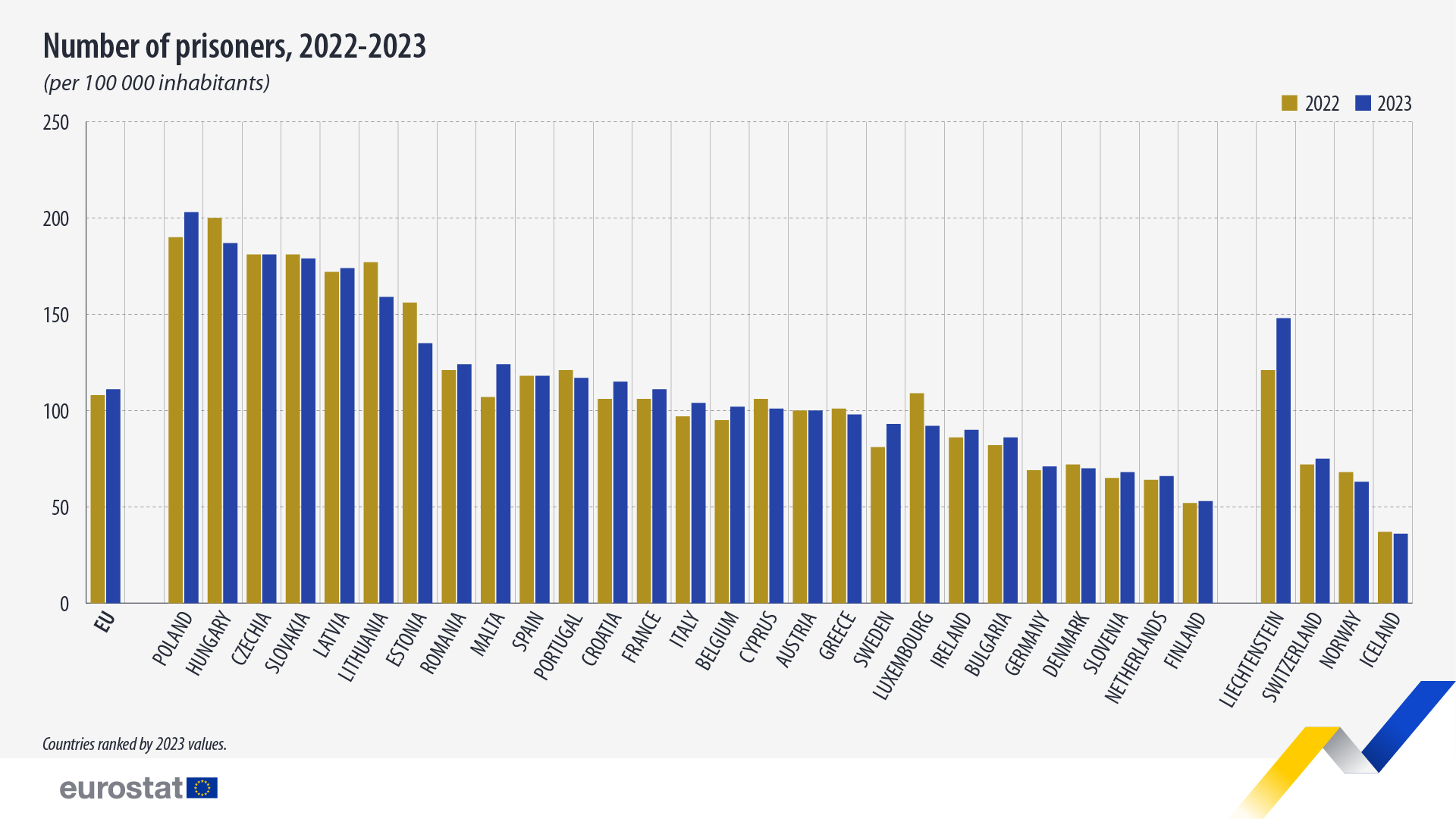
As we delve into the daunting statistics regarding prison populations in Europe, it’s clear that the issue is both significant and complex. In 2023, the European Union witnessed an increase in its prison population by 3.2%, with the total reaching approximately 499,000 inmates. This brings the rate to 111 prisoners per 100,000 inhabitants, marking a slight escalation from the previous year.

Historically, the year 2012 recorded the highest number of prisoners at 553,000. Between 2017 and 2019, there was stability, followed by a notable decrease in 2020. However, the trend has reversed, with a cumulative increase of 7.7% from 2021 to 2023.

Number of prisioners, 2022-2023 (per 100 000 inhabitants). Bar chart. Link to full dataset below.

Notably, Poland, Hungary, and Czechia top the list with the highest prisoner rates, while Finland, the Netherlands, and Slovenia showcase the lowest rates, reflecting diverse penal policies and social dynamics across the continent.

Cyprus faces a unique challenge with a staggering prison occupancy rate of 226.2%. This is significantly higher than countries like France and Italy, which also experience overcrowding issues. On a brighter note, Estonia, Luxembourg, and Bulgaria maintain the lowest occupancy rates, ensuring better living conditions for inmates.

These figures highlight critical issues that demand immediate attention and innovative solutions to ease the strain on Europe’s prison systems.

Trump Implements 100% Tariff on Foreign Films: A National Security Move?

New Tariff Shake-Up in Hollywood: Implications and Reactions

On Sunday, U.S. President Donald Trump declared a bold move: a 100% tariff on international films, claiming it as a shield against national security threats. This decision has sent ripples across the global movie industry, fueling intense debate on the future of filmmaking in America.

Trump emphasized on Truth Social that the American film industry is struggling due to competitive incentives offered abroad, categorizing this situation as not just economic but as a messaging and propaganda issue. Commerce Secretary Howard Lutnick assured that actions are underway, though specific enforcement strategies remain unclear.

Uncertainties Looming Large

As Hollywood executives scrambled for clarity, major players like Walt Disney, Netflix, and Universal Pictures considered the ramifications, with production practices facing significant upheaval. The geographical shift of film production has been a trend for years, lured by attractive tax incentives from Canada to Central Europe.

Meanwhile, global leaders in Australian and New Zealand filmmaking have voiced intent to bolster their local industries amidst this new American policy. The implications of such a policy are vast, touching even realms beyond film.

Competitive Edge and Industry Challenges

Roughly half of U.S. movie and TV investments exceeding $40 million are spent offshore, according to ProdPro. The diminishing allure of Los Angeles as a production hub is evident, with a significant decrease in local film activities largely attributed to more economically favorable locations abroad.

Faced with these changes, filmmakers and unions urge greater state-level incentives to maintain competitiveness. The broader impact of this tariff leapfrogs into the trade realm, with potential retaliations threatening American industry viability.

Historical Tariff Tensions

Considering past trade skirmishes initiated by this administration, apprehensions about potential retaliatory effects surface, echoing sentiments heard during the adjustments affecting other sectors, like those outlined in the Tesla tariff strategy.

Amidst fears of an economic slowdown, former Commerce official William Reinsch warns of detrimental retaliation, provoking fresh discussions on whether cinema truly constitutes a national security threat.

Upgrade Alert: Cyprus Airports’ Capacity Soars to 17M Annually!

Exciting developments are underway as Larnaca and Paphos airports initiate the second phase of their advancement projects. These efforts, spearheaded by Hermes Airports, aim to bolster the combined annual capacity of these gateways to an impressive over 17 million passengers!

This significant infrastructure overhaul involves a €170 million investment, exclusively funded by Hermes Airports. As Maria Kouroupi, Director of Aviation Development and Communication, highlights, this project promises to function as a ‘legacy for future generations,’ with goals extending through to 2040.

What’s in Store for Larnaca Airport?

The redevelopment at Larnaca Airport covers approximately 20,000 square metres over 30 months. A new wing comprising improved departure and arrival gates, additional baggage areas, and expanded commercial zones is anticipated. This will increase the passenger handling capability to 12.4 million people per year.

Enhancements at Paphos Airport

Similarly, Paphos Airport is set to witness 27 months of terminal enhancements—boosting the capacity by around 30 percent and improving both passenger flow and operational effectiveness. The southern parallel taxiway’s extension will further augment flexibility.

Once completed, Paphos will accommodate up to 5 million passengers annually, making it an integral part of Cyprus’ burgeoning travel infrastructure.

Record-High in Cyprus Real Estate Market Reaches €5.71bn: A Look into Quality and Market Dynamics

In an impressive stride, the Cyprus real estate market reached a new high of €5.71 billion in 2024, as highlighted in a comprehensive report by PwC Cyprus. This achievement marks a 1% uptick from the previous year, signaling intriguing shifts in market dynamics.

A notable observation from the report is a slight decline in transaction numbers, down 3% to 23,900 transactions. Yet, stability remains a hallmark of Cyprus’s market amidst global challenges.

Nicosia stands out with a 4% increase in transaction volume, while Limassol retains supremacy in transaction value, contributing to 44% of the market share.

The market’s backbone continues to be residential properties, accumulating €3.8 billion or 67% of the market’s value, a sector further emphasized in Cyprus Business Clubs Guide.

Commercial real estate is also on the rise, notably in Limassol and Nicosia, counterbalancing declines elsewhere.

Still, the demand from international buyers sees a 10% dip, though areas like Nicosia, Famagusta, and Larnaca show growth in foreign interest.

The luxury segment with properties over €1.5 million contributes €500 million, showing that exclusivity still finds a place with 188 high-end property transactions.

Meanwhile, a 2% reduction in building permits juxtaposed with a rise in project value suggests a pivot towards quality enhancements.

As Philippos Soseilos, CEO of PwC Cyprus, states, “Strategic reform under the Vision 2035 framework is pivotal for navigating future advancements.”

National Bank of Greece (Cyprus) Achieves Remarkable €13.6 Million Profit in 2024

Overview of 2024 Financial Success

The National Bank of Greece (Cyprus) has reported a notable net profit after tax of €13.6 million for 2024. This represents a substantial 143% increase compared to the previous year, showcasing the bank’s strong performance.

Impressive Asset Growth

The bank’s total assets have seen a significant rise, reaching €1.2 billion, marking an impressive year-on-year increase of 123%. This growth is primarily attributed to the bank gaining increased customer trust and strengthening its presence in the market.

Operational Efficiency and Loan Management

With a cost-to-income ratio now at 48.6%, a 24-percentage-point improvement, the bank demonstrates efficient use of resources through investments in its workforce and digital infrastructure. Furthermore, the bank achieved a notable decline in its non-performing loans (NPL) ratio, down to 1.8%, emphasizing effective credit risk management and a robust loan portfolio.

Interestingly, the bank’s consistent lending activities resulted in new loans totaling €625 million for the year, consolidating its support for the local economy.

Capital Resilience

With a Common Equity Tier 1 capital ratio of 22.6%, the bank continues to maintain a strong capital base amid the evolving financial environment. This aspect highlights its resilience and capability to adapt to market changes.

George Agioutantis, CEO of the National Bank of Greece (Cyprus), expressed optimism saying, “Our strategic direction is clear. We aim to create sustainable value for our customers, our team, and shareholders.”

Theodoros Loukaidis Reappointed as RIF Director General: A New Term of Innovation

The dynamic world of research and innovation in Cyprus continues to evolve as Theodoros Loukaidis is reappointed for a second five-year term as the Director General of the Research and Innovation Foundation (RIF). This decision, announced by the board of directors following an open selection process, sets the stage for further advancements in Cyprus’ R&I landscape.

Commitment to Excellence

Mr. Loukaidis, armed with an Executive MBA from Warwick Business School and a formidable background in engineering and business administration, has been pivotal over the past five years in elevating Cyprus’ international standing in innovation.

His leadership is expected to further bolster the country’s growth as an emerging R&I hub, with continued focus on projects and research partnerships that contribute to a competitive, unified ecosystem.

Looking to the Future

Support from the board is strong, reinforcing a belief in Loukaidis’ vision to steer Cyprus towards a vibrant and interconnected future.

As Cyprus continues to enhance its R&I capabilities, the ripple effects may be seen far beyond its shores, fostering collaborations and insights with global influencers in the field.

The Future Forbes Realty Global Properties
Aretilaw firm
eCredo
Uol

Become a Speaker

Become a Speaker

Become a Partner

Subscribe for our weekly newsletter